
Understanding the Big Picture: Orthopedic Job Search Timing
Orthopedic surgery is one of the most competitive and structured specialties when it comes to post‑training employment. As an MD graduate approaching the end of your orthopedic surgery residency—and possibly a fellowship—the question isn’t whether to start planning your career, but when.
The timing of your job search will affect:
- Your compensation and contract terms
- Practice type and geographic location options
- Call burden and OR block time
- Mentorship, case mix, and growth trajectory
- Visa and licensure logistics (if applicable)
For most residents, the key reality is this: the orthopedic surgery job market moves earlier than you think. Large groups and hospital systems often recruit 12–24 months ahead of your start date, particularly in high‑demand subspecialties and less saturated regions.
This article breaks down optimal job search timing for an MD graduate in orthopedic surgery, explains how it differs by subspecialty path, and offers a month‑by‑month framework so you can avoid feeling behind as graduation approaches.
From Match to Attending: Timeline Overview
Your orthopedic career path usually follows this arc:
- MS4: Allopathic medical school match into an orthopedic surgery residency
- PGY1–PGY3: Core orthopedic training and early specialization interests
- PGY4–PGY5: Senior resident responsibilities; fellowship applications; early networking
- Fellowship year (if applicable): Intense subspecialty training; active job search and interviews
- Post‑training: Transition to attending job; possible board certification, loan repayment strategies, and first contract renewal
Because you’re already an MD graduate and likely in or near residency completion, the crucial windows now are:
- Residency senior years (PGY4–PGY5)
- Final year of training (chief resident OR fellowship)
A realistic rule of thumb for the attending job search in orthopedic surgery:
- Academic or large hospital systems: Start 18–24 months before your target start date
- Large private or hybrid groups: Start 12–18 months before
- Small private practices / niche positions: Start 9–15 months before
- Locums / temporary roles: Start 3–6 months before
This isn’t about sending formal applications that early; it’s about laying groundwork—networking, clarifying your priorities, tracking the physician job market, and knowing how your subspecialty trends are evolving.
When to Start Job Search in Orthopedic Surgery: A Year‑by‑Year Guide
PGY3: Early Awareness and Strategic Positioning
You don’t need to apply for jobs in PGY3, but you do need to start thinking strategically.
Key actions:
Clarify long‑term goals
- Academic vs private vs hospital employed
- Subspecialty interest (sports, joints, trauma, spine, hand, foot/ankle, oncology, pediatrics, shoulder/elbow, etc.)
- Geographic priorities (must‑have vs nice‑to‑have regions)
Understand the physician job market for orthopedics
- National trends: persistent demand in community and rural hospitals, expansion of employed models
- High‑demand areas: general orthopedics, joints, trauma in many regions
- More saturated or urban subspecialty markets (e.g., sports in major coastal cities)
Optimize residency experience
- Seek cases in your preferred subspecialty
- Build relationships with faculty in that area—they’re your future references and networking bridge
- Consider research that supports your eventual niche if interested in academic practice
You’re not truly “in the ortho match” anymore, but your PGY3–4 choices still function like a second match: they shape which fellowships and, later, which jobs will realistically be in reach.
PGY4: Fellowship Applications and “Soft Launch” of Job Planning
PGY4 is the year you officially commit to your subspecialty path. That choice will significantly affect your later attending job search and timing.
Key milestones:
Fellowship applications (if pursuing fellowship)
- Most orthopedic fellowships (sports, joints, trauma, etc.) use standardized cycles and centralized applications (e.g., San Francisco Match or other systems).
- Your fellowship match result directly influences what kinds of jobs you can target and where.
Start early market reconnaissance
- Browse major job boards (AAOS, subspecialty societies, major recruiter sites)
- Notice patterns:
- Where are joints jobs clustered?
- Where is there persistent need for trauma or generalists?
- Which regions are oversaturated for sports?
Expand your professional network
- Attend national meetings (AAOS, subspecialty conferences)
- Introduce yourself to faculty from other institutions—future colleagues, references, or employers
- Ask mentors what the orthopedic surgery residency job market looked like for past grads from your program
You still may not be formally applying, but this is a critical preparation year for your future attending job search.
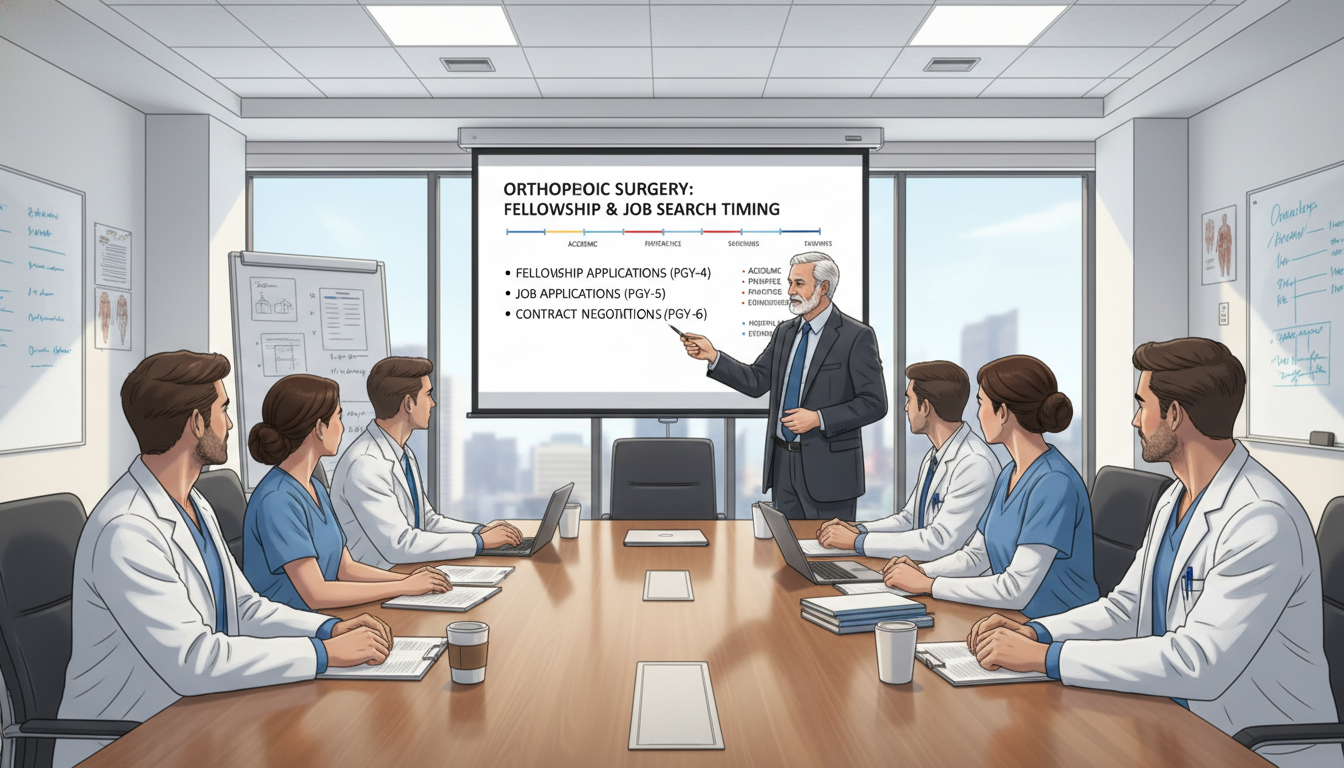
PGY5 (Chief Year, No Fellowship): Active Job Search
If you will finish residency and go directly into practice as a general orthopedist, you need to treat PGY5 as your full‑scale job search year.
Ideal start: 12–18 months before graduation
For July graduation, that typically means:
September–December (PGY4 end / PGY5 start):
- Finalize CV and personal statement (if pursuing academic roles)
- Inform mentors you’re beginning the attending job search
- Identify geographic targets and practice types
- Start responding to recruiter emails selectively
- Begin contacting department chairs/medical directors in regions of interest
January–May (PGY5 midpoint):
- Interview season for many community and hospital‑employed jobs
- Onsite visits, OR observation days, meeting partners and admin
- Negotiate initial offers; compare compensation structures and call burden
By early spring (around March–April):
- Aim to have at least one signed contract or LOI (letter of intent)
- This allows time for licensing, credentialing, and relocation
Starting your job search only 4–6 months before graduation can work in very high‑demand or rural areas, but it shrinks your options and can push you into taking “whatever is left” rather than what truly fits your goals.
Fellowship Year: Compressed, High‑Stakes Job Search
For many MD graduates in orthopedic surgery, the fellowship year becomes the main window for the attending job search. The timeline is more compressed but often starts earlier than residents expect.
Assuming a one‑year fellowship starting in August:
July–September (first 2–3 months): Early preparation
- Update CV with residency and fellowship details
- Identify target practice type:
- Arthroplasty in mid‑size town
- Sports in an academic center
- Trauma in a Level I/II trauma center
- Continue building subspecialty research or niche interests that make you attractive to those roles
September–December: Peak outreach and interviews
- This is when many large groups and hospital systems recruit for the next academic year
- You should be:
- Actively applying to posted positions
- Reaching out to connections at conferences
- Taking remote and in‑person interviews
- Many fellows sign offers as early as fall for the following July/August start
January–March: Finalizing contracts
- Aim to have signed your attending contract by mid‑fellowship
- This allows:
- State licensure and hospital credentialing
- Negotiation of OR block time and clinic resources
- Relocation planning and housing
April–June: Contingency planning
- If you’re still searching in late fellowship:
- Expand geographic targets
- Consider temporary locums if the ideal role isn’t yet available
- Talk to your fellowship director and mentors for last‑minute leads
- If you’re still searching in late fellowship:
Because the fellowship year is intense clinically, failing to plan your attending job search early can mean significant time pressure, rushed decisions, or accepting suboptimal offers.
How Subspecialty Affects Job Search Timing
Your place in the physician job market will vary substantially depending on your orthopedic subspecialty. This directly influences how early and how aggressively you should search.
High‑Demand Subspecialties (Often More Flexibility)
- Adult Reconstruction (Joints)
- Trauma
- General Orthopedics (especially in community/rural)
For these:
- Employers often recruit well in advance (12–24 months), but:
- Good positions remain available closer to graduation
- You can sometimes negotiate stronger terms later if a group is urgently trying to fill a role
Timing strategy:
- Start active search around 12–18 months before start date
- But you maintain some flexibility if you pivot slightly later
Competitive / Saturated Subspecialties (Earlier and More Targeted)
- Sports Medicine (especially urban/suburban)
- Spine, Hand (depending on region)
- Pediatrics, Oncology (more limited positions)
These can be more location‑restricted and market‑sensitive. For example, sports medicine in large coastal cities may have many applicants for few openings.
Timing strategy:
- Begin serious networking and reconnaissance even before fellowship starts
- Start formal job applications as early as 18–24 months before your target start date, particularly if aiming for a narrow set of cities or institutions
- Be ready to sign earlier to lock down desirable settings
Academic vs Private/Hospital Employed
Academic Orthopedics:
- Often requires:
- Research productivity
- Fit with departmental needs (e.g., they may need a trauma surgeon more than another sports surgeon)
- Searches can be formal and multi‑layered, involving:
- Division chiefs, chairs, and sometimes institutional committees
- Timelines may be longer, starting 18–24 months out.
Private Practice / Hospital Employed:
- Typically faster decision cycles
- May be driven by:
- Retirement of a partner
- Expansion of service lines
- Community demand data
- These roles commonly sign 6–12 months before start, but many start talks even earlier.
In both paths, being early gives you more options and leverage.

Practical Steps and Month‑by‑Month Action Plan
To translate timing theory into action, here’s a structured 12‑ to 18‑month plan leading up to your first attending job.
18–12 Months Before Start Date
Example: For a July 2027 start, this is January–July 2026.
Clarify priorities
- Rank: location, practice type, compensation, case mix, academic vs private
- Decide what is non‑negotiable vs flexible
Prepare your professional materials
- CV: updated with residency and any fellowship info
- Cover letter template customizable for each job
- Short paragraph on your clinical interests and value proposition (e.g., “sports with shoulder/elbow focus and interest in resident education”)
Research the market
- Regularly review:
- AAOS job board
- Subspecialty society job postings (AOSSM, AAHKS, etc.)
- Major health system websites in your target states
- Note patterns: compensation ranges, call structures, recruitment hotspots
- Regularly review:
Engage mentors
- Schedule meetings with:
- Residency program director
- Fellowship director (if in fellowship)
- Subspecialty mentors
- Ask specifically:
- “When do most people in my subspecialty sign?”
- “Which groups or systems would you recommend—and which should I avoid?”
- Schedule meetings with:
12–9 Months Before Start Date
Example: For a July 2027 start, this is August–October 2026.
Begin active outreach
- Respond to recruiter emails that match your preferences
- Send targeted emails to department chairs or group leaders in desired locations, including:
- Brief introduction
- Your training background and subspecialty
- Interest in potential openings for the upcoming cycle
- Attend conferences and let colleagues know you’re searching
Start first‑round interviews
- Virtual interviews with:
- Group leaders
- Department chairs
- Medical directors
- Virtual interviews with:
Refine your questions
- OR block time availability
- New patient wait times (a proxy for demand)
- Onboarding/mentorship structure for new grads
- Ancillary support: PAs, NPs, athletic trainers, cast techs
9–6 Months Before Start Date
Example: For a July 2027 start, this is November 2026–January 2027.
Onsite visits
- One‑ to two‑day visits:
- Case observation in OR
- Clinic shadowing
- Meetings with partners, anesthesia, PT/OT, radiology
- Tour hospital and community
- One‑ to two‑day visits:
Initial offers and negotiations
- Typical elements:
- Base salary and bonus structure (wRVUs, collections, etc.)
- Sign‑on bonus, relocation allowance
- Call schedule and compensation
- Partnership track (if applicable)
- Restrictive covenants and non‑compete clauses
- Typical elements:
Engage a contract attorney
- Choose one with physician contract and ideally orthopedic experience
- Review compensation benchmarks (MGMA, association data)
6–3 Months Before Start Date
Example: February–April 2027 for a July 2027 start.
Finalize and sign contract
- Try not to leave signing until the last 2–3 months unless necessary
- Build in contingencies if board passage is pending
Complete licensure and credentialing
- State medical license
- DEA registration
- Hospital credentialing and payer enrollment (can take 90–180 days)
Prepare personal logistics
- Housing and relocation
- Spouse/partner job search
- Childcare and schools, if relevant
Transition planning
- Discuss final cases and responsibilities with your program
- Arrange a smooth handoff of any ongoing research or QI projects
Common Pitfalls in Orthopedic Job Search Timing
Even highly capable MD graduates from top allopathic medical school match programs make timing mistakes in the orthopedic job market. Avoid these frequent missteps:
Starting too late
- Waiting until the last 4–5 months of training can limit options drastically, especially in desirable metro areas or competitive subspecialties.
Over‑focusing on a single city
- Restricting yourself to one metropolitan area (e.g., “only San Diego”) severely narrows your choices and can push you into accepting poor terms.
Ignoring practice fit in favor of salary
- A high base salary with poor call structure, weak support staff, or toxic culture can lead to burnout and rapid turnover.
Underestimating credentialing timelines
- Many hospitals need 3–6 months for full credentialing and payer enrollment; signing too late can delay your ability to bill and collect.
Not leveraging mentors
- Orthopedics is a small world. A single phone call from a respected mentor often carries more weight than a blind application.
Failing to plan for contingencies
- Always have a “Plan B” region/practice type, and in rare cases “Plan C” (e.g., short‑term locums) if the ideal option doesn’t materialize on your timeline.
FAQs: Job Search Timing for MD Graduate in Orthopedic Surgery
1. When should I start my attending job search if I’m going straight into practice after residency?
If you are an MD graduate in orthopedic surgery not pursuing fellowship, you should start your attending job search 12–18 months before your planned start date. For a July graduation, this typically means beginning outreach and applications by the prior summer or fall (early PGY5) and aiming to have a contract by early spring.
2. How does my fellowship choice affect when I should start looking for jobs?
Your fellowship determines the segment of the physician job market you will compete in:
- High‑demand fields (e.g., joints, trauma, general ortho): Start active searching around 12–18 months before start; you may find good options even if slightly later.
- More saturated fields (e.g., sports in big cities): Start networking and informal inquiries as early as 18–24 months before your desired start, and be prepared to sign earlier to secure desirable roles.
During your fellowship year, most fellows benefit from beginning serious outreach within the first 2–4 months.
3. I matched into an orthopedic surgery residency from an allopathic medical school. Does that influence my job prospects or timing later?
Matching to an orthopedic surgery residency from an allopathic medical school match typically indicates strong academic credentials and can be advantageous, particularly for academic positions. However, by the time you reach attending job search, your residency and fellowship reputation, case numbers, references, and subspecialty training are far more important than the MD/DO distinction.
The timing of your job search is not different because of your MD status; it’s driven by subspecialty, geography, and practice type.
4. What if I’m unsure about location—should I still start my search early?
Yes. Uncertainty about location is common, but it shouldn’t delay your attending job search. Instead:
- Identify 3–5 regions you’re open to rather than one city
- Conduct interviews in multiple areas to compare practice cultures and lifestyle
- Use early offers as benchmarks and leverage for later negotiations
If you wait to apply until you’ve perfectly decided on location, you may miss prime recruiting windows. It’s better to start broad, then narrow as you gain information.
Planning your job search timing as an orthopedic surgery MD graduate is as strategic as any step you took in your original ortho match. By approaching it systematically—starting early, leveraging your network, and aligning your timeline with your subspecialty and goals—you maximize your chances of landing a position that fits both your professional aspirations and your life outside the OR.