Understanding the Pathology Job Market and Why Timing Matters
The timing of your job search in pathology is almost as important as your CV, letters, and interview performance. Unlike some other specialties, the physician job market in pathology is relatively small, regionally variable, and sensitive to subtle shifts in supply and demand. Starting too late can mean fewer options or a scramble to secure a position before graduation; starting too early can lead to expiring offers, misalignment with your evolving interests, or contractual pitfalls.
For pathology residents and fellows, the questions are predictable:
- When should I start my pathology residency job search?
- How does timing differ for AP/CP vs. subspecialty-trained pathologists?
- How does the pathology match timeline (for fellowship) impact my attending job search?
- What are realistic timelines for networking, applications, interviews, and contract signing?
This guide breaks down the entire process by year of training and fellowship status, with a focus on when to start each component of your attending job search so that it aligns with training completion, visa needs, and personal/family plans.
Big-Picture Timeline: From Residency to First Attending Job
Before diving into details, it’s useful to have a high-level framework. For pathology, especially with one or more fellowships, you should think in terms of 12–18 months ahead of your projected start date for serious job searching.
Typical Training Pathways and Job Search Windows
Straight AP/CP (4 years) without fellowship
- Job search typically starts: Mid–PGY-3 to early PGY-4
- Target start date: Immediately after PGY-4 graduation
AP/CP + 1-year fellowship (e.g., surgical pathology, cytopathology, hematopathology)
- Job search typically starts: Early to mid-fellowship year
- Target start date: Immediately after fellowship completion
AP/CP + 2+ fellowships or research years
- Job search typically starts: 6–18 months before final training end date, depending on your situation, geography, and visa status
AP- or CP-only trainees with subspecialty fellowship
- Similar timing to AP/CP + fellowship, but consider narrower niche and potentially fewer job slots in some markets
In other words, for most pathology trainees:
Ideal “serious” job search window: 12–15 months before you plan to start as an attending.
Earlier than that, focus on exploration and networking rather than active applications and contract negotiation.
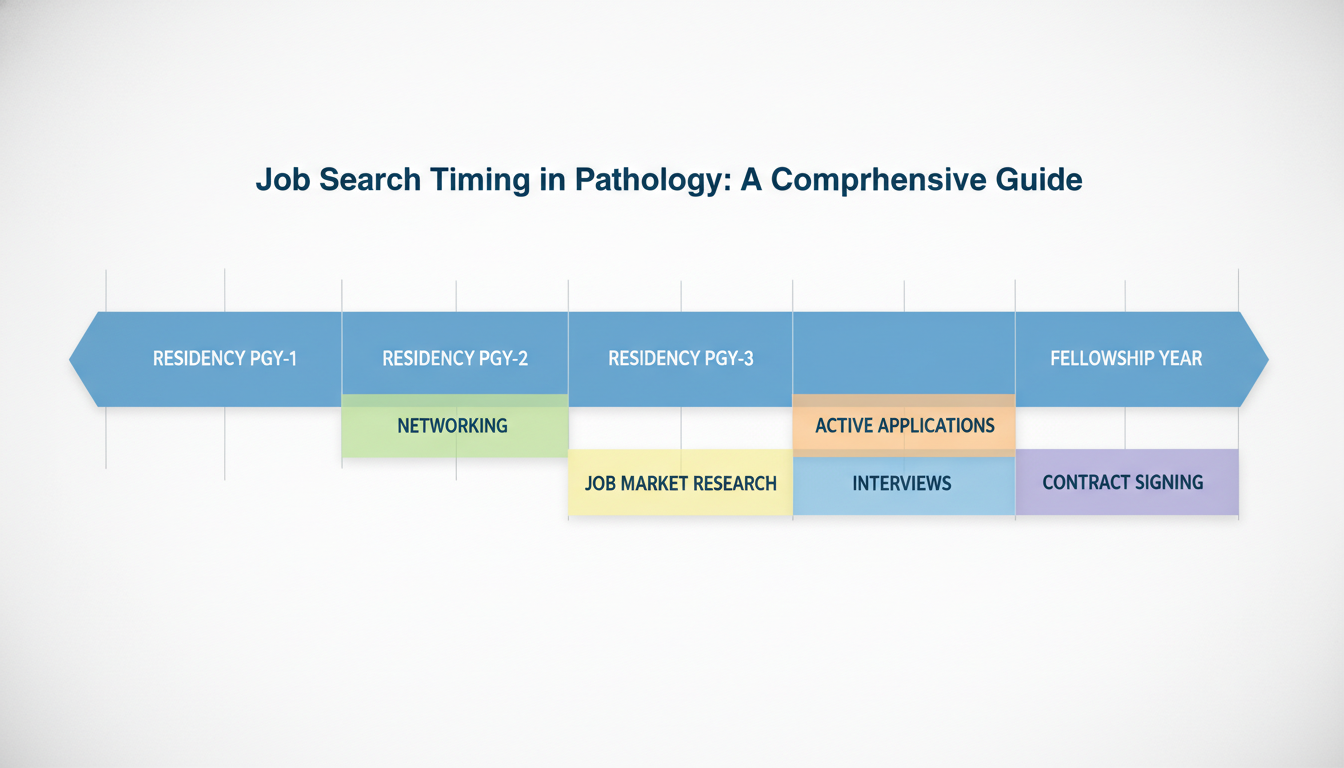
Year-by-Year: When to Start Each Phase of the Pathology Job Search
PGY-1 and PGY-2: Foundation and Early Exploration
Primary goal: Build skills and explore interests, not formal job hunting.
At this stage, most residents are still deciding:
- AP/CP vs AP-only or CP-only
- Subspecialty interests (e.g., heme, cytology, GI, dermpath, molecular)
- Whether they want an academic vs community vs hybrid career
What to do in PGY-1–2:
Observe the job paths of recent graduates
- Ask where recent alumni are working:
- Academic medical centers
- Large private groups with hospital contracts
- National reference labs
- Government (VA, public health labs, forensic/ME offices)
- Note how many did one vs multiple fellowships.
- Ask where recent alumni are working:
Begin very low-intensity networking
- Attend departmental conferences and grand rounds.
- Introduce yourself to visiting speakers and ask brief career questions.
- Connect with alumni on LinkedIn or by email after they give a talk.
Clarify your long-term direction
- Because fellowship choice strongly influences your first job, use these years to understand which subspecialties are in demand in your preferred geographic areas.
- Talk with the program director, fellowship directors, and senior residents about current trends in the physician job market for different pathology subspecialties.
What NOT to stress about in PGY-1–2:
- You do not need to apply for attending jobs.
- You do not need a polished job-market CV yet (but you should keep a running list of activities and achievements).
The key is to recognize that your future pathology job search will be built on connections and reputation that often begin in these early years.
PGY-3: Aligning Fellowship and Future Job Strategy
By PGY-3, the pathology match for fellowship is front and center. This has a direct impact on job search timing.
Key milestones during PGY-3:
- Decide whether you will do a fellowship (in most markets, yes).
- Select subspecialty(ies) based on:
- Interest and aptitude
- Demand in your target geographic areas
- Advice from mentors and alumni
Job search–related tasks in PGY-3:
Study the physician job market in pathology
- Look at job postings on:
- CAP, ASCP, USCAP, and subspecialty society job boards
- Major job sites (PracticeLink, NEJM CareerCenter, etc.)
- Pay attention to:
- Required/desired fellowships (e.g., “AP/CP + cytopathology or GI preferred”)
- Geographic clusters of need
- Type of practice (academic, community, private equity–backed, government, industry)
- Look at job postings on:
Begin targeted networking with future employers
- At national meetings (e.g., USCAP), introduce yourself to:
- Pathologists from departments you might want to join
- Fellowship directors at places you might later apply for jobs
- Mention that you are a PGY-3 planning Fellowship X and that you’re interested in Region Y long-term. This lays the groundwork so that when you later send a CV, you’re more than a name in an inbox.
- At national meetings (e.g., USCAP), introduce yourself to:
Refine your geographic preferences
- Discuss with your partner/family about:
- Where you might realistically live long-term
- Willingness to work in smaller cities or rural areas
- The earlier you clarify geographic flexibility, the better you can read the job market and shape your training decisions accordingly.
- Discuss with your partner/family about:
Timing takeaway for PGY-3:
You’re not yet sending attending job applications, but you are making choices (fellowship, geography, mentors) that will heavily influence how easy or hard your job search will be later.
PGY-4 (or Final Year of Residency): Laying the Groundwork
For residents going directly into practice after residency (less common in many regions, but still possible), PGY-4 is when the active attending job search starts. For those going into fellowship, PGY-4 is when you prepare all the tools you’ll need in your early fellowship job hunt.
Start in PGY-4:
Create or refine your professional CV
- Include:
- Education, training, anticipated completion dates
- Board status (or anticipated exam dates)
- Research, presentations, posters, QI projects
- Leadership roles, committee work, teaching experience
- Ask a senior faculty member to review it with an eye toward the pathology job market.
- Include:
Draft a general cover letter template
- One-page letter that you can customize later.
- Highlight:
- Training path and subspecialty
- Teaching and clinical interests
- Geographic preferences (optional or tailored per job)
- Keep the tone professional and clear rather than overly generic.
Collect references early
- Identify 3–5 faculty who can serve as strong references, ideally including:
- Program director
- Fellowship director (if already matched)
- One or two subspecialty faculty who know your work well
- Let them know your anticipated timeline for the job search.
- Identify 3–5 faculty who can serve as strong references, ideally including:
Signal your career interests to mentors
- For example:
“I’m planning on a GI fellowship and then I’d like to be in a community practice in the Midwest.” - This helps mentors think of you when they hear about openings.
- For example:
If you are skipping fellowship and job hunting during PGY-4:
- Begin active search 12–15 months before your desired start date:
- Applications: Early PGY-4
- Interviews: Mid PGY-4
- Contract signed: By late PGY-4
Competition and expectations may be higher now for fellowship-trained pathologists, so research your local physician job market carefully. You may need greater geographic flexibility.
Fellowship Year: The Critical Window for the Attending Job Search
For most pathology trainees, the fellowship year is when the real attending job search happens. Mis-timing during this year is the most common cause of stress.
Assume a July–June fellowship year and a July 1 attending start date. Here’s a breakdown:
12–15 Months Before Start Date (Usually Late PGY-4 / Very Early Fellowship)
- Finalize your CV and basic cover letter.
- Update LinkedIn and any professional profiles.
- Talk with your fellowship director and mentors about:
- Your target region and practice type
- Realistic expectations for the current physician job market in your niche
- Potential contacts they can introduce you to
10–12 Months Before Start Date (Early Fellowship: July–September)
This is typically when you should launch the active job search:
Start checking job boards weekly.
Begin sending targeted applications:
- Positions that explicitly list your fellowship/subspecialty.
- Institutions in your preferred region(s), even if they haven’t posted a job (cold outreach with CV + brief inquiry).
Ask mentors to:
- Send informal emails to colleagues on your behalf.
- Introduce you at national or regional meetings.
Why start this early?
- Some departments hire on a long horizon, especially academic centers.
- Employer internal processes (budget approvals, search committees, HR) can take 3–6 months or more.
- You may need multiple interview rounds, plus time for licensure and credentialing.
6–9 Months Before Start Date (Mid Fellowship: October–December)
- This is often the peak interview season for many pathology positions.
- Expect:
- Phone or video screening interviews.
- On-site interviews (or extended virtual visits) with slide sign-out observations and meetings with clinical and administrative leaders.
If you have not had any interviews by mid-fall:
- Expand your geographic range.
- Consider practice types you hadn’t initially prioritized (e.g., large reference labs, VA systems).
- Ask mentors to review your CV and cover letter and provide frank feedback.
- Consider additional skills or certifications (e.g., molecular pathology experience, informatics exposure) that differentiate you.
3–6 Months Before Start Date (Late Fellowship: January–March)
Aim to have one or more offers in hand.
Begin serious contract review, including:
- Salary and RVU or productivity metrics
- Call schedule and workload
- Partnership track details (for private practices)
- Non-compete clauses and geographic restrictions
If you are on a visa (H-1B, J-1 waiver, etc.), this is the time to:
- Confirm the employer’s ability to sponsor.
- Start immigration paperwork as needed.
What if no offer yet by 3–4 months before graduation?
- Intensify your search:
- Send targeted emails to department chairs and practice leaders.
- Be more flexible on location, especially if you previously limited to just a few cities.
- Short-term or locums positions can bridge gaps but approach them strategically and with legal guidance.
0–3 Months Before Start Date (Spring to Early Summer)
By this stage, most paths should be:
- Job accepted
- Contract signed
- Licensure and credentialing in progress
You may still be able to secure a late-position job, but:
- Options may be limited.
- You may have less leverage in negotiations.
- Moves and family logistics will be more compressed.

Special Timing Considerations: Visas, Academics, and Subspecialty Nuances
International Medical Graduates and Visa Issues
For IMGs and others with visa needs, job search timing in pathology must start earlier and be more deliberate.
Key points:
- H-1B and J-1 waiver positions are more limited; some practices avoid visa sponsorship due to cost and complexity.
- Start active job search at least 15–18 months before your start date if:
- You require a J-1 waiver position (e.g., Conrad 30 in the US)
- You anticipate multiple layers of immigration processing
- During early networking, explicitly ask:
- “Does your group/department routinely sponsor visas for pathology hires?”
- This prevents late-stage surprises.
Because of these constraints, IMGs often:
- Expand their initial geographic search radius more widely.
- Prioritize employers known to have sponsored pathology positions previously (VA, academic centers, larger hospital systems, certain rural/underserved areas).
Academic vs Community vs Private Practice
The type of practice you’re targeting also influences when to start your attending job search.
Academic Pathology:
- Often has longer lead times (budget cycles, search committees, multiple interviews).
- Start looking 12–18 months before your desired start.
- Be ready for “slow yes” processes; follow up politely at reasonable intervals.
Community Hospital or Large Health System:
- Timeline is often closer to 9–12 months before start.
- HR processes may still be lengthy, but decisions can be more straightforward.
Private Practice / Independent Group:
- Some groups recruit only when a need becomes urgent (retirement, new hospital contract).
- This can mean:
- Rapid hiring decisions within weeks.
- Less formal, more relationship-driven processes.
- To catch these opportunities, start building connections with local pathologists 1–2 years before you plan to practice in their region, so they think of you when a position opens.
Subspecialty “Hot” vs “Crowded” Fields
The strength of your bargaining position and how early you need to search can also depend on your subspecialty area:
- High-demand / flexible fields (varies by region and year; often general surgical pathology, cytopathology, combined AP/CP with heme, or broad-based subspecialists willing to sign out general cases):
- You may successfully find jobs with 9–12 months lead time.
- Narrow or saturated niches (e.g., certain organ-based fellowships in a small geographic market):
- Consider 12–18 months lead time, more geographic flexibility, or combining fellowships or skills (e.g., dermpath + general surg path; GU + informatics).
Stay in continuous contact with mentors who are actively aware of the current pathology job market; it can shift in just a few years.
Practical Strategies to Optimize Job Search Timing
1. Treat Job Search as a Long Project, Not a Last-Minute Task
Break your attending job search into phases with target dates:
Exploration (PGY-1–3)
- Learn markets, meet people, identify interests.
Preparation (PGY-4 / Pre-fellowship)
- Build CV, cover letter, references, and online presence.
Active Search (Fellowship year: 10–12 months before start)
- Apply, interview, and negotiate.
Finalization (3–6 months before start)
- Decide, sign, and complete credentialing.
Treat each phase as part of your professional development, not an emergency.
2. Use Conferences Strategically
Timing your networking and informal contacts around major meetings (USCAP, CAP, ASCP, subspecialty societies) can dramatically improve your access to opportunities:
- 6–18 months before your target start date, use conferences to:
- Arrange coffee chats with potential employers.
- Attend sessions or receptions where department chairs, fellowship directors, and private group partners gather.
- Mention your training timeline and intended start year clearly.
Sometimes positions are “in the works” long before they hit any job board. Being present and visible at the right time and place positions you to hear: “We might have a spot coming up—send me your CV.”
3. Balance Being Early with Not Locking Yourself in Too Soon
Accepting the first offer very early in your fellowship can:
- Mean missing better-fitting opportunities that appear later.
- Lock you into an area or practice model you may outgrow quickly.
On the other hand, waiting too long:
- Can leave you with fewer choices.
- May force you to compromise on geographic or practice preferences.
A common approach:
- Aim to collect a few interviews/offers over several months.
- Compare them thoughtfully with mentors.
- Try to sign a contract around 4–6 months before starting, earlier if visas or complex moves are involved.
4. Keep Your PD, Fellowship Director, and Mentors in the Loop
Timing pitfalls are often avoided when you consistently communicate with people who know the landscape:
- Tell them:
- When you start sending applications.
- What types of jobs you’re considering.
- Where you’re stuck (no interviews, conflicting offers, geographic limitations).
They can:
- Nudge slower departments or groups from the inside.
- Alert you when they hear about unposted openings.
- Advise you about when to accept a strong offer vs hold out for something more ideal.
Frequently Asked Questions About Job Search Timing in Pathology
1. When should I realistically start my attending job search as a pathology fellow?
For most pathology fellows, begin active job search activities 10–12 months before your desired start date. That usually means early in your fellowship year (July–September for a July start the following year). Use the months before fellowship to prepare your CV, references, and strategy, and use mid-fellowship for interviews and negotiations.
2. Is it a problem if I haven’t found a job by halfway through my fellowship year?
Not automatically, but it’s a signal to reassess. By mid-fellowship (about 6–8 months before graduation), you should ideally have at least some interviews completed or scheduled. If you don’t:
- Expand your geographic range.
- Consider a broader variety of practice types.
- Ask mentors to critique your CV and cover letter.
- Have them connect you with additional contacts.
You can still secure positions later in the year, but your options may narrow over time.
3. How does the pathology residency and fellowship match affect when I should start my job search?
The pathology match primarily affects your fellowship timeline, not the attending job search directly. However, fellowship choice (and when you match) determines your final training end date. You can start preparing job materials (CV, references) late in residency once your fellowship is set and then launch the attending job search early in your fellowship year. Think of it as: residency → match to fellowship → early fellowship = start of real attending job search.
4. How early should I start if I need a visa-sponsored pathology job?
If you require an H-1B or J-1 waiver, begin exploring the physician job market and informal employer contacts 15–18 months before your intended start date. Many employers are cautious about sponsorship, and immigration timelines can be tight. Start your active applications at least 12 months before start, and make visa questions part of your initial discussions so you don’t invest time in positions that cannot sponsor you.
By understanding how the pathology job market functions and aligning your actions with the right timeframe, you can approach the attending job search with far more control and far less last-minute stress. Thoughtful preparation, strategic timing, and consistent communication with mentors will put you in the best position to secure a job that fits both your professional goals and your life outside of medicine.