
Understanding the Timeline: When Job Search Really Starts in Plastic Surgery
The timing of your job search in plastic surgery is not a single moment—it’s a continuum that starts much earlier than most residents realize. In a competitive physician job market, especially in plastic surgery, the candidates who match into good attending positions on their terms are almost always the ones who started planning early.
Three overlapping timelines matter:
- Professional development timeline – building a CV that will be attractive to future employers
- Networking timeline – cultivating relationships that become job leads
- Formal job search timeline – actively pursuing positions, interviewing, and negotiating
For an integrated plastics match graduate or independent track trainee, the specifics differ slightly, but the principles are the same: you should think in years, not months, when planning your attending job search.
Before diving into year-by-year guidance, it helps to ask yourself:
- Do you want primarily academic, private practice, hospital-employed, or a hybrid role?
- Are you aiming for reconstructive-heavy, aesthetic-heavy, or balanced practice?
- Are you open to geographic flexibility, or are you location-limited?
- Is a fellowship (or another fellowship) part of your plan?
Your answers will shape how early and how aggressively you need to plan.
Big Picture: How the Plastic Surgery Job Market Works
The physician job market in plastic surgery has important features that directly affect job search timing.
1. Market Characteristics in Plastic Surgery
Relatively small specialty
Fewer trainees means fewer advertised jobs—but also fewer competitors in certain niches. Many positions are never publicly posted and are filled through word-of-mouth.Geographic clustering
Academic and high-end aesthetic practices cluster in major metropolitan areas; reconstructive roles and hospital-employed jobs are more broadly distributed but can still be highly competitive in desirable cities.Practice diversity
- Academic microsurgery and reconstructive oncology
- Community-based reconstructive/hand
- High-volume aesthetic surgery
- Burn, craniofacial, gender-affirming, limb salvage, peripheral nerve, and more
Each niche has its own ecosystem and hiring patterns.
Hidden job market
Many plastic surgery positions arise when:- A partner quietly plans retirement
- A group loses a surgeon unexpectedly
- A service line (e.g., breast reconstruction or microsurgery) expands
These openings often go first to known quantities—fellows, residents, or colleagues of current partners.
2. Academic vs. Private Practice Timing
Academic positions
- Often follow more structured hiring cycles tied to:
- Budget approvals
- Faculty recruitment seasons
- Institutional strategic plans
- The process can be slow:
- 3–6 months from first conversation to written offer is common
- Additional months for credentialing and onboarding
Private practice / Hospital-employed roles
- More variable:
- Some groups hire opportunistically with “We’ll make room for the right person”
- Others have defined succession plans (e.g., “We need a new partner in 18 months”)
- Timeline from first contact to offer can be shorter (1–3 months), but:
- Partnership terms are complex
- Negotiation takes time
- Due diligence (reviewing financials, call structure, buy-ins) is essential
3. Why Timing Matters More in Plastic Surgery
Because plastic surgery is small and highly networked, the earlier you begin:
- The more likely you are to hear about unadvertised positions
- The more time you have to align your training (electives, research, skillset) with your desired job
- The more leverage you gain in negotiation by not appearing desperate or time-pressured
- The better positioned you are if a dream job opens unexpectedly
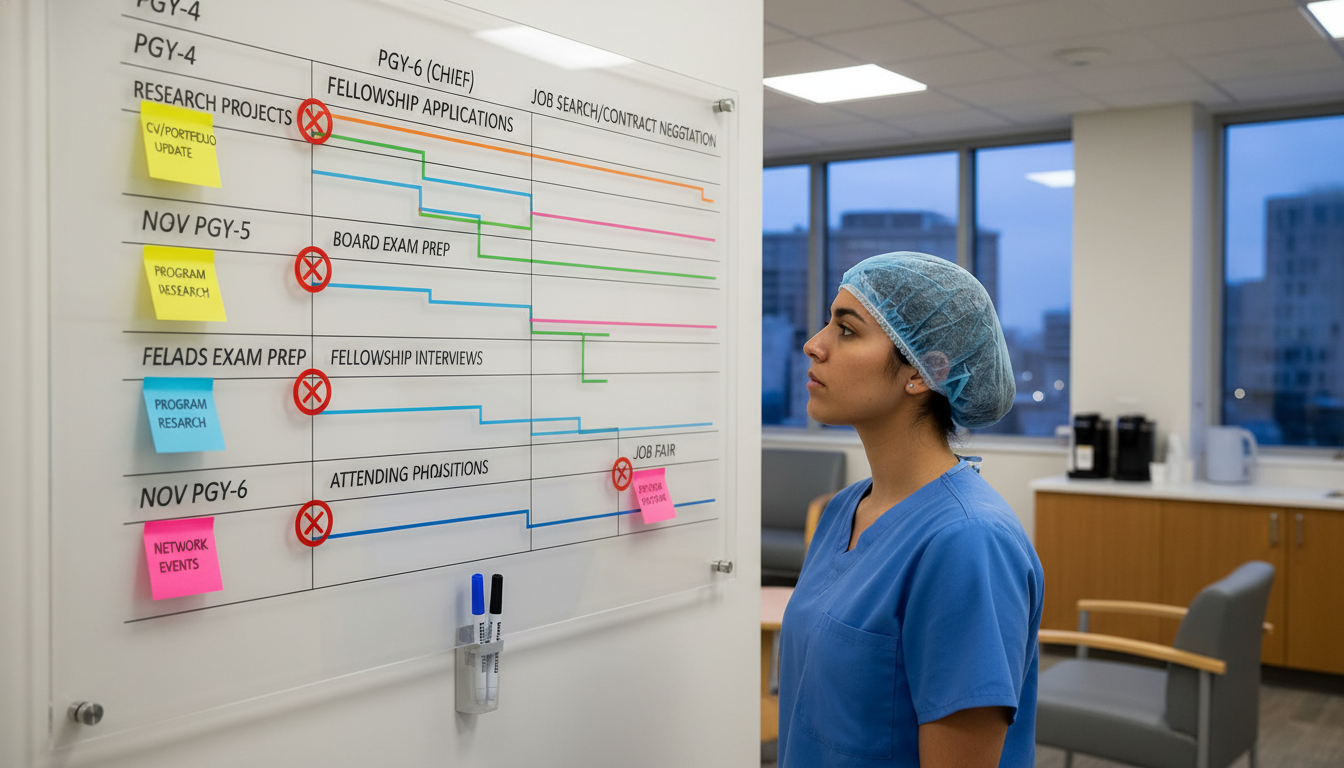
Year-by-Year Roadmap: From Residency to First Attending Job
This section assumes a 6-year integrated plastic surgery residency followed by an optional 1-year fellowship. You can adjust the timeline if you’re on the independent track or skipping fellowship, but the relative timing principles apply.
PGY-1 to PGY-3: Laying the Foundation (Not Officially “Job Search” Yet)
You are not actively looking for jobs yet, but job search timing begins here in the form of preparation.
Key priorities:
- Clinical reputation
- Be the resident faculty want to work with
- Develop a reputation for reliability, integrity, and good judgment
- Early mentorship
- Identify at least one plastic surgery mentor with a career path similar to your interests (academic, aesthetic, reconstructive)
- Have an explicit career conversation by PGY-2 or PGY-3:
- “I’m considering academic microsurgery vs. private practice—what does that path look like?”
- Research and CV-building
- Participate in projects that align with your future niche (e.g., breast reconstruction, hand, craniofacial, aesthetics)
- Aim to have first/second-author publications by mid-residency
- Conferences and networking
- Attend at least one major meeting (ASPS, The Aesthetic Meeting, microsurgery/hand societies)
- Introduce yourself to surgeons in areas of interest—this is the “soft launch” of your future job network
At this stage you don’t need to ask directly about jobs, but you do want people to know your name and see your work.
PGY-4 to PGY-5: Strategic Preparation and Early Exploration
Now you’re closer to independent practice, and informal job search timing becomes more specific.
Action steps:
- Clarify your post-training path
- Academic vs. private vs. hybrid
- Fellowship vs. no fellowship
- Desired balance of reconstructive vs. aesthetic
- Start geographic thinking
- Shortlist 3–5 regions where you could realistically see yourself living
- Consider family, partner’s career, housing costs, and call demands
- Build targeted skills
- If you want:
- Academic microsurgery: prioritize free flap experience, microsurgery fellow mentors, and complex recon cases
- Aesthetic practice: maximize cosmetic rotations, injectables, body contouring, and facial aesthetics
- Hand/nerve: pursue additional hand/upper extremity exposure
- If you want:
- Deepen relationships
- Let mentors know your evolving preferences:
“I’ve realized I’m most drawn to academic breast reconstruction with a microsurgical focus, ideally in the Midwest.” - This plants seeds for future job leads.
- Let mentors know your evolving preferences:
Should you be applying to jobs now?
Generally, no formal applications yet. But you should be in active exploratory conversations:
- Ask mentors:
- “What’s the job market like right now in academic plastics?”
- “Are there groups you’d recommend I get to know if I’m interested in [region/type of practice]?”
- Attend meetings with a more intentional networking plan:
- Go to specialty society receptions
- Introduce yourself to program directors and division chiefs at institutions you admire
PGY-6 (Final Year of Integrated) or Last Year of Independent: Decision Point and Early Actions
This year is pivotal, especially if you’re not doing a fellowship. The question “when to start job search?” during this year has a concrete answer for plastic surgery:
- If no fellowship:
Start active job search 9–12 months before your anticipated start date. - If doing fellowship:
Begin informational conversations now, but most formal applications will occur during fellowship.
Practical timeline without fellowship:
- 12 months before graduation:
- Formally update your CV and personal statement
- Ask 2–4 mentors if they’re comfortable serving as references
- Tell your network you’re looking:
“I’ll be finishing integrated plastics in June next year and I’m looking for a reconstructive-heavy private practice position in the Southeast.”
- 9–10 months before graduation:
- Contact department chairs, division chiefs, and practice leaders in your preferred regions
- Respond to recruiter outreach (selectively)
- Begin watching job boards and society postings regularly
- 6–9 months before graduation:
- Start interviewing
- Visit practices on-site when possible
If you decide to pursue a fellowship (microsurgery, hand, craniofacial, aesthetics), your attending job search shifts forward by a year—but the same 9–12 month pre-start window still applies.
Fellowship Year: Primary Job Search Window for Many Plastics Surgeons
For many in plastic surgery, the fellowship year is the main job search phase.
Recommended timing (assuming a 1-year fellowship starting July 1):
July–September (12–9 months before start date)
- Clarify target job type and location with your fellowship director
- Update CV with fellowship start and key skills
- Begin reaching out to:
- Academic departments that match your interests
- Private practices known for your niche (e.g., high-volume body contouring, breast reconstruction)
- Ask fellowship faculty:
“Do you know of programs or practices that may be looking for someone with my training next year?”
September–December (9–6 months before start date)
- This is prime interview season for many plastic surgery jobs
- Attend national meetings with clear goals:
- Meet with division chiefs
- Set up in-person conversation over coffee or dinner
- Ask about anticipated openings—not just posted jobs
- Begin on-site practice visits
January–March (6–3 months before start date)
- Target window for offer finalization and contract negotiation
- If you don’t yet have a position, intensify your search:
- Expand geography
- Consider hospital-employed roles
- Re-engage mentors for additional leads
April–June (3–0 months before start date)
- This is late but still salvageable—many last-minute positions emerge due to:
- Unexpected departures
- Failed hires
- Clinical expansion
- You may have less leverage and selection, but good matches can still be found
- This is late but still salvageable—many last-minute positions emerge due to:
The key is balancing ideal timing (starting early for more options) with practical reality (late-breaking opportunities often surface after budget approvals or partner decisions).
How Early Is Too Early? Calibrating Job Search Timing by Practice Type
Different settings require slightly different timing strategies.
Academic Plastic Surgery
- Ideal time to start:
12–18 months before your desired start date - Why earlier?
- Academic hiring requires:
- Approval from multiple layers (division, department, hospital, sometimes dean’s office)
- Budget cycles and faculty searches
- Time to align with service line needs (oncology, trauma, craniofacial, gender-affirming programs)
- Academic hiring requires:
- Practical steps:
- Start with informal conversations with division chiefs 18–12 months out:
- “I’ll be finishing my microsurgery fellowship in June next year and I’m interested in academic breast and lymphedema reconstruction. Would your program be open to someone with my profile in the near future?”
- Follow with formal applications once there’s mutual interest and an open line
- Start with informal conversations with division chiefs 18–12 months out:
- Risk of starting too early:
- Some departments may not know their exact needs >18 months out
- You may commit before seeing what other offers might arise
Still, in academics, earlier engagement is usually an advantage.
Private Practice Plastic Surgery
- Ideal time to start:
9–12 months before anticipated start date - Why slightly later than academics?
- Private practices often make decisions closer to need
- They may not want to “hold” a position for 18+ months
- Practical steps:
- Begin with:
- Direct outreach to practices in your target area
- Discreet inquiries through mentors who know regional groups
- Be prepared that:
- Some practices will consider talking early but won’t formalize an offer until 6–9 months out
- Begin with:
- Risk of starting too early:
- Practices may lose interest if the start date is too distant
- Terms might change as their patient volume and finances evolve
Solution: Keep early conversations exploratory rather than pushing for a binding offer.
Hospital-Employed or Health System Roles
- Ideal time to start:
9–12 months before start date, sometimes 6–9 months if the system already has an open requisition - Why?
- Systems are used to physician recruitment processes
- They can move relatively quickly once a position is approved
- Practical steps:
- Engage both:
- Directly with hospital leadership (service line chiefs, surgery chair)
- Through system recruiters
- Factor in:
- Credentialing and privileging timelines (3–6 months at many institutions)
- State licensure if you’re crossing state lines
- Engage both:
Aesthetic-Heavy / Cosmetic Practice
- Ideal time to start:
6–12 months before start date, with heavy emphasis on relationship-building well before that - Why?
- Purely aesthetic practices are often smaller, more personality-dependent, and owner-driven
- They may hire only when:
- They’re over capacity
- They want to expand to a new service (e.g., body contouring, facial aesthetics)
- Practical steps:
- Use residency and fellowship to:
- Attend aesthetic meetings
- Spend away rotations or electives with known aesthetic surgeons
- During fellowship:
- Discuss aesthetic practice opportunities 9–12 months out, but expect some groups to commit closer to 6 months out
- Use residency and fellowship to:
Practical Strategies: Making Job Search Timing Work for You
1. Build a Structured Job Search Timeline
Create a simple timeline with these columns:
- Date / Month
- Action Item (e.g., “Email Dr. X, update CV, apply to Y institution”)
- Target Practice Type (academic, private, hospital)
- Location
- Status (planned / in progress / complete)
Update it monthly starting at least 12 months before your target start date.
2. Use Each Academic Meeting as a Milestone
Before each major meeting:
- Set goals:
- 3 people to meet in your subspecialty
- 2 institutions or practices to explore
- Arrange in advance:
- Email division chiefs or practice leaders:
- “I’ll be at ASPS this year and would love to briefly meet to learn about your department/practice and discuss potential future opportunities.”
- Email division chiefs or practice leaders:
- Follow-up within 1 week of the meeting:
- Thank-you email
- Attach updated CV if appropriate
3. Partner With Mentors on Timing
Your mentors have seen many cycles of the integrated plastics match, fellowship recruitment, and attending hiring. Use their experience:
- Ask explicitly:
- “When do you think I should start my job search given my goals?”
- “If I want an academic job in [region], what’s the realistic timeline?”
- Show them:
- Shortlist of target locations
- Draft outreach emails
- Request intros:
- “Would you be comfortable introducing me to the division chief at [Institution X]?”
4. Don’t Ignore Recruiters—but Don’t Depend on Them
In the physician job market, especially in plastic surgery:
- Recruiters can be helpful for:
- Initial exposure to hospital-employed roles
- Understanding base compensation and incentive ranges in a region
- Limitations:
- They may not know unadvertised or premium positions
- High-end aesthetic practices and top academic roles are rarely filled purely through recruiters
Use recruiters as an adjunct, not the centerpiece, of your attending job search.
5. Time Your Negotiation Window Thoughtfully
Once offers are on the table:
- Try to cluster your job search so that:
- You’re interviewing at multiple places in a 2–3 month window
- Offers arrive roughly in the same general timeframe
- This improves your ability to:
- Compare positions objectively
- Negotiate from a position of having options
- Be transparent but professional:
- “I’m very interested in your position and currently finishing interviews with a couple of other institutions. I expect to have clarity in the next 3–4 weeks. Would that timing work for you?”
Common Pitfalls in Job Search Timing (and How to Avoid Them)
1. Starting Too Late
Problem:
Waiting until 3–4 months before graduation or fellowship completion to begin your search.
Risks:
- Limited options, especially in “destination” cities
- Compressed negotiation time
- Increased likelihood of taking a “starter job” that doesn’t match your long-term goals
How to avoid:
- Mark your calendar at 12 months before your target start date to begin active search steps
- Use mid-residency and early fellowship years for informational networking so you’re not cold-starting
2. Overcommitting Too Early
Problem:
Signing a contract very early (e.g., 18–24 months out) before exploring alternatives.
Risks:
- Locking into less favorable compensation or call structures
- Missing better-aligned opportunities that appear later
- Personal circumstances changing (partner’s job, family health, etc.)
How to avoid:
- Keep early conversations exploratory
- Ask for letters of intent or nonbinding expressions of interest rather than rushing to a signed contract when you’re >12 months from graduation
3. Ignoring Fit in Favor of Timing
Problem:
Choosing a job because it was available at the “right” time rather than the right fit.
Risks:
- Burnout from misaligned case mix or call burden
- Early job change (which can be disruptive and financially costly)
- Limited mentoring or growth opportunities
How to avoid:
- During interviews, probe:
- Case mix (percent reconstructive vs. aesthetic vs. hand vs. microsurgery)
- Surgeon satisfaction and turnover
- Support staff and infrastructure (e.g., microsurgery call, ICU support)
- Remember: your first job doesn’t have to be your forever job, but it should be a deliberate choice, not a rushed one.
4. Underestimating Lead Times: Licensing and Credentialing
Problem:
Accepting a job but not accounting for the time required to get licensed and credentialed.
Risks:
- Delayed start date
- Financial stress if income gap is longer than expected
How to avoid:
- Ask explicitly during negotiation:
- “What is your typical timeline for credentialing and privileging?”
- “Do you assist with state licensure if I’m not already licensed here?”
- Begin state licensure process as soon as you sign or are close to signing, especially in states with slower boards.
FAQs: Job Search Timing in Plastic Surgery
1. When should I start my job search if I’m finishing an integrated plastic surgery residency without a fellowship?
Begin active job search 9–12 months before your planned start date. That means:
- Update your CV and inform mentors about your plans at about 12 months out
- Start contacting practices, divisions, and hospital systems around 9–10 months out
- Aim to complete most interviews 6–9 months out and solidify an offer 3–6 months before your start date
If you know you want a competitive academic role in a specific region, start exploratory conversations even earlier (12–18 months out).
2. I’m in a microsurgery fellowship. When is the best time to look for jobs?
For a 1-year fellowship:
- Start informational conversations with your fellowship director and mentors early in the year (July–September)
- Begin active job search around 9–12 months before your attending start date (early to mid-fellowship)
- Expect most interviews between September and January, with offers often finalized January–March
This timing helps you capture both academic and private practice opportunities without rushing at the end of fellowship.
3. Is the physician job market in plastic surgery tight right now? Should I start earlier than other specialties?
Plastic surgery has a selective job market, but not uniformly “bad.” Nuances:
- Highly desirable cities and purely aesthetic positions are very competitive
- Reconstructive, hospital-employed, or regional positions may be easier to obtain
- Niche expertise (e.g., complex microsurgery, gender-affirming surgery, peripheral nerve) can create strong demand
Because the plastic surgery residency and fellowship world is small and network-driven, starting networking early (PGY-3 onward) and job search 9–12 months before your desired start date gives you significantly more options and leverage.
4. What if I don’t have any offers by 3 months before graduation or fellowship completion?
You’re not alone—late hiring is common, particularly when a group has an unexpected departure. Steps to take:
- Expand your geographic search radius
- Reconnect with mentors and explicitly ask:
- “Do you know of any positions that have opened late in the cycle?”
- Engage hospital-employed roles and systems that may move faster
- Be open to:
- A “bridge” job with solid training and stable income, even if it’s not your dream location
- Reassessing your absolute requirements for case mix and practice type
Even in a tight timeline, it is usually better to take a good-enough fit and revisit your ideal next step after a few years than to sign something truly misaligned out of panic.
Thoughtful, proactive timing transforms the job search in plastic surgery from a last-minute scramble into a strategic career move. Start early, leverage your mentors, align your search with your desired practice style—and treat timing as a tool you control, not a force that controls you.