
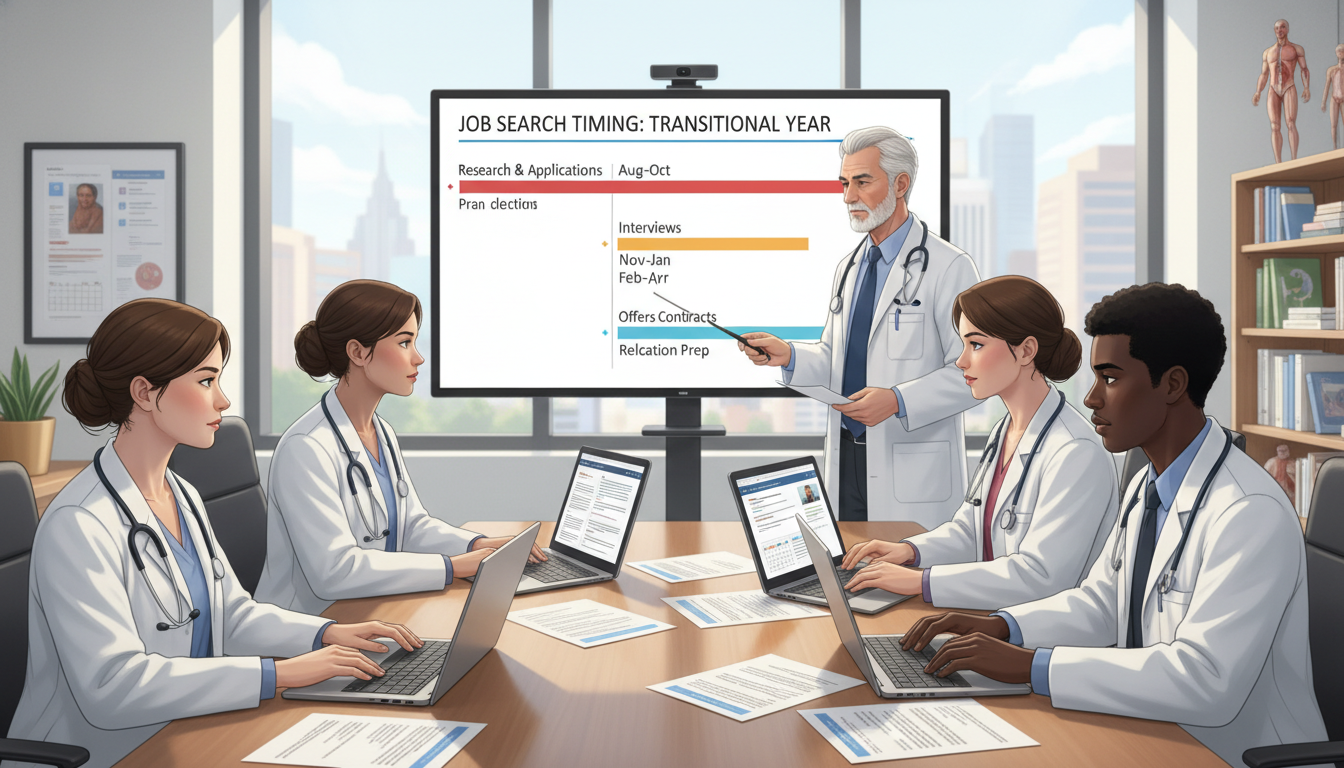
Understanding Job Search Timing in a Transitional Year Residency
For most physicians, the transitional year residency (TY) is exactly what it sounds like: a bridge between medical school and a categorical residency (e.g., radiology, anesthesiology, PM&R, dermatology). But it can also be a bridge directly into practice, especially for those entering prelim-only pathways or for international graduates navigating a nontraditional route.
Because the transitional year is only 12 months and often very front‑loaded with clinical responsibilities, the question of job search timing becomes unusually complex. You have less time to settle in before needing to think about your next step—whether that’s a categorical residency, a fellowship-like role, a non-clinical position, or an attending job.
This guide focuses on when to start job search activities during a transitional year, how the physician job market intersects with a one-year program, and how to tailor your timeline depending on your ultimate career path.
We will focus on four broad groups of TY residents:
- TY as part of a pre-matched categorical program (e.g., advanced radiology or anesthesia)
- TY followed by applying to a categorical residency
- TY as preparation for non-traditional or non-clinical roles
- TY leading directly to attending or independent practice roles (including some IMGs and hospitalist/urgent care paths)
Understanding which group you fall into is the first step in correctly planning your attending job search and broader career timeline.
How Transitional Year Structure Shapes Your Job Search Timeline
The transitional year residency typically runs from July 1 to June 30. While program specifics vary, most TYs share these features:
- 12 months total (no PGY-2 within the same program)
- Rotations in internal medicine, emergency medicine, surgery, and various electives
- Usually heavy frontline responsibilities early in the year
- Variable level of structured career advising (often less than in 3-year core residencies)
Because the year is short, almost every decision is compressed. Any misstep in timing—especially around the job market post-residency—has less room to correct.
Key timeline anchor points in a TY program
Think about your transitional year in quarters:
Q1: July–September
Orientation, adjusting to workflow, learning the hospital system, building your reputation, clarifying career goals.Q2: October–December
More confident clinically; time to solidify your next-step plans. This is often when serious planning for the next year must be underway.Q3: January–March
Applications, interviews, and contract negotiations are usually in full swing for those moving into jobs or categorical programs the following July.Q4: April–June
Wrap-up, licensure finalization, logistics (moving, credentialing), and preparing for your new role.
Your exact job search timing depends heavily on where you’re going after June 30. Below we break down each major pathway with specific action items.

Pathway 1: TY Linked to an Advanced or Categorical Position
Many residents in a TY program already matched into an advanced specialty (e.g., radiology, anesthesia, neurology, PM&R, dermatology) that begins at the PGY‑2 year. For these residents, the attending job search is typically years away, not months. Still, your TY year plays a strategic role.
Your main priorities in this pathway
- Build strong generalist clinical skills for long-term credibility
- Establish professional habits and systems you’ll carry into specialty training
- Create a foundation for future networking and recommendations
When you don’t need to worry about the job market (yet)
If you have a secure PGY‑2 seat, you generally do not need to:
- Look for attending jobs during your transitional year
- Engage in early job negotiations
- Worry about the timing pressures that primary specialty residents (e.g., IM or FM PGY-3s) experience
Your physician job market entry will usually happen late in your categorical residency or fellowship. For example:
- Radiology: Start attending job search in PGY-4/PGY-5, ~12–18 months before graduation.
- Anesthesia: Often PGY-3, about 12–18 months before finishing.
- Derm, PM&R, Neurology: Usually 12–18 months pre-graduation.
What you should do about long-term job search timing during TY
You can still lay groundwork:
Q1–Q2 (July–December)
- Clarify your subspecialty interests early (e.g., interventional vs diagnostic radiology)
- Request rotations or electives in relevant fields that will help with future fellowship or job competitiveness
- Begin tracking what matters to you long-term: academic vs community; geographic preferences; lifestyle priorities
Q3–Q4 (January–June)
- Build a small professional portfolio: a template CV, updated LinkedIn, or a basic profile on a physician recruiting platform
- Start reading about compensation models, practice types, and geographic job market differences in your future specialty
In this pathway, the job search timing you need to master is not immediate. But using your transitional year to build awareness will make your eventual attending search smoother and more strategic.
Pathway 2: TY Followed by a Categorical Residency (Not Yet Secured)
This is the highest‑stakes scenario for job search timing in a transitional year. Here, your transitional year is not just a bridge; it’s a launching pad, and the next step is not guaranteed.
You may be:
- Reapplying to a core specialty after an unsuccessful Match
- Switching from one specialty interest to another
- Using TY to strengthen your U.S. clinical experience and letters (common among IMGs)
In this context, “job search” is really a residency search, but the same principles apply: early preparation, market awareness, and decisive action.
Timeline for residents seeking categorical spots during TY
Because the residency application cycle (via ERAS/NRMP) is tightly scheduled, the timing is fairly rigid.
Before TY starts (ideally January–June before July 1)
- Clarify target specialties and programs
- Take/retake USMLE/COMLEX exams if needed
- Contact programs to understand how a transitional year will be viewed in their selection process
Q1 (July–September)
- Secure strong letters early—especially from core rotations in your target field (e.g., medicine, surgery, or specialty-specific electives)
- Prepare ERAS materials:
- Updated CV
- Personal statement (aligned with your new narrative)
- Evidence of growth since prior application cycle (scores, research, clinical evaluations)
- Identify mentors within your TY program who can advocate for you
Q2 (October–December)
- Active application season:
- Submit ERAS early (late September–October, depending on year’s timeline)
- Monitor and respond quickly to interview invitations
- Request time off or schedule swaps with co-residents for interviews
- Maintain strong clinical performance; your TY evaluations can influence program directors’ impressions through letters or phone calls
Q3 (January–March)
- Rank list submission and Match outcomes
- If unmatched:
- Participate in SOAP if eligible
- Begin contingency planning for the following cycle (research years, additional clinical experience, or non‑traditional paths)
Q4 (April–June)
- Finalize logistics for your new categorical position: contracts, relocation, credentialing
- Close out your transitional year with strong evaluations, as they can still be useful for state licensure and future jobs
How this relates to future job market entry
If you secure a categorical spot, your attending job search will happen near the end of that residency (or fellowship). From a long-term perspective:
- TY is about repairing or enhancing your trajectory, not immediately entering the physician job market
- Use this year to demonstrate reliability, growth, and professionalism—traits programs and, later, employers value

Pathway 3: TY as a Launchpad for Non‑Traditional or Non‑Clinical Careers
Some residents use a transitional year as a stepping stone into roles such as:
- Health policy or administration
- Pharma or biotech (e.g., medical affairs, clinical development)
- Medical education, consulting, or digital health
- Research‑heavy or informatics roles
In these settings, job search timing begins much earlier than many expect, because business, tech, and industry hiring cycles are different from GME schedules.
When to start job search in non-traditional pathways
A realistic non‑clinical job search often takes 6–12 months from initial exploration to signed offer—similar to the physician job market, but with different rhythms.
Q1 (July–September)
- Clarify what non‑clinical roles interest you:
- Policy? Quality improvement?
- Industry roles (pharma/med device)?
- Digital health/start‑ups?
- Begin informational interviews:
- Alumni from your medical school
- Faculty with administrative or industry roles
- Connections via LinkedIn or professional societies
- Start building a skills narrative:
- Leadership experiences
- Quality or systems projects
- Research or data analysis experience
Q2 (October–December)
- Targeted skill development:
- Online courses (e.g., healthcare management, clinical trials, health informatics)
- Participation in committees (QI, EMR optimization, etc.)
- Begin serious job search:
- Identify 10–20 organizations or role types of interest
- Tailor your CV for non-clinical roles (more outcomes, leadership, and project metrics; less rotation detail)
- Start applying to longer-lead-time positions (policy fellowships, industry internships, structured leadership tracks)
Q3–Q4 (January–June)
- Expect active interviewing and negotiations
- Align job start dates with your TY completion (often July–September)
- Clarify licensure needs:
- Some non‑clinical roles still value or require active licensure
- Others may not require ongoing clinical practice, but you may choose to maintain part-time clinical work for financial or professional reasons
Strategic tips
- Non‑clinical employers care more about communication, project outcomes, and leadership than about your exact specialty
- Your TY program can provide a proving ground for:
- Leading a small QI project
- Presenting at M&M or grand rounds
- Demonstrating reliability and teamwork—traits that translate well outside clinical medicine
Pathway 4: TY Leading Directly to Attending or Independent Clinical Roles
Although less common, some physicians move from a transitional year residency directly into some form of clinical practice. Situations include:
- IMGs using TY to gain U.S. experience before hospitalist roles abroad or in certain settings
- Physicians pursuing urgent care, occupational medicine, or telemedicine roles that may hire after limited postgraduate training (varies widely by jurisdiction)
- Locum tenens or short-term clinical assignments, sometimes paired with ongoing exam preparation or research
In these cases, the timing of your attending job search is critical, because:
- You are competing in the broader physician job market against applicants with more years of residency
- Employers may need extra reassurance about your readiness and scope of practice
- Credentialing and licensing processes can take several months
When to start job search if you plan to work clinically after TY
For most direct‑to‑practice paths, plan on an 8–12 month lead time before your desired start date.
Q1 (July–September)
- Clarify your licensing and certification situation:
- State license requirements (often need at least one year of ACGME training, but some states require more)
- Board eligibility implications if you do not complete a full core residency
- Begin market research:
- Explore urgent care, telemedicine, occupational medicine, or international roles
- Speak with recruiters and mentors about the realistic scope of work for a physician with only a TY
Q2 (October–December)
This is when you should start your job search in earnest:
- Contact physician recruiters and staffing agencies
- Update and refine your CV to emphasize:
- Breadth of clinical exposure
- Procedural skills
- Workload and responsibilities in your TY program
- Identify practice settings open to hiring early-career physicians with nontraditional training paths
Begin application submissions:
- Many employers hiring for July/August start dates will start recruiting by late fall and winter
- Locums agencies may have variable timelines, but credentialing still takes time
Q3 (January–March)
Intensify your job search:
- Actively interview (virtual and on-site)
- Compare offers (compensation, supervision, malpractice coverage, orientation period)
- Start state licensure applications if you haven’t already (some states can take 3–6 months)
Negotiate:
- Clarify expectations around:
- Onboarding and supervision
- Types of patients you’ll see
- Night/weekend coverage
- Productivity metrics (RVUs, visit volumes)
- Clarify expectations around:
Q4 (April–June)
- Finalize your next step:
- Sign contract(s)
- Complete credentialing paperwork for hospitals or clinics
- Obtain DEA registration, payor enrollment, and malpractice coverage
- Plan logistics:
- Housing, relocation, and any visa considerations (for IMGs)
- CME or skills courses to address gaps (e.g., urgent care procedures, telemedicine documentation)
Practical considerations and risks
- Be realistic about scope of practice with only a TY; some roles will be limited
- Consider your long-term board certification and career flexibility; you may be closing some doors by leaving formal GME early
- If possible, structure your work initially in more supervised or protocol-driven environments (e.g., large urgent care systems, telemedicine platforms with robust guidelines)
General Principles of Job Search Timing for All TY Residents
Regardless of pathway, several timing principles apply to nearly everyone in a transitional year residency.
1. Start with clarity, not panic
By the end of Q1 (September), you should be able to answer:
- Am I planning to continue in U.S. GME (residency/fellowship)?
- Am I aiming for a non-clinical path after TY?
- Am I preparing for direct clinical work or international roles after TY?
Without this clarity, you risk starting your job search too late or in the wrong direction.
2. Use a backward-planning approach
Work backward from your intended start date:
- For residency or fellowship: anchors are set by national match timelines
- For non-clinical roles: assume 6–12 months from serious search to start date
- For clinical jobs directly after TY: assume 8–12 months, including licensure and credentialing
Then set milestones:
- Exploration and networking
- Application preparation
- Active applications and interviews
- Contracting and onboarding
3. Exploit “hidden” time during TY
A TY can be busy, but you’ll have variable intensity between rotations. Use lighter months strategically:
- During electives:
- Update your CV
- Schedule informational interviews or recruiter calls
- Work on personal statements or cover letters
- During nights/weekends off:
- Research target employers or programs
- Complete online courses or certifications that support your chosen path
4. Don’t underestimate licensure and credentialing timelines
Even if you secure a job offer, practical delays can push back your start date:
- State medical license: 3–6 months in many states; more in some
- Hospital privileges: 2–4 months
- Payor enrollment: 2–6 months, sometimes concurrent with credentialing
This is why employers and recruiters often say to start your attending job search at least 9–12 months before graduation—and though you’re in a one-year program, the same caution applies if you’re heading straight into the physician job market.
Putting It All Together: Sample Timelines by Goal
Here are simplified job search timing snapshots for common goals after a transitional year.
A. TY → Advanced specialty (already matched)
- Q1–Q4: No active job search needed
- Focus:
- Clinical competency
- Professional habits
- Early curiosity about long-term practice models
B. TY → Categorical residency (not yet matched)
- Before TY: Prepare application materials, improve exam scores
- Q1: Secure strong letters; finalize ERAS application
- Q2: Apply, interview
- Q3: Match/SOAP; finalize plans
- Q4: Prepare for new residency start (no attending job search yet)
C. TY → Non-clinical role (policy, industry, digital health)
- Q1: Explore and network; define target roles
- Q2: Begin serious job search (applications, tailored CVs)
- Q3: Interviewing and negotiating
- Q4: Contracts, logistics, transition to post-TY role
D. TY → Direct clinical work / attending roles
- Q1: Clarify feasibility (licensure, scope); start market research
- Q2: Begin active job search, submit applications
- Q3: Intensive interviews and contracting; start licensing
- Q4: Credentialing, DEA, relocation; prepare clinically for new role
FAQs: Job Search Timing in Transitional Year Residency
1. When should I start my attending job search if I’m going straight into practice after a transitional year?
Plan to begin your search 8–12 months before your desired start date. For most TY graduates who want to start work in July/August after finishing, this means serious job search activities should begin by October–December of your transitional year. This allows time for interviews, contracts, licensure, and credentialing.
2. I already have an advanced position after my TY. Do I need to think about the physician job market now?
You do not need to start a formal attending job search during your TY if you are already matched to a PGY‑2 specialty. However, this is an ideal time to begin understanding your specialty’s physician job market: compensation models, regional differences, practice settings (academic vs private), and typical job search timelines (often 12–18 months before residency completion).
3. I’m unsure of my next step after TY. How late can I wait to decide?
You should aim for clear direction by the end of September (Q1). Waiting longer significantly increases stress and limits your options. Many pathways—residency reapplication, non-clinical roles, or attending-track jobs—require 6–12 months of preparation and search. If you’re still undecided after the first quarter, prioritize mentoring conversations, career counseling, and exploratory rotations.
4. Do recruiters really want to talk to a transitional year resident, or should I wait until closer to graduation?
If you plan to enter the physician job market directly after TY, recruiters absolutely want to speak with you by the middle of your year—often as early as October–January. They understand licensure and credentialing delays and prefer early engagement. For those not entering practice immediately (e.g., going into PGY‑2), you can still have exploratory conversations to learn about regional markets and practice models, but formal job search can wait until your final residency year.
By understanding how your transitional year residency intersects with the broader training and employment ecosystem, you can time your job search with intention instead of urgency. The year moves quickly; planning early ensures that when June approaches, you’re stepping into your next role—with clarity, preparation, and momentum.


