
Understanding the Timing Landscape in Urology
The timing of your job search in urology is just as strategic as choosing your subspecialty or fellowship. Because urology is a relatively small, procedure-heavy specialty with a mix of private practice, academic, and hospital-employed positions, the timeline is compressed and varies significantly by setting and region.
Several forces shape job search timing in urology:
- Smaller workforce and slower turnover compared to large fields like internal medicine
- High replacement cost of urologists (equipment, block time, call coverage) leading groups to plan hires 1–2 years in advance
- Subspecialty-driven jobs (endourology, oncology, female pelvic medicine, pediatrics, reconstructive, andrology) that may open on a fixed timeline
- Geographic stickiness: many urologists stay long-term in one region, so true openings can be sporadic
Because of these dynamics, you cannot treat the physician job market in urology as something you can “turn on” three months before finishing training. Instead, you need a phased strategy that starts early in residency and intensifies as you approach the urology match exit point into independent practice.
This guide focuses on job search timing for urology residents and fellows, with special emphasis on:
- How far in advance to start searching
- When to start job search activities in each PGY and fellowship year
- How academic vs private practice timing differs
- How the urology match rhythm influences hiring cycles
- What to do if you are off-cycle or changing jobs as an attending
Big-Picture Timeline: When to Start Job Search in Urology
For urology, a good rule of thumb:
General urology, no fellowship:
Begin active searching 12–18 months before graduation
Aim to sign a contract 6–12 months before graduationFellowship-bound residents:
Begin informal job exploration early in fellowship
Start active search 12–18 months before fellowship completion
Aim to sign a contract 6–12 months before completionUrology fellows (e.g., oncology, pediatrics, FPMRS, reconstructive):
Many academic positions recruit 12–24 months ahead
Private practice subspecialty-friendly jobs: 9–18 months ahead
Why this timing matters:
OR block and equipment planning
Groups and hospitals have to plan block time, equipment purchases (e.g., laser, robotic system access), and staff around a new urologist. That process can take 6–12 months.Credentialing and licensure lag
State licensure, hospital privileges, and payer enrollment can easily take 3–6+ months, especially in heavily regulated states.Visa and relocation issues
For international graduates needing visas or for those with tight geographic constraints (partner’s job, children’s schooling), you need longer lead time to find suitable options.Subspecialty alignment
If you’re a uro-oncologist or pediatric urologist, the number of positions in your niche is small; waiting too long leaves you with fewer choices or a forced “bridge job.”
Year-by-Year: Urology Residency and Fellowship Job Search Timing
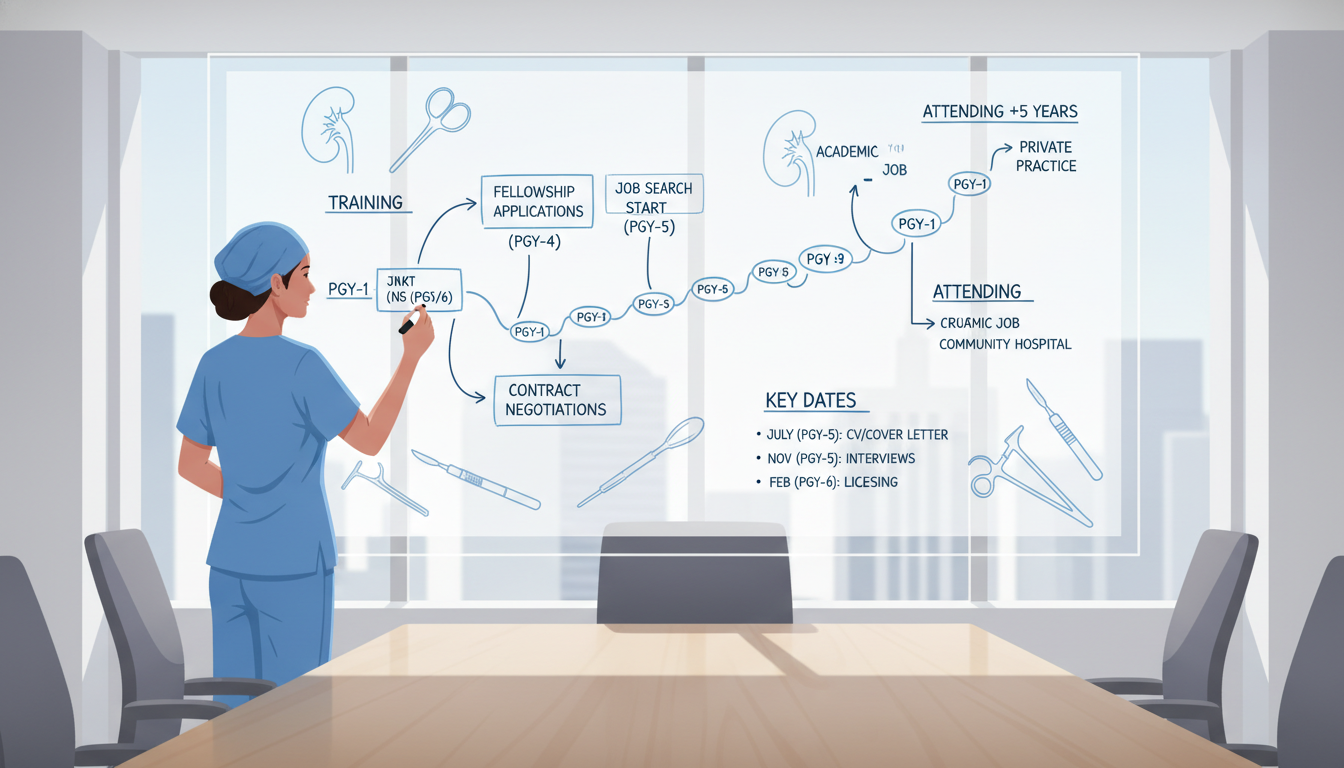
Below is a practical roadmap from early residency through fellowship for the urology job search.
PGY-1 to PGY-2: Foundation and Exploration (Not Yet Applying)
At this stage, you are not actively searching for jobs, but you are shaping the options you’ll have later.
Key timing goals:
- Understand broad career paths in urology:
- Academic vs private practice vs hospital-employed vs hybrid models
- Big health system vs small group vs single-specialty urology group
- Urban vs suburban vs rural practice
- Start noticing what attendings’ jobs actually look like:
- Clinic days vs OR days vs admin
- Call responsibilities
- Case mix (stone, oncology, BPH, reconstruction, pelvic floor, pediatrics)
Actionable steps:
- Ask each attending one or two focused questions:
- “How did you time your job search at the end of training?”
- “If you were graduating now, how early would you start looking?”
- Begin a simple career notes document (Cloud file or note app):
- Settings that appeal to you and why
- Geographic areas where you might want to live
- Early thoughts about fellowship interests
- Attend or watch online career panels at AUA or subspecialty meetings; note timelines mentioned by recent graduates.
At this stage, your main job is learning your field, but small, consistent steps keep you from scrambling later.
PGY-3 to PGY-4: Clarifying Goals and Laying Groundwork
By mid-residency, you should be moving from “anything is possible” to “I am likely heading toward X or Y path.”
For those considering fellowship:
- Most urology fellowships (oncology, pediatrics, FPMRS, endourology, etc.) have their own application cycles, often 2 years before completion of residency.
- Your fellowship timeline shapes your attending job search:
- If you match into fellowship, your attending job search will focus on the final fellowship year.
- If you decide against fellowship, you must pivot earlier to a direct-to-attending search.
Key timing goals (PGY-3/4):
- Narrow down your likely path:
- General urology vs fellowship-bound
- Academic-leaning vs clinically heavy setting
- Start early informational networking:
- Talk to alumni of your program practicing in different settings
- Introduce yourself at local or regional urology meetings
- Get CV and cover letter into basic shape (they will evolve)
Practical tip:
This is a great time to start a simple spreadsheet with:
- Name of institution/practice
- Location
- Type of practice (academic, private, hospital-employed)
- Clinical interests they emphasize
- Any contacts you have there (residency alumni, fellowship mentors, etc.)
You are still not formally applying, but you’re preparing the ground so that once you hit PGY-5 or fellowship, you can move quickly.
PGY-5 (Final Year of Residency, No Fellowship): Active Search Phase
If you are going straight from residency to practice, PGY-5 is your main job search year.
Ideal timing:
- Spring of PGY-4 to early PGY-5 (12–18 months before graduation)
- Start actively looking at postings:
- AUA Career Center
- Specialty society job boards (SUO, SPU, SUFU, etc., depending on your interest)
- Hospital system career pages
- Recruiter emails (with discernment)
- Contact mentors and alumni to ask:
- “Do you know any groups that might be hiring in [year]?”
- Start actively looking at postings:
- Summer–Fall of PGY-5 (9–12 months before graduation)
- Begin formally applying and sending targeted emails to practices of interest.
- Attend major meetings (e.g., AUA) with scheduled informational conversations or preliminary interviews.
- Fall–Winter of PGY-5 (6–9 months before graduation)
- Visit sites in person, interview, and compare offers.
- Start narrowing down to 1–3 serious options.
- Winter–Early Spring of PGY-5 (3–6 months before graduation)
- Finalize contract negotiations and sign.
- Start licensure and credentialing process.
If you start late (e.g., only 6 months before graduation):
- You may still find positions, especially in underserved or rural areas, or systems with urgent needs.
- However, your geographic and practice-style flexibility must increase, or you may need a temporary/locum role while waiting for a more ideal job to open.
Fellowship Years: Academic vs Private Practice Timing
If you pursue fellowship, your attending job search moves into the fellowship years.
Year 1 of Fellowship (for 2-year fellowships)
By mid Year 1, start:
- Discussing long-term goals with fellowship director
- Presenting at national meetings in the subspecialty you want (oncology, pediatrics, FPMRS, etc.)
- Asking your mentors where their former fellows have gone and when they signed
For academic positions in highly subspecialized fields:
- Some departments recruit 18–24 months in advance.
- Expressing interest very early (sometimes in the first half of fellowship) can position you for upcoming retirements or program expansions.
Final Year of Fellowship (or 1-year fellowship)
- 12–18 months before fellowship completion:
- Start actively looking and reaching out, especially for academic roles with limited spots.
- 9–12 months before completion:
- Formal applications and interviews should be underway.
- 6–9 months before completion:
- Aim to have offers in hand and be refining decisions.
- 3–6 months before completion:
- Contract signing and credentialing.
Academic vs Private Practice: How Timing Differs

Both academic and private practice settings recruit urologists regularly, but their timelines and triggers for hiring differ.
Academic Urology: Longer Horizon, More Formal Processes
Typical timing:
- Jobs often posted 12–24 months before start date
- Major decisions may be aligned with:
- Upcoming retirements
- Department expansions
- New service lines (e.g., opening a new robotics program)
- Hospital mergers or cancer center growth
What this means for you:
- If you know you want academics, especially in a specific subspecialty niche (e.g., uro-oncology with major case complexity, pediatric urology with a congenital focus), start conversations extremely early with your mentors.
- Academic hires often involve:
- Multiple rounds of interviews
- Chalk talks or research presentations
- Formal committee approvals
- Institutional budgeting cycles
Therefore, waiting until 6 months before completing training is often too late for many of the most competitive academic openings.
Practical tip:
During your fellowship or late residency, ask your mentor:
“If I want an academic job like yours, when should I start contacting departments, and which chairs or division chiefs should I talk to this year?”
Many academic jobs are filled via informal networking before public ads ever appear. Being early allows you to be in that “behind-the-scenes” pipeline.
Private Practice and Hospital-Employed: More Variable, Often Compressed
In private practice and hospital-employed models, hiring is often driven by:
- Immediate needs (a partner leaving, call coverage crisis)
- Rapid volume growth
- Opening a new clinic site or surgical center
Typical timing:
- Jobs may be announced 6–18 months before start.
- However, “urgent need” jobs can appear 3–6 months before you’re ready to start.
What this means for you:
- If you have flexible geography, you can often find a job even with a late start.
- If you have tight geographic targets, start looking earlier and more proactively, even cold-contacting groups that have not posted an ad yet.
Example:
You want to practice in a mid-sized city where there are two large urology groups and one hospital-employed service. Even if they are not advertising:
- 12–18 months before your target start date:
- Email a concise introduction:
- Who you are
- Training background
- What you’re looking for (e.g., “general urology with interest in stones and BPH”)
- Your timeline
- Ask whether they anticipate hiring in your timeframe.
- Email a concise introduction:
- Many groups will keep your CV on file and may reach out months later when a partner announces a planned retirement.
Strategic Considerations: Matching Job Search Timing to Your Situation
The “right” timing depends on several personal and market factors.
1. Your Geographic Flexibility
- High flexibility (multiple states/regions):
- You can start the active search ~12 months before and still find a strong match.
- You can afford to wait for favorable offers or negotiate harder.
- Low flexibility (one city or small region):
- Start 18–24 months before to build relationships and monitor for openings.
- Use alumni networks and mentors aggressively to get your name in early.
2. Subspecialty vs General Urology
- Broad general urology:
- Very marketable; you will find many openings across diverse settings.
- A 12–18 month active search is usually sufficient.
- Narrow subspecialty focus (e.g., complex reconstruction, pediatric, andrology):
- Fewer positions; specific niche practices.
- Start earlier and be prepared to:
- Accept a mixed case load job (some general, some subspecialty)
- Or extend your search horizon
3. Visa and Immigration Status
If you need a J-1 waiver, H-1B sponsorship, or green card support, timing is critical.
- Waiver jobs in urology may have stricter location constraints (often rural or underserved).
- Start 18–24 months before training completion to:
- Understand the waiver rules in your target states
- Identify employers familiar with the process
- Ensure enough time for legal and governmental processing
4. Family and Personal Factors
- Partner’s career, children’s schooling, or elder care may limit your options.
- Align your urology job search with:
- Academic calendars
- Your partner’s job transitions
- Housing markets and relocation timing
Extra lead time lets you synchronize two careers and avoid last-minute compromises.
The Attending Phase: Changing Jobs and the Mid-Career Market
The physician job market doesn’t stop once you secure your first position. Many urologists make one or more moves during their careers.
When should an attending start a job search?
If you’re unhappy early (first 1–2 years):
- First, clarify: are the problems fixable within your current job (e.g., call schedule, case mix, OR access)?
- If not, you’ll typically want to:
- Review your contract for notice requirements and restrictive covenants
- Start exploring the job market 6–12 months before you’d like to move
If you’re planning a strategic move (e.g., closer to family, academic switch, leadership role):
- Start the attending job search 12–24 months in advance, especially if:
- You have narrow geographic preferences
- You want a specific leadership or niche academic role
- Start the attending job search 12–24 months in advance, especially if:
Contractual timing issues:
- Notice periods: Many contracts require 60–180 days’ notice before departure.
- Non-compete clauses: May restrict practicing within X miles of current practice for Y months.
- These factors can greatly influence when you initiate conversations with potential new employers.
From a timing standpoint, mid-career urologists generally have more leverage but also more constraints (family, established referral base, contracts). Starting early gives you options rather than forcing a rushed exit.
Putting It All Together: A Sample Timeline
Here’s a consolidated example for a urology resident going straight to practice (no fellowship), starting PGY-3:
PGY-3
- Clarify interest in general urology vs subspecialty.
- Begin informal networking with alumni; track appealing regions.
PGY-4
- Spring: Decide definitively about fellowship; if not applying, plan direct-to-practice.
- Late PGY-4 (about 14–18 months before graduation):
- Update CV and draft a flexible cover letter.
- Start scanning AUA and regional job boards weekly.
- Ask mentors for introductions to groups in your target regions.
PGY-5
- Summer–Fall:
- Send targeted inquiry emails to practices and health systems even if they haven’t posted.
- Attend AUA with scheduled meetings/interviews.
- Fall–Winter:
- Visit top 3–5 sites; evaluate call, OR access, compensation, and culture.
- Request and compare offers.
- Winter–Early Spring:
- Negotiate and sign a contract 3–6 months before graduation.
- Start licensure and hospital credentialing immediately after signing.
FAQs: Job Search Timing in Urology
1. When should I start my urology residency job search if I’m not doing a fellowship?
For most residents going directly into practice, begin active searching 12–18 months before graduation (late PGY-4 to early PGY-5). Aim to have a signed contract 6–12 months before you finish, which allows enough time for licensure, credentialing, and relocation.
2. Does the timing differ if I’m planning to do a urology fellowship?
Yes. Your attending job search shifts to the fellowship years. For 1-year fellowships, start exploring positions early in fellowship and actively apply 12–18 months before completion (which, practically, is around the time fellowship begins). For 2-year fellowships, start serious conversations in the first fellowship year if you’re aiming for a competitive academic job, and apply formally by early in the final year.
3. I want a very specific city/region. How early should I start?
If your geographic preferences are strict (e.g., one metro area because of family or a partner’s job), start 18–24 months in advance. Many openings are never widely advertised; they arise when a partner quietly plans retirement or a hospital expands. Early relationship-building and alumni connections give you first access when those jobs appear.
4. If I’m an attending and thinking about changing jobs, when should I start my search?
Review your current contract for notice requirements and non-compete clauses first. Then, if possible, begin exploring the physician job market 6–12 months before you’d like to transition. For highly specific roles or limited geographic options, consider starting 12–24 months ahead to allow time for negotiations, licensure in a new state, and relocation planning.
Job search timing in urology is not one-size-fits-all, but understanding the typical windows—12–18 months for most transitions, earlier for niche academic roles or constrained geographies—lets you move from reactive scrambling to deliberate, confident career planning. By aligning your timeline with the realities of urology practice, you position yourself for a smoother transition from training to the right first (or next) attending job.