Understanding the Clinical Informatics Job Market as a US Citizen IMG
Clinical informatics is one of the most dynamic and rapidly evolving career paths for physicians. For a US citizen IMG (American studying abroad), it can also be a powerful way to blend clinical training with technology, analytics, and health system leadership—especially if traditional clinical pathways have been more challenging.
To time your job search well, you first need to understand the physician job market for clinical informatics and how it differs from a purely clinical role or a non-clinical tech job.
What makes clinical informatics unique?
Clinical informatics roles sit at the intersection of:
- Clinical care (MD/DO background; sometimes active practice)
- Data and analytics (EHRs, registries, dashboards, quality metrics)
- Technology (EHR configuration, decision support, interoperability)
- Change management and operations (workflow redesign, adoption, optimization)
Common roles after a clinical informatics fellowship or equivalent experience include:
- Clinical Informaticist / Physician Informaticist
- CMIO (Chief Medical Information Officer) – often later in career
- Associate/Assistant CMIO or Medical Director of Informatics
- Health IT medical director or physician lead
- Product or Medical Director roles in digital health and health IT companies
Why timing matters more in informatics
Your job search timing is critical because:
Hiring cycles differ
- Hospitals and health systems often budget and plan informatics positions on an annual cycle aligned with fiscal/budget years.
- Health IT and digital health companies may hire in waves tied to funding rounds, product launches, or expansion plans.
Credentialing and onboarding are slower
Even if your role is more informatics-focused, many positions still require:- Credentialing and privileging
- Licensure verification
- Background checks and HR onboarding
This can add 3–6 months between offer and start date.
Many roles expect prior exposure
Most employers expect:- Experience from a clinical informatics fellowship, or
- Ongoing informatics work during residency, or
- Documented health IT training, project work, or certifications
For a US citizen IMG, timing also intersects with:
- Visa not being an issue (huge plus for you), but
- Additional time sometimes needed to validate unfamiliar international medical training, and
- Potentially non-linear residency paths or gaps that you’ll need to frame strategically.
The rest of this article lays out specific timelines: when to start job search efforts relative to residency, fellowship, and graduation—and how to adapt if your path isn’t traditional.
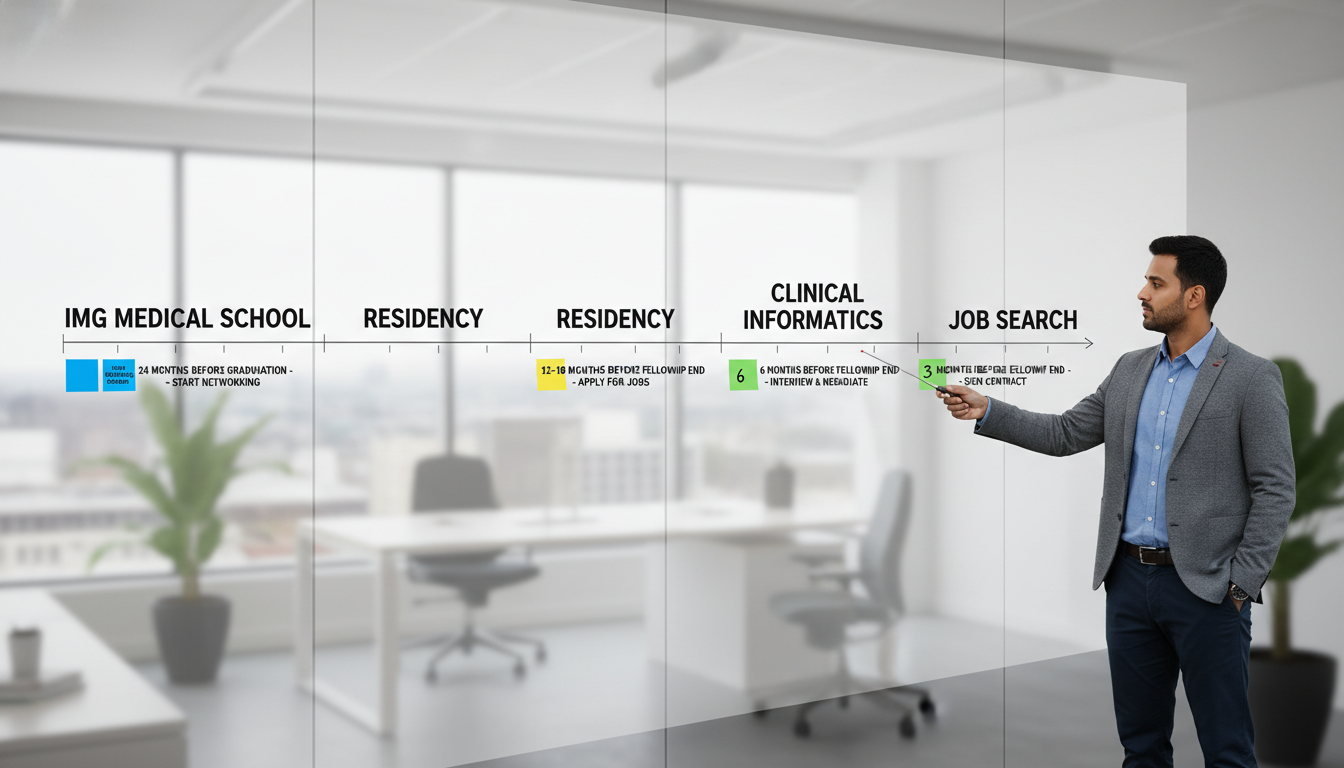
Timeline Overview: When to Start Your Job Search
One of the most common questions is “When to start job search?” for clinical informatics. The answer depends on where you are:
- During residency with an eye toward clinical informatics
- Applying to or enrolled in a clinical informatics fellowship
- Completing a fellowship and heading into the job market
- Pivoting from clinical practice into informatics mid-career
Below is a high-level overview, then we’ll break it down.
Ideal timing at a glance
If you are a US citizen IMG in:
Residency PGY-1 to PGY-2
- Focus: exposure, skill-building, networking
- Job search: just informational; not active applications yet
- Start tracking the physician job market in informatics
Residency PGY-3 (or final year of residency)
- T–18 to 12 months before start date:
- Decide: Fellowship vs direct entry into informatics role
- T–12 to 9 months:
- If fellowship-bound, apply to clinical informatics fellowships
- If skipping fellowship, start soft networking for future employer roles
- T–18 to 12 months before start date:
Clinical Informatics Fellowship – First Year
- T–18 to 14 months before fellowship completion:
- Clarify target role: academic, health system, or industry
- Refine your portfolio, LinkedIn, and CV
- T–12 months:
- Begin systematic networking and informational interviews
- T–18 to 14 months before fellowship completion:
Clinical Informatics Fellowship – Final Year
- T–9 months:
- Actively apply to positions
- Attend targeted conferences and reach out to hiring leaders
- T–6 months:
- Expect interviews and second-round discussions
- T–3 months:
- Aim to have an offer signed (especially for health system roles)
- T–9 months:
Already practicing clinically, pivoting to informatics
- Start 12–18 months before you want to shift roles
- Focus on:
- Gaining internal informatics responsibilities
- Completing foundational health IT training
- Building a project portfolio
For attending job search in clinical informatics, it’s safer to start earlier than you think. A 9–12 month runway is optimal for full-time informatics roles that involve credentialing or complex org structures.
Stage-by-Stage: From Residency to Fellowship to First Informatics Job
1. During residency as a US citizen IMG
As an American studying abroad who has successfully matched into residency, you already navigated one complex process. Use those same skills—early planning and structured preparation—for your informatics career.
PGY-1 to PGY-2: Exploration and positioning
Focus on:
Exposure to informatics
- Join or shadow the EHR optimization committee, quality improvement (QI) group, or IT-governance meetings.
- Volunteer for:
- Order set redesign projects
- Clinical decision support (CDS) initiatives
- EHR implementation, go-live support, or training
Foundational training Consider:
- Online coursework (e.g., basic SQL, introductory data analytics, health informatics MOOCs)
- AMIA 10x10 courses or similar foundational informatics programs
- Short health IT training programs to show formal engagement
Documenting your work Keep a live document of:
- Projects
- Role and scope (e.g., resident champion, workflow analyst)
- Measurable outcomes (e.g., 20% reduction in order errors, improved turnaround time) This will form the backbone of your CV and portfolio later.
Timing focus: No need for active job search yet. Instead, this is preparation time to make you competitive for a clinical informatics fellowship or early-career informatics role.
2. Deciding between fellowship and direct entry
For a US citizen IMG, a clinical informatics fellowship can be especially advantageous because:
- It mitigates any lingering concern about unfamiliar medical school backgrounds.
- It demonstrates US-based, ACGME-accredited subspecialty training.
- It expands your network of informatics leaders in academic and health system settings.
When to decide: 18–12 months before residency completion
Ask yourself:
- Do I want a primarily clinical career with informatics responsibilities?
- Or do I see myself in a primarily informatics role (health IT leadership, product strategy, data science–adjacent work)?
If you want a career built primarily in informatics, fellowship is often the better path—particularly for first-generation informaticists and US citizen IMG physicians who want to build credibility and access mentorship.
Practical timeline:
T–18 to 14 months before residency ends
- Research programs: academic vs community, emphasis (data science, implementation science, EHR optimization, AI/ML).
- Identify programs friendly to IMGs and to non-traditional paths.
T–14 to 10 months
- Prepare application materials:
- CV with explicit informatics projects
- Personal statement centered on health IT, systems improvement, and your long-term vision
- Request letters from:
- Program director
- Informatics mentors or QI leaders
- Others who can directly comment on your systems-thinking abilities
- Prepare application materials:
By the time you are in your final year of residency (PGY-3 or PGY-4), your focus should be either:
- Interviewing for clinical informatics fellowship positions, OR
- Beginning to explore direct-entry informatics roles (less common right out of residency, but possible if you have substantial project and technical experience).
3. During clinical informatics fellowship: The critical runway
Your clinical informatics fellowship is the most important period for positioning yourself in the physician job market for informatics.
Ideal job search timing if you are in a 2-year fellowship:
End of Year 1 (T–18 to 14 months before graduation):
- Clarify your target:
- Health system (department of informatics, CMIO track)
- Academic (informaticist with teaching/research)
- Industry (EHR vendor, digital health startup, large tech, payer)
- Adjust your project mix accordingly:
- Industry-bound → product, UX, data, AI/ML collaboration
- Academic-bound → research, publications, grants, teaching
- Health system-bound → enterprise EHR optimization, governance roles, leadership in clinical operations
- Clarify your target:
12 months before graduation: Build visibility
- Update LinkedIn with:
- “Clinical Informatics Fellow – expected completion [month/year]”
- Bullet points describing your major projects and tools (Epic, Cerner, SQL, Python, BI tools, etc.)
- Present posters or talks at:
- AMIA Annual Symposium
- HIMSS
- Specialty-specific informatics meetings
- Begin informational interviews:
- Ask mentors to introduce you to CMIOs, health IT directors, or medical directors at vendors.
- Target both organizations you already know and “aspirational” sites.
- Update LinkedIn with:
9 months before graduation: Start active search This is when you fully switch from learning about the market to participating in it.
Actions:
- Start applying to posted positions:
- “Clinical Informaticist”
- “Physician Informaticist”
- “Medical Director – Informatics”
- “Physician Executive, Health IT”
- Let your network know your timeline and preferences:
- Region
- Type of organization
- Desired mix of clinical vs informatics FTE
For a US citizen IMG, emphasize:
- No visa requirement (this is a strong positive).
- Board eligibility (or certification) in your primary specialty and in Clinical Informatics (if applicable).
- Clear examples of leading cross-functional projects.
- Start applying to posted positions:

4. Final year of fellowship: Active attending job search
This is where timing is most critical. The attending job search in clinical informatics moves at different speeds depending on the employer:
- Large academic center: slow (6–12 months from first conversation to start date)
- Medium health system: moderate (4–8 months)
- Vendor/industry: variable (2–6 months, but can be faster)
T–9 months: Structured application phase
Dedicate weekly blocks to:
- Searching job boards:
- AMIA job board
- HIMSS job board
- Hospital/health system career pages
- LinkedIn, Indeed (with filters: “clinical informatics,” “physician informaticist,” “CMIO,” “health IT medical director”)
- Sending tailored applications:
- Customize your CV and cover letter for each job.
- Emphasize specific relevant experience (e.g., Epic order set governance, CPOE optimization, CDS design, data warehouse projects).
- Searching job boards:
Begin first-round interviews:
- Expect multiple rounds:
- Initial HR / recruiter screen
- Conversation with CMIO or department director
- Panel interview with multi-disciplinary stakeholders
- Final conversation with senior leadership (CIO, CMO, or system leaders)
- Expect multiple rounds:
T–6 months: Deep interview and negotiation phase
By this point, if your search is going well:
- You should be in final-round interviews or already holding at least one offer.
- This is the time to carefully compare positions:
- Academic vs non-academic
- Percent clinical vs informatics FTE
- Remote, hybrid, or on-site expectations
- Support for ongoing professional development (e.g., AMIA membership, conference travel)
Aim to sign a contract 3–6 months before you finish fellowship.
This cushion gives:
- The employer time to complete credentialing and onboarding.
- You time to finish fellowship projects and transition smoothly.
If you are a US citizen IMG, anticipate occasional extra verification steps around:
- Foreign medical school diploma
- ECFMG certification and primary-source verification
These add time to credentialing. Early contract signing is your safety margin.
Navigating the Physician Job Market in Clinical Informatics
Understanding the physician job market for informaticists helps you set realistic expectations and prioritize your efforts.
Where the jobs are
Large health systems and academic medical centers
- Roles:
- Associate CMIO
- Physician Informaticist
- Medical Director for Clinical Informatics
- Pros:
- Strong infrastructure and established informatics teams
- Opportunities to teach, research, and mentor
- Cons:
- Slower hiring timelines
- More bureaucracy; competition can be intense
- Roles:
Community hospitals and regional systems
- Roles:
- EHR Medical Director
- Clinical Informatics Physician Lead
- Pros:
- Broader scope-of-responsibility; you may “wear many hats”
- Faster path to visible impact
- Cons:
- Fewer formalized roles; you may need to help define your job
- Roles:
Health IT vendors and digital health companies
- Roles:
- Medical Director, Clinical Informatics / Clinical Strategy
- Physician Product Owner
- Clinical Consultant / Implementation Specialist
- Pros:
- Faster-paced environment
- Exposure to innovation, product decision-making
- Cons:
- Less clinical activity; may require full pivot out of practice
- Earlier-stage companies can be unstable
- Roles:
Payers, analytics firms, and consulting companies
- Roles:
- Physician Informaticist, Data/Analytics
- Medical Director, Quality & Outcomes
- Pros:
- Strong focus on data, population health, and value-based care
- Cons:
- Indirect patient care; may feel farther from the bedside
- Roles:
How being a US citizen IMG shapes your strategy
Being a US citizen IMG affects your job search timing and approach in several ways:
No visa constraints:
- You don’t have to align start dates with H-1B or J-1 waiver deadlines.
- Employers often see this as lower administrative burden.
Need to demonstrate US-based competency:
- Your residency and fellowship, plus US references, will matter more than your medical school name.
- Highlight:
- US training institutions
- US-based leadership and project work
- Any recognition (awards, chief resident, teaching roles)
Perception management:
- Some hiring committees still carry bias (implicit or explicit) against IMGs. Counter this with:
- Clear communication skills
- Evidence of leadership
- Sophisticated understanding of US healthcare systems, regulations, and payment models
- Some hiring committees still carry bias (implicit or explicit) against IMGs. Counter this with:
All of this means you should prioritize early and consistent networking and allow enough lead time in your search to find organizations that value your background.
Practical Tactics: Making Your Job Search More Effective
Timing is only one dimension; your strategy and execution are just as important.
1. Build a clear brand early
Within 6–12 months of your desired start date, anyone who looks you up should understand:
- You are a physician informaticist (or aspiring one).
- You have concrete experience in:
- EHR optimization
- Clinical decision support
- Workflow redesign
- Data and analytics, even at a basic level
Actions:
Craft a 2–3 sentence professional summary for your CV and LinkedIn:
- “US citizen IMG and board-certified internist with formal training in clinical informatics and experience leading EHR optimization, CDS, and quality improvement projects across multi-site health systems.”
Publish short content (if comfortable):
- Blog posts or LinkedIn articles about informatics lessons from your projects
- Brief conference abstracts or posters
2. Use conferences and professional societies strategically
Target:
- AMIA (American Medical Informatics Association)
- HIMSS (Healthcare Information and Management Systems Society)
For timing:
- Attend at least one major conference in the 12–9 month window before your job start date.
- Pre-arrange meetings with:
- CMIOs
- Vendor medical directors
- Fellowship alumni at target institutions
Bring:
- A concise, practiced introduction:
- Who you are (US citizen IMG, specialty, fellowship)
- Your informatics focus areas
- Your desired start date and geographic preferences
3. Be transparent about timing with recruiters and hiring managers
When you speak with recruiters:
- Clearly state:
- “I am completing my clinical informatics fellowship in [month, year]. I’m targeting a start date in [month, year], and I’m beginning my search now because I know it can take 3–6 months to secure the right role and complete credentialing.”
This reassures them you understand the process and will stick to a realistic timeline.
4. Plan for a “Plan B” timeline
Even with perfect timing, the first position you secure may not be your dream job. For a US citizen IMG in clinical informatics, consider:
- Plan A: Ideal mix of clinical and informatics at a well-resourced system or industry role.
- Plan B:
- A largely clinical job with protected time for informatics projects, with the understanding you’ll transition more fully into informatics over 1–3 years.
- A non-fellowship-affiliated informatics or quality role that you leverage for experience and networking, then move again.
Because you don’t have visa constraints, you retain flexibility to pivot after gaining more US-based experience.
FAQs: Job Search Timing for US Citizen IMG in Clinical Informatics
1. When should I start my job search if I’m finishing a clinical informatics fellowship?
Start 9–12 months before your intended start date.
- At 12 months: update your materials, define your target roles, begin networking.
- At 9 months: submit applications to posted positions and actively schedule interviews.
Aim to sign a contract by 3–6 months before your completion date to allow time for credentialing and onboarding.
2. I’m a US citizen IMG in residency with an interest in clinical informatics. Do I need a fellowship before applying for informatics jobs?
Not strictly, but it’s highly beneficial—especially as a US citizen IMG. A clinical informatics fellowship:
- Strengthens your credibility in the physician job market.
- Expands your network in health IT.
- Provides structured project experience and mentorship.
If you have exceptional technical skills and substantial project work, you may find entry-level informatics roles without a fellowship, but the path is steeper.
3. How does my IMG background affect the timing or strategy of my attending job search?
You don’t have visa timing pressures, which is an advantage. However, you should:
- Start networking early (12–18 months before you want to start).
- Emphasize your US-based training and informatics accomplishments.
- Be prepared for slightly longer credentialing due to international degree verification.
Your strategy should focus on visibility, strong US references, and clear communications skills to counter any implicit bias.
4. I’m already an attending and want to pivot into clinical informatics. When should I start that job search and skill-building?
Begin 12–18 months before you hope to shift roles. In that time:
- Take on informatics-related responsibilities within your current organization (EHR projects, QI initiatives).
- Seek formal health IT training or certifications.
- Start networking with informatics leaders internally and externally.
By the 9–12 month mark, begin exploring external positions if no suitable internal transition is available.
Planning the timing of your job search with this level of structure will help you move confidently from residency or fellowship into the clinical informatics roles you’re aiming for—leveraging your strengths as a US citizen IMG and positioning you for long-term success in the evolving world of health IT.