
Understanding the EM–IM Job Market as a US Citizen IMG
The combined Emergency Medicine–Internal Medicine (EM–IM) pathway opens a uniquely flexible career, but it also creates specific timing questions that differ from categorical EM or IM. As a US citizen IMG, your strategy for job search timing after residency is especially important because you are navigating:
- A relatively small niche specialty (EM–IM combined)
- Two overlapping but distinct job markets (emergency medicine internal medicine)
- Potential perceptions about being an American studying abroad
- A physician job market that is tightening in EM in some regions, and stable or strong in IM in many others
Before we map out when to start your attending job search, it helps to understand the market forces you’ll face.
Key Features of the EM–IM Job Market
Smaller cohort, more customized roles
Very few physicians graduate from EM–IM combined programs each year. Many employers don’t fully understand how to best use your dual training until you explain it. That means:- Fewer “plug-and-play” EM–IM specific positions
- More need to negotiate or design hybrid roles (e.g., 60% EM, 40% IM or hospitalist, or administrative/academic split)
Divergent trends in EM vs IM hiring
- Emergency Medicine: In many urban and desirable regions, EM has become more competitive, with concerns about oversupply in certain markets and growing use of PAs/NPs. Smaller or rural hospitals may still have robust needs.
- Internal Medicine: IM and hospitalist positions remain widely available nationwide, particularly in community and rural settings, and for nocturnist and high-volume roles.
Your EM–IM training allows you to pivot between these, or combine them, based on local demand.
US Citizen IMG status in the job market As a US citizen IMG:
- You do not need visa sponsorship, which removes a major barrier many IMGs face.
- Some employers might still ask about your background as an American studying abroad. Most will focus on:
- Residency program reputation and performance
- Board certification/eligibility in EM and IM
- Your references and clinical track record
Overall, you are more advantaged than non–US citizen IMGs, but you may need to actively highlight your strengths and reassure employers about your training quality.
Timing pressures specific to EM–IM
- Academic centers may recruit early for hybrid roles or fellowship-type positions.
- Large EM groups may hire on an annual cycle, especially for July start dates.
- Hospitalist and IM-based jobs often have rolling recruitment and more flexibility.
Understanding these dynamics will shape when to start job search activities and how aggressive you need to be at each stage of residency.
The Ideal Timeline: When to Start Your Attending Job Search
The most critical question for EM–IM residents is not just “when to start job search,” but “how early to start each type of job search activity.” Below is a practical, month-by-month guide assuming a traditional 5-year EM–IM residency and a July graduation.
PGY-3: Laying the Foundation (18–24 Months Before Graduation)
At this stage, you are not formally applying, but you are positioning yourself.
Goals:
- Clarify what kind of EM–IM career you want.
- Explore markets and practice types.
- Build a network to make your later search easier.
Timing & Actions:
1. Self-assessment and career direction (beginning of PGY-3)
Decisions now will influence your job search timeline later.
Ask yourself:
- Do I want to practice:
- Primarily EM, with occasional IM shifts?
- Primarily IM/hospitalist, with EM backup?
- A true hybrid EM–IM role (e.g., split FTE between ED and inpatient/ICU)?
- Is academic medicine attractive or is a community job more appealing?
- Do I want a large city, mid-size city, or rural area?
- How important are schedule flexibility, loan repayment, and salary vs. lifestyle?
2. Light market reconnaissance (PGY-3 year)
- Use job boards (ACEP, SHM, NEJM CareerCenter) to:
- Note geographic regions with multiple EM/IM/hospitalist openings.
- Track which employers mention combined or hybrid roles.
- Talk to recent EM–IM graduates from your program:
- When did they start applying?
- How long did it take to sign a contract?
- What surprised them about the physician job market?
At this point, you do not need to contact recruiters formally unless you want early intelligence. The main objective is to know where opportunities cluster.
PGY-4: Early Positioning and Networking (12–18 Months Before Graduation)
This is the sweet spot to begin intentional planning for your attending job search as an EM–IM combined resident.
Goals:
- Narrow your geographic and role preferences.
- Begin quiet networking with potential employers.
- Build a CV that reflects your EM–IM strengths.
Timing & Actions:
1. 12–18 months out: Clarify your primary market
Decide on your target structure:
Track A – Primarily EM jobs
- Focus on ED groups, democratic EM groups, CMGs, or academic ED departments.
- Start earlier, as EM jobs in desirable metro areas may be competitive.
Track B – Primarily IM/Hospitalist roles
- Large hospitalist groups, community hospitals, private IM groups with hospital or clinic focus.
- These often recruit later and year-round, giving more flexibility.
Track C – True EM–IM hybrid positions
- Typically at academic medical centers, large tertiary hospitals, or systems that value cross-coverage.
- These may not be advertised; you will often craft them with leadership.
You can pursue more than one track simultaneously, but identify a primary focus.
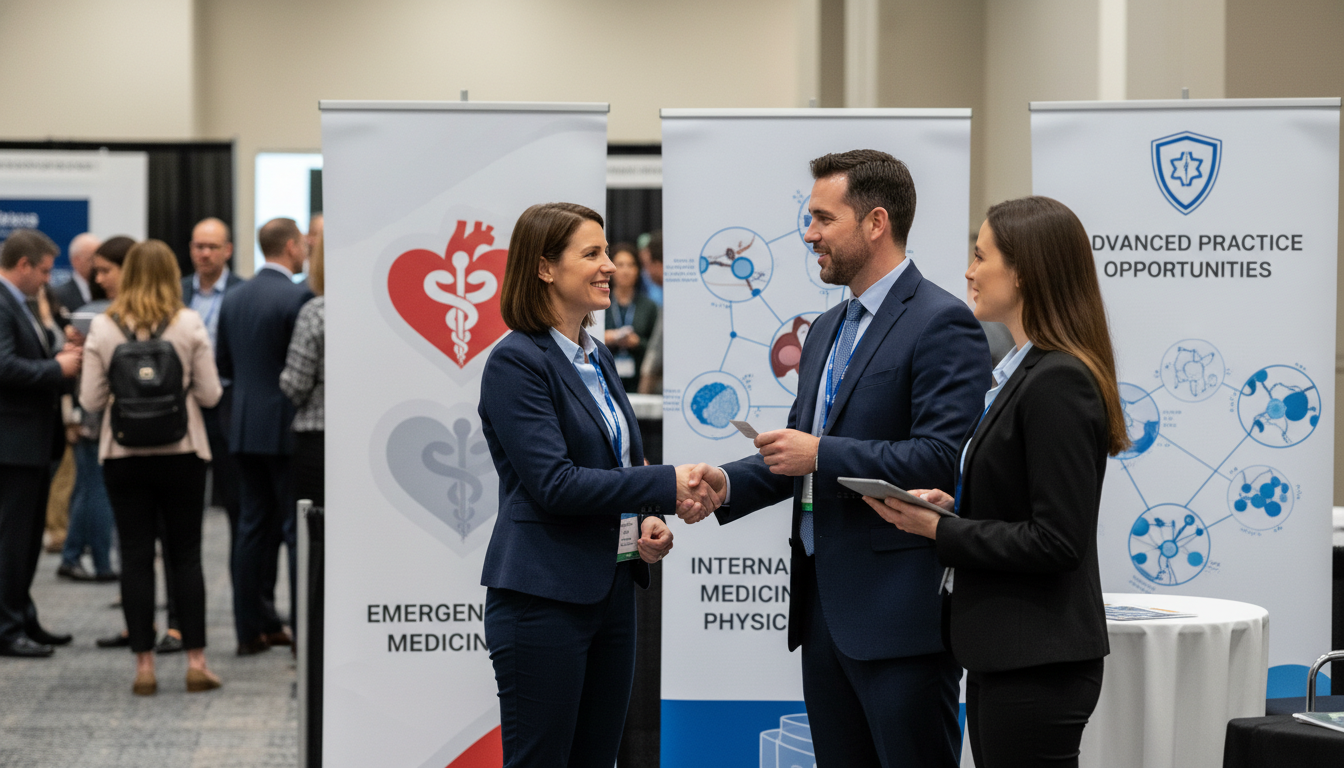
2. Attend conferences strategically (PGY-4 fall/winter)
Aim for:
- ACEP Scientific Assembly (for EM roles)
- SHM (Society of Hospital Medicine) Annual Meeting (for hospitalist roles)
- ACP, SAEM, SCCM if aligned with your career goals
At these meetings:
- Visit career booths and ask explicitly:
- “How have you used EM–IM combined graduates in your system?”
- “Do you have positions that allow dual practice or cross-departmental work?”
- Collect business cards and follow up with short, professional emails.
3. Update your CV and begin tailoring (PGY-4 year)
Emphasize:
- Dual board eligibility (or certification trajectory) in Emergency Medicine and Internal Medicine
- Strong rotations/roles:
- ED leadership, QI projects, throughput initiatives
- ICU or step-down experience
- Hospitalist rotation leadership, sepsis bundles, throughput projects
- Teaching or administrative experiences
This CV will be ready for formal applications in early PGY-5.
PGY-5: Active Job Search and Contract Negotiation (6–12 Months Before Graduation)
This is when timing becomes critical. For EM–IM residents, the main active job search window typically begins 6–12 months before graduation, with some variation by practice type.

1. When to Start Job Search by Practice Type
A. Primarily Emergency Medicine roles
- Ideal start: 9–12 months before graduation
For a July finish, start August–October of PGY-5.
Why early?
- EM in popular areas (coasts, major metros, academic centers) can be tightly contested.
- Large EM groups finalize staffing and credentialing months in advance.
- Privileging in some hospital systems can take 3–6 months.
Action steps:
- September–November:
- Email group directors or medical directors directly with CV + cover letter.
- Respond to recruiter outreach with a clear statement of your timeline.
- October–January:
- Schedule interviews (in-person or virtual).
- November–February:
- Negotiate and aim to sign a contract.
B. Primarily Internal Medicine / Hospitalist roles
- Ideal start: 6–9 months before graduation
For July graduation, start November–January of PGY-5.
Why a bit later?
- Hospitalist jobs are often more plentiful and recruited on an ongoing basis.
- Many hospital systems are comfortable hiring within 6-month windows.
Action steps:
- November–January:
- Respond to job postings and recruiter emails.
- Reach out to hospitalist chiefs in your preferred cities.
- December–March:
- Interview and compare offers.
- January–April:
- Finalize your choice and sign a contract.
C. Hybrid EM–IM positions
- Ideal start: 9–12+ months before graduation
Why so early?
- These roles are often custom-created.
- You may need:
- Approval from both EM and IM departments
- Coordination of FTE splits and compensation modeling
- Extra time for negotiation
Action steps:
- August–October:
- Identify institutions that already employ EM–IM graduates or are open to innovation.
- Email both the ED chair and IM/hospitalist director expressing interest in a combined role.
- October–February:
- Have focused conversations about:
- FTE split (e.g., 0.6 EM / 0.4 IM)
- Call responsibilities
- Academic time, teaching, or admin duties
- Have focused conversations about:
- November–March:
- Work toward a clear written job description and contract.
2. Key Milestones in the PGY-5 Job Search
6–12 Months Before Graduation (Primary Window)
- Finalize geographic targets (e.g., 3–5 cities or regions).
- Send out applications and introduction emails.
- Schedule interviews and site visits.
4–6 Months Before Graduation
- You should have:
- At least a few serious offers in hand.
- A good sense of compensation norms in your regions (base pay, shift differentials, bonuses).
- Begin contract review with:
- A trusted mentor
- Possibly a healthcare attorney (especially if there are complex clauses, restrictive non-competes, or partnership tracks).
3–4 Months Before Graduation
- Aim to sign your primary contract by this point.
- Complete credentialing paperwork promptly:
- Medical staff applications
- State license (if not already started; in some states you must begin this 12+ months ahead)
- DEA registration (often after state license is active, but you can plan ahead)
If you reach 3 months before graduation without a signed offer, it’s time to widen your search geographically or be more flexible with job type.
Special Considerations for US Citizen IMG EM–IM Graduates
Although you don’t carry the visa-related barriers of many IMGs, your background as a US citizen IMG and American studying abroad still influences your strategy—especially timing.
1. Addressing Training Perception Early and Proactively
Some employers unfamiliar with international schools might ask extra questions. To keep the process smooth and on schedule:
- Lead with your US-based residency training:
- “I trained in a fully accredited ACGME EM–IM combined program at [Institution].”
- Emphasize:
- Board eligibility in both EM and IM
- US-based clinical performance, metrics, and letters of recommendation
- Provide polished letters from program leadership who can vouch for your readiness and professionalism.
Doing this early prevents delays in decision-making and keeps your job search timeline on track.
2. Taking Advantage of Visa Independence in Timing
Unlike non–US citizen IMGs:
- You do not need to wait for institutions willing to sponsor J-1 waivers, H-1B, or other visas.
- This gives you:
- Much more geographic freedom
- Ability to negotiate purely on fit, schedule, and compensation
Practically, this means:
- You can feel more comfortable starting at the earlier end of the suggested windows and still wait for the right fit.
- If necessary, you can pivot late (3–4 months before graduation) to a different region or role without legal constraints.
3. Market Strategy: EM vs IM as a US Citizen IMG
Given the evolving physician job market:
In crowded EM markets, your US citizen IMG background is usually not the primary issue—competition from US MD/DO grads and local candidates is.
- Timing strategy: Apply early and cast a wide net, especially if you want major metropolitan areas.
In IM/hospitalist roles, many systems face ongoing staffing shortages.
- Timing strategy: You often have leverage, and positions may still be open even 2–3 months before graduation, but don’t rely entirely on this; use the 6–9 month window for security.
For hybrid or academic EM–IM roles, your dual training plus US-based residency is your main asset.
- Timing strategy: Start conversations early, frame yourself as a solution for both ED and internal medicine service needs.
Practical Tips to Stay on Schedule and Avoid Pitfalls
1. Build Your Timeline Backwards
Working from your graduation date, build a mini “Gantt chart”:
- T–12 months: Decide primary market (EM vs IM vs hybrid)
- T–10 months: Finalize CV and begin applications (especially for EM/hybrid)
- T–8 months: Interview phase in full swing
- T–6 months: Have at least 1–2 solid offers; start contract reviews
- T–4 months: Sign contract; finish licensing & credentialing
- T–0: Transition smoothly into attending role
2. Use Your EM–IM Program Leadership as Allies
Program directors and faculty are invaluable for managing timing:
- Ask them:
- “When have prior EM–IM graduates here typically signed contracts?”
- “Which hospitals or groups are historically EM–IMG friendly?”
- They may:
- Make introductions to EM chairs or hospitalist directors.
- Help accelerate the timeline if an employer is dragging their feet.
3. Keep a Job Search Log
To manage multiple timelines:
- Track:
- Date you sent CV
- Contact person
- Interview dates
- Offer status
- Deadlines requested by employers
This helps you:
- Politely nudge recruiters or directors if weeks go by without updates.
- Compare offers systematically and decide in time to avoid last-minute panic.
4. Be Realistic About Location vs Timing
If you want:
- A very specific city or region (e.g., one major metro), be prepared to:
- Apply earlier
- Accept some trade-offs on compensation or schedule
If you are:
- More flexible geographically (especially open to secondary cities or rural areas), you may:
- Have options later in the season
- Use offers from different regions to negotiate better terms
Frequently Asked Questions (FAQ)
1. When should an EM–IM resident start looking for their first job?
For most EM–IM residents, active searching should begin 6–12 months before graduation, depending on the role:
- 9–12 months out for primarily EM or hybrid EM–IM roles.
- 6–9 months out for primarily IM/hospitalist roles.
As a US citizen IMG, you can afford some flexibility, but starting in these windows gives you the best mix of options and security.
2. Is the physician job market harder for a US citizen IMG in EM–IM?
You face fewer barriers than non–US citizen IMGs because you don’t need visa sponsorship. In many cases, employers will care more about:
- Your EM–IM residency program quality
- Board eligibility in EM and IM
- References and clinical performance
In crowded EM markets, competition is about sheer volume of applicants, not primarily IMG status. In IM/hospitalist markets, there’s often strong demand; your US residency and flexibility are major advantages.
3. How early should I worry if I don’t have an offer?
Red flags by timing:
4 months before graduation with no serious leads:
- Expand your geographic search and consider hospitalist roles if focused only on EM.
- Reach out to recruiters directly and leverage your program leadership for introductions.
3 months before graduation with no signed contract:
- Accelerate decision-making; consider accepting a strong offer even if it’s not your “perfect” location, knowing you can reassess after a few years.
4. Should I prioritize EM, IM, or hybrid roles as a new EM–IM graduate?
There is no universal answer, but consider:
Primarily EM if:
- You enjoy high-acuity, shift-based work.
- You are comfortable with EM job competition and can start searching early.
Primarily IM/hospitalist if:
- You value more predictable schedules and potentially more stable demand.
- You want a strong general medicine base early in your attending career.
Hybrid EM–IM if:
- You want to fully use your dual training.
- You are willing to navigate more complex negotiations and start early (9–12+ months out).
You can also start in one domain (e.g., hospitalist) and transition over time to more EM or a hybrid role as opportunities arise.
By planning your job search timing deliberately and leveraging your strengths as a US citizen IMG with EM–IM combined training, you can navigate the physician job market with far less stress. Start early enough to protect your options, stay organized, and use your unique dual skill set as a powerful asset in both emergency medicine and internal medicine settings.