
Why Job Search Timing Matters So Much for US Citizen IMGs in Ophthalmology
For a US citizen IMG (American studying abroad) who has successfully navigated the ophtho match and completed (or is completing) ophthalmology residency, the next challenge is just as strategic: when to start your job search.
The physician job market in ophthalmology is relatively strong but uneven. Geographic preferences, fellowship plans, visa issues for your spouse, and academic vs private practice goals all intersect with timing. For US citizen IMGs in particular, timing matters because:
- You may feel pressure to “prove yourself” in competitive markets.
- Certain academic departments and larger groups hire on a fixed cycle.
- Relocation, licensing, and credentialing can take longer than you expect.
- The best attending jobs for new grads often get filled 9–12 months before a start date.
This article walks through a practical, month‑by‑month framework for job search timing in ophthalmology, tailored specifically for US citizen IMGs—from late residency through your first attending job and beyond.
Understanding the Ophthalmology Job Market for US Citizen IMGs
Overall Landscape
Ophthalmology remains a relatively stable, in-demand specialty, but opportunities vary:
- High demand: Smaller cities, rural communities, and multi-specialty groups.
- Moderate demand: Mid-sized metro areas and regional academic centers.
- Highly competitive: Top-tier academic institutions and major metropolitan areas (NYC, Boston, SF, LA, Chicago).
As a US citizen IMG:
- You avoid the visa constraints many IMGs face, which is a major advantage in the attending job search.
- Some employers may be less familiar with international medical education paths, so your CV and references must clearly demonstrate quality and US-based training.
- Having completed an ACGME-accredited residency (and likely fellowship) in the US is usually more important than where you attended medical school.
Key Hiring Patterns in Ophthalmology
Most ophthalmology employers hire on two broad timelines:
Academic / Large Health Systems
- Often plan 12–18 months ahead.
- Positions may be tied to budget cycles (fiscal year starts July or October).
- Search committees can take several months to move from posting to offer.
Private Practices & Ophthalmology Groups
- Hiring needs often arise 6–12 months before they want you to start.
- Small practices may decide late, especially if they’re waiting on volume growth or a senior partner’s retirement decision.
- Some positions never hit large job boards—hiring can be driven by networking and word of mouth.
Because of these patterns, the optimal timing of your job search depends heavily on:
- Whether you plan to complete a fellowship.
- Whether you’re seeking academic vs private practice roles.
- How geographically flexible you can be.
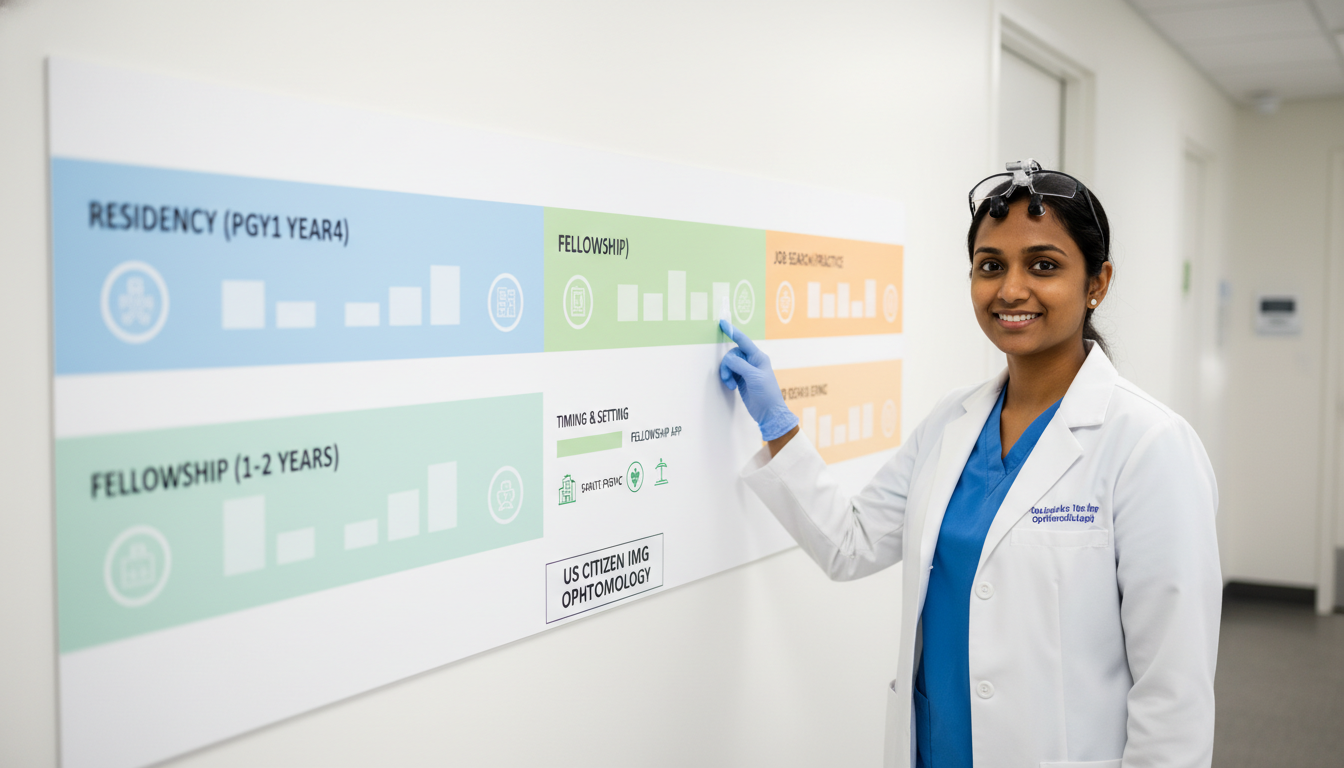
Optimal Job Search Timeline: PGY-3 Through Early Attending
This section assumes a traditional 3-year ophthalmology residency (PGY-2 to PGY-4) and optional 1-year fellowship. Adjust the timing as needed for integrated or extended programs.
PGY-3 (or Second Year of Ophthalmology Training): Laying the Foundation
Even though you’re not ready to apply for jobs, PGY-3 is when strategic preparation starts.
Goals:
- Clarify long-term career direction.
- Position yourself for the roles you’ll want later.
- Start early networking.
Action Steps:
Clarify Your Career Targets
- Decide if you’re leaning toward:
- Comprehensive ophthalmology vs subspecialty.
- Academic medicine vs private practice vs hybrid (academic-affiliated group).
- Reflect on geographic preferences:
- “Must-have” factors (family nearby, spouse’s job market, climate).
- “Deal-breakers” (cost of living, distance from major airports, etc.).
- Decide if you’re leaning toward:
Fellowship Decision (If Applicable)
- If you want a fellowship (e.g., cornea, retina, glaucoma, pediatrics), this decision affects your job search timing.
- Fellowship applications are typically due during PGY-3; match results often dictate when you can start targeted networking in that subspecialty.
Begin Strategic Networking
- Attend subspecialty conferences (e.g., ASCRS, AAO, ASRS) as budget and time permit.
- Introduce yourself to faculty from programs and regions of interest.
- Keep a simple spreadsheet of contacts: name, institution, email, when/where you met, and notes.
Optimize Your CV
- Make your US-based training and board-eligibility status very clear.
- As a US citizen IMG, highlight:
- US clinical experience.
- US letters of recommendation.
- Any leadership roles or research showing initiative and reliability.
Timing Summary (PGY-3):
- No formal job applications yet.
- Intense focus on networking, CV building, and clarifying priorities.
PGY-4 (Final Year of Ophthalmology Residency): Exploring and Positioning
PGY-4 is the bridge between training and early attending life—timing decisions this year are crucial, especially for American studying abroad who want to maximize their US career options.
Major Scenarios:
- You are going straight into practice after residency.
- You are doing a fellowship (most common in subspecialties like retina, cornea, glaucoma).
If You’re Going Straight into Practice After Residency
When to Start the Job Search:
- 9–12 months before graduation is ideal.
- For a June/July finish, that means:
- Start active search: August–October of PGY-4.
- Earlier if you want top-tier academic roles or specific HCOL cities.
Timeline & Actions:
July–September (PGY-4 start):
- Refine your CV and cover letter.
- Sit down with your program director and trusted faculty to:
- Discuss your target regions and practice types.
- Identify practices or departments where they can introduce you.
- Begin informational interviews:
- Email faculty or alumni at target locations: “I’m a PGY-4 at [Program]. I’ll be graduating in [Month, Year] and am exploring opportunities in [Region/Type of practice]. Could we set up a brief call to learn more about your group/department and what you look for in new hires?”
September–December:
- Start formal applications:
- Major job boards (AAO Jobs, Ophthalmology Online classifieds).
- Group websites.
- Academic institution postings.
- Simultaneously, use networking-based outreach:
- Email practices in your target area even if they haven’t posted a job: “I’m finishing ophthalmology residency at [Program] in [Month, Year] and am very interested in the [City/Region] community. Does your group anticipate adding a comprehensive ophthalmologist in the next 12–18 months?”
- Aim to attend AAO (usually October/November) and schedule informal discussions with prospective employers.
- Start formal applications:
December–March:
- Expect most interviews in this window.
- If you’re geographically flexible, you might receive multiple offers; if you’re limited to one city, expect more variability and potential delays.
- Start reference checks and be prepared with:
- At least 3 strong US-based ophthalmology references.
- Clear explanation of your training path as a US citizen IMG (if asked).
March–May:
- Negotiate offers (more on this later).
- Finalize your decision at least 3–4 months before graduation to allow time for:
- Licensing (state-dependent).
- Credentialing with hospitals and payors.
- Relocation planning.
If You’re Pursuing Fellowship After Residency
Your attending job search shifts about one year later, but the timing principles stay the same.
During PGY-4:
- Focus on fellowship placement and performance.
- Keep a long view of where you might want to work after fellowship:
- If your dream job is academic retina in a certain region, start meeting faculty there early.
- Ask your residency mentors: “Which graduates of our program are practicing in [Region/Subspecialty] that I should talk to?”
Bottom Line for PGY-4:
- Start your attending job search about 9–12 months before your anticipated final training completion date (residency or fellowship).
Fellowship Year: When and How to Launch Your Attending Job Search
For many US citizen IMG ophthalmologists, fellowship is when the real attending job search occurs.
Ideal Start: 9–12 Months Before Fellowship Ends
- For a July–June fellowship, this means August–October of your fellowship year.
Early Fellowship (Months 1–3):
- Clarify your niche: high-volume surgery vs mixed clinic/surgery, academic research, premium IOLs, etc.
- Discuss with your fellowship director:
- Your ideal job structure.
- Their realistic impressions of your competitiveness for specific roles (academic vs private, high-demand cities vs others).
- Where past fellows have gone and who might be hiring.
Mid-Fellowship (Months 3–8): Formal Search Phase
- Follow the same rhythm as the PGY-4 direct-to-practice pathway:
- Job boards + direct outreach.
- Network through national and subspecialty meetings.
- Lean heavily on your residency and fellowship mentors’ networks.
Late Fellowship (Months 8–12):
- Finalize offers, contracts, and licensing.
- Plan relocation and onboarding.
Why 9–12 Months Is Ideal in Ophthalmology:
- Employers can visualize and plan your start date.
- You’re early enough to access unadvertised opportunities.
- If a position falls through, you still have time to pivot.
Strategic Considerations Unique to US Citizen IMGs

Leveraging Your Strengths as a US Citizen IMG
Although IMGs can face biases earlier in training, as an attending job candidate you also have distinct strengths:
Visa Independence
- You don’t require employer sponsorship, which:
- Reduces cost and administrative burden for the practice.
- Makes you a more attractive candidate in smaller groups that can’t handle immigration complexity.
- You don’t require employer sponsorship, which:
Resilience and Adaptability
- As an American studying abroad who matched into a competitive field like ophthalmology, your history shows:
- Persistence.
- Ability to navigate complex systems.
- Comfort with multicultural environments—valuable in diverse patient populations.
- As an American studying abroad who matched into a competitive field like ophthalmology, your history shows:
US-Based Clinical Credentials
- Strong US residency (and often fellowship) training and US board-eligibility often matter more than where you went to medical school when employers decide on hiring.
Addressing Common Concerns Employers Might Have
You may occasionally encounter implicit questions about your background as a US citizen IMG. Prepare to address these smoothly:
Perception: “Is their training comparable?”
- Emphasize:
- ACGME-accredited residency and any fellowships.
- Case volume and complexity.
- Board-eligible/board-certified status.
- Have a short, confident narrative:
- “I chose to attend medical school in [Country] because [brief reason], then pursued US-based residency training to ensure I met the highest standards for ophthalmology practice here. My training at [Institution] has been excellent, with strong surgical volume and subspecialty exposure.”
- Emphasize:
Perception: “Will they integrate well with our team and patients?”
- Highlight your communication skills, teamwork, and patient satisfaction.
- Share examples of leadership or teaching roles during residency/fellowship.
Perception: “Will they stay long-term?”
- Employers worry about turnover. Be clear on your geographic and long-term goals.
- If you’re targeting a specific city due to family, spouse, or community ties, say that explicitly.
Practical Strategies for a Successful Ophtho Job Search
1. Use a Structured Timeline
Regardless of your exact path, a generic timeline for job search timing in ophthalmology (for US citizen IMGs) looks like this:
T-18 months (optional early stage)
- Start thinking about geography and practice style; informal networking.
T-12 months
- Actively research markets and practices in your target regions.
- Update CV; talk with mentors about opportunities.
T-9 to T-6 months
- Main application and interview phase.
- Visit practices in person whenever possible.
T-6 to T-3 months
- Finalize offers, negotiate contracts, initiate licensing/credentialing.
T-3 to T-0 months
- Relocation, onboarding, finalize scheduling templates.
“T” here is the start date of your first attending job (usually July/August after completion of residency or fellowship).
2. Combine Multiple Job Search Channels
Don’t rely on just one source. For the ophtho match you probably used centralized application systems; for attending jobs, it’s more fragmented.
Use at least these four:
Job Boards
- AAO, subspecialty society sites, major physician job platforms.
- Good for understanding compensation ranges and typical job descriptions.
Networking
- Residency and fellowship alumni.
- Faculty referrals.
- Conference coffee meetings or dinners.
Cold Outreach
- Find groups in your desired city/region using Google, AAO directory, or insurance network lists.
- Short, personalized emails expressing interest and your anticipated completion date.
Recruiters
- Especially helpful for private practice and hospital-employed positions.
- Less useful for highly specialized academic roles, but can still provide market intel about compensation and demand.
3. Understand How Timing Interacts with Negotiation
Your negotiating leverage is often better when:
- You start early and have multiple options.
- You’re willing to consider more than one geographic region.
- You can walk away if a contract or culture doesn’t feel right.
If you start your search too late (e.g., 2–3 months before finishing training), you may feel forced to accept suboptimal terms just to secure a job quickly.
Key items to address early enough in the process:
- Base salary and productivity structure (collections vs RVUs).
- Partnership track details in private practice.
- Call coverage expectations.
- Referral patterns and the volume of surgical cases.
- Support for building niches (refractive surgery, complex anterior segment, pediatric, etc.).
4. Plan for Licensing and Credentialing Timelines
Starting a job search 9–12 months ahead isn’t just about job availability—it’s also about administrative timelines:
State Medical License:
- Some states process in 6–8 weeks; others can take 4+ months.
- If you’re targeting a competitive state, apply as soon as you sign a contract or even slightly earlier if you’re certain about location.
Hospital Privileges and Payor Credentialing:
- Privileges often take 3–4 months.
- Insurance credentialing can take 60–120 days, depending on payors.
- If you delay, you may be unable to bill or operate at full capacity at the start.
As a US citizen IMG, you don’t have to worry about immigration processing for yourself, which simplifies timing significantly—but these other processes can still cause delays if you start too late.
5. Protect Your Transition: Financial and Personal Planning
The job search timing question isn’t only professional; it’s also personal:
- Build a 3–6 month financial cushion if possible, since:
- Initial months in practice may be lower income (productivity-based models).
- Moving and licensure costs add up quickly.
- Involve your partner/family early:
- Their job search or school needs may shift your geographic timeline.
- You may choose to start your search a bit earlier to give spouses or partners more lead time in their own career moves.
FAQs: Job Search Timing for US Citizen IMG in Ophthalmology
1. When should I start my attending job search as a US citizen IMG in ophthalmology?
For most US citizen IMG ophthalmologists:
- If going directly into practice after residency:
Start serious searching 9–12 months before graduation. - If doing a fellowship:
Start 9–12 months before fellowship completion.
Start earlier (12–18 months) if:
- You are targeting very specific geographic areas.
- You want a highly competitive academic job.
- You hope to compare multiple major cities before deciding.
2. Does being a US citizen IMG change my job search timing compared with US grads?
In terms of pure timing, not significantly. Ophthalmology employers care most about:
- ACGME-accredited residency (and fellowship, if applicable).
- Board-eligibility/board-certification.
- Clinical skills and fit with the practice.
The main difference is that, as a US citizen IMG, you:
- Don’t require visa sponsorship, which can sometimes accelerate hiring decisions.
- May need to explain your training path more clearly, but this doesn’t change when you should start the search—just how you present yourself.
3. How does the physician job market look for new ophthalmology attendings right now?
The physician job market in ophthalmology is generally favorable, with:
- Stronger demand in non-urban and mid-sized markets.
- More competition in prestigious academic centers and major coastal cities.
- Growing need in subspecialties like retina, glaucoma, and cornea, especially in community settings.
For US citizen IMGs who have completed US residency (and fellowship if desired), there are ample opportunities if you:
- Start your search on time (9–12 months before start date).
- Remain open to a range of practice types or geographies.
- Use networking to uncover positions not widely advertised.
4. Can I start my job search only 3–4 months before finishing training?
You can, but it’s risky and usually not advisable in ophthalmology. Starting only 3–4 months before finishing:
- Limits your options—many attractive roles may already be filled.
- Reduces your negotiating leverage.
- Increases the likelihood of delayed start dates due to licensing and credentialing.
A more secure approach is to:
- Start exploration and networking about 12 months ahead.
- Start formal applications and interviews 9–12 months before your desired start date.
Thoughtful job search timing is one of the highest-yield decisions you’ll make as a soon-to-be ophthalmologist. As a US citizen IMG, you’ve already navigated a complex path to reach this point. Use the same strategic planning—starting early, leveraging mentors, and understanding the rhythms of the ophthalmology job market—to ensure your first attending role sets you up for the long, rewarding career you’ve worked so hard to build.