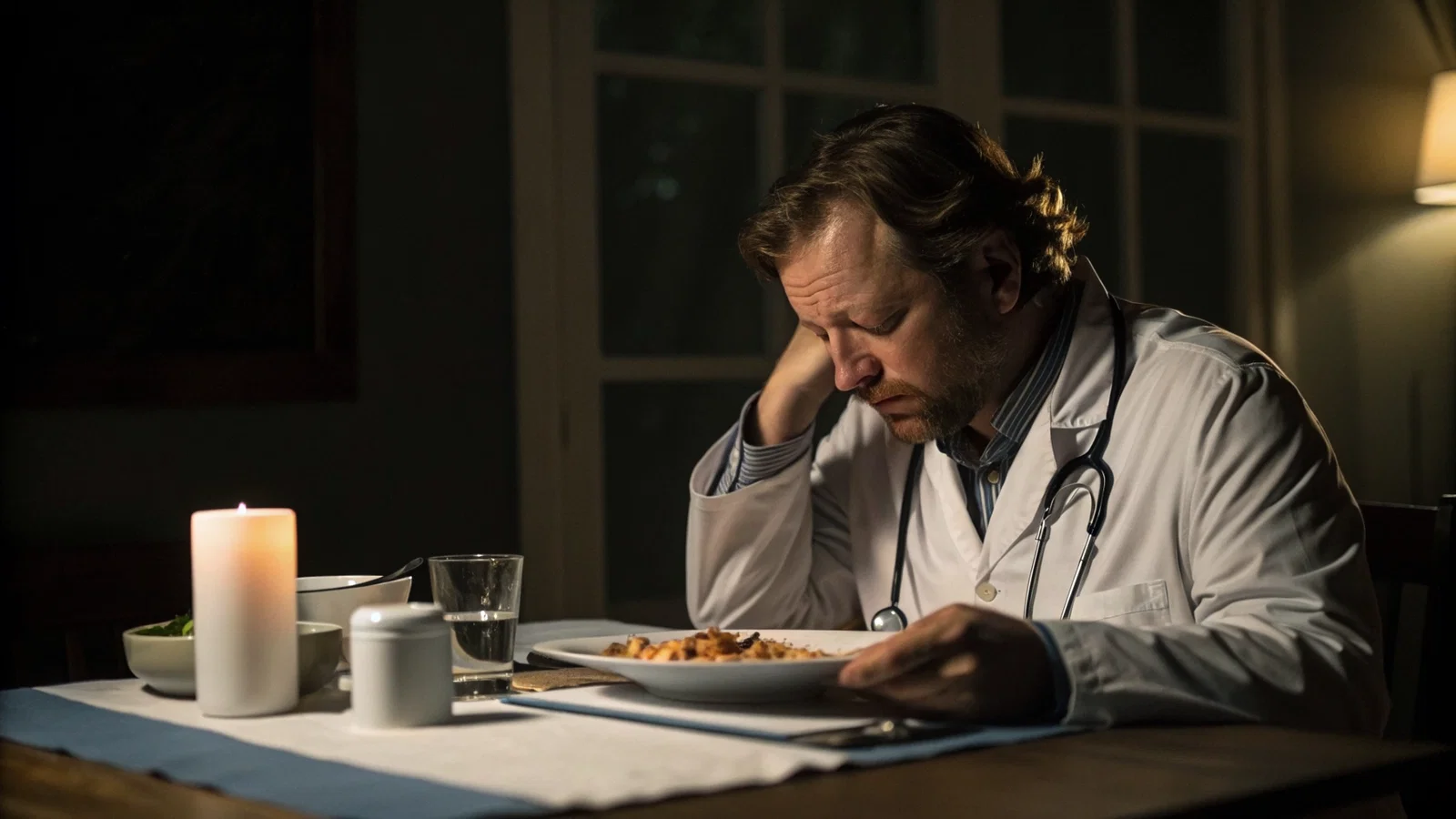
Have you ever stared at the ceiling at 2 AM, heart pounding, realizing the "lifestyle-friendly" specialty you bled for might actually be a trap?
I do this every single night. You spend years grinding through Step exams, kissing up to attendings, and sacrificing your twenties just to match into a supposedly "chill" outpatient field. Dermatology, outpatient pediatrics, allergy, psychiatry. The holy grails of work-life balance. But then you start your sub-I or intern year, and the terrifying realization hits you like a freight train: choosing a so-called lifestyle specialty didn't magically cure burnout. It just changed the flavor of your misery.
I watch my attendings, people who supposedly have it all figured out, lugging their heavy laptops home every single night. Dr. Evans, our clinic director, literally brought his computer to his daughter's soccer game last month. I saw him charting on the bleachers while she was on the field. That image is burned into my retina. They preach about wellness in morning huddles while their eyes are glued to the EHR at 9 PM. It gives me this creeping, suffocating dread. If the people at the absolute top of the food chain can't escape the clinic's gravitational pull, what chance do I have?
It sparks this paralyzing fear that I picked the wrong residency track entirely. My career feels ruined before it even starts. I'm supposed to be enjoying my evenings, reading a book, or just staring at a wall in peace. But instead, I'm just pre-grieving the free time I know I'll never get back. I lie awake wondering if I should have just gone into surgery. At least surgeons leave the hospital when the operation is done. In the clinic, the work follows you home like a ghost.
Where Does All the Time Go? The Invisible After-Hours Shift
Protecting your time requires understanding how attendings in lifestyle fields actually design their week rather than trusting recruitment brochures.
Let's shatter the catastrophic myth of the 40-hour work week in modern medicine right now. It's a lie. A complete, unadulterated fairy tale they tell medical students to keep the pipeline full. When they say "9-to-5," they only mean the hours you are physically trapped in the exam room. They conveniently forget to mention the invisible after-hours shift that waits for you at home.
Look at that chart. Seven hours of actual patient care. That's the easy part. That's why we went to medical school. Then comes the endless nightmare of "pajama charting." You spend three hours clicking through drop-down menus, arguing with the EHR, and trying to justify your medical decision-making to a billing algorithm that doesn't understand human nuance.
And just when you think you're finally done, the inbox pings. Two more hours managing unread lab results, refilling meds, and answering patient portal messages. A patient messages you at 11 PM asking if their toe looks a little purple. Do you reply? If you don't, and it's early sepsis, you're doomed. If you do, you've just opened the floodgates for every other anxious patient on your panel. The constant panic of missing a critical potassium level in your inbox keeps me awake. What if I miss it? What if a patient crashes because I was trying to eat dinner?
Documentation debt is quietly stealing our weekends. You spend Saturday morning catching up on charts from Thursday because you ran 45 minutes behind seeing a complex new patient. What if I never catch up? What if the debt just compounds until I drown in it? I feel like I'm digging a hole with a plastic spoon, and the dirt just keeps piling up faster than I can throw it out.
Is Every Specialty Like This? Comparing the Worst-Case Scenarios
I am constantly paralyzed by comparison. I scroll through social media and see my friends who matched into radiology or pathology posting pictures of their weekend hikes and elaborate brunches. Are they actually sleeping? Are they really leaving work at work, or am I just suffering alone in my outpatient clinic? I obsessively analyze their lives, convinced they found the secret loophole I missed. I stalk their profiles looking for signs of exhaustion, desperate for validation that they're miserable too. It's toxic, I know. But the anxiety makes me do it.
It makes me desperately evaluate if transitioning to alternative settings is my only escape hatch. Maybe I should ditch traditional clinical practice entirely. Telehealth sounds like a dream until you realize you're just doing the exact same EHR clicking from your couch instead of a hospital basement. Concierge medicine? Sure, if you want to be on call 24/7 for wealthy patients who text you at midnight about their mild heartburn. I've seriously considered just becoming a pharmaceutical rep. At least they get company cars and don't have to chart. But then I remember I spent $300,000 on medical school and I actually want to help people. It's a toxic trap with no visible exit.
The nagging doubt that keeps me staring at the wall is that no matter what field I match into, the administrative burden will always crush my soul. The EHR doesn't care if you're a surgeon, a psychiatrist, or a dermatologist. The click-burden is universal. The insurance prior authorizations are universal. I feel like I'm running on a treadmill that's slowly tilting upward, and I'm just waiting for the moment I finally slip and break my neck. There is no safe haven. There is only the inbox.
How to Stop the Bleeding: Emergency Life-Hacks Before I Burn Out Completely
I can't just sit here and spiral. I need actionable strategies to reclaim my evenings before residency applications lock me into a decade of misery. If I don't fix this now, I'll be a zombie by the time I'm an attending. I refuse to let the system win.
First, we need hard boundaries with the electronic health record. Can I actually shut my inbox off without getting fired? I've started asking my senior residents this, and the answer is a terrifying "it depends." But you have to try. I'm learning to set strict auto-responders on the patient portal after 6 PM. If it's a true emergency, they need to go to the ER, not message me about their blood pressure meds. When I try to close my laptop at 5:30 PM, the clinic manager sometimes gives me this look. Like I'm committing a crime. But I have to protect my peace, or I'll have nothing left to give.
Second, workflow optimization templates. I used to type out every HPI from scratch like an idiot, trying to make every note a masterpiece. Now, I aggressively use smart phrases and dot phrases. If I don't template my life, I feel like a total failure every time I fall behind. I have a template for everything: normal physicals, medication refills, standard follow-ups, normal EKGs. It shaves maybe 45 seconds off a note, but when you see 25 patients, those seconds buy you your evening back.
You also have to chart in the room. I know, the patient is staring at you, and it feels incredibly rude. But the alternative is staying until 8 PM. I look them in the eye, explain I'm documenting in real-time so I can give them my full attention later, and I type while they talk. It's awkward at first. Some patients hate it. But it's the only way I survive. I'd rather have a slightly awkward 15 minutes than a three-hour pajama charting session.
The Brutal Truths You Need to Accept
- Even the most "lifestyle-friendly" specialties suffer from severe administrative creep that extends the workday indefinitely.
- Pajama charting and electronic inbox management are the silent killers of resident and attending well-being.
- Setting rigid technological and operational boundaries is not optional if you want to survive clinical practice without burning out.