
The myth that “if you want balance, you can’t do surgery” is dangerously oversimplified.
You’re not crazy for loving the OR and also wanting to see your family, sleep, or have a hobby that isn’t just “trying not to cry in the call room.” Those things are not mutually exclusive. But they are in tension, and pretending otherwise is how people end up miserable and burned out.
Let’s talk about what this actually looks like, without the sugarcoating or the doom.
The Core Fear: “If I Choose Surgery, I Lose My Life”
You know the script:
You tell someone you’re interested in surgery and they hit you with the Greatest Hits:
- “Hope you don’t like sleeping.”
- “Say goodbye to your 20s.”
- “You can have a family or be a surgeon. Pick one.”
- “You think you’ll be different? Everyone thinks they’ll be different.”
And then you go home and spiral:
What if they’re right?
What if I match, grind for 7+ years, and realize I’ve built a life I hate?
What if I become that bitter attending who tells students not to do this?
Here’s the uncomfortable truth: surgery can wreck your life if you walk into it blindly, romanticize the grind, or pick the wrong niche for your personality.
But here’s the other truth nobody yells as loudly: there are surgeons, right now, who:
- See their kids regularly
- Have hobbies that aren’t “gym when I’m not post-call”
- Take real vacations
- Don’t live at the hospital once they’re out of residency
They didn’t get there by luck. They got there by being surgical about their choices.
Reality Check: What the Hours Actually Look Like
Let me be blunt: if you’re asking, “Is surgical residency lifestyle-friendly?” the answer is no. It’s not. For any subspecialty.
Residency is the worst version of surgical life, not the permanent version. But you need to know what you’re signing up for.
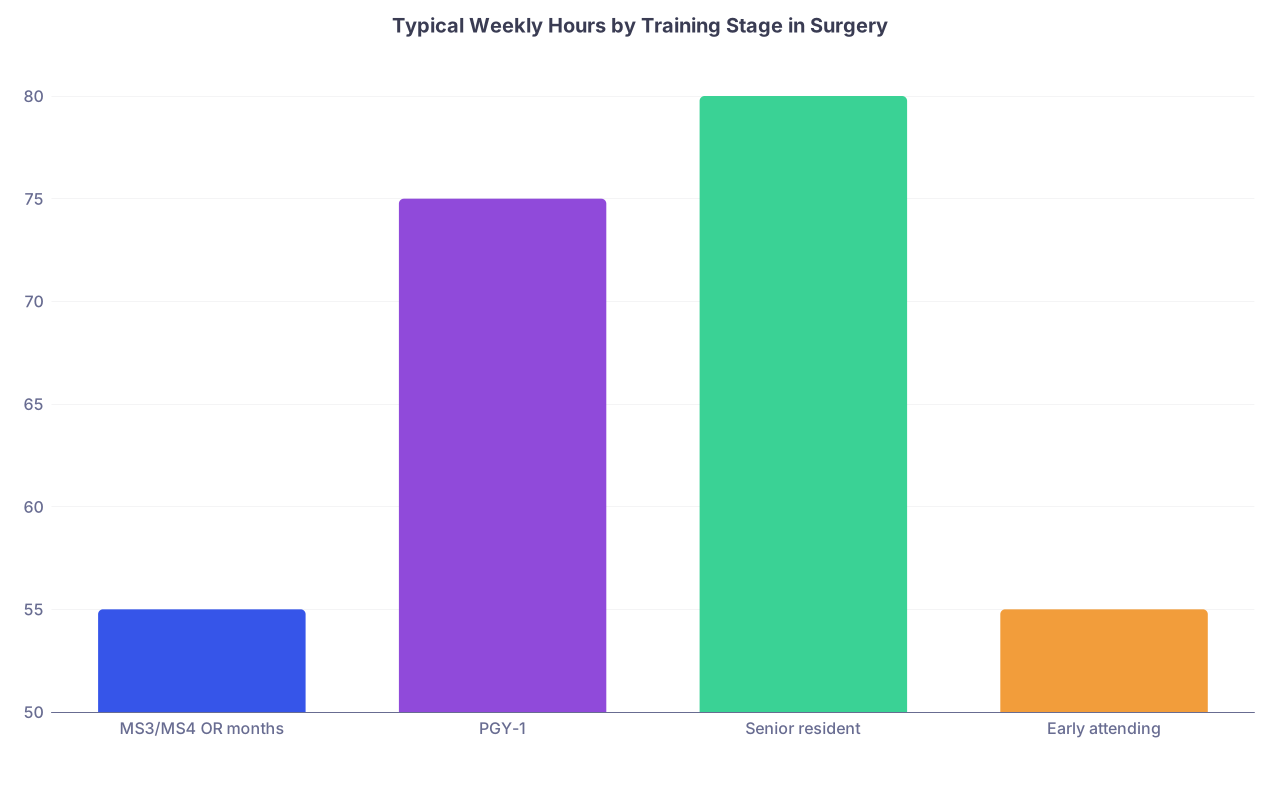
| Category | Value |
|---|---|
| MS3/MS4 OR months | 55 |
| PGY-1 | 75 |
| Senior resident | 80 |
| Early attending | 55 |
These are averages. Some weeks will be better, some will be ugly.
MS3/MS4 on surgery:
- You’re there early for pre-rounding, leave after cases, chart at home because the EMR hates you.
- The hours feel extra brutal because you have no control and zero efficiency.
Residency (general surgery, ortho, neurosurg, ENT, etc.):
- 70–80 hours is not an exaggeration at many programs.
- Some rotations will flirt with the 80-hour limit in a very “creative” way.
- Nights, weekends, q3/q4 call. You are not in control.
Attending life:
- This is where the specialty and practice type you choose matter a ton.
- A community breast surgeon working 4 days a week is not living the same life as a Level 1 trauma surgeon taking q2 trauma call.
If someone tells you, “Once you’re an attending it’s chill,” that’s too vague. Some surgery attendings have surprisingly manageable lives. Some are wrecked and aging 10 years per call block.
So the question you should really be asking isn’t “Is surgery lifestyle-friendly?”
It’s: “Which flavors of surgery leave room for a balanced life once training is over?”
The Most Lifestyle-Friendly Surgical Paths (Relatively Speaking)
If you love the OR but your chest tightens when you hear “q2 trauma call,” you’re not doomed. But you need to be strategic.
Here’s a rough comparison that people actually talk about in break rooms, not brochure-level nonsense:
| Field | Training Length (yrs after med school) | Typical Lifestyle Potential* |
|---|---|---|
| General Surgery | 5 | Highly variable |
| Breast Surgery (fellow) | 6 (5+1) | Often good |
| Colorectal Surgery | 6 (5+1) | Moderate |
| Surgical Oncology | 7 (5+2) | Variable |
| Plastics (integrated) | 6 | Often good (depending) |
| ENT | 5 | Moderate to good |
| Ophthalmology | 4 | Generally very good |
| Ortho | 5 | Highly variable |
| Urology | 5–6 | Moderate to good |
*Lifestyle potential = as an attending, in a well-chosen practice, after you stop saying yes to everything out of guilt.
Let me call a few of these out.
Ophthalmology: The “Did I Just Win?” Surgical Life
If you want surgery + very real lifestyle potential, ophtho is often the poster child.
- Shorter, more predictable OR cases.
- Loads of clinic. Most call is home call.
- Emergencies exist but it’s not trauma surgery at 3 a.m. every other night.
I’ve seen ophtho attendings who:
- Work 4 days a week
- Have dedicated OR days
- Rarely come in overnight
They still work hard. Residency still hurts. But the endgame can be genuinely balanced.

ENT, Plastics, Breast, and “Elective-Heavy” Surgery
Within more classic surgery-adjacent fields, certain niches are friendlier:
ENT:
- Mix of clinic and OR.
- Lots of elective cases (sinus surgery, ear tubes, thyroid, etc.).
- Lifestyle depends heavily on whether you’re doing big head & neck cancer cases at an academic center vs a community ENT-heavy clinic practice.
Plastics:
- Highly variable.
- Cosmetic-heavy private practice? You can often control your schedule and say no to insane call.
- Big reconstructive cases at academic hospitals? Different story.
Breast Surgery:
- Often clinic + elective OR.
- Emergencies are there (abscesses, bleeding, complications), but they’re not trauma-level daily chaos.
- Many breast surgeons I’ve seen had stable weekday schedules, occasional call, real weekends.
These are the people who show up at residents’ weddings and don’t look like they just survived a disaster zone.
General Surgery: It’s All About the Type of Practice
General surgery on its own isn’t automatically lifestyle poison. But it’s the most wildly variable.
You could be:
- A community general surgeon doing mostly elective hernias, cholecystectomies, colon resections, scoped stuff, with shared call and a decent schedule.
- A trauma/acute care surgeon at a Level 1 center, living in the hospital during your call weeks, constantly dealing with unpredictable chaos.
And within gen surg there are sub-niches where the OR is central but hours can be less insane in the right setting: bariatrics, minimally invasive, colorectal (sometimes), surgical oncology in certain practices.
The thing nobody tells you clearly enough: your future call schedule + practice model will shape your life much more than the generic label of “surgery.”
But What About During Residency? Am I Just Supposed to Suffer?
Here’s the dark thought you probably have but don’t say out loud:
“I could maybe handle a tough attending job if it meant good money and control… but I’m terrified of residency. I don’t know if I can survive 5–7 years of being exhausted and miserable.”
You’re not wrong to be scared. Surgical residency is a grind. Sometimes dehumanizing. And yes, some residents do burn out, switch specialties, or quietly lose huge pieces of themselves.
So no, you can’t make surgical residency “balanced” in the Instagram sense. But you can keep it survivable and protect your future self.
A few non-fluffy realities I’ve seen actually help:
You pick program culture over name brand.
The “prestige at all costs” places are often the ones quietly expecting 80 hours to be a suggestion. Residents there brag about suffering like it’s a badge of honor. I’ve watched those same people five years later, and a lot of them are just… tired. Some wish they’d gone to the “less shiny but more humane” program.
You protect something non-negotiable.
I don’t mean daily yoga and home-cooked meals. I mean one or two things that tether you to your identity:
- A weekly call with your sibling or partner
- Lifting 3x/week even if it’s 25 minutes
- Religious services when you can actually swing it
It sounds small. It’s not. It’s usually the difference between “I’m tired” and “I don’t recognize myself anymore.”
You accept that some months will be awful and that doesn’t mean you chose wrong.
ICU months. Trauma-heavy blocks. Those weeks where three attendings are out and the service is drowning. You will have stretches where you seriously Google “Can I switch specialties after PGY-2?” That doesn’t automatically mean you’re in the wrong field. It might just mean you’re in a brutal rotation.
Can You Have a Family, Hobbies, and Surgery?
This is the fear I hear most, especially from people who want kids or already have a partner:
“What if I do this and I’m a ghost in my own life? What if my kids barely know me? What if my partner resents me forever?”
Here’s the pattern I’ve actually seen:
Surgeons who end up with some version of balance:
- Choose practices with shared call and boundaries.
- Learn to say “no” to the endless creep of “just one more case, just one more committee.”
- Accept that they won’t be at every event, but they will be present at the important ones.
- Pair with partners who truly understand the deal and aren’t secretly hoping you’ll magically have a 9-5.
Surgeons who are absolutely wrecked:
- Try to be the hero for everyone: hospital, patients, partners, kids, extended family.
- Never say no to extra cases or committees because they feel guilty or scared of being seen as “weak.”
- Work at places that exploit that guilt.
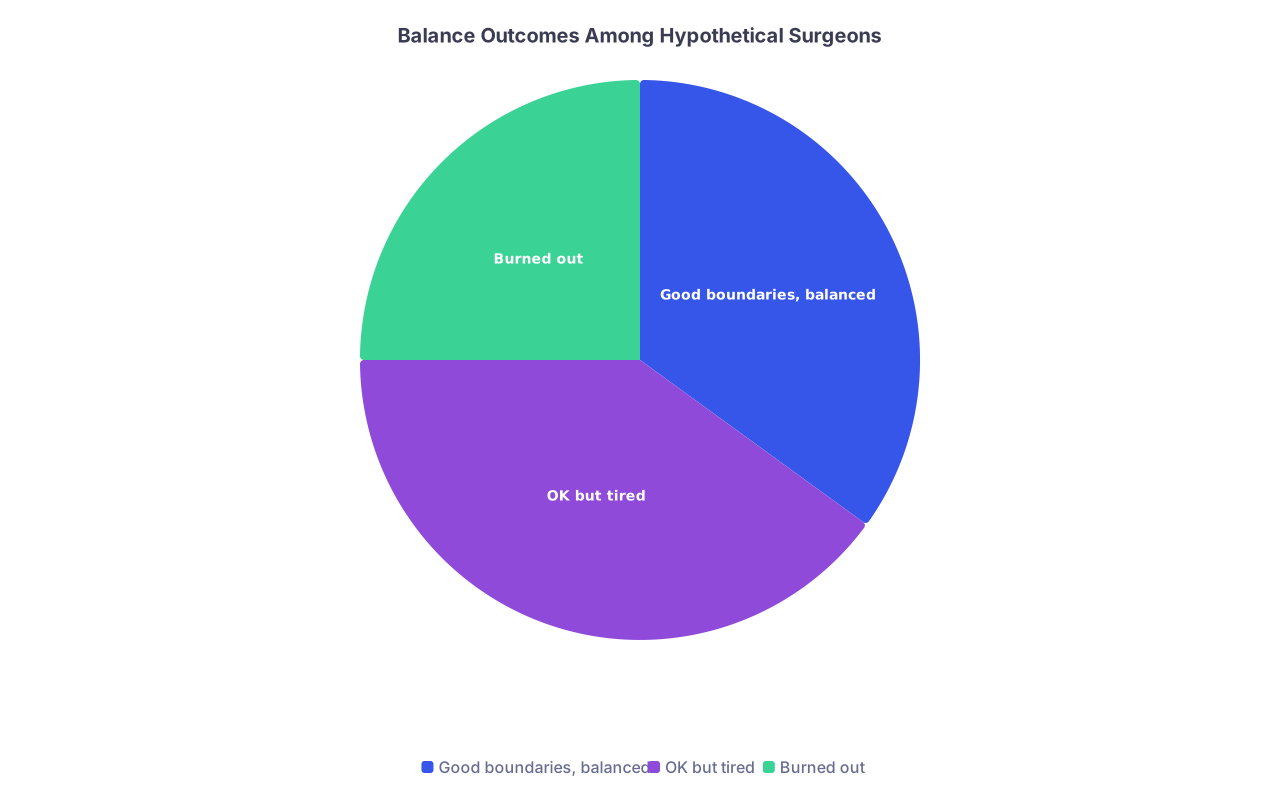
| Category | Value |
|---|---|
| Good boundaries, balanced | 35 |
| OK but tired | 40 |
| Burned out | 25 |
No, this isn’t a randomized controlled trial. It’s the pattern when you walk down the hall and actually talk to 20 surgeons honestly.
What You Should Be Watching for Right Now as a Student
You can’t fast-forward to attending life, but you can collect real data.
On your surgery rotations, instead of just asking, “Do you like surgery?” try listening for:
- Does this attending ever mention their life outside the hospital in a way that doesn’t sound like a joke?
- Do residents talk about sleep and food like mythical concepts, or do they actually leave sometimes?
- What’s the vibe at 6 p.m.? Are people furious they’re still there, or accepting because it’s not every night?
And ask pointed questions—not the fluffy “how do you balance surgery and life?” That invites fake answers. Try:
- “In the last month, how many nights did you get home by 7?”
- “If you could redo it, would you still pick this specialty and this practice setting?”
- “What would you warn your younger self about before choosing this path?”
Watch their face when they answer. That tells you more than the words.

The Ugly What-Ifs You’re Afraid to Say Out Loud
Let’s just drag them into the light.
What if I pick surgery and regret it?
It happens. People switch. People finish and then pivot into research, admin, industry, or less clinically intense roles.
But here’s the key: the people who regret it most are usually the ones who:
- Chose for prestige or ego.
- Ignored every red flag during rotations because “I’ll be different.”
- Thought loving the OR was enough to carry them through everything else.
Loving the OR is necessary. It’s not sufficient. You also need:
- Tolerance for chaos and uncertainty.
- Willingness to accept that your time is not fully yours for several years.
- At least some adrenaline-seeking, delayed-gratification wiring.
If all of that sounds like a foreign language to your brain, that’s data.
What if I don’t pick surgery and regret that?
That regret can be worse. I’ve met hospitalists who still sneak into the OR to “watch a case for a minute” and then stand there way too long, clearly heartbroken.
If you know you feel truly alive in the OR—time disappears, your brain locks in, you don’t resent the long day the same way—that’s not something to dismiss lightly.
Can Surgery Ever Fit a “Balanced Life”?
Yes—with the biggest asterisk in the world.
- Not balanced in your 20s the way your non-med friends are.
- Not always balanced during residency.
- Not balanced every week, even as an attending.
But balanced over the arc of a career? With the right subspecialty, the right practice, and the ability to set actual boundaries?
Yes. People are doing it. Right now. Quietly. They’re just not on social media screaming about how content they are.

| Step | Description |
|---|---|
| Step 1 | Love the OR |
| Step 2 | Consider lifestyle surgical fields like ophtho |
| Step 3 | Explore core surgical residencies |
| Step 4 | Elective heavy niches like breast or plastics |
| Step 5 | Trauma or complex onc |
| Step 6 | Choose group with shared call |
| Step 7 | Choose center that respects limits |
| Step 8 | Balanced attending life possible |
| Step 9 | Can tolerate tough residency? |
| Step 10 | Value more lifestyle or acuity? |

If you love the OR and fear the hours, you’re not weak. You’re paying attention.
The goal isn’t to find a specialty with zero sacrifice. That doesn’t exist. The goal is to choose the sacrifices you can actually live with—and to remember that residency is a brutal chapter, not your whole story.
FAQ (Exactly 5 Questions)
1. If I care a lot about lifestyle, should I just avoid surgery altogether?
Not automatically. If you like procedures and precision but want more control over your time, fields like ophthalmology, some ENT practices, some plastics, and breast surgery can be solid compromises. The key is to honestly assess whether you can handle a few very tough years in residency for the chance at a significantly better attending life.
2. Is it realistic to have kids during surgical residency?
People do it every year. It’s hard. You will miss some things. Your partner and support system matter a lot. Programs vary wildly—some are supportive about parental leave and schedule adjustments; some are performatively “supportive” and practically useless. When you interview, ask residents privately how pregnancy/parenthood has been handled recently, not just what the written policy says.
3. What if I’m not naturally “hardcore” but I still love the OR?
You don’t have to be a stereotypical “savage” surgery resident to succeed. But you do need resilience, some tolerance for pain (the metaphorical kind), and the ability to function when tired. If you dread every early morning or long day on your surgery rotation, that’s a red flag. If you’re tired but weirdly fulfilled after a long OR day, that’s a green flag.
4. Are academic surgery jobs always worse for lifestyle than community ones?
Usually they’re more demanding: research, teaching, committees, bigger cases, more complex patients. But community jobs can also be brutal if call is frequent and poorly distributed. General trend: if you want balance, a well-structured community or private group practice with shared call and lots of elective work is often better than a big-name academic center where “work-life balance” is mostly a PowerPoint slide.
5. How do I know if it’s just a bad rotation vs surgery not being right for me?
Look at patterns, not a single month. If one malignant attending or one awful service makes you miserable, that’s one thing. If multiple different teams, at different hospitals, all leave you dreading the OR and fantasizing about clinic instead, that’s bigger. Pay attention to your internal reaction on OR days vs clinic days. Where do you feel most like yourself?
Key points:
- Surgery and a balanced life can coexist, but only if you’re strategic about subspecialty, practice setting, and boundaries—and you survive a rough residency chapter.
- Loving the OR isn’t enough; you need a personality that can tolerate delayed gratification and heavy training years without losing yourself completely.
- If you’re scared, that’s good. Use the fear to ask harder questions, choose more carefully, and build a surgical career that’s sustainable instead of cinematic.