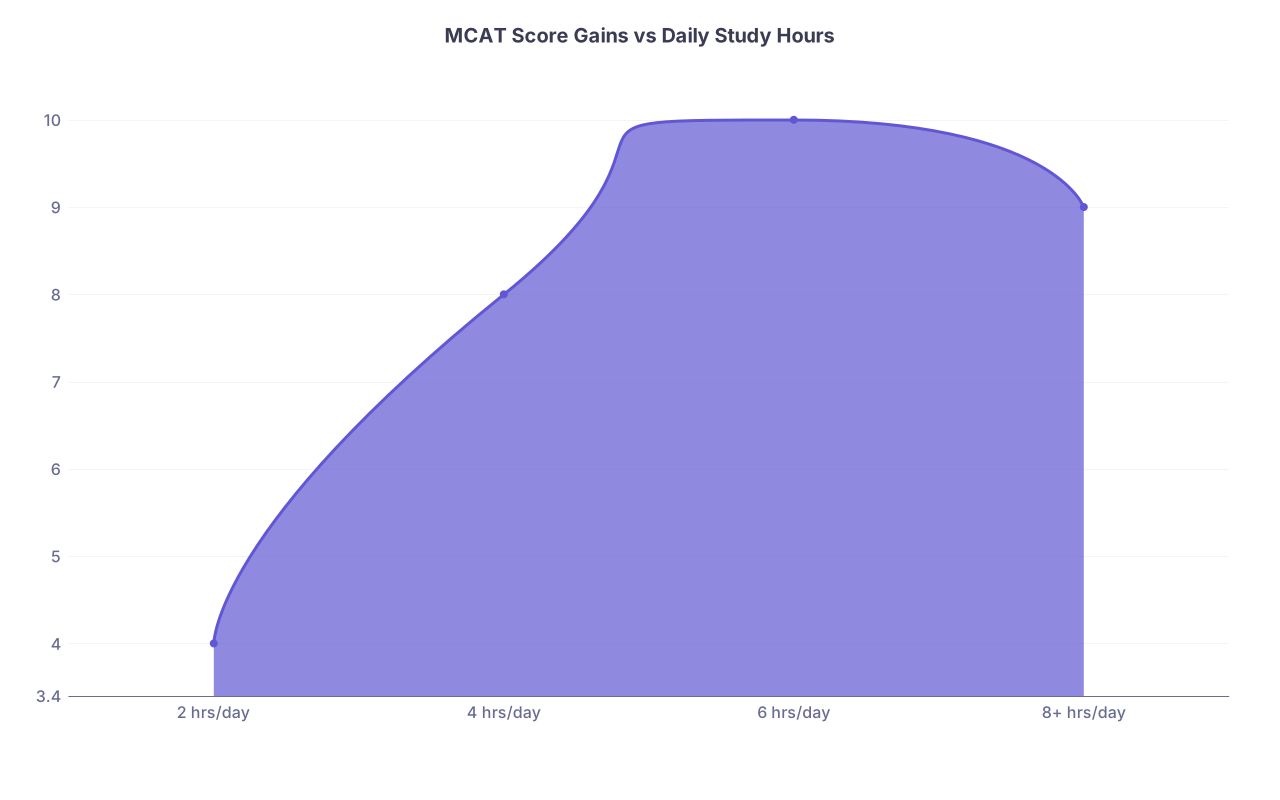
Your focus doesn't randomly die in Section 3. It crashes there on purpose. Or rather, your biology designed it to.
That wall you hit right as Biological and Biochemical Foundations starts, slow reading, re-reading the same sentence, dumb mistakes on stuff you actually know, that's not a personal flaw. It's a predictable failure point built into a 7.5-hour test.
Here's what's actually happening and how to train for it.
The Science of Mental Fatigue: Why Section 3 Is the Danger Zone
The MCAT order is brutal by design: Chem/Phys (95 min) → 10-min break → CARS (90 min) → 30-min lunch → B/B (95 min) → 10-min break → Psych/Soc (95 min).
By the time you start B/B, you've already done 185 minutes of high-stakes reasoning. About 3.5 hours if you include check-in and instructions. Your brain has been sprinting since 8 a.m.
Three things collide right there:
1. Glycogen depletion. Your brain is 2% of body weight and burns 20% of your glucose. Sustained executive function drains it fast. 2. Sustained attention decay. Research on vigilance tasks shows a sharp drop after 90-120 minutes. The MCAT asks you to do it for twice that, with no real rest. 3. Decision fatigue. You've made ~150 judgment calls already. Every passage, every eliminated answer costs glucose and willpower. That's ego depletion, your mental battery for self-control and focus is just lower.
B/B is the perfect storm. You're past the "two-hour wall," you just came back from lunch where your blood sugar spiked and crashed, and the content is dense, detail-heavy, impossible to fake.
I've seen this happen to 520+ scorers. Section 1 and 2 look great. Section 3? 5-7 point dip in practice. Not because B/B is harder for them. Because their stamina protocol is trash.
Glucose, Sleep, and Circadian Rhythms: The Fuel Behind Focus
Your prefrontal cortex, the part that holds a pathway in working memory while you parse an experiment, is a glucose hog. And a sleep snob.
Pull an all-nighter before a full-length? Your scores will lie to you. Sleep deprivation hits the prefrontal cortex first. You'll feel okay in C/P on adrenaline, then fall off a cliff in CARS and B/B.
If your practice scores are stalling despite endurance training, explore strategies for how to break through an MCAT plateau by refining your approach.
Same with circadian rhythm. Most MCATs start at 8 a.m. If you woke at 6:30, your natural circadian dip hits 2-4 hours later. Guess what time B/B starts? Roughly 12:30-1:00 p.m. Your body wants a nap. The test gives you amino acid Km graphs.
This isn't woo. It's measurable.
Fuel it right:
- Sleep: 7.5-8.5 hours for the 3 nights before, not just the night before. Consistent wake time. No "catch-up" sleep, it doesn't work.
- Morning meal: Tested carbs + protein + fat, 90-120 minutes before. Think: oatmeal + eggs + peanut butter. Not a sugar bomb. Not just coffee.
- Don't fast through. Brains don't run well on willpower and black coffee.
That dip at B/B is the critical depletion zone. You have to plan nutrition to flatten it, not accept it.
Psychological Barriers: Anxiety, Burnout, and the 'Wall'
The physical drop triggers a mental spiral. And that spiral makes the physical drop worse.
Here's the typical B/B loop: You hit a hard experimental passage. You notice you're slow. You think, "I'm losing focus." Anxiety spikes. Cortisol goes up. Working memory shrinks. You re-read. Time pressure builds. Now you're thinking, "If I bomb B/B, med school is gone." Classic catastrophizing.
Novice test-takers fight the thought. Experts expect it.
For more on maintaining momentum, check out tips on avoiding common MCAT preparation mistakes that can undermine your progress.
The difference isn't intelligence. It's reframing. A novice says, "I can't focus, I'm failing." An expert says, "There's the dip. Right on schedule. This is where I win points because everyone else quits."
You need a script ready before test day. Not vague positivity. An actual line.
Try: "Of course I'm tired. Everyone is. Focus for the next passage only."
Training Your Brain: Building Test-Day Endurance Through Practice
You don't build endurance by doing more content review. You build it by doing longer, more boring, more realistic practice.
Progressive overload. Same principle as lifting.
Phase 1: Build Base (Weeks 1-2) One full-length per week. Full timing. Take the breaks, but use them however you want. Goal is just finishing without mental collapse.
Phase 2: Increase Load (Weeks 3-4) Two full-lengths per week. Cut breaks to 7 minutes and 20 minutes. Add distractions, library, not silent bedroom. Practice refocusing.
Phase 3: Simulate Real (Weeks 5-6) One full-length per week, but exact simulation. Mask on. Earplugs in. Same snacks. Same caffeine dose at same time. No phone during breaks. Ever.
Phase 4: Peak Stamina (Weeks 7-8) This one sucks, but works. Do a full-length Saturday morning, review lightly, then do another full-length section (B/B + P/S) Sunday morning under fatigue. Or do two full-lengths in two days. You teach your brain that B/B doesn't get to be an excuse even when tired.
Non-negotiables:
- 6-8 total full-lengths minimum. Less than that? You haven't trained stamina.
- Focus drills: Twice a week, do 90-minute blocks of passages with zero breaks, no standing, no water. Watch your mind wander and pull it back. That's the rep.
- Review fatigue pattern, not just score. Where did you miss easy ones due to focus? That's data.
In-the-Moment Strategies: What to Do When Your Focus Wanes
You'll still lose focus on test day. The goal isn't perfect focus. It's fast recovery.
When you feel the fog in B/B:
- 10-second micro-break between passages. Don't roll into the next one. Close eyes. Drop shoulders. Three breaths, in 4, hold 2, out 6. Then eyes to next passage.
- Eye rest. Look 20 feet away for 5 seconds every 20 minutes. Your ciliary muscles are fried from screen staring. It helps more than you think.
- Self-talk script. Use it out loud in your head: "Reset. Next passage. I know this stuff." Cheesy? Works anyway.
- Move strategically. If you're stuck on question 46 for 90 seconds, you're burning glucose you need for 51-59. Flag, move, come back. Momentum beats perfection in B/B.
During breaks, do not sit. Blood pooled in your chair is blood not in your brain.

Pacing and Breaks: Maximizing the MCAT's Scheduled Breaks
You get 10 / 30 / 10. Use them like a Formula 1 pit stop, not a gossip session.
Official structure: C/P (95 min) → 10 min → CARS (90 min) → 30 min lunch → B/B (95 min) → 10 min → P/S (95 min)
What kills you during breaks: Checking your phone, talking to other testers about answers, doom-scrolling, eating a huge greasy meal.
Sample routine that actually restores:
- First 10-min: Bathroom first, always. Then 150-200 cal fast carbs + water. Banana + trail mix. Walk hallway length twice, roll neck/shoulders. No phone.
- 30-min lunch: Protein + complex carbs + small fat. Turkey sandwich + apple + nuts is ideal. Eat half now, half later if you're nervous. Walk 3-4 minutes outside if allowed. Breathing. Eyes closed 60 seconds. Review NOTHING.
- Last 10-min: Light snack if needed, water, bathroom, movement. Splash cold water on face. Quick mental reset: "P/S is retrieval, not problem solving. Finish strong."
Eat what you trained with. Nothing new on test day. That's how you get a stomach cramp during B/B.

This isn't about tricks. It's about respecting that a 7-hour exam is an endurance event. Train your body, train your focus recovery, and use the breaks ruthlessly.
For a specific plan if your practice scores start to drop, see a 7-day damage control plan.
Do these three things this week:
- Schedule your next full-length as a full simulation, same wake time, same food, exact breaks, no phone.
- Pick your B/B reset script and your 10-second breathing pattern. Write them on a sticky note.
- Audit your sleep for the last 3 nights. Fix wake time before you add more study hours.
Stop blaming focus. Build it.