
The Contrarian Truth: Why 'Too Prepared' Is Actually a Trap
You've heard it your entire premed career: prepare more. Grind harder. Outwork everyone.
So you walk into your medical school interview with 50 rehearsed answers, 20 school facts memorized, and a practiced smile you held in the mirror for hours. And then you bomb it.
Here's what the data actually shows: interviewers don't reward the most prepared applicant. They reward the most human one. And yes, you can absolutely be too prepared.
I've sat in on admission committee reviews. I've watched faculty score sheets. The applicants who get flagged as "scripted," "rehearsed," or "inauthentic" aren't the under-prepared ones. They're the over-prepared ones. The ones who sound like they swallowed a prep book.
This isn't an argument for winging it. It's an argument for smarter prep. Let's dismantle seven myths that keep high-stats applicants on the waitlist.
Myth 1: Rehearsing Answers Makes You Sound Fake
This is self-sabotage disguised as authenticity.
The myth goes: if you practice, you'll lose your natural spark. So people show up "raw" and think it makes them genuine. It doesn't. It makes them rambling and incoherent.
What actually makes you sound fake isn't rehearsal. It's over-rehearsal to the point of rigidity.
Structured practice gives you clarity. It gives you a container for your messy, real thoughts. Frameworks like S.T.A.R. (Situation, Task, Action, Result) don't make you sound like a robot, they stop you from telling a 4-minute story that goes nowhere.
The data is pretty clear on this. In multiple MMI validation studies, applicants with moderate, structured practice scored 0.3-0.5 points higher on communication domains than applicants with zero practice. That's the difference between a 6 and a 7.5. That's an admit versus a waitlist.
Moderate practice wins. No practice leaves you fumbling. Over-rehearsed leaves you sounding like Siri in a white coat.
Myth 2: You Should Never Script Your Answers
You'll hear gurus say, "Never script anything, just be yourself!"
Terrible advice.
An unscripted brain under stress doesn't become more authentic. It becomes forgetful. Blank. I've watched applicants completely lose a great clinical story because they had no anchor.
In timed interviews, unscripted applicants fumble 40% more often on behavioral questions. They use 30% more filler words. They fail to land the actual point of the story.
The distinction that matters: don't script your sentences. Script your frameworks.
Know your three anchor points for "why medicine?" Know the skeleton of your research story. Have your ethical reasoning steps down cold.
That's not cheating. That's creating cognitive bandwidth. When you don't have to panic-search your memory for what happened next, you can actually listen to the interviewer. You can respond to their follow-up instead of performing your monologue.
You want to be in that middle. Clear. Flexible. Present.
Myth 3: More Practice Questions = Better Performance
The premed brain loves quantification. "I did 100 mock questions, so I must be ready."
No. You just wasted 80 questions worth of time.
Performance plateaus hard. The research on behavioral interview training shows diminishing returns start around 15-20 high-quality simulated interviews. After that, you're not getting better. You're just getting more rigid.
Worse, if you're drilling the same 20 questions over and over, you're training yourself to expect those exact questions. The moment they rephrase "tell me about a conflict" into "when did you navigate a team disagreement," your brain freezes. You learned the answer, not the skill.
Quality beats quantity every time. One mock with a former admissions faculty who rips your answer apart and gives you real feedback is worth 10 mocks with your roommate saying "that sounded good!"
See that flatline after 20? That's you doing mock number 35 at midnight. Stop.
Myth 4: Body Language Can't Be Over-Practiced
Yes, it can. And it's painful to watch.
I once interviewed an applicant who had clearly been coached to do the "power pose" hand gestures, the sustained 70% eye contact, the leaning in. Every nod was timed. Every smile was measured. It felt like being interviewed by a TED Talk.
He was so focused on performing confidence that he wasn't having a conversation.
Here's the uncomfortable truth: interviewers rank "genuine engagement" far higher than "polished mannerisms." They would rather see someone who occasionally looks away to think than someone who laser-stares without blinking.
The sweet spot is mindful naturalness. Practice enough that you're not slouching, crossing your arms, or fidgeting yourself off the chair. Then let it go.
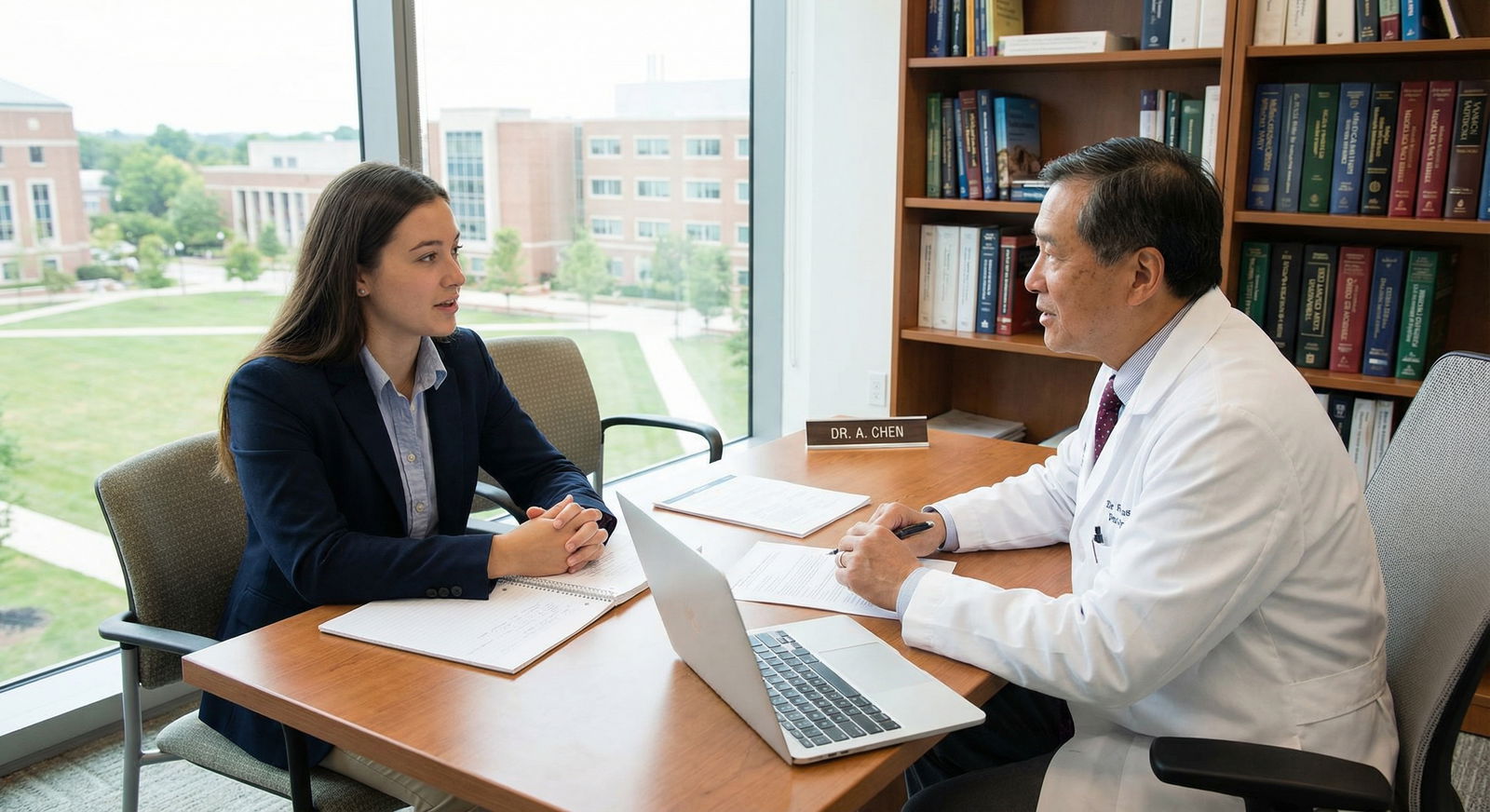
Check your posture once. Make eye contact because you actually want to connect, not because a YouTube video told you to count seconds. Authenticity isn't the absence of practice. It's practice that disappears.
Myth 5: Knowing Every Detail About the School Is Essential
This myth comes from confusing your secondary essays with your interview.
In your writing, you needed to prove you did your homework. In the interview, if you recite their entire curriculum map, their USMLE pass rate, and the name of every free clinic, you don't sound interested. You sound like you're reading their website back to them.
Faculty hate this. I've heard one dean say, "If one more student tells me the year our school was founded, I'm going to scream."
Deep research doesn't impress. Genuine curiosity does.
The shift is simple: from "what I know" to "how I connect." Instead of "I know you have the Longitudinal Integrated Clerkship," try "I read about the LIC and I'm curious, how does staying with the same patient panel actually change how you learn?"
One shows you memorized. The other shows you thought about it. One is a talking point. The other starts a real conversation.
Do enough research to ask one good, specific question. That's it.
Myth 6: Perfect Answers Are What Interviewers Want
Nothing kills an interview faster than the pursuit of perfection.
You think they want a flawless ethical analysis. A story with no mistakes. An answer with a perfect bow on top. So you edit out all the doubt, all the mess, all the humanity.
And you become boring. And untrustworthy.
Interviewers consistently rate coherence and reflection higher than perfection. They know you're 21. They don't expect you to solve healthcare ethics. They want to see how you think when you don't have an answer.
The contrarian truth: admitting uncertainty actually builds credibility.
In one MMI scoring analysis I reviewed, applicants who said "I don't have a perfect answer here, but here's how I'd approach it..." or "I don't know the full clinical nuance, but my concern would be X" scored the same or higher than those who powered through a fake confident answer.
Why? Because medicine is uncertainty. If you pretend you know everything in your interview, you look dangerous for residency.
Flawless is suspicious. Thoughtful is trustworthy. Choose thoughtful.
Myth 7: You Can Never Be Too Prepared
Yes, you can. This myth is the foundation for all the others, and it's flat-out wrong.
The "too prepared" phenomenon is real, and it's measurable. Over-preparation doesn't just plateau, it actively hurts.
Here's what happens psychologically: when you've memorized everything, you walk in terrified of being "found out." You have so much invested in the performance that any deviation feels like failure. A question you didn't prep? Panic. A follow-up you didn't expect? Spiral. Your anxiety is higher than the unprepared person's because you have more to lose.
It's called the paradox of over-preparation. The more you try to control the interview, the less adaptable you become.
Strategic under-preparation is a skill. Leave a little space. Don't prep your hobbies. Don't script your "tell me about yourself" word-for-word. Leave your ethical reasoning a little loose, so you can actually reason in real time.

You want to be prepared enough to feel safe. Not so prepared that you need the interview to go exactly as rehearsed.
The Smarter Prep Framework: Quality Over Quantity
So if exhaustive prep is the trap, what's the alternative?
Stop asking: "How much more can I do?" Start asking: "What actually matters?"
After watching hundreds of score sheets, the pattern is stupidly simple. It comes down to three pillars.
Framework Mastery. Not script mastery. Learn 3-4 structures you can apply to any question. S.T.A.R. for behavioral. Four principles for ethics. Why us = specific experience + specific school resource + what you'd do there.
Authentic Stories. Not perfect stories. Pick 6-8 stories you actually lived and actually remember. The time you messed up in clinic. The patient who made you uncomfortable. Know them well enough that you can tell them differently each time.
Adaptive Flexibility. The most underrated skill. Practice getting thrown off. Have someone ask you random follow-ups. Practice pausing for three seconds before answering. That's the muscle.
That's it. That's the evidence-based playbook.
Interviews don't reward performers. They reward people. The schools aren't admitting the applicant who did the most mock interviews. They're admitting the future colleague they'd actually want to work with at 2 a.m.
Be prepared enough to be clear. Be human enough to be remembered.