The obsession with giving “perfect” answers is ruining more medical school and premed interviews than low GPAs ever will.
You are not losing interviews because you didn’t memorize enough ideal phrases. You are losing them because you sound like everyone else. Polished. Safe. Forgettable.
And admissions committees are tired of it.
Let me be blunt: the neat, over-rehearsed, airtight answer you’ve practiced 30 times in the mirror is very often worse than the slightly messy, honest answer that shows real thinking, real uncertainty, and real personality. Not just in theory. In actual outcomes.
What interviewers actually score – not what you think they do
Most premeds believe interviews are scored like an exam: you get “points” for saying the “right” thing and lose points when you say the “wrong” one. So you chase perfect phrasing, safe opinions, and scripts.
That is not how structured interviews are evaluated.
Pull up the published rubrics from schools that bother being transparent: places like the University of Toronto, UBC, some US MD and DO programs that post MMI station descriptors, or the competency lists used in residency interviews. You see the same themes over and over:
- Self-awareness
- Ethical reasoning
- Communication style
- Insight into mistakes
- Capacity for growth
- Empathy and perspective-taking
Notice what is not on there: “gave the textbook answer,” “never hesitated,” “sounded 100% certain about everything.”
In fact, some programs literally train raters to penalize obviously rehearsed, formulaic answers. I’ve sat in those calibration sessions. Phrases like “sounds coached,” “generic,” “pageant answer” show up in the comments. That’s not my guess. That’s what actual interviewers write.
And there’s a practical reason. Perfect answers are nearly impossible to distinguish from each other. If every applicant tells the same “weakness that’s secretly a strength” story, the scores cluster and no one stands out. The applicant who admits a real weakness, owns it, and shows clear change? That person jumps off the page.
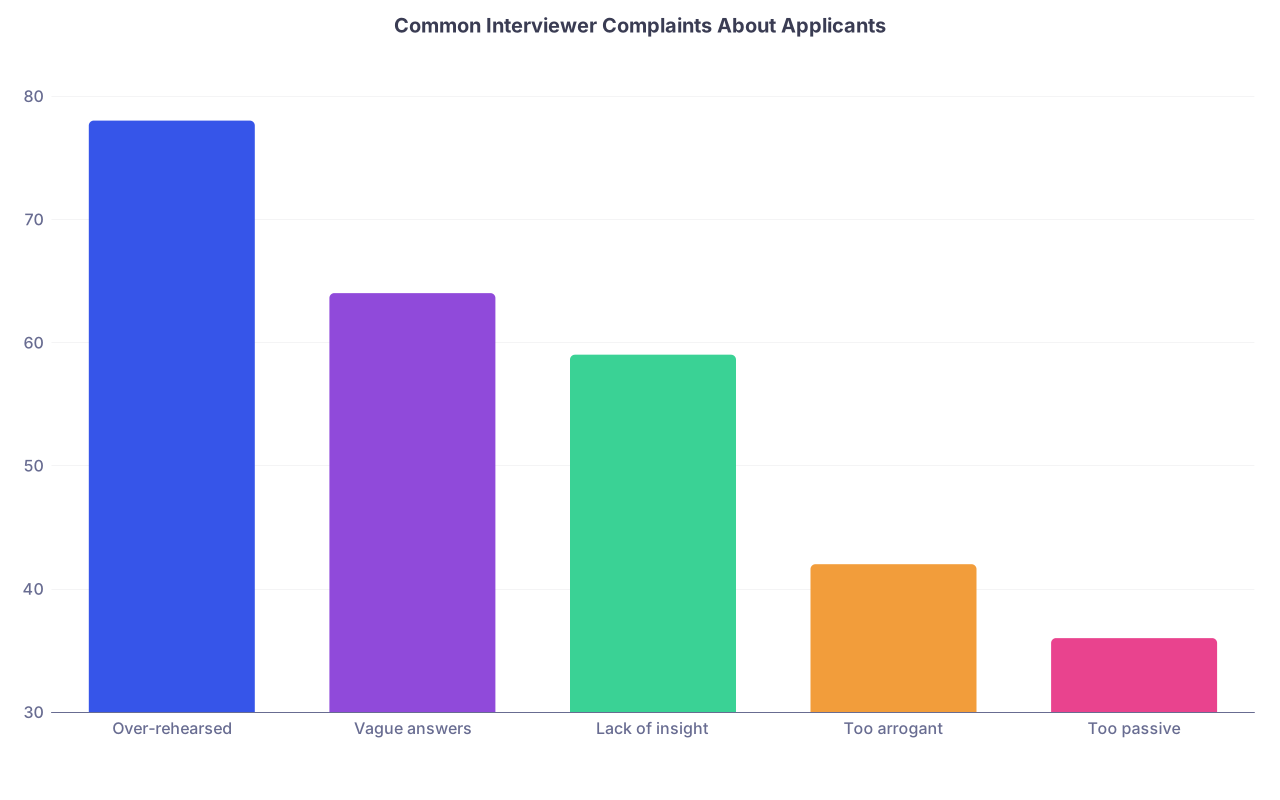
| Category | Value |
|---|---|
| Over-rehearsed | 78 |
| Vague answers | 64 |
| Lack of insight | 59 |
| Too arrogant | 42 |
| Too passive | 36 |
You want numbers? In multiple small studies of MMI and structured interviews, what predicts higher ratings is not “fluency” or “no pauses” but things like:
- Demonstrated reflection on past experiences
- Concrete examples rather than abstractions
- Internal consistency between answers and demeanor
None of that requires perfection. It does require honesty and specificity.
The “perfect answer” trap: what it looks like in real life
Let me show you how this goes off the rails in the actual room.
You get a question:
“Tell me about a time you made a mistake and what you learned.”
The “perfect answer” mindset does this:
You freeze for half a second. Then your training kicks in. You reach for a harmless “mistake” that isn’t really a mistake.
“I tend to care too much and sometimes take on more than I can handle. For example, I once volunteered for several leadership roles at once but I learned to better manage my time and now I’m very organized.”
Neat. Safe. Also utterly useless.
No concrete stakes. No actual consequences. No emotional reality. And no real evidence of growth.
Now contrast that with the messy but honest version:
“I mismanaged a research commitment last year and almost tanked the project timeline. I was trying to juggle MCAT prep, a part-time job, and lab work. I told myself I could handle it, didn’t ask for help, and ended up missing a key deadline for data entry. My PI was pretty blunt with me. It was uncomfortable and I was embarrassed. Since then, I’ve started doing two things differently: I say ‘no’ earlier, and I bring problems to my supervisor before they become disasters. I still don’t do this perfectly, but my last two semesters have been much more sustainable.”
Is it neat? No. You admit you screwed up and someone called you out.
Does it raise eyebrows? Maybe a little.
Does it sound like something an actual human would say and learn from? Absolutely.
And that’s exactly the point.
Interviewers are not looking for people who never mess up. They’re looking for people who mess up, own it, analyze it, and change. The “perfect” answer erases that entire arc.
Why messiness reads as competence in medicine
Here is the uncomfortable truth: medicine is ambiguous. Constantly.
Patients do not present like USMLE vignettes. Ethical issues are not clean. Diagnoses are probabilities, not certainties. Physicians who can’t tolerate uncertainty are dangerous. They over-test, over-treat, and under-communicate.
Interviewers know this. Many are clinicians who have watched shiny, hyper-polished trainees crumble the moment real complexity hits.
So when you treat interview questions as an exam with one “right” answer, you signal the exact opposite of what they actually want:
- You show you’re more concerned with looking competent than being thoughtful
- You avoid ambiguity instead of wrestling with it
- You prioritize self-protection over honesty and relationship
An applicant who says:
“Honestly, I’m not entirely sure what I would do first, and I see arguments on both sides. Let me walk you through how I’d think about it…”
often gets rated higher than the one who launches immediately into a flawless, memorized ethical algorithm. Because the first one is showing their actual reasoning process. The second one is showing Google.
Messy but transparent thinking beats polished recitation in any field that deals with uncertainty. Medicine is near the top of that list.
The data on authenticity, rapport, and impact
Let’s step away from med school for a second and look at broader research.
Communication studies have shown, repeatedly, that people trust communicators more when they admit minor uncertainty, change their minds with new evidence, or acknowledge tradeoffs. There’s work on “conversational humanness” and “self-disclosure” that shows higher rapport, especially in evaluative settings.
In OSCEs and standardized patient encounters, students are often graded up when they respond to difficult emotional content in a human way, not in a protocol-perfect robotic way. Saying something like, “I’m not sure I can fully understand what you’re going through, but I’m listening and I don’t want you to feel alone in this,” hits differently than, “I’m sorry you feel that way,” even though both technically “show empathy.”
Same in interviews.
Programs that use MMIs have reported that applicants who bring in specific, lived stories with emotional nuance are consistently rated as more empathetic and self-aware than those with vague, generic answers. And—this is key—those applicants are often less polished, more halting, more “imperfect” in delivery.
Messy does not mean rambling. It means real.
Real beats rehearsed.
What “messy but honest” actually looks like (without tanking your chances)
Do not misread me: “Be messy” is not permission to be sloppy, unprepared, or unprofessional. You still need structure. You still need to answer the question. You still need restraint.
“Messy but honest” looks like this:
You answer directly, even when the truth is not flattering.
You give concrete examples from your actual life, not fictionalized versions tuned for optics.
You include your thought process, not just the final conclusion.
You acknowledge nuance, not flatten it to avoid risk.
You admit limits: what you didn’t know then, what you’re still working on now.
Let’s run a few common question types and how the myth of the perfect answer ruins them.
1. “Why medicine?” – the scripted catastrophe
The stereotypical “perfect” answer:
“I’ve always wanted to be a doctor. From a young age, I was fascinated by science and helping people. During my shadowing and volunteering, I confirmed my passion for medicine and I’m excited to combine my love of science and service to make a difference.”
This is indistinguishable from 500 other answers. It tells me nothing about you.
Messy but honest:
“I did not grow up knowing I wanted medicine. In fact, I started undergrad thinking I’d go into engineering because I liked problem-solving and building things. The pivot happened during my second year when my grandfather had a stroke. I watched physicians explain complex ideas to a scared, stubborn man who hated hospitals. One neurologist in particular sat at eye level and didn’t sugarcoat anything, but he also didn’t make my grandfather feel stupid. That combination of technical skill and communication hit me hard. I started shadowing in neurology after that, then worked as a medical assistant in a clinic. I still like building systems and solving problems, but now I want to do it with patients, not just machines.”
Not perfect. A little long. But actually about you.
2. “What’s your biggest weakness?” – the fake humility show
The “perfect” answer:
“I’m a perfectionist. I tend to hold myself to very high standards and sometimes spend too much time on details, but I’m learning to balance that.”
Again: empty calories.
Messy but honest:
“I procrastinate on tasks that feel ambiguous or emotionally uncomfortable. I saw this especially when I had to call families as a hospice volunteer; I’d find reasons to reorganize the supply closet instead. I’m not proud of that. What helped was breaking down the call into a script for the first 30 seconds and preparing before each shift with the nurse. I’m better now, but I still catch myself avoiding certain tasks and I’ve started labeling that in the moment instead of pretending it’s ‘being busy.’”
This gives an interviewer something to work with. You identified a real behavior. You showed context. You demonstrated specific strategies.
And yes, a few applicants will read this and think, “But won’t they think I’m weak?” No. They’ll think you’re unusually self-aware for someone at your stage.
| Style | How It Sounds | Common Interviewer Reaction |
|---|---|---|
| Scripted-perfect | Polished, generic | “Coached, not memorable” |
| Slightly messy | Pauses, real details | “Genuine, reflective” |
| Confessional-dump | Oversharing, disjointed | “Boundary issues, unfocused” |
| Balanced-honest | Specific, owned, concise | “Mature, strong candidate” |
3. Ethical questions – where fake perfection is obvious
If you get an ethical scenario and immediately launch into a textbook four-principles mini-lecture, most medically trained interviewers will clock it.
Question:
“A 14-year-old wants birth control but doesn’t want her parents to know. What do you do?”
Perfect answer version:
“I would respect patient autonomy, consider beneficence and non-maleficence, and also think about parental rights. I would explain confidentiality, assess maturity, and consult guidelines to balance everyone’s interests.”
Sounds like someone’s ethics worksheet. Does not show how you think when your stomach drops and you have 10 minutes and real humans in front of you.
Messy but honest:
“I’d feel a real tension here between respecting her developing autonomy and recognizing that parents are usually central in teens’ lives. Since I’m not yet a physician, I don’t know every legal detail, but I do know many jurisdictions allow confidential reproductive care for minors. So I would start by making sure she understands what confidentiality actually means in that clinic, assess risks like coercion or abuse, and probably try to explore her relationship with her parents. Ideally, I’d help her think through whether there’s a safe way to involve them later, but I wouldn’t reflexively disclose without understanding the law and clinic policy. I’d want supervision from my attending in this situation.”
You admit your limits. You walk through competing values. You show deference to actual law and supervision. That’s competent.
The real skill: controlled vulnerability
The people who do best in interviews are not the ones who “say whatever comes to mind.” That’s chaos.
The winners are the ones who’ve practiced how to be honest without oversharing. Call it controlled vulnerability.
You can talk about failure without turning the interview into therapy. You can show emotion without collapsing. You can admit uncertainty while still sounding like someone who can function under pressure.
The myth of the perfect answer pushes you to strip out everything human and leave only clean, safe, dead language. Controlled vulnerability brings just enough of your real mind and real life into the room to make you memorable—and trustworthy.

| Step | Description |
|---|---|
| Step 1 | Get Question |
| Step 2 | Reach for memorized script |
| Step 3 | Generic, safe, forgettable answer |
| Step 4 | Pause and think |
| Step 5 | Pick real example |
| Step 6 | Share specific details |
| Step 7 | Show reflection and growth |
| Step 8 | Default Reaction |
How to retrain yourself before interview day
If you’ve been marinating in “perfect answer” culture from premed forums, YouTube coaches, and those dreadful “Top 50 Interview Answers” PDFs, you’ll need to actively unlearn some things.
Three practical drills that actually work:
The 10-second honesty pause
When you practice, force yourself to pause 5–10 seconds after hearing the question. No speaking. Just thinking. Get used to the discomfort of that silence. It’ll keep you from reflexively spitting out memorized lines.The “could I write this in my diary?” test
After you answer, ask: “If I wrote this exact story in my journal, would I be slightly embarrassed by how fake it sounds?” If yes, you’re scripting, not speaking.The one-level-deeper rule
For every story you tell, push one level deeper than your first instinct. Not just “I learned time management,” but how you actually changed your behavior in the following weeks. Not just “I was stressed,” but what that looked like in your day-to-day life.
You’re not throwing preparation out the window. You’re preparing your mindset and honesty, not just your lines.
When “messy” goes wrong – and how to avoid that
There is a line, of course.
Messy but honest is not:
- Trauma dumping unedited stories that leave the room emotionally flooded
- Ranting about your bad professor, unfair grading, or terrible advisor
- Bragging about “breaking rules for the right reasons” like it’s a movie
- Turning every question into a confessional about your impostor syndrome
If your answer makes the interviewer worry about your boundaries, stability, or professionalism, you’ve crossed into the wrong kind of messy.
A good litmus test:
Would a mature attending physician you respect nod at your answer and think, “That’s honest and appropriate,” or would they feel protective or uncomfortable?
You can keep it real and still keep it professional. That’s the balance.
Stop aiming for flawless. Aim for believable.
Your competition isn’t the mythical applicant who has a perfect answer to every question. That person doesn’t exist. The real competition is the sea of very similar, very polished, very bland applicants who all sound like they read the same Reddit thread the night before.
You do not beat them by sounding more like them.
You beat them by being the one person in the room who sounds like a real future colleague, not a PR statement.
Years from now, you won’t remember the exact wording of your answers, or the one question where you hesitated too long. You’ll remember whether you walked into those rooms trying to impress people with perfection, or trying to connect with them as a flawed but honest human being. The second one is much harder to fake—and much harder to forget.