The biggest mistake premeds make is waiting for an interview invite before preparing for interviews. By then, you are already late.
You prepare from the day you hit “submit” on your primary, not from the day you get your first “We are pleased to invite you…” email. Let me walk you through what you should be doing week by week so that by the time that first invite lands, you are dangerous—in a good way.
Big-Picture Timeline: Primary to First Invite
At this scale, think in phases, not random tasks. Here is the rough pattern most premeds actually experience:
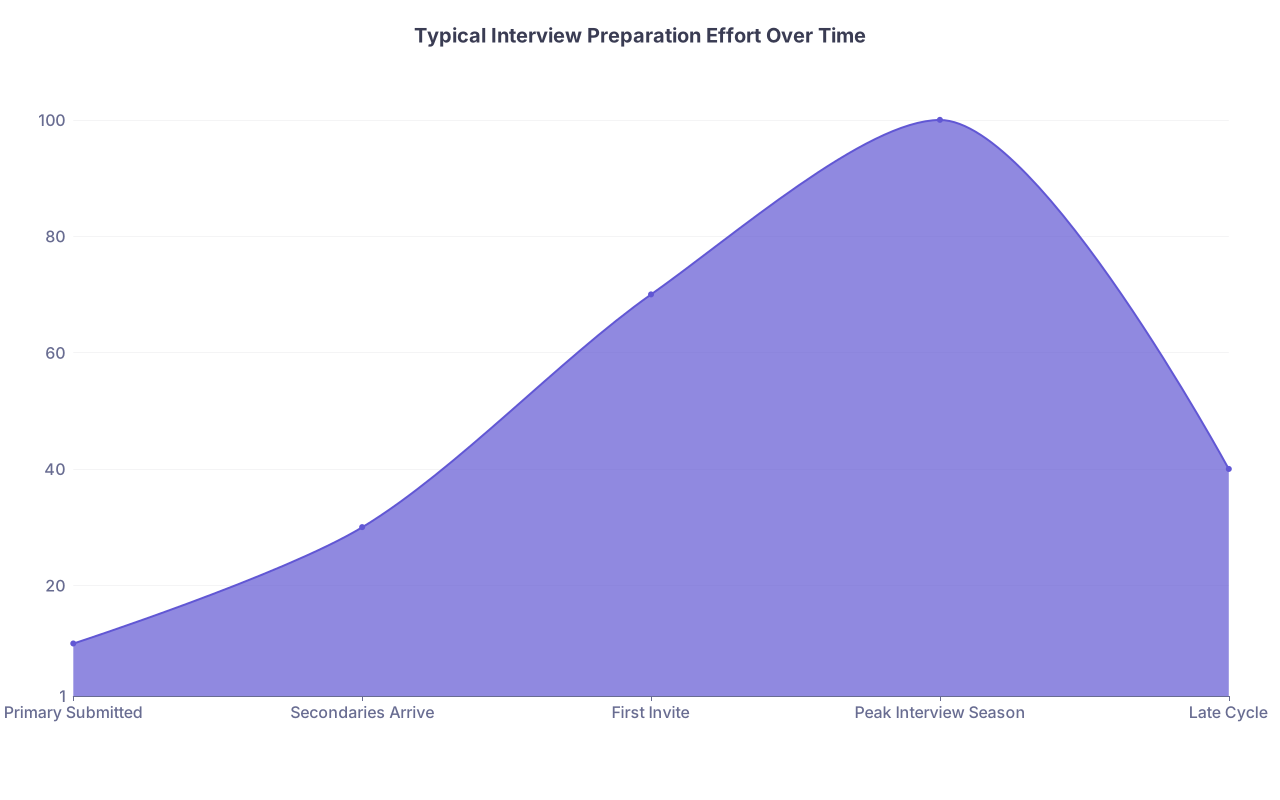
| Category | Value |
|---|---|
| Primary Submitted | 10 |
| Secondaries Arrive | 30 |
| First Invite | 70 |
| Peak Interview Season | 100 |
| Late Cycle | 40 |
- Primary submission → Low effort on interview prep (most people ignore it)
- Secondaries in full swing → Moderate effort
- First invite received → Panic and crash-course prep
- Peak interview season → Exhausting, constant prep and performance
You are going to shift that curve left. By the time the average applicant is opening their first “how to interview” article, you will already have:
- A working story bank of experiences
- A baseline answer structure for core questions
- A realistic sense of your application weaknesses
- At least one mock interview under your belt
The rest of this guide is chronological. Follow it.
Phase 1: Primary Submitted to Secondaries Released (Weeks 0–4)
Anchor point: You have just submitted your primary AMCAS/AACOMAS/TMDSAS.
At this point you should stop refreshing your email and start quietly building your interview foundation.
Week 0–1: Immediate Post-Submission
Focus: Inventory and awareness
At this point you should:
Print or save your full primary application as a PDF.
Read it like an interviewer will.- Highlight:
- Repeated themes (teaching, advocacy, leadership)
- Gaps (no long-term non-clinical service, weak research, etc.)
- Any “red flags” (withdrawals, MCAT retake, academic dip)
- Highlight:
Create an “Interview Prep” folder.
Inside it, set up:- One document: “Story Bank”
- One document: “School Notes”
- One document: “Common Questions Practice”
- One document: “Red Flags and Tough Questions”
Draft your baseline “Tell me about yourself” (TMAY).
Keep it rough. 2–3 minutes spoken.- Past: Where you come from / early influences
- Present: Who you are now as a student and person
- Future: What kind of physician you are aiming to be
Do not obsess over wording yet. You are building clay, not carving marble.
Week 2: Core Question Categories
Focus: Structure over perfection
At this point you should map out categories of questions, not 100 individual prompts.
Use this list as your spine:
- “Tell me about yourself.”
- “Why medicine?”
- “Why our school?”
- “Strengths and weaknesses”
- “Describe a challenge or failure.”
- “Ethical dilemma / difficult patient / conflict.”
- “Leadership example.”
- “Diversity / working with different backgrounds.”
- “Tell me about a time you made a mistake.”
- “What do you do for fun / outside of academics?”
Now, for each category:
- Write bullet-point outlines, not essays.
- For the main ones (TMAY, Why Medicine, Why This School), note:
- 1–2 key experiences
- 1 core theme
- 1 sentence that ties back to their mission or your future role
Week 3–4: Build Your Story Bank
Focus: Evidence, not slogans
At this point you should have started a story bank that looks something like this:
| Story ID | Category | Experience Source | Competencies Shown |
|---|---|---|---|
| S1 | Leadership | Free clinic coordinator | Initiative, teamwork |
| S2 | Ethical Dilemma | Hospice volunteering | Empathy, professionalism |
| S3 | Failure/Resilience | Organic Chem midterm | Growth mindset, grit |
| S4 | Conflict | Research lab dispute | Communication, maturity |
| S5 | Diversity | ESL tutoring | Cultural humility, service |
For each story, jot down:
- Context (setting, your role)
- Problem or challenge
- Action (what you did, not what “we” did)
- Result and reflection (what changed, what you learned, what you do differently)
You are quietly preparing to answer dozens of questions by deeply knowing a dozen stories. Smart trade.
Phase 2: Secondaries Arrive (Weeks 4–10)
Anchor point: Secondaries start hitting your inbox. Your time gets crushed.
Most people drop interview prep here. That is a mistake.
Week 4–5: Parallel Track – Secondaries + Interview Basics
Focus: Don’t lose the interview thread
At this point you should:
Block 2–3 hours per week specifically for interview prep.
Non-negotiable. Put it on your calendar.Refine 3 core scripts (spoken, not written):
- TMAY – 90 seconds to 2 minutes
- Why Medicine – 2 minutes
- Why This School – 60–90 seconds template you can customize
Record yourself on your phone. Watch it back once. Fix the obvious issues:
- Rambling
- Overly technical language
- Sounding like you are reading a secondary aloud
Align stories with competencies.
Schools are looking for specific things: resilience, teamwork, communication, service, ethics.Label your story bank with at least one AAMC Core Competency per story. You are reverse-engineering their evaluation rubric.
Week 6–7: First Live Practice
Focus: Say it out loud to another human
At this point you should schedule and complete:
- 1 low-stakes mock interview with:
- A campus premed advisor
- A career center counselor
- A friend in grad school
- A trusted mentor (not your parent if they cannot be objective)
Give them:
- Your school list
- Your personal statement
- A few representative activities
Ask them specifically to comment on:
- Clarity of your main themes
- Whether you actually answered the question
- Any verbal tics (“like,” “um,” “you know”)
- Body language (eye contact, posture)
Week 8–10: Start School-Specific Research (Before Invites)
Focus: Strategic familiarity, not memorization
At this point you should start building short research briefs for likely schools (state schools, your mission fit programs, places where your stats line up).
For each school, capture in your “School Notes” file:
- 2–3 mission or values phrases that genuinely resonate
- 1–2 specific programs, tracks, or features (e.g., UCSF’s PRIME, Pitt’s longitudinal research)
- 1 thing that aligns with your background (rural, first-gen, research-heavy, community service)
Do not write essays. Bullet points only. Your future self will plug these into your “Why this school?” answers and your questions for interviewers.
Drop in a few lines like:
- “I was struck by your focus on X, which ties to my work in Y.”
- “Your emphasis on Z resonates because of my experience with…”
You will customize on the fly later, but the raw material will be ready.
Phase 3: The “Quiet Gap” Before First Invite (Weeks 10–16+)
Anchor point: Secondaries are mostly done. You have no interview invites yet. Anxiety is rising.
This is where many applicants either check out or meltdown. You are going to do neither.
Week 10–12: Deepening and Polishing
Focus: Sharpening, not rewriting
At this point you should:
Tighten your core answers.
Re-record TMAY and Why Medicine.Aim for:
- Clean structure (beginning–middle–end)
- 1–2 vivid specifics (a patient, a moment, a quote)
- Less biography, more insight (“This experience taught me…”)
Prepare for tough questions.
Use your “Red Flags and Tough Questions” doc. Common categories:- “Tell me about this C in organic chemistry.”
- “Why did you take time off?”
- “You retook the MCAT. What changed?”
- “Your research is light. Why?”
For each, write a three-part response:
- Brief context (no excuses)
- Clear growth/action
- How it influences how you will handle future challenges
Run 1–2 targeted mocks.
Design them around:- Only ethical scenarios
- Only academic performance questions
- Only communication/ conflict scenarios
You are training like an athlete here: drills, not just scrimmages.
Week 13–16: Logistics and Readiness
Focus: Being able to say yes to any date
At this point you should quietly prepare the boring but critical pieces:
Interview wardrobe sorted:
- Suit / blazer tried on and tailored if needed
- Shoes that are comfortable for a full day
- Professional bag or portfolio
Technology for virtual interviews:
- Neutral background (wall, bookshelf, not your bed)
- External webcam or at least tested laptop cam
- Headset or microphone that does not echo
- Internet speed test, backup hotspot plan if needed
Draft question list for interviewers.
Aim for 6–8 solid questions that you can adapt:- Curriculum
- Advising
- Clinical exposure
- Support for interests (rural health, global health, research, etc.)
At this point you should be able to accept an interview offer for next week and not scramble for clothes, equipment, or generic questions.
Phase 4: The Week You Get Your First Invite
Anchor point: The subject line hits your inbox: “Interview Invitation.”
Your heart rate spikes. You are exactly where you planned to be.
Day 0: The Invite Arrives
At this point you should:
Respond promptly but not impulsively.
Within a few hours is fine. Check:- Available dates
- Format (MMI vs traditional vs hybrid)
- Virtual vs in-person
Choose the earliest date you can be properly prepared for.
Do not push 4–6 weeks out “to study.” You are already prepared. Early dates often signal enthusiasm and can position you better in the cycle.Immediately create a one-page “School Interview Sheet.”
For this specific school:- Date, time, time zone
- Format (MMI, panel, one-on-one)
- Required tech/platform (Zoom, proprietary)
- Dress code if specified
- Any essays/short answers required pre-interview
Attach it to your “School Notes.”
Days 1–3: School-Specific Tailoring
Focus: Marrying your preparation to their identity
At this point you should:
- Revisit your earlier school research notes and update them:
- Look at any new curriculum changes
- Check out 1–2 current students on YouTube / Reddit / school blog for flavor
- Customize:
- A 60–90 second “Why this school?” answer
- 3–4 specific questions you want to ask them
- Identify which stories from your bank fit this school best:
- Heavy on service? Choose your strongest community service narratives.
- Research powerhouse? Emphasize your project ownership and curiosity.
- Rural / primary care focused? Bring out longitudinal patient contact and continuity-of-care stories.
Now you are not walking into “an interview.” You are walking into this school’s interview.
Phase 5: Final Week Before the Interview
Anchor point: You have a confirmed date. Countdown starts now.
T–7 Days: Structured Run-Through
At this point you should schedule:
- One full-length mock interview matching the format:
- Traditional → 45–60 minute conversation
- MMI → 6–8 stations with ethical and scenario prompts
- Hybrid → mix both
Simulate:
- Same time of day as the actual interview, if possible
- Same clothes
- Same platform (Zoom, etc.)
Ask your mock interviewer(s) to give brutally honest feedback. Not “You did great.” You want:
- Where you lost their attention
- Answers that felt generic
- Moments where you sounded rehearsed or insincere
- Any content gaps (e.g., you say you love research but cannot describe your hypothesis)
T–5 Days: Tighten and Lighten
At this point you should:
Revisit your TMAY, Why Medicine, Why This School:
- Cut filler phrases
- Remove jargon
- Add 1–2 sharp, concrete images (the clinic hallway at 6 a.m., the patient you sat with after bad news, etc.)
-
- 10 minutes: random question cards (pull from online lists)
- 10 minutes: answer one tough question into your phone camera and review
Do not schedule three more full mocks. That is how you burn yourself out and start sounding robotic.
T–3 Days: Logistics Lockdown
At this point you should fully confirm all logistics.
For in-person:
- Verify:
- Travel (flights, buses, driving route)
- Lodging (hotel or student host)
- Campus map, building, and check-in location
- Pack:
- Printed copy of your application
- A few copies of your CV (optional but good)
- Notepad and pen
- Simple folder or portfolio
For virtual:
- Do a platform test:
- Log into any provided portals
- Test camera and mic, framing your upper torso and face
- Check lighting at the interview time of day
- Decide:
- Where you will sit
- What is in the background (keep it boring)
- How you will handle any tech issues (backup device, phone number)
You want to remove every avoidable source of anxiety.
T–1 Day: Mental Reset
At this point you should stop studying new material.
Your tasks:
- Brief review:
- School notes
- Story bank headlines (not full scripts)
- Logistics checklist and schedule
- Do something normal:
- Short walk
- Light exercise
- Early, screen-free night
You are not cramming for an exam. You are showing up as a coherent, rested, reflective person.
Snap View: What You Should Be Doing When
Here is a compressed view if you want a quick mental map.
| Stage | Timeframe After Primary | Main Focus |
|---|---|---|
| Foundation Building | Weeks 0–4 | Story bank, core questions, TMAY |
| Dual Track with Secondaries | Weeks 4–10 | Parallel prep + first mock |
| Quiet Gap | Weeks 10–16+ | Tough questions, polish, logistics |
| First Invite Week | Variable | School-specific tailoring |
| Final Pre-Interview Week | T–7 to T–1 days | Full mock, refinement, recovery |
And if you like visual process flows:
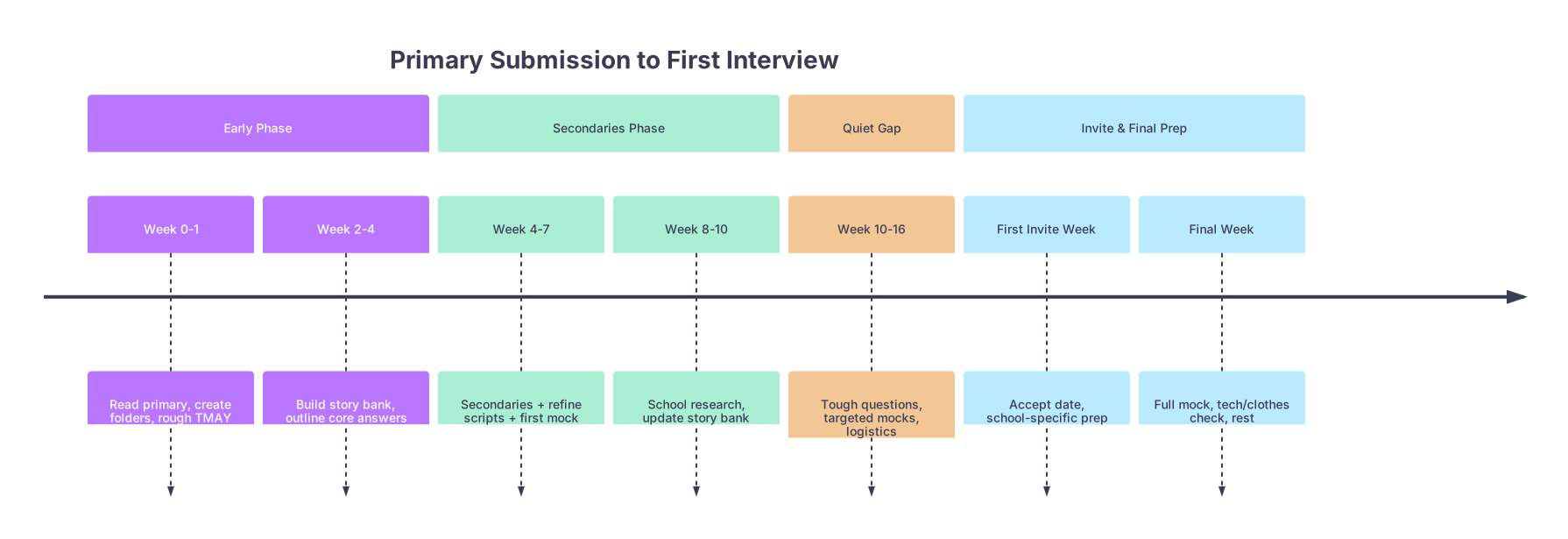
| Period | Event |
|---|---|
| Early Phase - Week 0-1 | Read primary, create folders, rough TMAY |
| Early Phase - Week 2-4 | Build story bank, outline core answers |
| Secondaries Phase - Week 4-7 | Secondaries + refine scripts + first mock |
| Secondaries Phase - Week 8-10 | School research, update story bank |
| Quiet Gap - Week 10-16 | Tough questions, targeted mocks, logistics |
| Invite & Final Prep - First Invite Week | Accept date, school-specific prep |
| Invite & Final Prep - Final Week | Full mock, tech/clothes check, rest |
Do Not Wait for Validation to Start Acting Like an Interviewee
You do not “become” an interviewee the day you get an email. You already are one the day you submit your primary. Schools are reading that file and asking, consciously or not:
- Could I see this person across the table from me in a few months?
- Do they have anything to say beyond “I like science and helping people”?
Your job between primary submission and first invite is to make sure that when that moment comes, your mouth can keep up with your file.
Start now.
Open a blank document today and title it “Story Bank.” List five experiences you might want to talk about in an interview—just headlines. That is your first concrete step. Then schedule one 30-minute block this week to turn one of those headlines into a full, structured story.