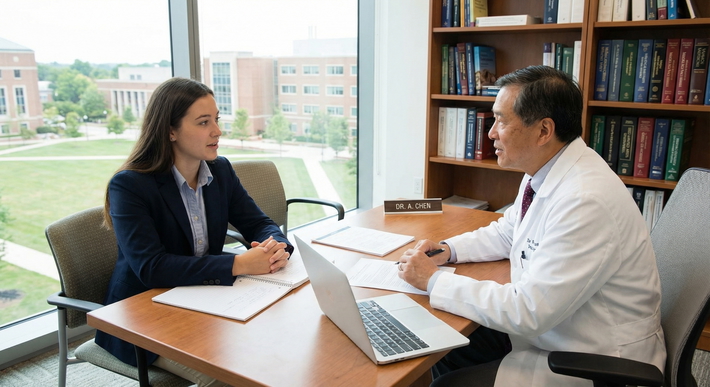
Winging your first medical school interview is how strong applicants quietly kill their chances.
You get exactly one shot at a first impression with each school. Four weeks is enough time to walk in sharp, calm, and convincing—or to show up as the person who “did some prep” and gets passed over for someone hungrier and better prepared.
Here’s a ruthless, chronological 4‑week countdown plan. Follow it, week by week, day by day, and you’ll walk into that first interview sounding like someone who belongs in medicine—not like someone reciting Reddit answers.
Big Picture: Your 4-Week Interview Timeline
At this point—four weeks out—you should stop “thinking about preparing” and start running a real plan.
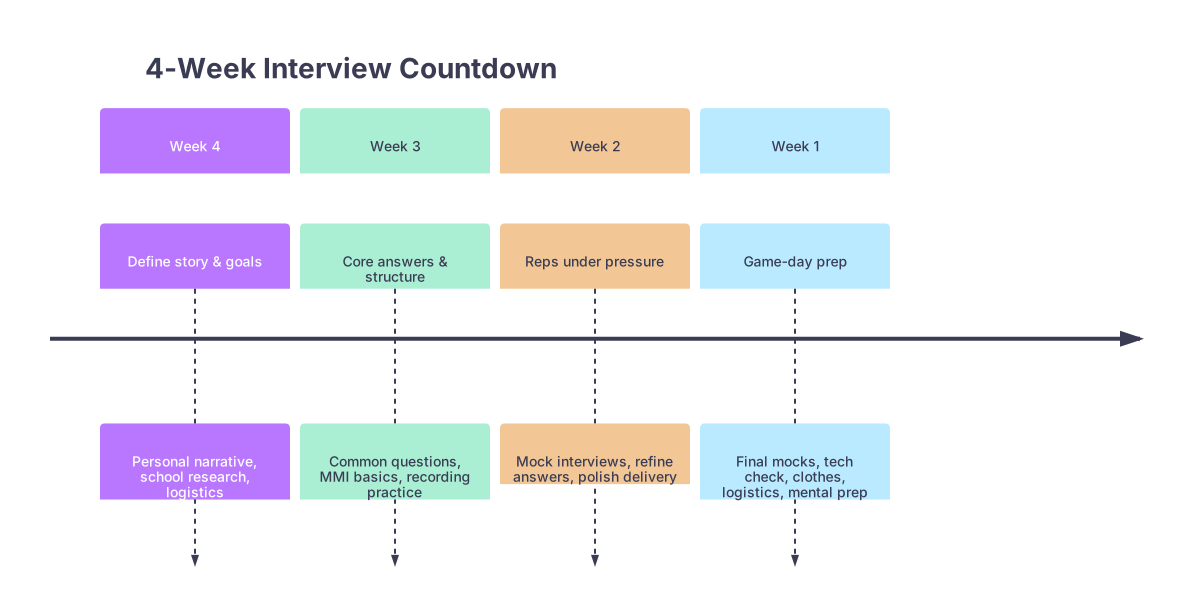
| Period | Event |
|---|---|
| Week 4 - Define story & goals | Personal narrative, school research, logistics |
| Week 3 - Core answers & structure | Common questions, MMI basics, recording practice |
| Week 2 - Reps under pressure | Mock interviews, refine answers, polish delivery |
| Week 1 - Game-day prep | Final mocks, tech check, clothes, logistics, mental prep |
Week 4: Build Your Foundation (Story, Research, Logistics)
At this point (28–21 days before your interview), you should:
- Lock down your core “who I am” story
- Learn this specific school cold
- Eliminate all preventable logistics problems
Day 1–2: Clarify Your Narrative
Sit down for 60–90 minutes. No distractions. You’re answering one question: “Why you and why medicine—in a way that isn’t generic?”
Write out, in bullet form:
Origin sparks
- First real exposure that made medicine personal (not “I like science + helping people”)
- Patient or family story, shadowing experience, health inequity you saw
Trajectory beats
- 3–5 key experiences that actually changed you
- For each: what you did, what you learned, how it shaped how you’ll be as a physician
Now + future
- What kind of medical student you’ll be (strengths, learning style, contribution)
- Two or three long-term directions you’re curious about (not locked in, but focused)
Do not write an essay. This is scaffolding. Two pages of messy bullets is perfect.
At this point you should be able to answer, out loud, in 90 seconds:
“Walk me through the path that led you to medicine.”
If you can’t, stay here until you can.
Day 3–4: Deep Dive on the School
Most applicants stop at “I like your curriculum and commitment to service.” That’s code for “I skimmed the homepage.”
You’re going deeper.
Make a one-page “School Dossier” (yes, literally one page):
Curriculum specifics
- Pre-clinical length (e.g., 1.5 vs 2 years)
- Notable features: longitudinal clinics, small group structures, early patient contact
- Anything that matches how you learn
Programs & tracks
- Dual degrees (MD/MPH, MD/MBA, MD/MA in Bioethics)
- Distinctive programs: Urban Health track, Rural Health, global health partnerships
Research & clinical focus
- 2–3 departments, institutes, or labs that genuinely align with your interests
- One or two faculty whose work overlaps with what you’ve already done or want to do
Mission & culture
- Pull out specific mission phrases and values
- Identify 2–3 you actually connect with (not all of them)
Location realities
- Patient population, key hospitals, community health issues in that city/region
Print it or save it to a single easy-to-scan PDF. This is your pre‑interview “cheat sheet.”
Day 5: Logistics & Setup
At this point, logistical chaos is your worst enemy. Fix it now.
- Block the entire interview day off your calendar
- Confirm time zones (I’ve seen people miss start times because the invite used ET and they assumed local)
- Travel:
- Book flights and lodging (aim to arrive at least the afternoon before, not same day)
- Plan how you’ll get from airport to hotel to campus (Uber, train, shuttle)
- Virtual:
- Update Zoom/Teams
- Test mic, camera, and lighting
- Choose background (plain wall or tidy room; no bed in the frame)
Create a simple checklist for interview morning:
- Outfit ready
- Directions / Zoom link
- Backup internet option (hotspot or nearby library/café)
- Phone and laptop fully charged
Day 6–7: Baseline Performance Check
You’re not “practicing.” You’re taking a diagnostic.
Record yourself answering these 3 questions, no prep:
- Tell me about yourself.
- Why medicine?
- Why our school?
Watch the recording. Brutally. Check:
- Do you ramble past 2 minutes?
- Are you staring off, saying “um” every sentence, or reading off a mental script?
- Does your answer actually sound like you—or like something you think they want?
Write down 3 specific things to fix:
- One content issue (too vague, missing story, no detail)
- One style issue (speed, tone, eye contact)
- One structural issue (no clear start/middle/end)
This is your starting line.
Week 3: Core Answer Construction & Structured Practice
Now you build the spine of your interview performance. At this point (21–14 days out) you should be:
- Drafting and tightening your high-yield answers
- Learning the frameworks that keep you from rambling
- Getting comfortable hearing yourself speak
Day 8–10: Build Your Core Answer Bank
No, you don’t write scripts. You build outlines.
Create bullet frameworks for:
Tell me about yourself (1.5–2 minutes)
- Present (what you’re doing now)
- Past (2–3 key experiences that shaped you)
- Future (what kind of student/physician you’re aiming to be, tied to their school)
Why medicine? (1.5–2 minutes)
- Personal spark (brief story)
- Exploration (clinical, research, service)
- What you’ve learned about the realities of medicine
- Why you still want in, and what traits you bring
Why our school? (1–1.5 minutes)
- 2–3 specific features from your dossier
- How they match your experience, values, or goals
- What you hope to contribute there
Strengths & weaknesses
- Strengths: choose 2–3 that show up in your activities (not “I work hard”)
- Weakness: something real, not catastrophic, with a clear growth arc
Challenging situations
- Use STAR (Situation, Task, Action, Result)
- Have at least:
- One teamwork conflict
- One failure or setback
- One ethical gray area or difficult interaction
You want bullets, not paragraphs. Example:
- Challenging team situation (shadowing clinic project)
- S: Clinic QI project, teammate chronically late
- T: Keep project on track without alienating him
- A: 1:1 convo, clarified expectations, shifted tasks, set check-ins
- R: Project finished early; teammate later thanked me for directness
Day 11–12: Start Daily Short Drills
Now you move from “thinking” to “speaking.”
Every day this week:
- 15–20 minutes of timed answers
- Pick 3–4 questions and record yourself (phone is fine)
- Aim for:
- 60–90 seconds for most responses
- 2 minutes max for big ones (tell me about yourself, why medicine)
Sample drill questions:
- Tell me about a time you failed.
- Tell me about a time you worked with a difficult person.
- What do you do for fun?
- How do you handle stress?
After each session:
- Rewatch one or two answers
- Jot down: 1 thing that worked, 1 thing to adjust tomorrow
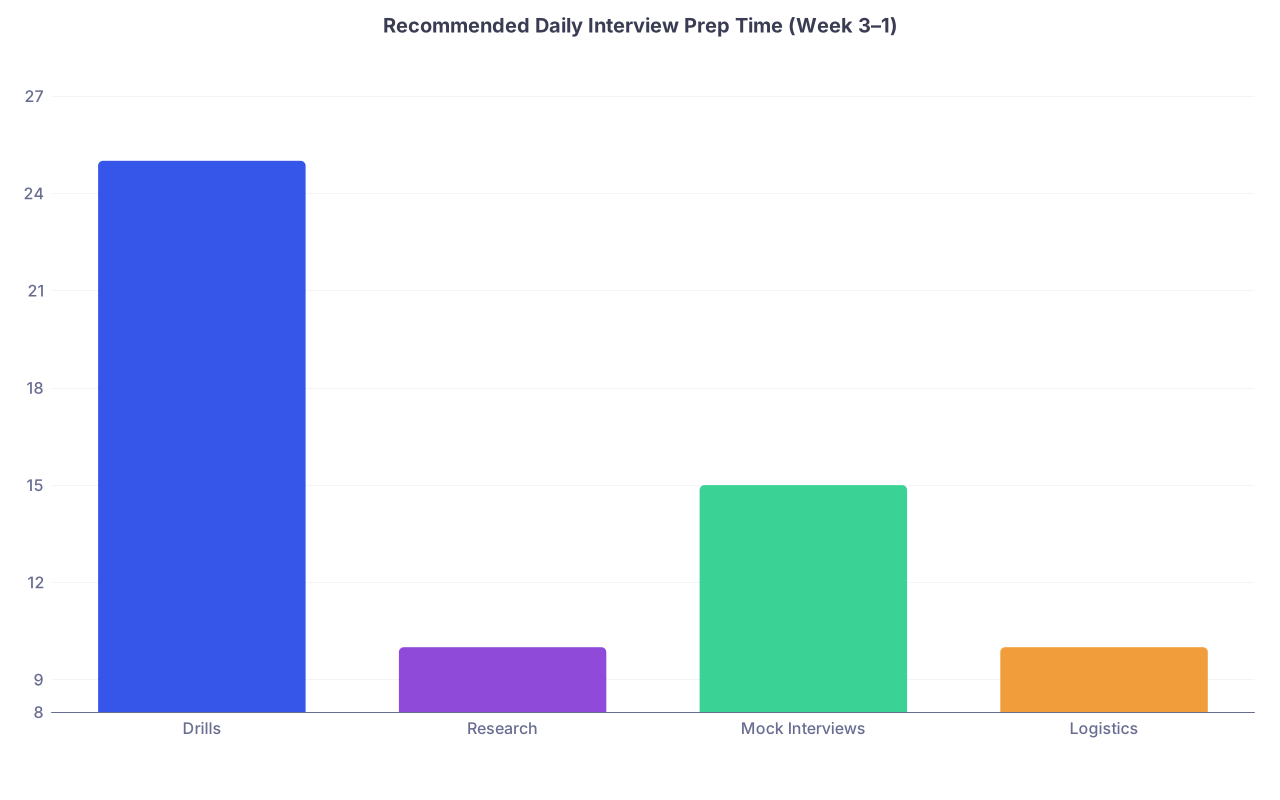
| Category | Value |
|---|---|
| Drills | 25 |
| Research | 10 |
| Mock Interviews | 15 |
| Logistics | 10 |
Day 13–14: Get Your First Real Feedback
At this point, you should expose your answers to another human.
Options, in order of usefulness:
- Pre‑health advisor with med school interview experience
- Current med student (ideally at the same school, but not mandatory)
- Trusted mentor who’s actually willing to be honest
- If all else fails: a friend who can call you out on sounding fake
Do a 30–45 minute mock:
- Have them use at least:
- Tell me about yourself
- Why medicine
- Why our school
- A couple of behavioral questions
Ask for concrete feedback:
- What did you remember most from my answers?
- Where did I sound rehearsed or vague?
- What question made you least confident in me?
Update your bullet frameworks based on this. Not longer—sharper.
Week 2: Reps Under Pressure & Content Depth
Now we shift from “I sort of know what I’ll say” to “I can handle curveballs and follow‑ups.” At this point (14–7 days out), you should be:
- Doing focused, higher-pressure practice
- Reading on ethics and healthcare issues
- Dialing in your presence on camera or in person
Day 15–16: Ethics & Healthcare Awareness
You do not need to be a policy expert. But you do need to sound like someone who lives in the real world.
Pick 2–3 topics and spend an hour each:
- Health disparities / social determinants of health
- Insurance basics and access to care
- Physician burnout and wellbeing
- Telemedicine and technology in healthcare
Sources:
- NEJM Perspective pieces
- JAMA opinion articles
- Reputable news coverage of healthcare issues
For each topic, jot:
- What’s the core issue?
- One or two perspectives people reasonably hold
- Where you stand and why (tentatively is fine)
You’re preparing for:
- “What do you think is the biggest challenge in healthcare today?”
- “Tell me about a healthcare issue that interests you.”
Day 17–18: MMI or Traditional-Specific Prep
Check your interview format. At this point you should know if it’s:
- Traditional (1-on-1 or panel)
- MMI (stations, some role-play, some ethical scenarios)
- Hybrid
If MMI:
- Practice 4–6 prompts per day
- Use a simple structure:
- Clarify the scenario
- Identify stakeholders
- Discuss options and tradeoffs
- State what you would do and why
- Acknowledge what you don’t know
If traditional:
- Focus more on follow-up questions:
- “Tell me more about that.”
- “What did you learn specifically from that experience?”
- “How would you handle that differently now?”
Either way, keep answers structured. STAR for experiences. Clear “thesis first” for opinions.
Day 19–20: Simulated Interview Under Real Conditions
You need at least one “dress rehearsal.”
- Time-block 60 minutes
- Wear what you’ll wear on interview day
- Set up where you’ll actually sit (for virtual) or imagine being in the room
- Use a question list (there are dozens online) and:
- Have someone else ask you live or
- Pull random questions from a shuffled list and answer as if it’s live
Record the full session.
After:
- Write down 3 recurring issues (for example, talking too fast; saying “like” every sentence; wandering off-topic)
- Pick one to focus on each subsequent practice day
You are not trying to be perfect. You’re trying to be controlled and authentic under stress.
Week 1: Final Polishing & Game-Day Execution
This is where people either peak correctly or cram themselves into burnout. At this point (7–0 days), you should be:
- Refining, not rewriting
- Sleeping well
- Reducing volume and increasing precision
Day 21–23: Targeted Tune-Ups
Each day this week, do 20–30 minutes, max:
Day 21:
- Focus: “Tell me about yourself” and “Why medicine”
- Goal: Smooth, confident, under 2 minutes each
- Record twice; adjust pacing and clarity
Day 22:
- Focus: Behavioral questions
- Use 5 prompts; answer each with STAR
- Watch 1–2 answers and see: did I actually answer the question, or just tell a story I like?
Day 23:
- Focus: “Why our school” and “Questions for us”
- Prepare 5–7 real questions about:
- Curriculum
- Advising
- Community engagement
- Student wellness
- Research/mentorship
- Avoid questions you can Google in 10 seconds
Day 24–25: Appearance, Logistics, and Final Mock
Day 24: Appearance & tech
- Try on your full outfit
- Check:
- Fit (not too tight when sitting)
- Wrinkles (fix them now, not the night before)
- Shoes (clean, not brand-new painful)
- For virtual:
- Test lighting at the same time of day as your interview
- Adjust camera to eye level
- Do a 2-minute recording and see what your interviewer will see
Day 25: Final mock interview
- 30–45 minutes
- New interviewer if possible
- Ask them to be blunt: “What’s the one reason you wouldn’t accept me based on this?”
- Listen to that reason. Decide if there’s a realistic tweak you can make in the remaining days.
Day 26–27: Taper, Don’t Cram
At this point, your work is mostly done. Over-prepping now usually makes you sound robotic.
Each day:
- 10–15 minutes max:
- Skim your school dossier
- Run through your question list
- Answer 2–3 questions out loud, no recording
Then stop.
Use the rest of the time to:
- Exercise lightly
- Eat normally
- Get consistent sleep
If you must “study” something, read one thoughtful healthcare piece and think through your opinion on it.
Day 28: Interview Eve
No heroics today.
Confirm:
- Interview time and location/Zoom link
- Alarm(s) set
- Transportation plan (for in-person: exactly when you’re leaving, backup option)
Pack (for in-person):
- Folder with: schedule, directions, extra copies of your resume
- Small notebook + pen
- Water bottle and small snack
- Mints (not gum)
For virtual:
- Close all unnecessary apps
- Turn off notifications
- Put a “do not disturb” sign on your door if you have roommates
Evening:
- 5–10 minutes of light review only
- Then something relaxing that pulls you out of your head: walk, show, chatting with a friend
- Aim for a real bedtime, not “I scrolled TikTok until 2 a.m.”
Day 29: Interview Day – Hour-by-Hour
You’ve done the work. Today is execution.
Morning (2–3 hours before):
- Wake up with enough buffer for unexpected issues
- Light breakfast (nothing risky for your stomach)
- 5–10 minutes:
- Skim your school dossier once
- Glance at your question list
- Say “Tell me about yourself” once, out loud. Then stop.
60–90 minutes before:
- Get fully dressed
- For in-person:
- Plan to arrive 30 minutes early to campus/interview site
- For virtual:
- Open Zoom/Teams early
- Test mic and camera
- Put your phone on silent and out of reach
15–20 minutes before:
- No more content review
- Focus on breathing:
- In for 4, hold for 4, out for 6, repeat a few times
- Remind yourself:
- They already like you enough to invite you
- You are there to have a conversation, not to pass an oral exam
During the interview:
- Listen to the full question before answering
- Pause one beat to think—this reads as thoughtful, not clueless
- If you blank, it’s fine to say:
“That’s a great question. Let me think for a second.” (Then actually think for 2–3 seconds and choose a direction.)
After:
- Jot down:
- Who you spoke with (names, roles)
- Any specific topics you discussed
- Anything you wish you’d said differently (for next interviews, not to obsess)
Evening:
- Send concise, genuine thank-you notes or emails to interviewers if contact info is provided. Same day or next morning is ideal.
Then let it go. You’re not doing a post-mortem all night.
| Week | Primary Focus | Daily Time Target |
|---|---|---|
| Week 4 | Story, school research, logistics | 45–60 minutes |
| Week 3 | Core answers, first feedback | 30–45 minutes |
| Week 2 | Ethics, MMIs, full mock | 30–40 minutes |
| Week 1 | Polishing, taper, game-day | 10–30 minutes |
FAQ (Exactly 2 Questions)
1. How much interview prep is “enough”?
If you’ve followed a plan like this—4 weeks, most days, 20–40 minutes—you’re in the “enough” zone. The real signs you’re ready: you can answer “Tell me about yourself,” “Why medicine,” and “Why our school” clearly and under 2 minutes; you’ve done at least two full mock interviews with real feedback; and you’re not rewriting answers the night before. Anything beyond that is polishing, not salvation.
2. What if my first interview is in 10 days, not 4 weeks?
Compress the plan. You’ll skip the luxury of slow build and go straight to high-yield: one day for story + school research, two days to build core answer bullets, then daily 20–30 minute drills and at least one full mock. You won’t feel as relaxed, but you can still show up competent and coherent. And everything you build for this interview becomes prep for the next one.
Bottom line: four weeks is enough time to turn raw potential into a credible, compelling interview presence. At this point you should have: a clear personal story that connects to medicine, a specific understanding of this school, and a track record of speaking your answers out loud under pressure. Do that, and you walk in as the version of yourself they actually admitted on paper.