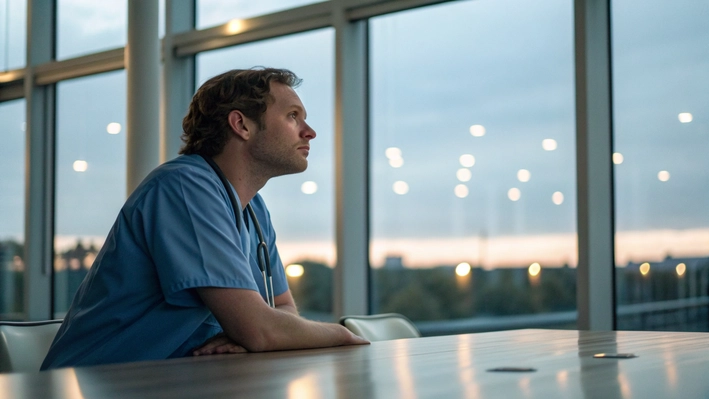
The blunt truth: walking into a medical school interview clutching pages of notes is a bad look.
You can—and should—prepare. You can review. You can even glance at a one-page sheet in the lobby. But actively bringing and using notes inside a medical school interview or MMI station usually hurts more than it helps.
Let’s break this down properly so you know exactly what’s smart, what’s allowed, and what quietly makes committees think, “This person is not ready.”
The Short Answer: Can You Bring Notes?
Here’s the direct answer most people dance around:
Traditional interviews (one-on-one or panel):
You can bring a slim pad or portfolio, but you should not rely on or read from notes during the conversation. At most, jot a couple of words between interviews or right after.MMIs (Multiple Mini Interviews):
You generally should not bring notes into stations, and in many cases you’re explicitly prohibited. Use only the prompt provided. Some schools will even tell you to put away personal materials.Virtual interviews:
Technically you could have notes on your desk or screen. Practically, admissions can tell when you’re reading or scanning. Overuse makes you look stiff, over-rehearsed, and not ready for real clinical conversation.
So the guiding principle is simple:
Notes are for before the door opens, not during the interaction.
Why Interviewers Don’t Like Seeing Notes
Medical schools are not testing your ability to memorize 50 facts about their program. They’re testing:
- How you think under mild pressure
- How you communicate in real time
- How you respond to people, nuance, and unexpected questions
I’ve watched interviews where an applicant kept glancing at an index card. The content on the card was probably good. It did not matter. Every glance said: “I can’t trust myself to speak without a script.”
Here’s what note-using signals, fairly or not:
Poor preparation.
If you need to read your “Why our school?” answer, it tells the committee you haven’t internalized it.Weak communication skills.
Doctors don’t talk to patients with a written script. They think out loud, adapt, and clarify. That’s what interviewers want to see.Low confidence.
Even if you are confident, the optics of holding notes fight against you.
That doesn’t mean you must be perfect. It just means the occasional pause to think is better than the constant crutch of a page of talking points.
Traditional Interview: What You Should Actually Bring
You do not need to show up empty-handed. But you need to be strategic.
Here’s the setup I recommend that looks professional and keeps you from relying on notes:
- A slim portfolio folder (or padfolio), containing:
- 2–3 copies of your CV or AMCAS activities list
- Printed copy of your secondary essay or personal statement (for you, not to hand out)
- A single, clean sheet with:
- 3–5 specific questions for the school/interviewer
- 3–5 bullet reminders of examples you might use (e.g., “clinic triage story,” “organic chem tutoring challenge,” “ethics research case”)
- A pen
That’s it. Not a binder. Not a color-coded MCAT-style packet.
What you do with it:
- Keep it closed most of the time.
- Maybe open it briefly if the interviewer says, “Do you have any questions for me?” and you don’t remember one.
- Do not read answers. Do not scan it for every question.
Used this way, notes are a safety net, not a teleprompter.
MMI Stations: Different Rules, Higher Stakes
MMIs are a different animal. They exist specifically to see you think on your feet.
Most MMIs have very clear rules:
- No phones
- No personal notes
- No talking about station content between circuits
- Only the prompt sheet you’re given
Some programs have a “reading time” area outside the door where you see the prompt, maybe with a scrap sheet for your own quick notes. That paper usually stays at the station. It’s not a personalized cheat sheet.
Here’s what’s smart for an MMI:
- Use the reading time to:
- Identify the core dilemma or question
- Jot 3–4 words: stakeholders, key principle, structure (e.g., “autonomy vs beneficence,” “patient, family, team,” “acknowledge → explore → plan”)
- Then walk in and talk to the person in front of you, not to the paper.
If you’re constantly looking down or reading from a note paper in an MMI, you’re missing the point of the format. And scorers notice.
Virtual Interviews: The Temptation to Cheat Yourself
Virtual interviews make this worse because you can surround yourself with notes. I’ve seen people with:
- Post-it notes stuck all around the monitor
- A full “answer bank” open in another window
- A Google Doc with 30+ scripted answers
Here’s the problem: interviewers can see your eyes. If you’re constantly scanning left/right/up, they know you’re reading. You’ll also sound robotic.
For virtual interviews, here’s what actually works:
- One or two small sticky notes near the camera:
- Big picture prompts only, like:
- “Show reflection, not resume”
- “Tie back to values”
- “Ask about curriculum/feedback”
- Big picture prompts only, like:
- Maybe 3–5 school-specific keywords at the bottom of your screen (e.g., “Longitudinal clinics, early patient contact, service-learning”).
If you couldn’t read it from six feet away, it’s probably too detailed.
You want memory triggers, not scripts.
Situations Where Limited Note Use Is Actually Fine
There are a few scenarios where having or glancing at notes is either neutral or mildly positive:
Asking thoughtful questions at the end
You might say: “I wrote this down so I wouldn’t forget to ask—could you tell me more about how the [X longitudinal clerkship] is structured?”
That looks prepared, not insecure.Multi-interview days
If you have several back-to-back conversations, you might step out, jot a few reflections, then put the portfolio away again. That’s you staying organized, not you leaning on notes mid-interview.After the interview for thank-you emails
A few keywords about what you discussed (“health disparities project,” “loves evidence-based teaching,” “grew up in rural area”) will help you write specific follow-ups.
In all three cases, the pattern’s the same: notes are used between or after conversations—not during.
What To Memorize vs What To Just Understand
You don’t need a photographic memory. But if you need a paper to answer these, you’re underprepared:
- “Why medicine?”
- “Why our school?”
- “Tell me about yourself.”
- “What’s a challenge you’ve faced and how did you handle it?”
- “A time you received critical feedback?”
- “How do you deal with stress or failure?”
You should have:
- 3–5 go-to stories (clinical, research, service, leadership, personal challenge) that you know so well you can tell them in your sleep
- A clear, internalized framework for ethics-style questions:
- Identify the issue
- Acknowledge both sides
- Talk about gathering more information
- Emphasize communication and respect
- Propose a balanced path
Once you understand these deeply, you won’t need pages of prompts.
A Simple Framework: How To Prepare Without Bringing Notes In
Here’s how to get the benefit of notes without carrying them into the room like a shield.
Step 1: Build a “Master Notes” Document at Home
One document only, with:
- Your 3–5 core stories (bulleted, not scripted)
- A short “Why medicine” and “Why this school” section
- Clusters of possible questions with quick bullet answers
- A few ethical/behavioral frameworks
This is your practice document, not your test-day crutch.
Step 2: Practice Out Loud Until You’re Bored
The magic moment is when you can:
- Answer standard questions without looking
- Adapt the same story to multiple prompts
- Keep answers under 2 minutes, with a clear beginning, middle, and end
Do this with a friend, advisor, or just your phone camera. It feels stupid and awkward. Do it anyway. That’s how the content moves from “notes” to “you.”
Step 3: Create a One-Page “Day Of” Sheet
Night before the interview, condense everything into one page:
- 5 bullet-point story cues
- 3 reasons you like the school (specific, not generic)
- 3–5 questions to ask
- Maybe 3 key values you want to convey (e.g., “service, curiosity, humility”)
Look at it in the morning. Review it in the lobby or prior to logging into Zoom. Then put it away.
If you’ve done the prep right, that’s all you need.
What If You’re Anxious You’ll Blank?
Everyone worries about this. Some actually do freeze for a moment.
You’d still be better off saying:
“Let me take a second to think about that—”
[pause, brief smile, breathe]
“Okay, one example that comes to mind is…”
than frantically flipping through papers or staring at a wall of Post-its.
Blanking for a few seconds is human. Reading from a script in a conversation that’s supposed to show your maturity and spontaneity is not.
If your anxiety is severe, work on:
- Mock interviews with “curveball” questions
- Practicing comfortable pauses
- Giving yourself permission to regroup out loud:
“I can think of a couple of examples. I’ll share the one that best shows how I responded to feedback.”
That sounds mature. Notes don’t fix panic—they just give you something else to cling to.
Quick Comparison: What’s Actually Appropriate?
| Format | Bring Portfolio? | Use Notes During? | Glance for Questions? |
|---|---|---|---|
| In-person traditional | Yes | Very limited | Yes, briefly |
| In-person MMI | Usually yes | Only prompt sheet | Rarely or no |
| Virtual traditional | N/A (digital) | Minimal prompts | Yes, if discrete |
| Virtual MMI | N/A (digital) | Only prompt sheet | Rarely or no |
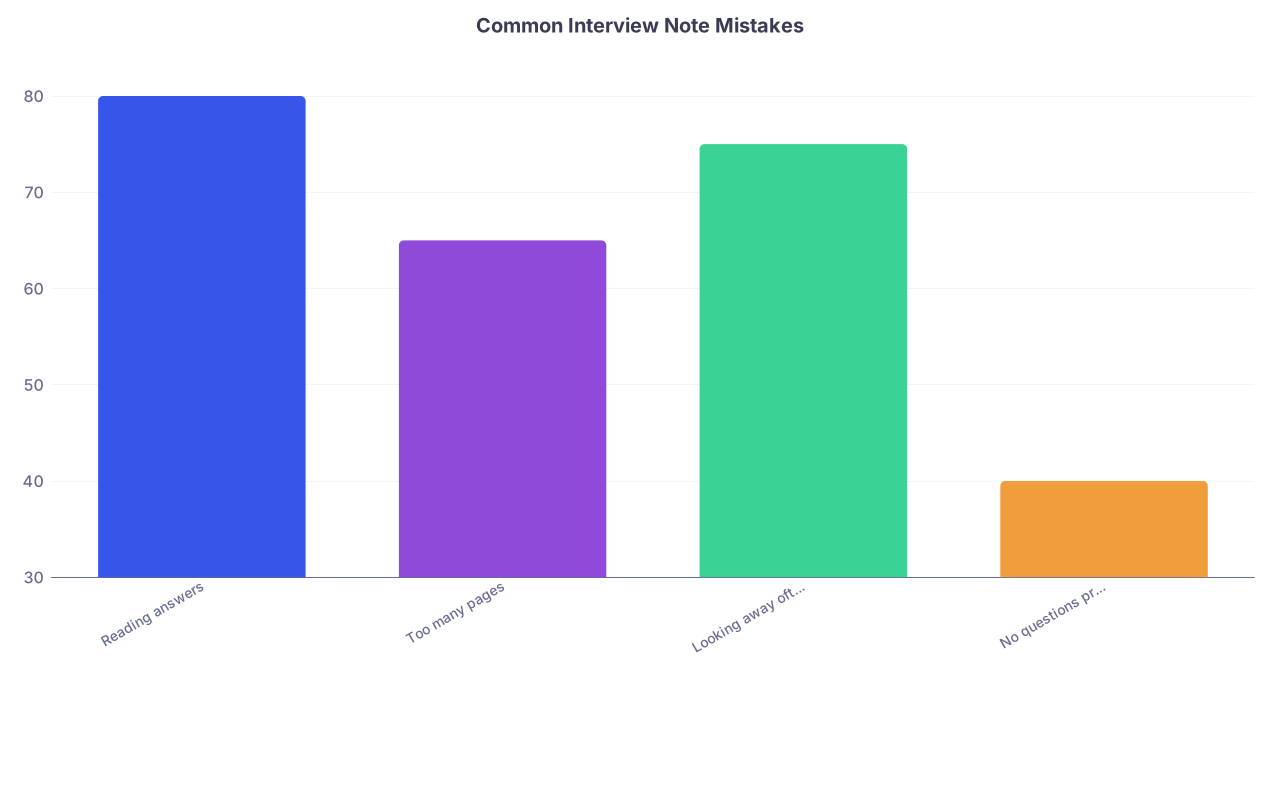
| Category | Value |
|---|---|
| Reading answers | 80 |
| Too many pages | 65 |
| Looking away often | 75 |
| No questions prepared | 40 |
One More Subtle Point: The Professionalism Test
Medical school interviews are your first “clinic-style” professional encounter in this career path. Interviewers are quietly asking:
- Can I see this person sitting with a patient?
- Can they talk without constantly checking something?
- Do they handle uncertainty like an adult or like a panicked test-taker?
If you look like you need notes for a 30-minute conversation about yourself and your motivations, the leap to “trusting you in a clinical setting” gets harder.
Professionals routinely:
- Prepare heavily
- Carry reference materials
- Barely use them in the actual meeting
That’s the posture you want to project.

| Step | Description |
|---|---|
| Step 1 | Create Master Notes at Home |
| Step 2 | Practice Out Loud |
| Step 3 | Condense to One-Page Sheet |
| Step 4 | Review Before Interview |
| Step 5 | Bring Portfolio, Use Sparingly |
| Step 6 | Follow School Rules, Use Prompt Only |
| Step 7 | Use Minimal Prompts Near Camera |
| Step 8 | Focus on Conversation |
| Step 9 | In-Person Traditional? |

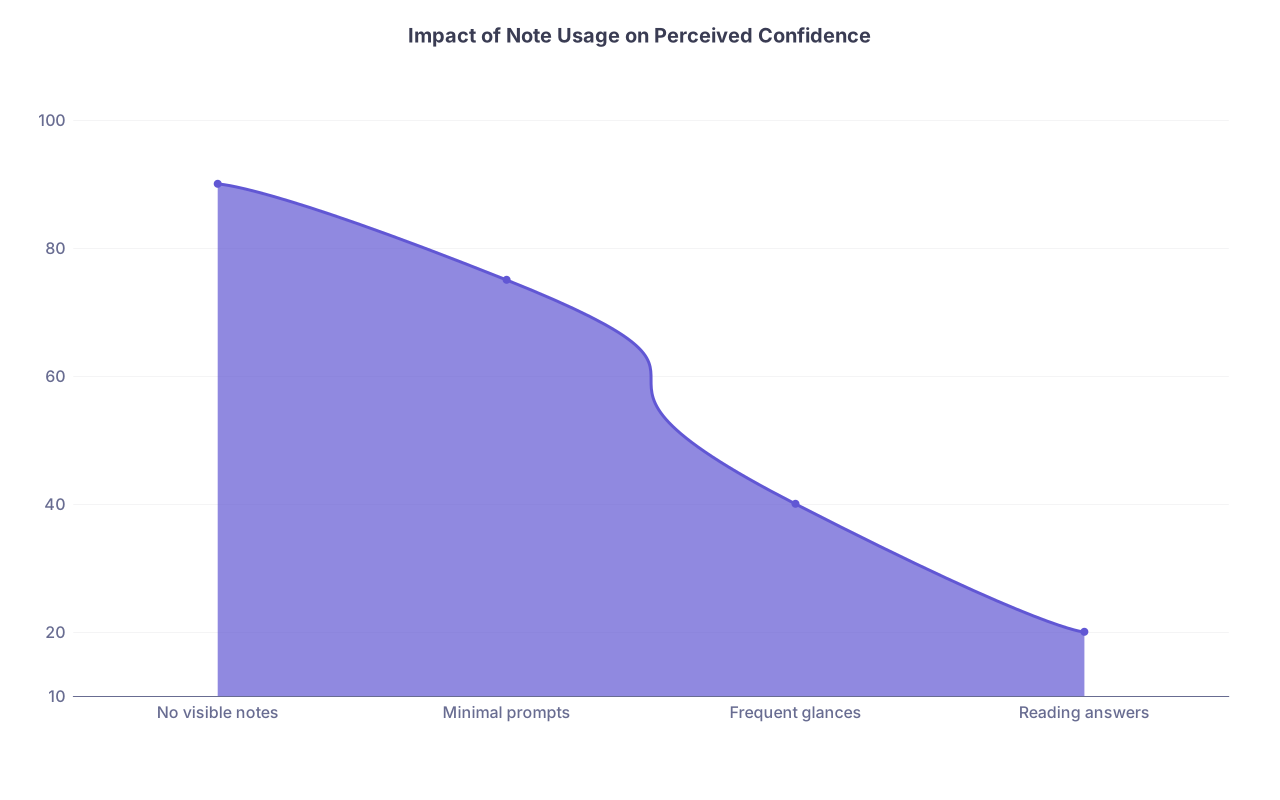
| Category | Value |
|---|---|
| No visible notes | 90 |
| Minimal prompts | 75 |
| Frequent glances | 40 |
| Reading answers | 20 |

FAQ: Notes and Medical School Interviews
Are you allowed to bring notes into a medical school interview?
Usually yes for traditional in-person interviews, as part of a professional portfolio. You’re generally allowed to hold a padfolio with a pen, resume, and a small list of questions. MMIs often restrict outside materials to just the prompt sheet provided. Even when allowed, relying on notes during the actual conversation is strongly discouraged.Will interviewers think badly of me if I write things down?
Briefly jotting a keyword or two—especially between interviews or after—is fine. Constant writing during an interview, or looking down more than you look up, does hurt you. It makes you seem disengaged or overly scripted. If you want to remember something for thank-you emails, wait until you leave the room or log off.Can I read from a prepared statement for “Why medicine” or “Why this school”?
No. That looks terrible. You should know these answers so well you can say them naturally. Scripted monologues come off as fake, even when the content is good. You’re better off giving a slightly imperfect but authentic response than a polished paragraph you clearly memorized.Is it okay to bring a list of questions to ask the interviewer?
Yes, if it’s short and not treated like a checklist. A few written questions in your padfolio are totally acceptable, especially if you preface them briefly: “I jotted down a couple of questions I didn’t want to forget. Could I ask about…” Just don’t bury your face in the page. Glance once, then go back to eye contact.What about taking notes in an MMI station with an ethical scenario?
Use whatever scratch paper they give you during the “reading time” for quick structuring words, not full sentences. Once you walk in, rely mainly on your understanding and reasoning, not the notes. Don’t bring personal notes from home into MMI stations unless the school explicitly allows it (very rare).For virtual interviews, how many notes are too many?
If your eyes are obviously moving around the screen to read, it’s too many. A couple of short prompts near the camera—key values, 2–3 school-specific phrases, “pause and think”—are fine. A full answer bank on your second monitor is a trap. You’ll sound stiff and the interviewer will know you’re reading.What should I do if I freeze and forget what I wanted to say?
Own the moment briefly: “Let me take a second to think about that.” Pause. Breathe. Then either use a core story you know well, or start with how you’d approach the situation. That kind of composure impresses people. Scrambling through notes or visibly panicking does not. Trust that a thoughtful, slightly slower answer beats a memorized one every time.
Key points:
Use notes as preparation, not as a live script. Bring a slim portfolio and maybe a one-page sheet, but keep it mostly closed. In the room—whether it’s traditional, MMI, or virtual—the person in front of you deserves your eyes, your mind, and your honest, unscripted self.