Why do some perfectly nice answers to “Why medicine?” make interviewers politely smile…then forget you 10 seconds later?
Let me be blunt: most applicants bomb this question. Not because they’re bad people or bad candidates, but because their answer sounds like everyone else’s. Generic. Safe. Forgettable.
The good news? What interviewers actually want is clear, and you can prepare for it.
What Interviewers Are Actually Testing With “Why Medicine”
They aren’t just asking, “Why do you want to be a doctor?”
They’re silently asking:
- Are you naïve or realistic?
- Are you motivated by ego or service?
- Are you running toward medicine or running away from something else?
- Have you actually seen what this job looks like on a bad Tuesday at 3 a.m.?
Your answer has to hit four boxes:
- Credible motivation – your story makes sense and feels earned, not invented last month.
- Informed understanding – you show you know what medicine really is, not the TV version.
- Alignment with physician work – your values and strengths fit what doctors actually do.
- Forward-looking maturity – you connect your past, present, and desired future.
If your answer is missing any of these, they notice.
The Answers That Turn Interviewers Off (Even If They’re “True”)
You need to see what fails before you can build something strong.
Here are the classics that quietly hurt you.
The vague altruism answer
“I just want to help people.”
Of course you do. So do nurses, social workers, teachers, PTs, and public health professionals. You haven’t explained why medicine specifically.The prestige/achievement answer
“I love science and I want a challenging, respected career.”
Translation in many interviewers’ heads: “I like status and achievement.” Not a good look, even if partially true.The trauma-only answer with no reflection
“My grandmother died of cancer, so I decided to become a doctor.”
Powerful starting point, but if it stops there, it sounds reactive and emotional, not thoughtful and tested.The savior complex answer
“I want to fix the healthcare system and help the underserved.”
Strong intention. But if you have no sustained track record that matches this claim, it sounds like idealistic sloganeering.The over-academic answer
“I’m fascinated by pathophysiology and cellular signaling pathways.”
Fine for PhD interviews. For MD/DO, it’s incomplete. Where are actual patients? Actual clinical exposure?The robotic personal statement recap
You just recite your essay in slightly different words. They can tell. It feels rehearsed and inauthentic.
The problem with all of these isn’t that they’re “wrong.” It’s that they’re thin. Unbalanced. Either all emotion, all intellect, or all slogans.
Interviewers want to hear a story with spine.
The Core Structure of a Strong “Why Medicine” Answer
Here’s the skeleton I’ve seen work over and over—with premeds, traditional and nontraditional, MD and DO, U.S. and international.
Use this basic flow:
- Origin spark – where the idea started
- Reality testing – how you tested that early idea against the real world
- Deeper understanding – what you learned about the real work of physicians
- Personal fit – how your strengths/values match that work
- Future direction – the kind of physician you hope to become
Keep each part anchored to concrete experiences, not abstract statements.
Let’s break it down.
1. Origin Spark: Start Human, Not Heroic
You don’t need a dramatic tragedy. You need something real and specific.
Examples:
- “I first started thinking about medicine in high school when I translated for my parents at doctor’s visits.”
- “My first real exposure was volunteering in our local free clinic’s front desk during my sophomore year.”
- “I had zero doctors in my family; I stumbled into medicine through a shadowing program my college ran with the county hospital.”
Then briefly describe a moment or two that made you curious, not “decided forever.” Interviewers respect curiosity more than sudden life epiphanies.
2. Reality Testing: Show You Did the Hard Boring Work
This is where a lot of applicants fall apart. They jump from “spark” to “So I knew I wanted to be a doctor,” with nothing in between.
You need to show: I didn’t just feel this. I tested it.
Talk about:
- Shadowing where you saw the less glamorous side
- Clinical work as a scribe, MA, EMT, tech, CNA
- Long-term volunteering with real patients
- Longitudinal research or QI work that intersected with patient care
Be specific about what you observed that most premeds never mention.
“I realized how much time the attending spent calling family members after hours”
is more powerful than
“I saw how much doctors care about patients.”
3. Deeper Understanding: Prove You Know What the Job Actually Is
Here’s what interviewers want to hear between the lines:
“This person understands the trade-offs and still wants the job.”
Show that you’ve seen:
- The cognitive part: complex problem-solving, uncertainty, pattern recognition
- The emotional part: delivering bad news, sitting with suffering, dealing with burnout
- The system part: constraints of insurance, EMR, time limits, team-based care
Good phrasing sounds like:
- “What surprised me was how much of the job is teaching—patients, families, med students, even other team members.”
- “I saw that a lot of the work isn’t dramatic saves; it’s incremental improvement over months or years.”
- “I’ve watched residents stay late to coordinate care with social work and home health. That made me appreciate how relational this field really is.”
Suddenly you sound like someone who’s actually been in the room. Because you have.
4. Personal Fit: Connect Your Traits to This Work
This is where you transition from “Here’s what medicine is” to “Here’s why I belong there.”
Do not just rattle off adjectives: “I’m compassionate, hardworking, and resilient.” Everyone says that.
Tie specific traits to specific tasks of a physician.
For example:
- “I like sitting with complicated problems that don’t have obvious answers. That’s what drew me to research at first, and it’s also what I appreciated watching my preceptor work up undifferentiated chest pain in clinic.”
- “I’m good at building trust over time. In the free clinic, I saw that follow-up only happened when patients felt genuinely heard. That longitudinal relationship is exactly what appeals to me in primary care.”
- “I’ve always been the person in my family explaining complex things in simple language. Seeing attendings do that around chemo decisions felt strangely familiar and oddly energizing.”
Now you’re matching who you are with what physicians actually do all day.
5. Future Direction: Show a Thoughtful, Flexible Vision
You do not need a locked-in specialty. Saying “I’m 100% going into neurosurgery” as a 21-year-old usually sounds naïve.
But you should show a directional sense of the kind of work and environment that attracts you.
Examples:
- “Right now I’m drawn to fields where I can build long-term relationships—like internal medicine or pediatrics—but I’m keeping an open mind for clinical exposure in medical school.”
- “I see myself working in a safety-net setting, probably in an academic center where I can combine clinical care with teaching and quality improvement work.”
- “I want a career that keeps me close to patient care but also lets me contribute to system-level changes, especially in immigrant and underserved communities.”
This tells interviewers: you’ve thought beyond “admissions” and into “actual career.”
A Sample Answer That Actually Works
Do not copy this. Use it as a blueprint.
“I first started thinking seriously about medicine in high school, not because of some big dramatic event, but because I was the one translating for my parents at doctor’s appointments. I remember sitting in the exam room, trying to find the words in Spanish to explain ‘pre-diabetes’ to my mom, and realizing how much power there was in simply helping her understand what was happening.
In college, I tried to test whether that interest in healthcare was real or just familiarity. I started volunteering at the student-run free clinic, first at the front desk and eventually as a clinical assistant. That was my first time spending hours in a clinic, watching visits that were more about housing insecurity and medication affordability than about textbook diseases.
What really pushed me toward medicine specifically was a summer working as a scribe in the emergency department. I saw the whole spectrum in a single shift—coding a patient in one room while explaining to another family why their child’s fever didn’t need antibiotics. It wasn’t glamorous. There were drunk patients yelling, families frustrated about wait times, and physicians staying late to finish notes. But I watched one of the attendings take an extra 10 minutes at 2 a.m. to call a patient’s daughter and explain her father’s CT scan results in simple language. That blend of diagnostic reasoning, communication, and responsibility for the whole person is what made the role of physician feel like the right fit for me.
Over the last few years, I’ve learned that medicine is as much about managing uncertainty and systems as it is about science. Through my research project on readmissions, and through working with our clinic’s social worker, I’ve come to appreciate that being a good doctor means working within constraints, coordinating with a team, and still showing up fully for patients who may not always be able to show up for themselves.
I’m drawn to that combination of long-term problem-solving and relationship-building. I like sitting with complicated stories, asking questions, and helping people make sense of their options—that’s what I’ve been doing informally with my family and more formally with patients in the free clinic. In the future, I see myself in a field where I can build those ongoing relationships—maybe internal medicine or family medicine—and work in a safety-net setting where language, culture, and trust are central parts of care. I know my understanding will deepen in medical school, but the more I’ve seen of the day-to-day work, the more I feel that medicine is the place where my skills, values, and experiences line up.”
Notice what’s there:
- Specific settings (free clinic, ED, scribe)
- Concrete observations (late-night phone call, non-glamorous realities)
- Balanced view (good and bad)
- Clear personal fit and future direction
No clichés needed.
Common Traps and How To Fix Them Quickly
Here’s a quick comparison of weak vs strong approaches.
| Element | Weak Version | Strong Version |
|---|---|---|
| Motivation | “I want to help people” | Specific story of helping real patients |
| Understanding | “Doctors save lives” | Nuanced view of daily physician work |
| Experience | List of activities | 2–3 deep experiences with reflection |
| Fit | “I’m hardworking and caring” | Traits tied to physician tasks |
| Future direction | “I’ll figure it out in residency” | Broad but thoughtful career orientation |
If your current answer sounds more like the left column, you’ve got work to do.
How to Build Your Answer Step-by-Step (Today)
If you want something actionable, do this:
Write down your three most meaningful clinical/patient-related experiences.
For each, answer:
- What surprised me?
- What was emotionally hard?
- What did I see doctors doing that I didn’t expect?
- What part of what they did actually energizes me?
Underline any patterns. Those are your “personal fit” themes.
Now sketch:
- 2–3 sentences: how it started (spark)
- 4–6 sentences: how you tested it (experiences + reflection)
- 3–4 sentences: what you learned about medicine as a career
- 3–4 sentences: how who you are fits that work
- 2–3 sentences: the kind of physician you hope to become
Aim for 2–3 minutes spoken out loud. Then tighten it until you can say it naturally without sounding like you’re reading a script.
How This Answer Should Feel in the Room
Interviewers are listening for three “vibes”:
- Calm conviction – You’re not overselling; you sound settled in your decision.
- Honesty about the downside – Acknowledge challenges without drama.
- Curiosity and humility – You know you’re at the beginning, not the finish line.
If you catch yourself trying to impress, you’re usually drifting into fluff or exaggeration. Pull back to specifics. Stories. Details you actually lived.
They don’t need poetry. They need to believe that if they hand you a white coat, you won’t regret it in five years.
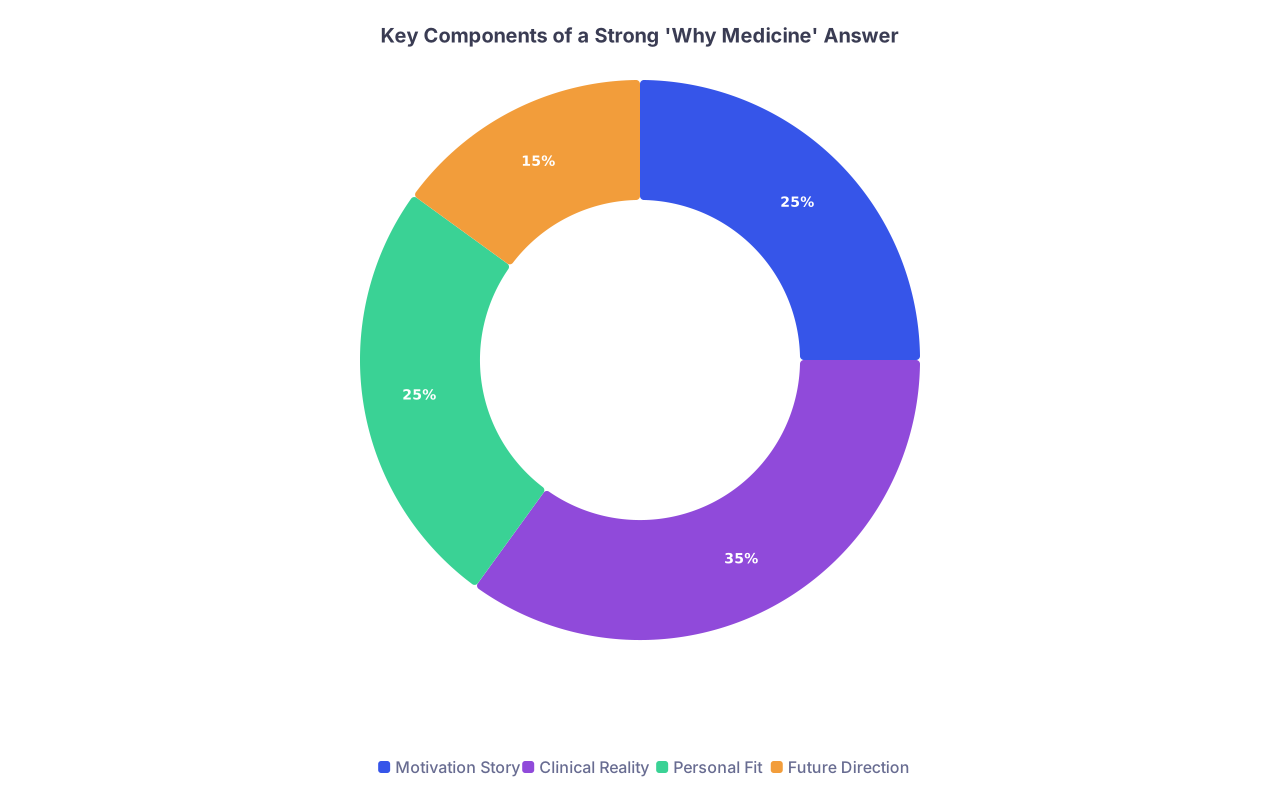
| Category | Value |
|---|---|
| Motivation Story | 25 |
| Clinical Reality | 35 |
| Personal Fit | 25 |
| Future Direction | 15 |

| Step | Description |
|---|---|
| Step 1 | List Top Experiences |
| Step 2 | Extract Surprises & Lessons |
| Step 3 | Identify Personal Themes |
| Step 4 | Draft Spark & Reality Testing |
| Step 5 | Add Personal Fit & Future Vision |
| Step 6 | Practice Out Loud & Refine |
FAQ: “Why Medicine” Question – 7 Quick Answers
Is it bad to talk about money, stability, or job security as part of my reason?
Yes, in this context it usually lands badly. Everyone knows medicine can be stable and well-compensated, but centering that in your answer makes you sound transactional. You can acknowledge wanting a career with long-term responsibility and impact, but leave salary and “stability” out of your “why medicine” pitch.Can I say I do not know my future specialty yet?
Absolutely. In fact, it often sounds more mature. Say something like, “I’m open on specialty, but I’m drawn to [type of work: longitudinal care, procedures, acute care, etc.].” Show you’ve thought about the kind of physician you want to be without pretending to have it all figured out.What if my main motivation really is a family illness or personal health story?
That’s fine as a starting point, but it cannot be the entire answer. Use it as the spark, then spend most of your time on what you did afterwards: the experiences you sought out, what you learned about medicine, and why you still chose it after seeing the harder realities.How long should my “Why medicine?” answer be in an interview?
Aim for 1.5 to 3 minutes. Under a minute usually means you’re being shallow. Over 3 minutes and you’re monologuing. Practice with a timer until you can hit a sweet spot where you cover spark, reality testing, understanding, fit, and future without rambling.Is it okay to reuse parts of my personal statement answer?
Yes, but don’t recite. Use the same core story and themes, but speak more conversationally. Interviewers want to feel like they’re hearing a thoughtful person talk, not listening to your essay in audio form. Change the wording, keep the backbone.Do I have to mention research, leadership, or other CV items in this answer?
Only if they’re genuinely part of your “why medicine” story. For example, research that changed how you see disease or health systems can absolutely belong. But don’t stuff your resume into this answer. They’ll ask about research separately. Here, you’re explaining motivation and fit.How do I handle it if my motivation changed over time (e.g., started premed for the wrong reasons)?
Own it—briefly—and show your evolution. For example: “I’ll be honest, I started premed in freshman year because I was good at science and my parents liked the idea. But over time, working in X setting and doing Y experience shifted my reasons. Now, what keeps me committed is…” Interviewers respect honest growth when it’s paired with concrete experiences and a clear current rationale.
Open a blank document right now and write three specific clinical moments that stick in your mind—good or bad. Those are the raw materials of your “Why medicine” answer. Build from there.