
It’s 8:25 a.m. You’re sitting in a too-bright conference room on interview day, wearing the same navy suit as three other people in the corner. You’ve rehearsed your answers. You’ve memorized your “Three Reasons I Want To Be A Doctor” speech. You’ve even practiced your smile in the mirror.
Five hours later, you’re back in your hotel room, exhausted. You think you nailed it. You hit all your talking points. You said “passionate” at least six times.
Meanwhile, down the hall, there’s another applicant who walked into the same interviews with less-perfect answers, a couple of small stumbles… but a quiet, grounded presence and real curiosity about the patients, the school, and the people in front of them. Faculty walked out of those rooms saying:
“Did you meet that student from [X]—very thoughtful. I liked them.”
Guess who’s more likely getting ranked higher.
Let me tell you what actually happens behind those closed doors and why calm, genuinely curious applicants routinely beat the perfectly polished ones. This isn’t theory; it’s the pattern you’d see if you sat in our debrief meetings month after month.
What Interviewers Are Actually Looking For (That No One Says Out Loud)
Here’s the part premed advisors rarely tell you: nobody on the committee is impressed that you rehearsed your answer to “tell me about yourself.”
That’s the bare minimum.
Interviewers–especially seasoned attendings and program/committee members–are trying to answer a few very specific questions:
- Can I see this person sitting across from a scared patient at 2 a.m.?
- Will they be safe, teachable, and trustworthy under stress?
- Will they make the team better or worse?
We don’t say it in the brochures, but that’s the truth.
Now look at those three questions. None of them are answered by how polished you are. They’re answered by:
- How regulated your nervous system is in conversation
- Whether you can actually listen, respond, and think in real time
- Whether your curiosity overrides your need to perform
A calm, curious applicant makes everyone in the room feel:
“I can work with this person.”
A polished, robotic one makes them feel:
“I have no idea who this person really is, and I don’t want to find out the hard way.”
That’s why the calm ones win.
What “Polished” Looks Like From the Other Side of the Table
You’ve been told to be prepared, professional, articulate. Reasonable.
The problem is what that advice turns into when premed anxiety gets hold of it.
Here’s how “polished” actually shows up to us:
- Over-scripted answers that sound like they came from a YouTube video
- Zero follow-up questions that aren’t obviously rehearsed
- Smiling through every topic, even the heavy ones, in a weird, mismatched way
- Not acknowledging uncertainty, ever
- Name-dropping, over-selling, over-branding yourself
- Repeating personal statement lines word-for-word
I’ve sat in faculty rooms hearing comments like:
- “Smooth, but I couldn’t get a sense of who they are.”
- “That was… a performance.”
- “They’re saying the right things. I just don’t buy it.”
You need to understand: faculty see 30, 40, 60+ applicants a season. By 10 a.m., we can smell over-rehearsed language a mile away. The applicant thinks: “I sounded so professional.” The interviewer thinks: “They’ve practiced that answer 20 times; I don’t know how they actually think.”
That gap is where people lose spots.
Why Calm + Curious Is So Powerful
Calm and curious does a few things psychologically, both for you and for the interviewer.
First, calm tells us about your baseline under stress. Not whether you feel calm—everyone is nervous—but whether you can stay tethered enough to listen and think.
Curiosity tells us whether you’re still capable of real human interaction when you care about the outcome.
Here’s how that plays out in the room.
You’re asked:
“Tell me about a time you worked with someone difficult.”
Polished answer:
“Well, during my shadowing at [Hospital], I worked with a very challenging patient. I remained professional, listened actively to their concerns, and collaborated with the healthcare team to develop a patient-centered solution. This experience taught me the importance of empathy, resilience, and communication.”
Clinical. Sterile. You hit all the “right” words and said nothing real.
Calm + curious answer:
You pause. Actually remember the person.
“Sure. I’m thinking of a patient from my volunteer time in the ED. He was angry—swearing at the staff, refusing vitals. I remember feeling a little scared, honestly. I also realized nobody had actually explained what we were waiting for in plain language. When I sat and just asked him what he understood so far, it turned into a different interaction. I didn’t ‘fix’ him, but I learned how much tension comes from miscommunication. I’m still trying to get better at catching that earlier.”
Same general idea. Completely different effect. You just showed:
- Emotional awareness
- Actual learning, not a pre-packaged “lesson”
- Willingness to admit imperfection
- Curiosity about what was underneath the behavior
Faculty trust that a lot more than a flawless speech.
What Calm Actually Looks Like (You Don’t Need to Feel It)
Here’s the twist: the calm applicants don’t necessarily feel calm. Many are buzzing inside. But they’ve figured out how to appear—and eventually become—present enough to function.
From the interviewer’s chair, “calm” looks like this:
- You listen to the entire question without visibly preparing your answer mid-way
- You’re comfortable pausing for 2–3 seconds before responding
- Your speech has normal cadence; you’re not sprinting or dumping words
- You allow yourself to say “let me think about that for a second”
- Your posture isn’t frozen; you shift, breathe, adjust naturally
- When you don’t know something, you say so cleanly and move on
I’ve seen applicants with worse stats get pulled up the rank list because an attending said: “That one? They seemed grounded. I can see them in the ICU at 3 a.m. and not losing it.”
Compare that to the hyper-polished applicant who answers every question instantly, with perfect eye contact, zero hesitation, and a LinkedIn-ready soundbite.
It looks efficient. It does not look real.
And physicians are very, very tuned into who feels real—because we deal with faking all day from patients, consultants, administrators. We’re trained to sense incongruence.
Curiosity: The Trait That Separates “Fine” From “We Want Them”
There’s something else we talk about in selection meetings that applicants underestimate: who actually seems interested in this place, these people, this work.
Not generically. Specifically.
Curious applicants do a few subtle things differently:
They ask questions that grow out of the conversation, not from a pre-written list.
They latch onto details we mention and say, “Wait, how does that work in your system?”
They ask about the hard parts of training here, not just the shiny ones.
They show interest in patients and how care is delivered, not just “research opportunities” and “match lists.”
Picture two applicants at the end of a faculty interview.
Applicant A, polished:
“Thank you so much for your time. I was wondering, what kind of research opportunities are available for students in the first two years?”
We’ve been asked this exact question 200 times. It tells us nothing about you beyond “I know I’m supposed to ask something now.”
Applicant B, calm + curious:
“You mentioned earlier that your clinic serves a lot of uninsured patients and that it affects how you think about tests you order. How do students here learn to balance evidence-based care with real-world constraints like that?”
Now we’re having a conversation. You’re thinking like someone who might actually be responsible for patients someday.
Afterward, the attending says, “They were engaged. Good questions. I liked talking with them.” That comment often carries more weight than the content of any one answer.
How Committees Actually Talk About You
Here’s where you see the payoff.
After interview day, the committee or subcommittee sits down to discuss candidates. Everyone pulls up the file: scores, letters, personal statement, interview notes.
The polished applicant gets comments like:
- “Strong application.”
- “Well prepared.”
- “Professional, but a bit rehearsed.”
- “Didn’t get a strong sense of their personality.”
These comments sound neutral. They’re not. They’re code for “we could take them, but there’s no one in this room fighting for them.”
The calm, curious applicant gets comments like:
- “I really liked talking with them.”
- “They asked great questions.”
- “Seemed very thoughtful and mature.”
- “Not the highest stats, but I’d be happy to work with them.”
You want someone on that committee saying, “I’d be disappointed if we lost them.” That’s the applicant who gets rescued when the algorithm wants to drop them a few spots.
Here’s the unspoken ranking logic:
When two candidates are statistically similar, the tiebreaker is almost always, “Who did people like more?”
Not in a superficial way. In a “who do we trust and want on our team” way.
Calm and curious is extremely likable to clinicians. Polished but opaque is not.
Where “Polished” Training Actually Hurts You
Let me walk through a few common pieces of mainstream advice that sabotage applicants.
1. Memorizing “perfect answers” to everything
You rehearse:
- “Tell me about yourself”
- “Why medicine?”
- “Why this school?”
- “Greatest strength/weakness”
Then the interviewer asks something slightly off-script:
“Who’s the most difficult type of person for you to work with, and what happens to you internally when you’re around them?”
Now you’re exposed. The mask slips. You either:
- Force your generic “I sometimes care too much” weakness answer into the question and sound fake
- Or panic, because this wasn’t in your notes
Curious applicants treat questions like prompts for exploration, not tests. They respond to the actual question, sometimes with,
“Hmm, that’s interesting. I think the people I struggle with most are…”
They’re not aiming for perfection. They’re aiming for honesty plus reflection. Which is much easier to maintain across a full day.
2. Over-practicing with friends / advisors who reward smoothness
A lot of mock interview feedback is garbage because people praise the wrong things:
“You sounded really confident.”
“That answer was so polished.”
“You didn’t say ‘um’ once!”
You internalize that as the goal. So you sand off every rough edge until there’s nothing left that sounds like you. Then you end up in front of a 62-year-old nephrologist who’s been interviewing for 20 years, and he can’t stand it.
Better practice metric:
“Did I actually feel like myself just now?”
“Did I say anything that surprised me?”
“Did I learn something new from my own story when I said it out loud?”
If the answer is always no, you’re practicing to be a performer, not a physician.
3. Treating questions as traps instead of invitations
Polished applicants assume every question is a landmine and try to detect the “correct” answer.
Calm, curious applicants treat questions as:
- “What does this person want to understand about me?”
- “What might be interesting here?”
So when asked, “What do you think will be the hardest part of medical school?” they don’t say:
“I think the hardest part will be balancing my commitment to patient care, research, and self-care, but I’m confident in my time management skills.”
They might actually answer:
“I suspect it’ll be tolerating not knowing enough, especially early on. I like to feel competent, and medicine seems designed to expose your gaps daily. I’m trying now to get more comfortable asking for help sooner instead of hiding when I don’t know something.”
Every clinician in the room thinks:
“Yep. That’s the job. And they already see it.”
How To Train Calm + Curiosity (Without Becoming Sloppy)
If you’re reading this thinking, “Okay, but what do I actually do differently?”, here’s the insider version. It’s not about abandoning preparation. It’s about preparing for presence, not performance.
First, understand the risk balance:
| Style | Pros | Cons |
|---|---|---|
| Over-Polished | Fewer awkward pauses | Feels scripted, hard to trust |
| Under-Prepared | Feels authentic (sometimes) | Disorganized, can ramble, misses point |
| Calm-Curious | Real, thoughtful, engaging | Requires comfort with imperfection |
Your goal is the third column: prepared enough not to flail, loose enough to be real.
A few concrete shifts:
Rewrite your stories, not your scripts.
Pick 6–8 real experiences (clinical, personal, academic). For each, know:- What actually happened
- What you felt
- What changed in you afterward
Then stop. Don’t memorize sentences. You want flexible stories, not pre-recorded speeches.
Practice pausing on purpose.
In mock interviews, force yourself to pause 2 seconds before every answer. At first it feels unbearable. On camera, it looks normal. You’re giving your brain room to think instead of auto-play the script.Add one real-time observation in every answer.
Something like:
“As I’m thinking about it now, I realize…”
or
“I didn’t fully appreciate this at the time, but looking back…”That’s curiosity about your own experience. Faculty love that.
Ask questions that only make sense at this school with this person.
If you could ask the same question at every single school, it’s probably generic. Use what they’ve told you during the interview to build a question. That signals real engagement.
What This Looks Like Over a Full Interview Day
Here’s the pattern I see every year.
Polished applicant arrives with a mental checklist. As the day goes on, they burn out:
- Morning: high energy, answers smooth.
- Midday: script starts to crack; they repeat phrases, sound tired.
- Afternoon faculty interview: they’re in survival mode, leaning harder on rehearsed lines.
By the last interview, their “Why our school?” answer sounds identical to the morning version, just flatter.
Calm, curious applicant behaves differently:
- Morning: a little nervous, maybe a touch slower, but listening hard.
- Midday: they’ve picked up details from the info session, students, and tours and are weaving those into conversations.
- Afternoon: they’re asking more specific, grounded questions. They’ve warmed up and actually seem more themselves as the day goes on.
By the end, faculty and residents are saying, “They seemed even better in the last interview than the first.”
Who do you think we remember?
To make it explicit:
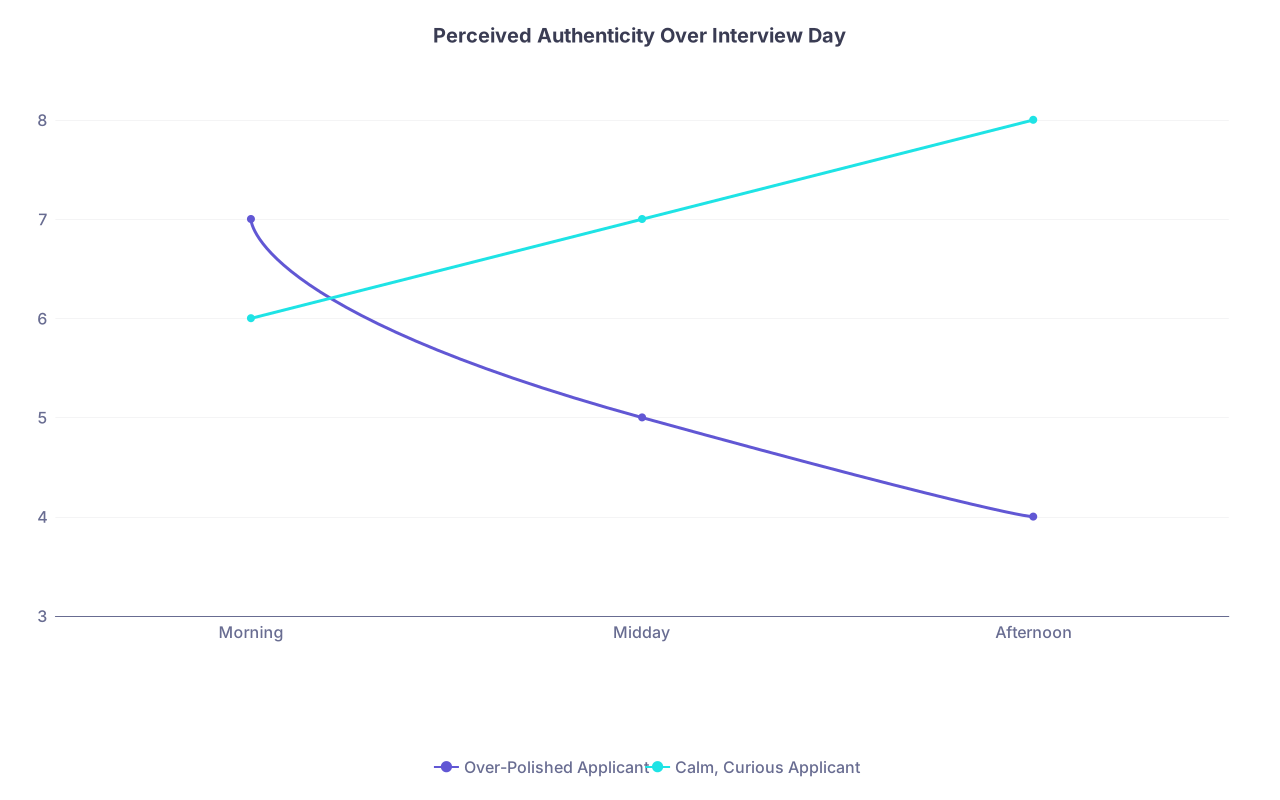
| Category | Over-Polished Applicant | Calm, Curious Applicant |
|---|---|---|
| Morning | 7 | 6 |
| Midday | 5 | 7 |
| Afternoon | 4 | 8 |
That’s the curve you’re aiming for. Start good. End better.
The MMI Twist: Where Calm + Curious Really Exposes the Fakers
Multiple Mini Interviews (MMIs) were basically built to punish over-polished applicants.
Why? Because you can’t script 10 different 7-minute scenarios with changing roles, ethical dilemmas, and communication tasks. If you try, it shows.
I’ve watched this happen in MMI circuits:
The polished applicant delivers a flawless “respect for autonomy” mini-lecture to a standardized patient who just wants to feel heard. The rater writes: “Used correct language, but did not respond to patient’s actual emotion.”
The calm, curious applicant stumbles once or twice, but says, “You look really upset right now. What’s the hardest part of this for you?” Then stays quiet. The rater writes: “Connected emotionally, adapted response, strong communication.”
Remember: MMIs are scored on domains like communication, empathy, ethical reasoning, and adaptability—not on how clean your paragraph sounded.
Curiosity naturally hits those targets. Polished performances fall flat as soon as the scenario goes off-script.
One Mental Reframe That Changes Everything
Stop seeing the interview as an oral exam you can ace with the right key. See it as a series of conversations where the other person is quietly asking themselves:
“Would I trust this person with my patients and my team?”
Once you accept that as the question, the strategy becomes obvious:
- You show up regulated enough to think and listen.
- You let your curiosity push through your anxiety.
- You drop the fake gloss that makes you look safe but unknowable.
Calm, curious applicants aren’t better at “selling” themselves. They’re better at letting us see enough of the real person to make a confident decision.
Final Takeaways
- Over-polished interviews feel safe to you and untrustworthy to faculty. Calm + curious feels a bit riskier to you and far more convincing to us.
- You don’t need perfect answers. You need real stories, thoughtful reflection, and the ability to pause, think, and ask good questions.
- Selection committees remember the applicants they enjoyed thinking with, not the ones who sounded most like a premed blog post. Aim to be that person.