
The first 60 seconds of your interview can override 4 years of stats.
I am not exaggerating. I have watched an applicant with a 510 MCAT crush “Tell me about yourself” so hard that a room full of faculty started lobbying for them over someone with a 522 who came in stiff, formulaic, and forgettable.
You’ve been taught to worship numbers. GPA. MCAT. Class rank. Those matter for screening. But once you are in the interview chair, I will tell you exactly how program directors and admissions committees think: your “Tell me about yourself” answer is the control-alt-delete for everything we think we know about you on paper.
If you blow that opening, we spend the rest of the interview trying to figure out what went wrong. If you nail it, we spend the rest of the interview trying to prove ourselves right for liking you.
Let me walk you through what really happens on our side of the table—and exactly how to build an answer that quietly outperforms your MCAT.
What’s Actually Going Through Their Heads When You Start Talking
On the schedule, you’re just “9:30 – Applicant #4.” We’ve seen your file. Maybe.
Here’s the real sequence.
Thirty seconds before you walk in, someone is skimming your ERAS / AMCAS printout or PDF. They’re not memorizing your MCAT; they’re trying to answer three questions before you even sit down:
- Do I have to be on guard for any obvious red flags?
- Is this going to be another identical overachiever with no personality?
- Is there anything interesting I can ask about?
Now you walk in. Small talk. You sit. We ask some variant of: “So, tell me about yourself.”
This is not a warm‑up. It is the diagnostic exam.
In those first 60–90 seconds, we are subconsciously grading you on things no one ever lists on the website:
- Would I want this person as my student / colleague?
- Can they talk to a stranger like a human being?
- Do they have a spine, or are they just reciting what they think we want to hear?
- Do they sound like the same person who wrote this personal statement?
If your MCAT was a blood test, “Tell me about yourself” is the physical exam. And any clinician will tell you: a perfect lab value doesn’t save a patient who looks terrible at the bedside.
We’ve all sat through this disaster pattern:
“Uh… so I’m originally from [City], I went to [College] where I majored in biology and minored in chemistry, I took the MCAT in [Month] and I’m really passionate about helping people…”
As soon as the word “passionate” shows up in sentence two, we mentally check out. You’re giving us your CV in paragraph form. You’re not giving us you.
That’s the core mistake. Thinking this question is asking “summarize your accomplishments,” when what we’re actually asking is:
“Who am I dealing with? And will they be a nightmare to teach and work with?”
Why This One Answer Can Outweigh Your MCAT
Let me be blunt: by the time we interview you, your MCAT is largely done doing its job.
You got screened in. Congratulations. The 515 that got you in the door and the 520 that got someone else in the door are now both just “strong enough.” We’re not holding a scorecard under the table as you talk.
What we are doing is something like this:
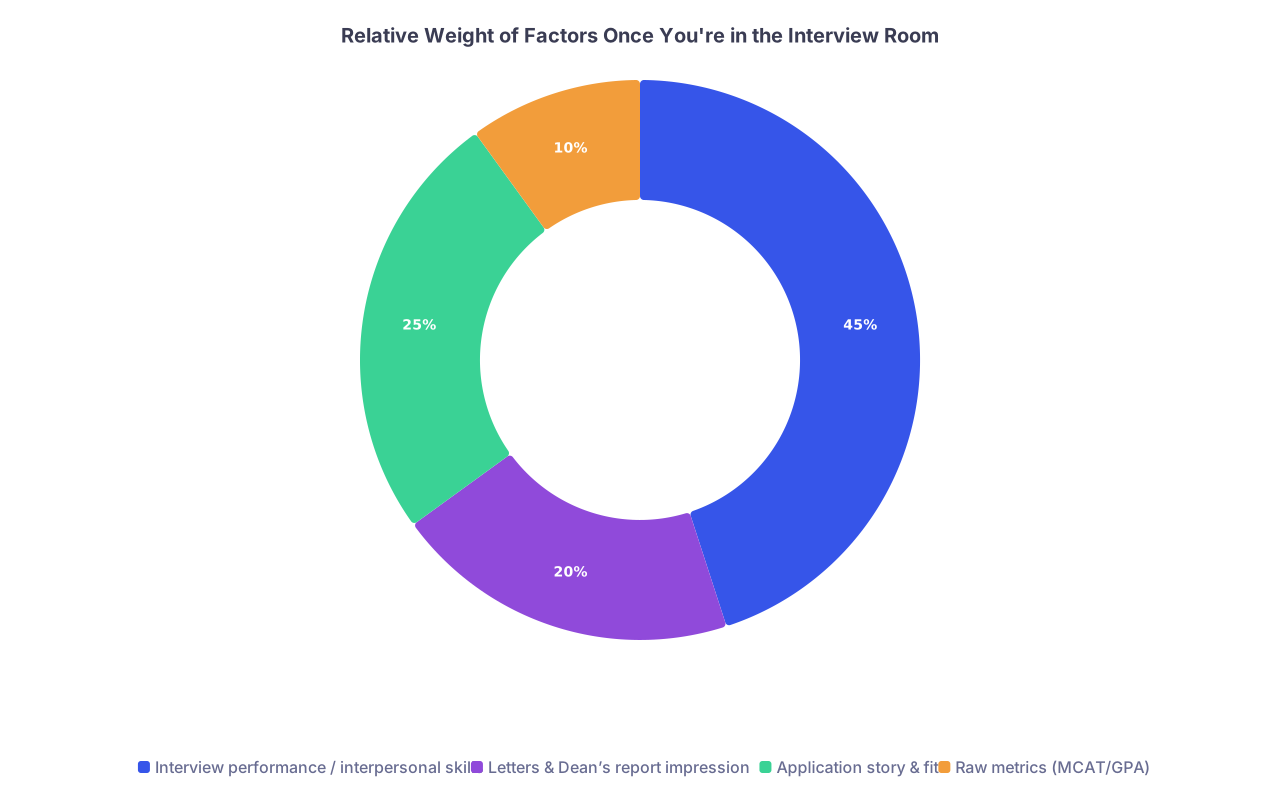
| Category | Value |
|---|---|
| Interview performance / interpersonal skills | 45 |
| Letters & Dean’s report impression | 20 |
| Application story & fit | 25 |
| Raw metrics (MCAT/GPA) | 10 |
No one will publish that chart on an official website. But versions of that conversation happen behind closed doors constantly.
I’ve heard it word for word:
- “Her MCAT is a little lower than average, but she was fantastic in person, really thoughtful.”
- “Look, his numbers are great, but he was flat. I can’t see him on our wards.”
- “We can teach medicine. We can’t teach not being weird.”
Do some programs overweight numbers? Of course. Especially for pre‑interview screening. But when I’m sitting in a ranking meeting for a competitive program, the arguments are rarely “She had a 516 and he had a 513.” They’re “She really impressed me; he felt rehearsed” or “He lit up when he talked about teaching; that fits us.”
Your “Tell me about yourself” answer is the first, cleanest piece of data we get on:
- Emotional intelligence
- Self‑awareness
- Communication
- Authenticity
- Maturity
You can’t fake those with a score report.
What Strong Interviewers Actually Do With Your Answer
Faculty do not all interview the same way. But there’s a pattern you should assume.
We use your answer as:
A stress test
Can you talk when the script runs out? This is a low‑stakes, open question that simulates rounds, talking to patients, talking to families. If you crumble here, I don’t trust you in harder moments.A roadmap
Whatever you highlight, I’m going to probe. If you lead with “I’m really interested in research,” expect targeted questions. If you center family, values, or a key experience, that’s where I’ll dig.A calibration tool
Your answer either matches or contradicts the impression from your personal statement and letters. If you wrote a poetic story about resilience and then answer this like a robot, the dissonance is a red flag.
There’s also a psychological quirk no one tells you about: primacy bias. The first strong impression tends to anchor the rest of the interview. If you come out focused, coherent, and grounded, we interpret later small stumbles more leniently. If you start scattered? We start hunting for flaws.
This is why that first answer matters more than you think. It’s not just “one question.” It’s the frame for everything that follows.
The Anatomy of an Answer That Makes Committees Fight For You
Let me walk you through what a high‑level “Tell me about yourself” answer actually looks like from our side of the table.
No, it’s not a script. Scripts sound fake. I’ve seen candidates literally move their eyes up and to the left while reciting something their advisor clearly drilled into them. It’s uncomfortable.
What you want is a structure that keeps you honest and coherent.
Think in three beats:
- Who you are as a person now
- The arc that got you here
- Where that arc is pointing in medicine
Notice what’s missing: any mention of MCAT, GPA, or “hard‑working, dedicated, passionate.”
1. Start with identity, not credentials
Good openers are clean and human.
“I grew up in a small town in Arizona, and I’ve always been the person in my family who people go to when something is wrong—medical or otherwise. Right now, I’m a senior at X University where I split my time between the emergency department, teaching organic chemistry, and actually learning to cook something other than eggs.”
That kind of start does three things: orients us geographically, hints at personality, and signals you’re not just a stack of accolades.
Weak opener that sounds like everyone else:
“I’m a senior at X University majoring in biology, with a minor in chemistry, and I’m applying to medical school because I’ve always been interested in science and helping people.”
I cannot tell you how many times I’ve heard that almost verbatim. When I do, I already know this interview will be uphill.
2. Tell a focused story, not your full life history
The middle of your answer should be a very short, curated story. One throughline. Not everything you have ever done.
For example:
“In high school, my younger brother was in and out of the hospital with poorly controlled asthma. I remember one resident who actually sat on the edge of his bed and explained to him—at his level—what was happening and what he could do. That interaction stuck. When I got to college, I started volunteering at a free clinic that serves a large immigrant population, and I found myself drawn to that same kind of bedside teaching, especially when there were language and trust barriers.”
There’s a clear thread: family experience → curiosity about medicine → service → emerging identity. That’s what I remember after you leave.
The mistake is the chronological laundry list:
“I did research in a cardiology lab, I volunteered at the hospital, I shadowed an orthopedic surgeon, I was part of AMSA, and I did some tutoring…”
That tells me nothing about you. Only that you can check boxes.
3. Land the plane: who you are now and what you’re like to work with
You do not need to know your specialty. You do need to convey what kind of colleague and learner you are.
Something like:
“Those experiences have made me someone who’s very comfortable in chaotic environments, but also very aware of how much small moments of communication can change a patient’s experience. I’m excited about medical school because I want to take that instinct and actually pair it with real clinical skill, and I’m especially interested in schools where students get early, meaningful patient contact.”
That tells us:
- You’ve reflected on your experiences.
- You know what kind of environment energizes you.
- You’re already thinking like a future clinician.
Compare that to:
“So overall I think I’m a hard worker and very passionate about medicine and I’m excited for the opportunity.”
Empty calories.
How This Plays Differently for High‑ and Lower‑MCAT Applicants
The cruel truth: the same answer doesn’t land the same way for everyone.
Here’s the behind‑the‑scenes dynamic.
| Applicant Type | Quiet Internal Question | What Your Answer Needs to Do |
|---|---|---|
| Very high MCAT (520+) | Are they more than a test-taker? | Show warmth, humility, and team orientation |
| Average-strong MCAT (510–519) | Solid baseline—do they fit our culture? | Show clear story and interpersonal ease |
| Below-average MCAT for this school | Did we misjudge, or are they a hidden gem? | Radiate maturity, thoughtfulness, and growth potential |
No one is saying this out loud, but you will feel it in how questions are asked.
If you’re the 522, we’re looking for reasons to believe you’re not a stereotype: brilliant, socially awkward, inflexible. If your opening answer is robotic, hyper‑technical, or ego‑heavy, that stereotype hardens. If you come across as grounded and generous? Now we’re excited.
If you’re sitting on a 505 at a place where the median is 515 and you got a shot because something else about your application screamed “interesting,” your “Tell me about yourself” answer is your chance to justify the risk someone took moving you from a maybe to an invite. You need to show that you think clearly, speak clearly, and have depth. That can fully compensate for a weaker score—if we believe you will thrive once you’re actually here.
I’ve personally watched a committee put a 503 applicant onto the ranked-to-match list in front of multiple 515+ applicants. Not because we were blind to scores. Because that 503 came in with a coherent life story, real insight from years as an EMT, and presence that made every faculty in the room say, “That’s going to be a phenomenal clinician.”
The MCAT is a risk estimate. Your interview is the correction factor.
The Subtle Red Flags Hidden in Your Answer
Let me give you the stuff advisors rarely say out loud, but faculty talk about after you leave the room.
Here are patterns that quietly sink candidates regardless of their MCAT:
The “brand deck” answer
You sound like a LinkedIn post: over‑optimized, buzzwordy, no rough edges. We do not trust you. Medicine is messy. If you can’t even talk like a real person here, what will you do when families are crying in front of you?The overshare
Turning this into a therapy session about your trauma, your family drama, or your unresolved resentment toward previous institutions makes us nervous. You can reference hard things, but if the emotional work is clearly unfinished, we see risk.The martyr
If your answer is a monologue about sacrifice, suffering, how hard you’ve worked compared to others, we hear: “This person may be brittle and difficult on a team.”The empty grindset
“I love to work hard, I push myself, I like to be busy all the time.” Sure. So does everyone. If there’s nothing deeper—no curiosity, no human hook—you sound like a future burnout case.The vague wanderer
“I’ve tried a bit of everything and I’m keeping my options open.” That’s fine in reality. But if your answer has no clear throughline, we worry about commitment and follow‑through.
You don’t have to be flawless. But you do need to sound like someone we’d trust with a vulnerable patient, at 2 a.m., when no one is around to supervise your character.
How to Actually Build and Practice Your Answer (Without Sounding Fake)
You cannot wing this. But you also cannot memorize it word for word. The balance is to rehearse structure, not script.
Here’s the process I’ve seen work for serious candidates:
Write it long
Sit down and write out your answer in full. Don’t worry about time. Just get the story out—identity, key experiences, who you are now.Strip it to 90 seconds
Read it aloud and cut. Anything that sounds like a bullet point from your CV? Cut. Anything that could be said by 1,000 other applicants? Cut. Leave the parts that only belong to you.Check for three beats
- Who you are (present)
- How you got here (short arc)
- Who you are becoming (as a future physician)
Record yourself
Your phone is fine. Watch it once as if you were an interviewer. Do you look like someone you’d want to work with at 5 a.m.? Or someone giving a class presentation? Adjust.Practice with a human who will be blunt
Not your nicest friend. The one who tells you when something is cringe. Ask them: “Does this sound like me, or like an interview robot?”
Then stop tinkering. Over‑practiced answers feel dead. Once it’s good, your job is to get comfortable saying some version of it, not to hit every comma.
Why This Matters Even Before You Apply
You’re premed or early in med school? Good. This is the perfect time to start thinking this way.
The best “Tell me about yourself” answers are not invented senior year. They’re the natural result of making choices that are consistent with who you are.
If you know your throughline is teaching and mentorship, you’ll start seeking roles that reflect that: TA, peer tutor, community educator. If your throughline is immigrant health, you’ll gravitate to clinics, language work, advocacy. That way, when you sit down years later and someone says, “Tell me about yourself,” you’re not scrambling to reverse‑engineer a fake theme.
You’re just describing your life.
And here’s the punchline: that’s exactly the person we want to admit.

| Step | Description |
|---|---|
| Step 1 | Premed focused only on GPA/MCAT |
| Step 2 | Collect random activities |
| Step 3 | Weak, generic story |
| Step 4 | Forgettable interviews |
| Step 5 | Premed reflecting on identity early |
| Step 6 | Choose aligned experiences |
| Step 7 | Clear personal throughline |
| Step 8 | Compelling Tell me about yourself |
| Step 9 | Stronger overall evaluations |
FAQ – No-Nonsense Answers
1. How long should my “Tell me about yourself” answer actually be?
Aim for about 60–90 seconds. Under 45 seconds, you probably gave a shallow or generic answer. Over 2 minutes, you’re rambling or listing your CV. You want just enough to give us a clear mental picture and a few hooks to ask about, then stop and let us lead.
2. Should I mention my MCAT, GPA, or specific awards in this answer?
No. We already see your numbers. If you bring them up unprompted, you risk sounding insecure or boastful. Use this answer to show what your application cannot show well: your personality, your reasoning, your values, how you think. If we want to talk about scores or academics, we’ll ask.
3. What if my story isn’t dramatic or “special” enough?
That’s usually your own insecurity talking. We’re not looking for tragedy or heroism; we’re looking for clarity and honesty. “I liked biology, I liked working with people, and over time I realized I’m happiest when I’m in service roles” is fine—if you back it up with real experiences and speak like a genuine human. A simple, coherent story told well will beat a melodramatic, over‑polished narrative every single time.
Key points to remember: once you’re in the interview chair, your MCAT is background noise; how you open your mouth is front and center. “Tell me about yourself” is not small talk, it’s the exam you were never formally warned about. Treat that answer with the same respect you gave your MCAT prep, and you’ll see just how often it tilts decisions in your favor.