
The scene you do not see
It’s 6:45 pm. The interview day is long over. You’re at home obsessively replaying your answers to “Tell me about yourself,” wondering if you talked too fast.
Across town, in a small conference room with bad coffee and worse fluorescent lighting, three faculty and one dean have your name on the screen.
Two applicants. Same GPA. Same MCAT. Similar extracurriculars. Both “strong” in the pre-interview scoring system.
The dean leans back and says something like:
“Alright. They’re basically tied on paper. Let’s see what the interviews show.”
This is the moment you never get to see.
This is where your interview actually earns (or loses) you a seat.
Let me walk you through what really happens in that room.
First: how tightly bunched you actually are
Programs will never say this out loud, but I’ve seen the spreadsheets. Once you clear a school’s basic academic threshold, you blend into a massive gray zone.
You think you’re being compared to the mythical “average applicant.” You’re not. You’re being compared to your direct competition that year: the 40–60 people with very similar numbers and activities.
At many med schools, the pre-interview screen produces some kind of composite score. It might weight:
- GPA and MCAT
- Rigor of coursework / school name
- Shadowing, clinical exposure
- Research
- Service, leadership
- Disadvantage / context flags (first-gen, SES, etc.)
- “Mission fit” tags from readers (rural, primary care interest, diversity, etc.)
Then they draw a line.
- Above line: interview
- Below line: no interview
- In the “maybe” band: dean or committee debate
By the time you’re invited, the committee usually sees you as “academically OK enough that we’d accept if the person doesn’t derail in person.”
So on pre-interview paper scores, you and a huge chunk of invitees are within a very narrow band. That’s why interview performance suddenly matters far more than you think.
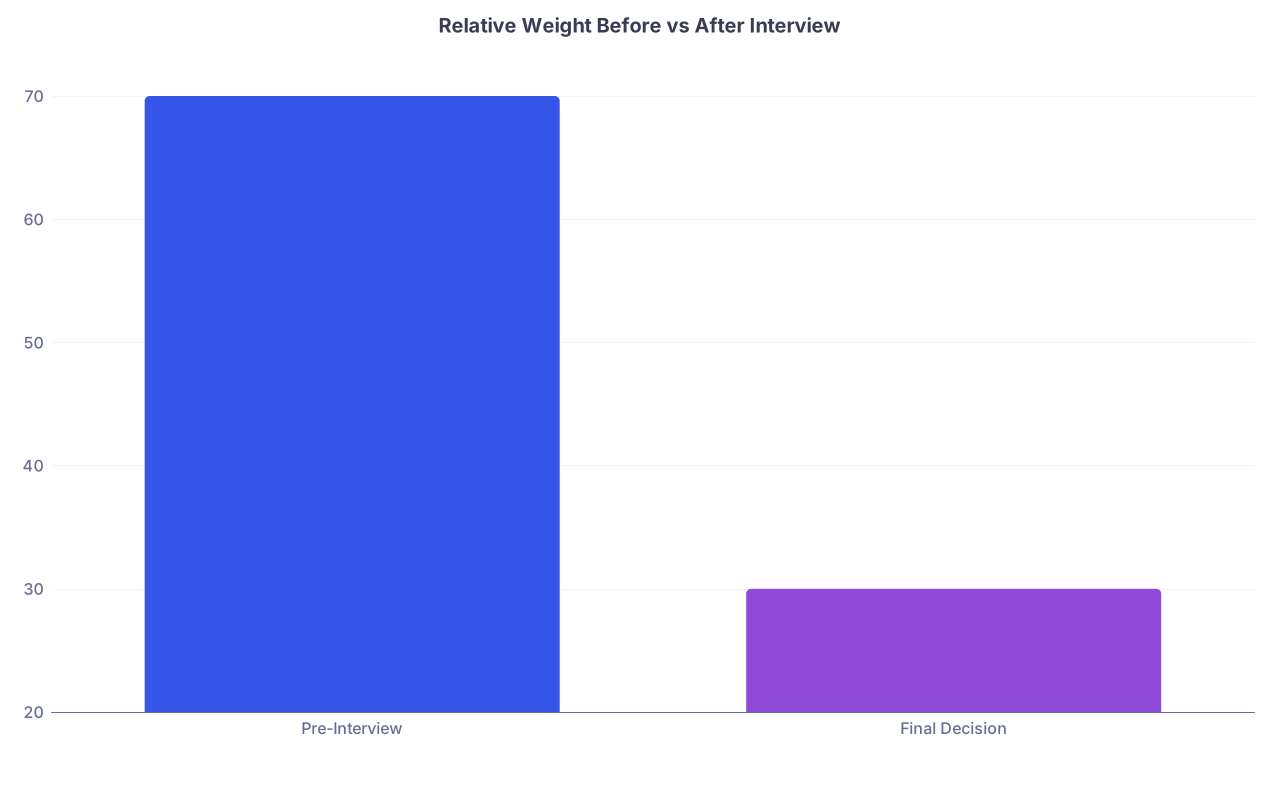
Here’s what that looks like when admissions leaders are honest over a beer:
| Category | Value |
|---|---|
| Pre-Interview | 70 |
| Final Decision | 30 |
What that chart doesn’t show: inside that “final decision” 30%, your interview is often the tiebreaker for people who look nearly identical on the spreadsheet.
What committees actually look at after interviews
The myth is that they “holistically” review you again from scratch.
Reality: they pull up your file, glance at a pre-interview score or summary, then flip straight to the interview evaluations. Because that’s the only new data.
Different schools format these differently, but you’ll see some version of:
- Numerical ratings from each interviewer (1–5 or 1–10)
- Free-text comments
- “Recommended: Accept / Waitlist / Reject” boxes
- Sometimes a professionalism / red-flag checkbox
Let me be blunt: the numbers matter far less than the comments. Everyone knows Dr. X grades harshly and Dr. Y gives everyone 9/10. What cuts through are the lines people actually write.
I’ve sat in meetings where nobody mentions the interview score at all. They read one line of comment out loud and that’s it. Decision made.
You’ll hear things like:
- “Student A: ‘Would be an asset to any class. Mature, thoughtful, great insight into patient care.’”
- “Student B: ‘Polite but canned. Could not articulate any real self-reflection.’”
On paper those two applicants might both have “4.3/5” interview scores. The committee doesn’t care. They care which one they feel safer betting four years and $250,000+ of institutional investment on.
How ties actually show up in the room
Ties are not a theoretical thing. They’re concrete.
Imagine this typical scene at a mid-tier MD program:
They have 8 acceptances left to give in a “round.” On the screen is a queue of 20 interviewed applicants who are in range for those 8 spots.
Nobody is comparing #1 vs #20. They’re focused on the big cluster in the middle: the group where any of them “could” be accepted or waitlisted without violating policy.
That’s where the interview becomes a weapon. The back-and-forth usually sounds something like this:
“Alright, Weisman vs Patel. Metrics almost identical. Any strong feelings?”
Someone scrolls to the interview notes.
“Weisman: ‘Strong communicator, clear understanding of team roles, able to admit limitations. Genuine with patients.’”
“Patel: ‘Intelligent but defensive when asked about weaknesses. Over-rehearsed answers.’”
No one in that room is saying, “But Patel’s MCAT is 1 point higher.” They don’t care. By this point, that noise is background.
They care who will embarrass them less on the wards and who will be easier to remediate if things go south. The tie breaks almost instantly in favor of the one whose interview comments show:
- Maturity
- Self-awareness
- Genuine motivation
- Ability to work with others
Not the one who sounded like they memorized Reddit threads.
The three unspoken “buckets” your interview drops you into
Admissions offices don’t always label them this way, but this is how people actually talk behind closed doors.
Bucket 1: The “easy yes”
These are the applicants who make people in the room literally say, “Oh, I liked them a lot.”
On paper, they might be “above average” but not insane. What pushes them over?
Things like:
- Interviewers write: “Top 10% of candidates I’ve met this year”
- Multiple interviewers independently mention the same strength (“very grounded,” “phenomenal insight into underserved care”)
- Strong storytelling that clearly connects experiences to your motivations, not just a list of things you did
- They seemed comfortable being themselves, not auditioning
In tie situations, anyone in Bucket 1 almost always gets pushed up. You beat the equivalent-GPA Kid Who Gave Textbook Answers every single time.
Bucket 2: The “safe middle”
This is where most people land.
Polite. Competent. Nothing obviously wrong, nothing particularly memorable.
Interview comments for this group sound like:
- “Pleasant, articulate, standard premed story.”
- “Did fine. Answers somewhat generic but appropriate.”
- “Would be a solid medical student.”
You are tied with a lot of people here. Where you fall in this bucket only matters when the committee starts splitting hairs, and that’s when tiny details of your interview comments get weaponized.
- One note about “great insight into dealing with failure” can nudge you above another “safe” applicant.
- One note about “seemed unsure about why this school specifically” can shove you down.
This is why the “I’ll just be normal and not mess up” strategy is so dangerous. The pool of “did fine” is already enormous.
Bucket 3: The “no, thank you”
You don’t need to scream something offensive to land here. That’s the obvious red flag category. More subtle versions land here too.
Comments like:
- “Overly rehearsed, could not provide concrete examples beyond rehearsed lines.”
- “Minimized responsibility in discussing an ethical lapse.”
- “Dismissive about certain patient populations.”
- “Troubling lack of insight into own limitations.”
- “Seemed to be applying to med school because ‘I like science and helping people,’ no deeper motivation discussed.”
In a tie situation, anyone with even a faint whiff of Bucket 3 loses. No contest.
Nobody wants to defend, in front of the dean, why they accepted the applicant that two people called “defensive” when they could’ve accepted another applicant with fully clean interview notes.
The specific interview moves that break ties in your favor
Let’s get tactical. What, concretely, do “tie-breaking” interviews look like from the committee side?
I’ll give you some patterns that show up in notes and sway discussions.
1. Crisp, grounded “why medicine” that’s not a personal statement rehash
Committees are bored of vague origin stories. They want to see how you think now.
The applicants who stand out tie their narrative together in a way that gives the interviewer good phrases to write down. Think “coherent story spine,” not melodrama.
Example of what leads to strong notes:
- You briefly connect a key experience (family illness, longitudinal clinic volunteering, scribing)
- You show how that changed your understanding of what physicians actually do day to day
- You talk specifically about responsibilities, tradeoffs, and sacrifices you’re saying yes to
- You avoid cliché phrases like “I just want to help people” as your main thesis
Then the note reads: “Thoughtful and realistic understanding of the profession. Has seen both the hard and rewarding parts.”
When that note is sitting next to someone else’s “Standard answer, heavy on cliché” in a tie situation, you win.
2. Real self-reflection on mistakes and weaknesses
This is a big one. Committees are obsessed with how you handle things when you’re wrong. Because you will be wrong. A lot.
Weak candidates try to dodge:
- “My greatest weakness is that I care too much.”
- “I’m a perfectionist.”
- “I work too hard and can burn out.”
Interviewers roll their eyes and write: “Canned answer to weakness question. Lacked depth.”
The people who break ties in their favor do this instead:
- Name a specific, believable weakness (difficulty delegating, speaking up in conflict, overcommitting)
- Give a concrete example of when it caused a problem
- Explain what you did to address it, with specific actions
- Acknowledge it’s ongoing work, not a finished product
Now the note says: “Excellent insight into own growth areas. Already taking steps to improve. Will be coachable.”
In a borderline choice, “coachability” is gold.
3. Ability to talk about others, not just yourself
When an interviewer asks about a team conflict, a difficult patient, or leadership, the committee is really looking for: Do you make everything about you?
The tie-breaking candidates:
- Give credit to others unprompted
- Don’t throw teammates under the bus
- Take responsibility for their role in conflicts
- Don’t portray themselves as the lone hero in every story
Notes then include lines like: “Collaborative mindset. Appears to work well with others and share responsibility.”
In contrast, the self-centered storyteller gets: “Minimized own role in conflict. Spent most of answer criticizing others.” Easy tiebreaker.
4. Specificity about the school—without fawning
You don’t need to memorize every institute and NIH grant. But if your answer to “Why our school?” sounds like it was copy-pasted across 15 interviews, it shows.
What swings a tie: pointed, plausible reasons you fit that school.
Examples:
- Naming a curricular approach and how it matches how you learn
- Talking about a genuine interest in a local patient population or community program
- Referencing a student-run clinic you’d actually join and why
- Linking your background or goals to something specific they offer
The interviewer then writes: “Clear understanding of our program. Good fit for our [X] track / community partnerships.”
In a tie with someone whose comment says, “Generic answer, could apply to any school,” you know which way the room leans.
MMI vs traditional: the tie-breaking math changes a bit
In MMI-heavy schools, the game shifts. You don’t just have one interviewer’s impression; you might have 6–10 brief encounters, each scored separately.
Committees then have patterns to look at. The worst place to be? Inconsistent.
Something like this:
- 2 stations: “Excellent, thoughtful, warm”
- 2 stations: “Rushed, superficial answers, seemed disengaged”
- 2 stations: “Average”
Now the room is nervous. You look like a gamble.
The applicants who break ties their way in MMI settings do two key things:
- Maintain a steady baseline of professionalism and warmth in every station
- Avoid tanking any one station with a weird attitude or flippant answer
I’ve heard this sentence verbatim:
“I’d rather take the one who was consistently ‘good’ across all stations than the one who had two ‘amazing’ and two ‘yikes.’”
Because a red flag in even one station can override the high scores. Nobody wants to explain to the dean why they admitted the person who was “rude to the actor nurse in station 4.”
What actually gets read out loud from your interview
Let me show you the type of language that literally breaks a tie, because I’ve heard people read these mid-meeting:
- “Applicant was one of the few who asked thoughtful questions about how we teach clinical reasoning, not just about match stats.”
- “Stood out for genuine curiosity about underserved care; discussed concrete work with [specific population].”
Versus:
- “Bright but one-dimensional. Predominantly talked about personal achievements. Less depth on patient care side.”
- “Very focused on prestige and specialty competitiveness. Did not articulate what they’d contribute to a medical school community.”
When two files are side by side, the specific words in those comments act like weights on a scale. You want phrases that sound like an endorsement, not just an observation.
How committees talk about “fit” when they’re breaking ties
You will hear this word a lot: “fit.” It’s vague on purpose. But it’s not meaningless.
In tie situations, “fit” gives people cover to push for the applicant they instinctively trust more.
That trust comes from your interview.
Here’s how “fit” arguments actually sound:
- “I think Rossi is a better fit for our heavy clinical focus. Their stories kept coming back to patient interaction, not just bench research.”
- “Nguyen seems like they’d thrive in our collaborative environment. Their examples were all about team growth, not individual glory.”
- “I’m not sure Lee really understands what our longitudinal clinic model entails. They didn’t seem particularly interested in the primary care aspect.”
Is it subjective? Of course. But if you understand that this is the lens they’re using, you can give them material that fits the story they want to tell about accepting you.
The hidden power of “no issues” interviews
Not everyone is going to deliver a “wow” interview. That’s fine. But there’s a quieter function of your interview that matters just as much: not giving the committee a reason to drop you.
Sometimes the only difference between two “tied” applicants is that one has a weird off-note in their interview comments.
Examples I’ve actually seen:
- “Arrived 7 minutes late to virtual interview without apology or explanation.”
- “Seemed uninterested in our school specifically; did not ask questions at the end.”
- “Answered ethical question with concerning focus on personal risk over patient safety.”
In a tie, that’s fatal. Even if everything else was decent.
So yes, your goal is to stand out positively. But your baseline is: don’t create an avoidable, negative sentence in that comment box.
What you should change in how you prepare
Let me be blunt: most applicants massively misallocate their interview prep.
They drill “Tell me about yourself” fifty times. They memorize answers. They binge YouTube “top 50 questions.”
Then in the actual interview, they sound like they’re reading stage directions in their head.
Here’s where that hurts you in tie-breaking:
- Interviewers can’t get you off-script to see how you think
- Your answers lack texture and personal specificity, so they blend into every other rehearsed premed
- Your affect is slightly stiff, because you’re hunting for memorized phrases rather than having a conversation
That produces bland comments. Bland comments don’t win ties.
You should absolutely prepare. But your preparation should be designed to create good notes, not perfect performance.
Focus on:
- Building 5–7 strong, flexible stories from your real life that show resilience, teamwork, conflict navigation, curiosity, ethical thinking
- Practicing how to talk about those stories conversationally, not word-for-word
- Getting comfortable pausing, thinking, and then answering—rather than blurting your first rehearsed line
- Rehearsing honest answers to: “Why medicine? Why our school? What will be hardest for you in med school?” until they feel true, not theatrical
If a faculty interviewer writes, “Thought deeply before answering. Did not feel canned,” that helps you more than delivering a TED-talk level monologue.
Final reality check
By the time you’re at the interview stage, most of the game is already decided. But the part that isn’t? That’s exactly where your interview sits.
Those committee rooms aren’t full of people agonizing over 0.03 GPA differences. They’re full of people saying things like:
“If we have one more seat this round, who do you trust more to be in your small group for the next two years?”
That answer doesn’t come from your MCAT percentiles. It comes from how you showed up, human to human, in a 30–60 minute conversation.
So remember these three things:
- Post-interview “ties” are real—and common. Between applicants with nearly identical stats, the interview comments are often the only meaningful difference.
- Committees don’t obsess over your interview score; they obsess over the specific phrases your interviewers write down. Your job in prep is to earn strong, concrete comments.
- The tie usually breaks toward the applicant who shows maturity, real self-awareness, and specific fit with the school—not the one with the most polished, memorized script.
Prepare for the room you’ll never see, not just the room you walk into. That’s where your seat gets decided.