It’s Sunday night. Your first big interview is in eight days. You’ve got classes, maybe a part‑time job, maybe a research meeting you can’t skip. You don’t have a month. You barely have a week.
You can still run a real interview boot camp. But it has to be structured. Hour by hour. No fluff.
Here’s how to do a one‑week sprint that actually moves the needle, not just makes you feel “busy preparing.”
Ground Rules Before Day 1 (Tonight)
Before your “Week 1, Day 1” even starts, you set the rules of the game. Otherwise, the week dissolves into random YouTube videos and half‑finished answers.
At this point (Tonight, 60–90 minutes), you should:
Define your target
- Is this for:
- A medical school MMI?
- A traditional one‑on‑one or panel interview?
- A combined day (MMI + traditional)?
- Pull the exact format from:
- School website (e.g., “10 stations, 7 minutes each, 2-minute reading period”)
- SDN or Reddit (filter the noise, look for consistent reports)
- Write this in big letters on a page:
“This week I’m preparing for: [School] – [Format] – [Date].”
- Is this for:
-
- Open Google Calendar / paper planner.
- For each day (Mon–Sun), hard‑block:
- 1 main prep block (60–120 min)
- 1 “micro” block (15–20 min)
- Non‑negotiable rule: if you miss a block, you move it, you don’t delete it.
Collect your raw materials
- Your:
- Primary and secondary applications
- Activities list / CV
- Personal statement
- A simple doc titled “Interview Boot Camp – [Your Name]”.
- One friend / mentor you can ask for a 30‑minute mock on Day 6 or 7.
- Your:
Once this is done, your one‑week boot camp starts.
Day 1: Story Inventory + Core “Tell Me About Yourself”
Day 1 is about raw content. Not polish. Not sounding “smooth.” You’re building the clay you’ll shape later.
Morning/Primary Block (60–90 min)
At this point, you should:
Do a 10-minute baseline recording
- Open your phone camera or Zoom.
- Answer these three, no prep, in one take:
- “Tell me about yourself.”
- “Why medicine?”
- “Tell me about a time you faced a challenge.”
- Save the file as “Baseline – Day 1.”
- You’ll hate watching it. That’s fine. It’s the control.
Build your “story bank”
- Open your Boot Camp doc and create four headings:
- Leadership
- Teamwork / Conflict
- Failure / Challenge
- Service / Empathy
- Under each, list 2–3 specific episodes from your life:
- “Led premed club to start free MCAT tutoring, had to recruit 10 tutors, initial signups failed.”
- “Shadowed Dr. Chen in ED when language barrier almost caused med error; stepped in with interpreter.”
- For each story, jot:
- Context (2 lines)
- What you did (bullets, not paragraphs)
- Outcome or what changed
- What you learned (1–2 bullets)
- Open your Boot Camp doc and create four headings:
Draft a rough ‘Tell Me About Yourself’ (TMAY)
- Aim for 60–90 seconds.
- Structure:
- Past: where you’re from / academic focus
- Pivot: key experiences driving you toward medicine
- Present: what you’re doing now
- Future: what you’re excited to explore in med school
- Do not worry about perfection. Get a version 1 on paper.
Micro Block (15–20 min, evening)
- Read your TMAY out loud 3–4 times.
- Time it. Trim anything that pushes it past 90 seconds.
- Mark anything that sounds like a brochure (“I have always wanted to help people” → delete or rewrite).
By the end of Day 1 you should have:
- A baseline recording
- A 1–page story bank
- A rough TMAY script
Day 2: Why Medicine, Why This School, and Red Flags
Day 2 is “motivation and risk management.” You answer why you belong in medicine, at that school, and you plug obvious holes in your story.
Primary Block (60–90 min)
At this point, you should:
Write “Why Medicine?” (90–120 seconds)
- Pull 1–2 key stories from yesterday.
- Structure:
- Spark: first serious exposure (not “I loved Grey’s Anatomy”)
- Sustained: a few experiences that deepened the interest (clinical + nonclinical)
- Reflection: what you learned about the realities of medicine
- Commitment: how that leads to you applying now
- Avoid:
- “I like science and helping people.”
- Over‑trauma dumping.
- Overly heroic “I saved a patient” tone as a premed.
Build “Why this school?” template
- Choose one specific school you’re about to interview at.
- Spend 20–25 minutes:
- Skimming their curriculum page
- Looking up:
- One unique curricular feature (e.g., “Longitudinal clerkship,” “Problem‑based learning studios”)
- One program/track that actually matches your interests (global health, underserved, research)
- One culture detail (“students describe faculty as accessible; pass/fail preclinical”)
- Draft a 60–75 second answer:
- 1 sentence: what you want from a med school experience
- 2–3 specifics from their program
- 1–2 connections to your own experiences or goals
Identify and script your “red flag” answers
- Look at your record: anything that could raise eyebrows:
- MCAT score drop / retake
- Low science semester
- Leave of absence
- Gap with nothing on CV
- For each, write a 60–90 second, non‑defensive explanation:
- Brief context
- Ownership: what you did wrong or what happened
- Concrete changes you made
- Evidence of improvement
- One page, bullet style. You’ll refine delivery later.
- Look at your record: anything that could raise eyebrows:
Micro Block (15–20 min)
- Stand up and practice:
- “Why medicine?”
- “Why this school?”
- Record audio only. Don’t look at yourself.
- Listen once. Note:
- Any rambling
- Any clichés you want to fix tomorrow
Day 3: Behavioral Questions and the STAR Framework
Today is mechanics. You already have content. Now you’re shaping it into clean, tight answers to “Tell me about a time…” questions.
Primary Block (60–90 min)
At this point, you should:
Lock in the STAR skeleton
- STAR = Situation, Task, Action, Result.
- On a half‑page, write it down like a checklist you’ll glance at:
- Situation: 1–2 sentences
- Task: what your responsibility was
- Action: what you actually did (3–5 bullets, action verbs)
- Result: concrete outcome + reflection
Map stories to common behavioral questions
- Open yesterday’s story bank.
- For each story, label which questions it can answer:
- “Leadership” → “Tell me about a time you led a team…”
- “Conflict” → “Tell me about a time you disagreed with a teammate…”
- “Failure” → “Tell me about a time you failed…”
- Aim for:
- 2–3 stories that can flex to multiple questions.
Do timed drills with real questions
- Pick 5–7 behavioral questions:
- “Tell me about a time you made a mistake.”
- “Describe a situation where you had to work with someone difficult.”
- “Tell me about a time you had to adapt quickly.”
- For each:
- 30 seconds: choose the story + mentally outline STAR.
- 90 seconds: answer out loud, recording yourself.
- After each answer, jot:
- What went long
- Where you lost the thread
- Any missing “Result” or weak reflection
- Pick 5–7 behavioral questions:
Watch 2–3 minutes of your recording
- Don’t torture yourself with the whole thing.
- Look at:
- Fidgeting / eye contact issues
- Speaking speed
- Fillers: “like,” “um,” “you know”
- Choose one behavior to work on tomorrow. One only.
Micro Block (15–20 min)
- Rapid‑fire drill with yourself:
- Pull up a random list of behavioral questions.
- Do 30-second thinking / 60-second answer for 3 questions.
- No recording. Just speed and structure.
By the end of Day 3 you should:
- Have 5–7 stories mapped to multiple questions
- Be reliably using STAR (even if it’s not perfectly smooth)
Day 4: MMI or Traditional – Format‑Specific Reps
Day 4 depends on your interview format. If you’re MMI only, you’re doing station reps. If you’re traditional/panel, you’re doing longer conversation drills. If it’s a hybrid, you split.
Primary Block (60–90 min)
At this point, you should choose the right track.
If you have MMI coming up
Do a mini‑MMI with yourself (5 stations)
- Find 5 prompts:
- 2 ethical (e.g., “Parents refuse life‑saving treatment for a child…”)
- 2 situational (e.g., “You see a classmate cheating…”)
- 1 personal/behavioral
- For each:
- 2 minutes: read and jot bullet points
- 6 minutes: answer out loud as if you’re in the station
- Use your phone timer. No pausing mid‑station.
- Find 5 prompts:
Use a simple ethics framework
- For any ethical scenario, mentally walk this order:
- Stakeholders: who’s involved, what each wants
- Principles: autonomy, beneficence, nonmaleficence, justice
- Options: list 2–3 reasonable choices
- Preferred path: which you’d choose and why
- Communication: how you’d explain it respectfully
- Don’t try to sound like a bioethics professor. You’re not.
- For any ethical scenario, mentally walk this order:
Run one “acting” station
- Example:
- “A peer is frequently late to clinic, putting patients behind schedule. You’re their partner. Confront them.”
- Stand up. Picture a person. Talk to an empty chair if you have to.
- Focus on:
- Using “I” statements
- Naming the behavior, not attacking the person
- Inviting their side of the story
- Example:
If you have traditional / panel interviews
15-minute mock with yourself
- Set a 15-minute timer.
- Answer 5–7 questions back‑to‑back:
- TMAY
- Why Medicine
- Why This School
- Strengths / Weaknesses
- A challenge / failure
- No stopping, no “let me redo that.”
Work on conversational pivoting
- Practice adding one “connecting line” at the end of each answer:
- “…and that’s part of why I’m especially drawn to your longitudinal clerkship model.”
- “…which is also reflected in the research project you may have seen on my application.”
- This makes you sound like a human having a conversation, not a robot reading index cards.
- Practice adding one “connecting line” at the end of each answer:
Panel‑style simulation (even if alone)
- Put three sticky notes on your wall labelled:
- “Faculty”
- “Student”
- “Dean”
- When you answer a question, glance between them like you would in a room.
- This stops you from staring blankly in one direction in the real thing.
- Put three sticky notes on your wall labelled:
Micro Block (15–20 min)
- If MMI:
- Do one extra 6-minute station (ethics or situational).
- If traditional:
- Rehearse TMAY and Why Medicine back‑to‑back, standing, once.
Day 5: Feedback Day – Bring in Another Human
If you skip this, your weak habits stay hidden. You need at least one other pair of eyes or ears.
Primary Block (60–90 min)
At this point, you should:
Set up a 30-minute mock with someone
- Options:
- Pre‑health advisor
- Upper‑class student who already interviewed
- Friend who can fake being serious for half an hour
- Tell them:
- The format (MMI vs traditional)
- The date and school
- “Please be honest and specific. I promise I won’t get offended.”
- Options:
Give them a simple feedback rubric
- Ask them to rate 1–5 on:
- Clarity of answers
- Organization (did they follow a structure?)
- Authenticity (does it sound like you?)
- Nonverbal presence (eye contact, speed, filler words)
- And to answer:
- “If you were on the admissions committee, would you feel confident this person belongs in med school? Why or why not?”
- Ask them to rate 1–5 on:
Run the mock and record (audio or video)
- Treat it like the real thing:
- Dress at least semi‑formal from the waist up
- Sit at a desk/chair you might actually use on interview day
- Do not stop mid‑answer. You would not in the real interview.
- Treat it like the real thing:
Debrief immediately for 10–15 minutes
- Ask:
- “What’s the one biggest thing I should fix before my interview?”
- “Which answer felt weakest to you?”
- “Did anything sound fake or rehearsed?”
- Write down feedback in your Boot Camp doc.
- Ask:
Micro Block (15–20 min)
- Choose two answers to fix based on feedback.
- Redraft them quickly:
- One behavioral story
- One motivation answer (TMAY / Why Medicine / Why This School)
Day 6: Polish, Edge Cases, and Logistics
You’re not learning new content now. You’re tightening, smoothing, and making sure nothing on your application can surprise you.
Primary Block (60–90 min)
At this point, you should:
Do a focused re‑record
- Re‑record:
- TMAY
- Why Medicine
- A common behavioral answer (e.g., failure)
- Watch 3–4 minutes:
- Compare to your Baseline – Day 1.
- If you don’t see improvement, you’re not being honest with yourself about practice quality.
- Re‑record:
Bullet review your entire application
- Go through each activity on your app:
- Shadowing
- Volunteering
- Research
- Leadership
- For each, write one line:
- A specific patient, moment, or challenge you can talk about.
- Anticipate questions:
- “Tell me more about your research with Dr. X.”
- “What did you actually do in the free clinic?”
- “Why did you only stay in this activity for six months?”
- Go through each activity on your app:
Prep answers for awkward/edge questions
- Examples:
- “What will you do if you don’t get into medical school this cycle?”
- “Is there anything you would change about your application?”
- “What’s a major weakness or blind spot you’re working on?”
- Keep answers grounded:
- Concrete next steps, not “I’ll just reapply.”
- One real weakness, framed with active work on it.
- Examples:
Lock down logistics
- If virtual:
- Test your platform (Zoom/Teams/etc.).
- Check camera angle, lighting, microphone.
- Choose a neutral background.
- If in‑person:
- Confirm:
- Route and travel time
- Parking
- What you’re wearing from head to toe
- Confirm:
- Pack a physical folder:
- Copy of your application
- Notepad and pen
- School info sheet with 2–3 questions you’ll ask them
- If virtual:
Micro Block (15–20 min)
- Fast lightning round:
- 5 questions, 45 seconds each, no recording:
- TMAY
- Why this school?
- Strength
- Weakness
- Challenge/failure
- 5 questions, 45 seconds each, no recording:
- Focus on answering directly in the first sentence.
Day 7: Taper, Confidence, and Day-Before Routine
This is not the day to do a 3‑hour panic cram. You’re consolidating, not rewriting.
Morning Block (45–60 min)
At this point, you should:
Do one light mock set (no more than 20–25 minutes)
- Either:
- 6–7 traditional questions, or
- 3 short MMI‑style stations (if that’s your format)
- Medium effort. Think 70–80% intensity, not max.
- Either:
Run a “greatest hits” review
- Skim:
- Your TMAY
- Why Medicine
- Why This School
- Your top 4–5 stories (leadership, teamwork, conflict, failure, service)
- Read them out loud once, then close the document.
- Skim:
Rehearse your questions for them
- Prepare 3–4 specific questions to ask interviewers, such as:
- “How does your advising system support students exploring multiple specialties?”
- “Could you tell me about how students get involved with [specific clinic/program you read about]?”
- Make sure each question:
- Couldn’t be answered with a 5‑second Google search.
- Reflects something you genuinely care about.
- Prepare 3–4 specific questions to ask interviewers, such as:
Micro Block (15–20 min, evening)
- No new questions.
- 10–12 minutes:
- Visualize walking into (or logging onto) the interview.
- Visualize answering TMAY calmly.
- Visualize 1–2 tough questions and you staying composed.
- Then shut it down:
- Lay out clothes.
- Confirm alarm.
- Try not to scroll through SDN horror stories.
Sample One-Week Boot Camp Schedule at a Glance
| Day | Focus | Main Output |
|---|---|---|
| 1 | Story bank + TMAY | Baseline recording, story list, TMAY draft |
| 2 | Why Medicine / Why School / Red flags | 2 motivation answers, 1-page red flag responses |
| 3 | Behavioral answers (STAR) | 5–7 mapped stories, timed practice reps |
| 4 | Format-specific drill (MMI vs traditional) | 5 mini-stations or 15-min mock |
| 5 | External feedback | 30-min mock, written feedback notes |
| 6 | Polish + logistics | Updated answers, app review, tech/route confirmed |
| 7 | Taper + confidence | Light mock, finalized questions, mental run-through |
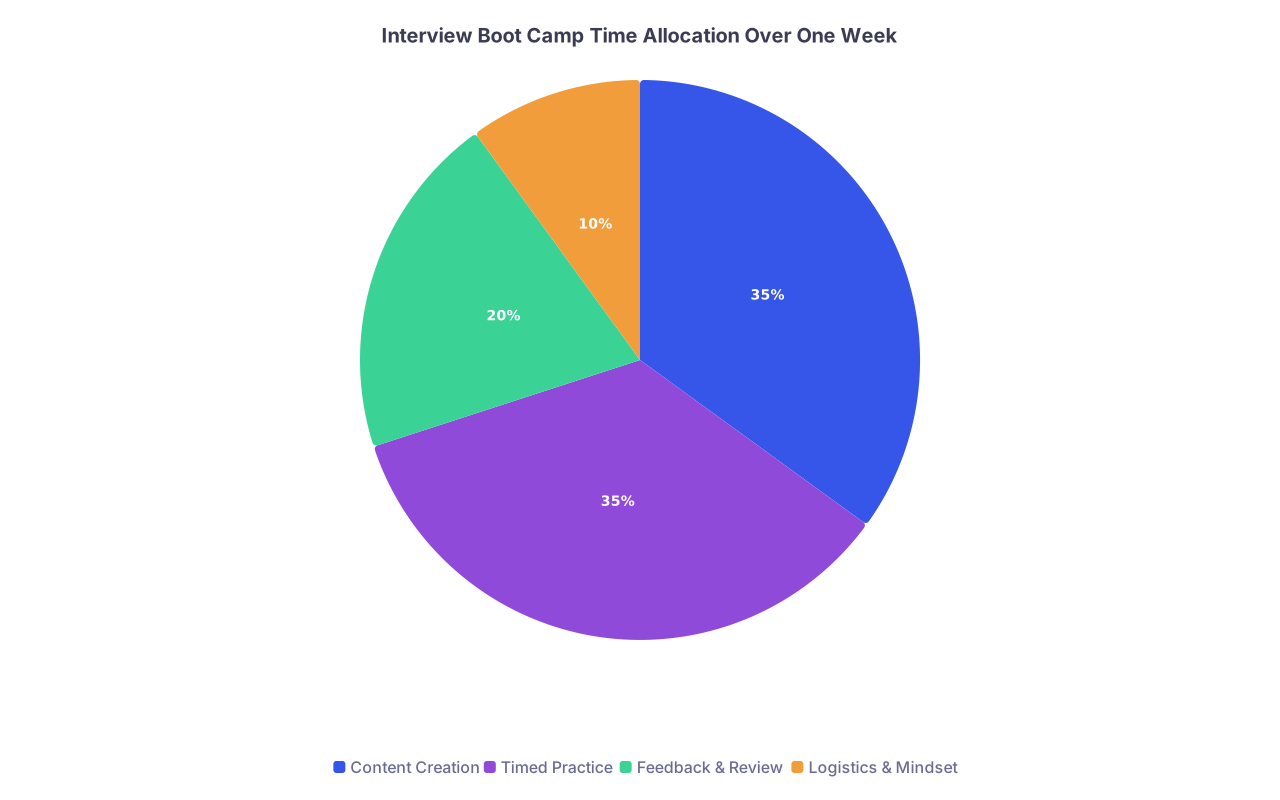
How Your Practice Time Should Break Down
| Category | Value |
|---|---|
| Content Creation | 35 |
| Timed Practice | 35 |
| Feedback & Review | 20 |
| Logistics & Mindset | 10 |
- First half of the week is heavy on content creation.
- Middle is timed practice and feedback.
- End is refinement and mental prep.
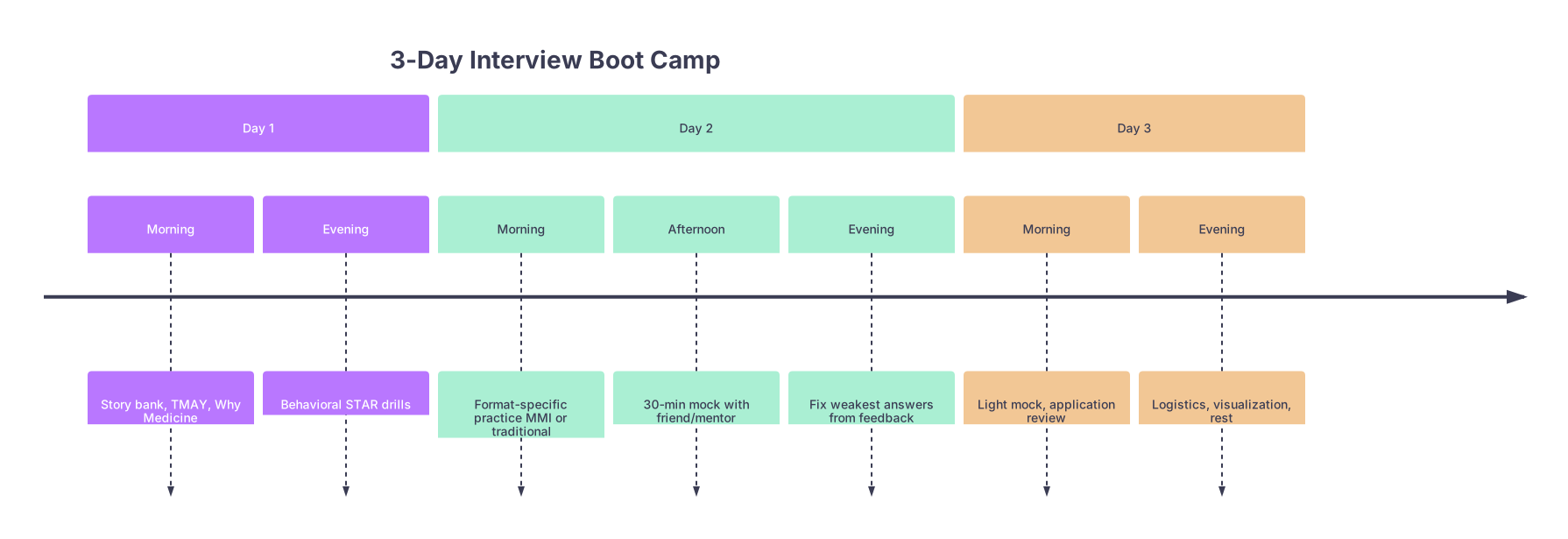
If You’re Even More Time-Crunched (Interview in 3–4 Days)
If you don’t actually have a full week, compress as follows:
| Period | Event |
|---|---|
| Day 1 - Morning | Story bank, TMAY, Why Medicine |
| Day 1 - Evening | Behavioral STAR drills |
| Day 2 - Morning | Format-specific practice MMI or traditional |
| Day 2 - Afternoon | 30-min mock with friend/mentor |
| Day 2 - Evening | Fix weakest answers from feedback |
| Day 3 - Morning | Light mock, application review |
| Day 3 - Evening | Logistics, visualization, rest |
You don’t skip categories. You just cut the fluff and combine blocks.
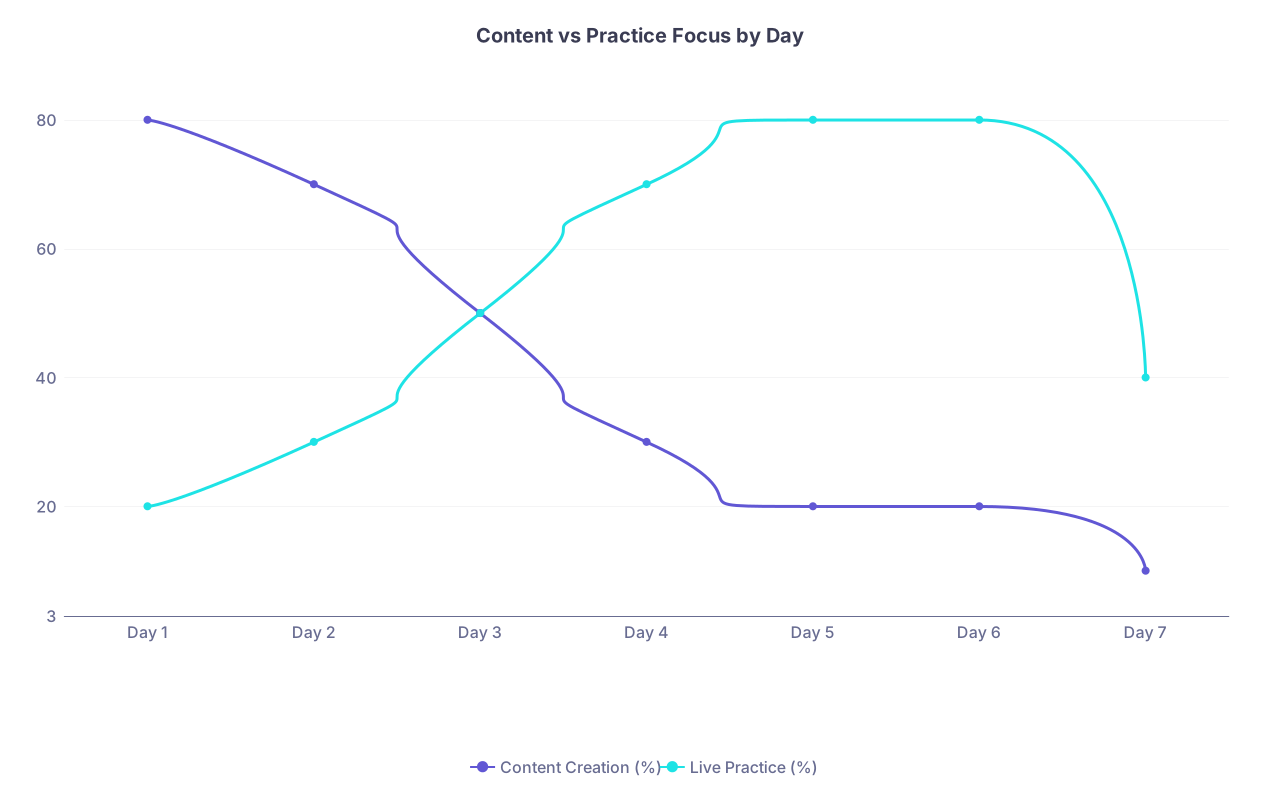
Example Content vs Practice Balance Across the Week
| Category | Content Creation (%) | Live Practice (%) |
|---|---|---|
| Day 1 | 80 | 20 |
| Day 2 | 70 | 30 |
| Day 3 | 50 | 50 |
| Day 4 | 30 | 70 |
| Day 5 | 20 | 80 |
| Day 6 | 20 | 80 |
| Day 7 | 10 | 40 |
Early: build.
Middle: test.
Late: sharpen and rest.
Quick Visual: Core Skills Covered During the Week
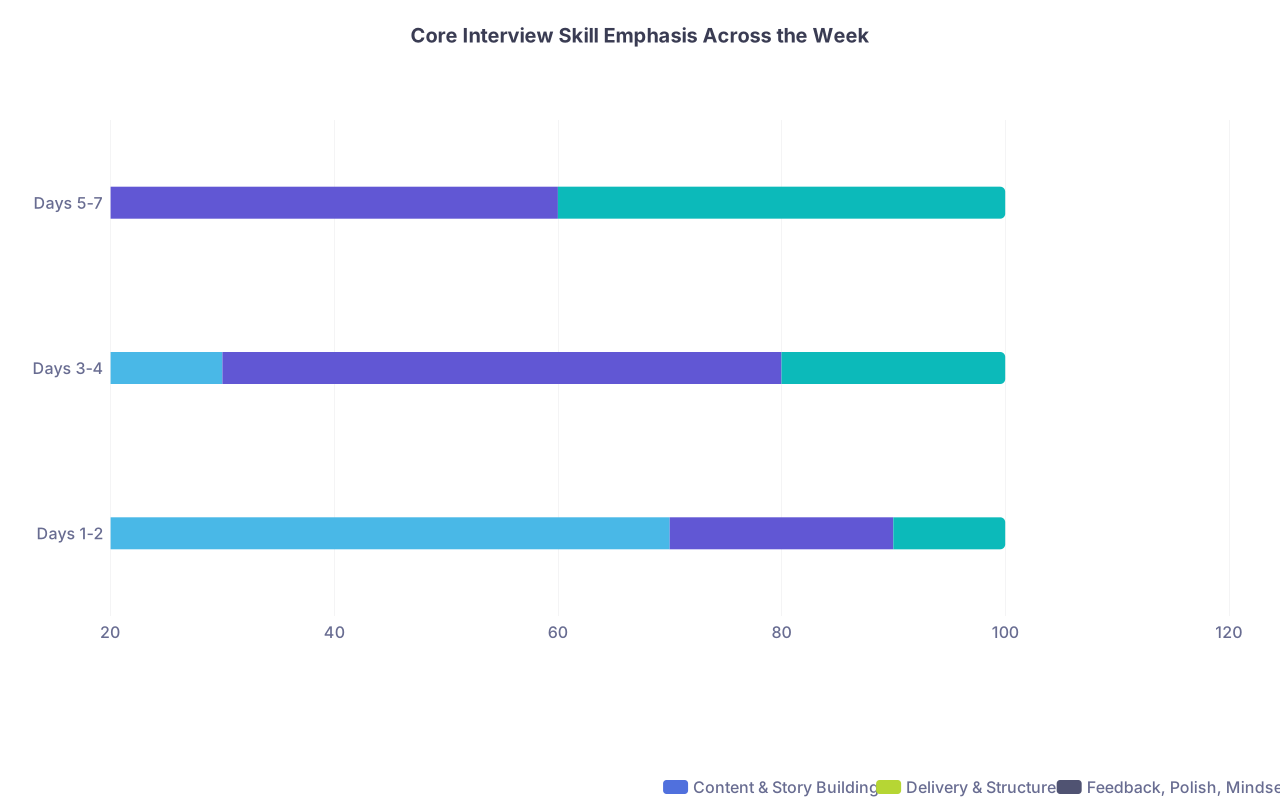
| Category | Content & Story Building | Delivery & Structure | Feedback, Polish, Mindset |
|---|---|---|---|
| Days 1-2 | 70 | 20 | 10 |
| Days 3-4 | 30 | 50 | 20 |
| Days 5-7 | 20 | 40 | 40 |
You’re cycling through:
- Building content
- Structuring it
- Stress‑testing and polishing it
Not just re‑reading your personal statement 15 times.
Final Check: What You Should Have the Night Before
By the end of this one‑week boot camp, you should:
- Be able to answer TMAY, Why Medicine, and Why This School smoothly in under 90 seconds each.
- Have 4–6 flexible stories that can stretch to cover:
- Leadership
- Teamwork
- Conflict
- Failure
- Service
- Adaptability
- Have at least one mock under your belt with another human’s feedback.
- Know your logistics cold:
- Tech/route
- What you’re wearing
- What questions you’ll ask them

The 3 Things That Actually Matter
Structure beats talent.
You don’t need to be naturally charismatic. You do need a repeatable way to organize your answers (TMAY, Why Medicine, STAR).Live reps beat passive prep.
Talking out loud, on camera, under a timer for even 20 minutes a day will do more for you than 3 hours of silently scrolling question lists.Clarity and authenticity beat perfection.
You’ll never script every line. You don’t need to. You need clear stories, honest reflections, and enough practice that your brain can focus on connecting with the interviewer instead of panicking about what to say next.