The day before your interview will make or break how all your preparation shows up in the room.
Most applicants treat it like “review everything one more time.” That is wrong. At this point you should be executing a tight, time‑blocked checklist, not cramming.
I am going to walk you through the last 24 hours in order: morning, afternoon, evening, and morning‑of buffer. Minute by minute? Not quite. But close enough that you can copy this into your calendar and follow it.
24–18 Hours Before: Lock Your Logistics and Tools
At this point you should stop thinking “interview” and start thinking “operations.” Your first job is to remove every possible source of day‑of chaos.
1. Confirm where, when, and how
By 24 hours before, you should:
- Re‑read your interview email and portal instructions.
- Confirm:
- Exact time (and time zone, especially for virtual).
- Interview format: MMI, traditional, panel, group.
- Platform for virtual: Zoom, Teams, proprietary system.
- Building name, floor, room number for in‑person.
- Add:
- Address / meeting link to your calendar invite.
- Backup phone number or contact email (program coordinator).
Do not trust your memory. I have watched people show up to the wrong campus, wrong building, or an hour late because they assumed.
| Item | What You Should Have Ready |
|---|---|
| Interview Time | Start time, time zone, estimated end time |
| Location/Link | Exact address or meeting URL saved in calendar |
| Contact Info | Coordinator phone + email |
| Format | MMI, traditional, panel, group, virtual |
| Tech Requirements | Platform, downloads, proctoring rules |
2. Route, timing, and backup plans (in‑person)
18–24 hours before, physically or virtually “walk” your route.
- Use Maps to:
- Check travel time at the same time of day as your interview.
- Identify parking options and costs.
- Plan:
- Primary route and ETA (arrive 30 minutes early).
- Backup route / alternative transit (ride share, bus, train).
- If you are staying at a hotel:
- Ask the front desk about travel time and shuttle options.
- Set a wake‑up call in addition to your alarm.
3. Tech check (virtual)
If your interview is virtual, at this point you should be done troubleshooting, not starting.
Do this 18–24 hours before:
- Test:
- Internet speed (aim for 10 Mbps+ upload).
- Camera and microphone in the exact platform (Zoom, WebEx, etc).
- Set up:
- Neutral background (wall, tidy bookshelf, no bed clutter).
- Laptop on stable surface, at eye level.
- Power: plugged in, not on battery.
- Disable:
- Notifications: email, messages, Slack, system pop‑ups.
- Automatic updates and scheduled restarts.
Run a test call with a friend or family member. Ask them if your lighting, sound, and framing look professional. Fix it now, not 5 minutes before.
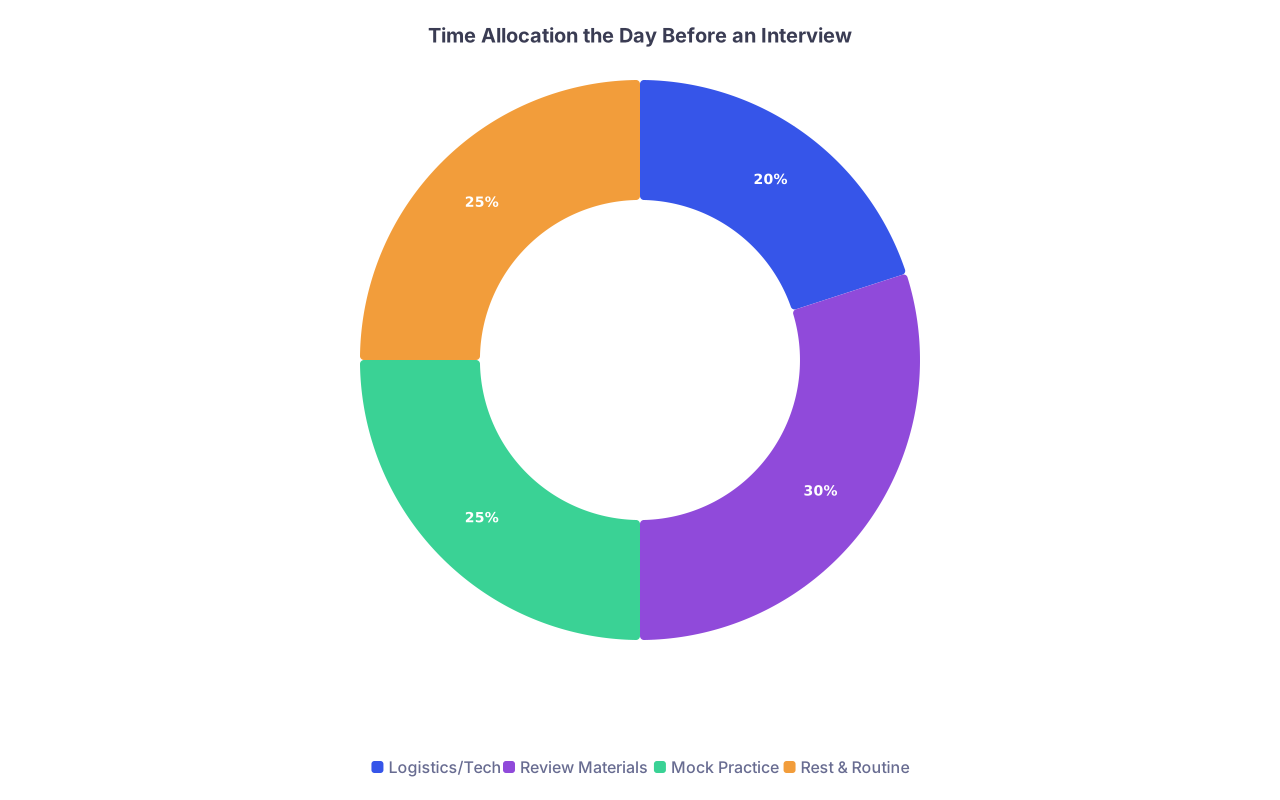
| Category | Value |
|---|---|
| Logistics/Tech | 20 |
| Review Materials | 30 |
| Mock Practice | 25 |
| Rest & Routine | 25 |
18–12 Hours Before: Targeted Content Review (Not Cramming)
At this point you should be shifting from logistics to what is in your head—but in a structured way. The wrong move here is trying to reread every personal statement, every secondary, and 50 pages of school info.
You are aiming for familiarity and freshness, not memorization.
4. Review your application materials (60–90 minutes total)
Pull up:
- Primary application / AMCAS/AACOMAS.
- Secondary essays to this specific school.
- CV / activities list.
- For medical students: ERAS application, personal statement, and experiences section.
Then, in one pass, scan for:
- 3–5 key themes you want them to remember:
- Example: “Mentorship,” “Health disparities,” “Longitudinal commitment,” “Team sports,” “Resilience.”
- 4–6 cornerstone experiences:
- Your “go‑to” stories: a particular clinic, lab project, leadership role, difficult patient, or challenge.
Write these on a single sheet or digital note:
- 3 core identity themes.
- 4–6 labeled experiences with:
- Role.
- Setting.
- One key outcome or lesson.
This becomes your “story menu” for the next phase.
5. Research the program/school strategically (45–60 minutes)
You are not writing a report. You are looking for hooks and alignment.
Focus on:
- Mission and values language.
- Unique offerings:
- Track programs (global health, primary care, research).
- Curriculum format (systems‑based, problem‑based learning).
- Clinical strengths (safety‑net hospital, rural rotations).
- Any specific initiatives that match your background:
- Health equity initiatives.
- Student‑run free clinics.
- Longitudinal clerkships.
Create a quick “Program Snapshot” for yourself:
- 2–3 specific reasons this school/program fits you.
- 1–2 faculty interests or clinical areas that overlap with yours.
- 1 program concern or question you genuinely want to ask about.
That sheet is what you review again the next morning.
12–8 Hours Before: Practice Answers and Delivery
This block is where most people either overcook it (3‑hour mock interviews until midnight) or underprepare (“I’ll just be myself”). Both are bad strategies.
You want focused, time‑limited practice.
6. Rehearse the “big three” answers (30–45 minutes)
By this point you should be able to answer, without rambling:
- “Tell me about yourself.”
- “Why medicine?” / “Why this specialty?”
- “Why our school/program?”
Practice:
- Say them out loud.
- Time them. Aim for:
- 60–90 seconds for “Tell me about yourself.”
- 60–90 seconds for “Why medicine/this specialty?”
- 45–75 seconds for “Why this program?”
If an answer is hitting 3 minutes, you are story‑dumping. Trim.
Focus on:
- Clear structure (past → present → future).
- 1–2 concrete examples instead of vague adjectives.
- Ending with a forward‑looking line that ties to the program.
7. Hit the core behavioral questions (30–45 minutes)
You are not trying to rehearse 50 questions. You are building flexible stories you can adapt.
Use your 4–6 cornerstone experiences and run them through prompts like:
- “Tell me about a time you failed.”
- “Tell me about a conflict with a team member.”
- “Describe a stressful situation and how you handled it.”
- “Tell me about a time you showed leadership.”
- “An ethical dilemma you faced in a clinical or research setting.”
Use a simple structure (yes, the classic works when done well):
- Situation.
- Action.
- Result.
- Reflection / lesson.
Record yourself on your phone for at least 2–3 answers. It is painful, but you will catch:
- Rambling.
- Overuse of filler words.
- Speaking too fast or too softly.
Fix one thing at a time. Do not chase perfection.
8–5 Hours Before: Questions You Will Ask + Social Media Sweep
At this point you should flip the perspective. They are not just evaluating you; you are evaluating them. Also, interviewers absolutely do Google applicants.
8. Prepare 6–8 targeted questions (30 minutes)
Weak question: “What sets your program apart?”
Strong question: “You emphasize longitudinal community engagement. How do students practically stay involved with the same patient population across pre‑clinical and clinical years?”
Build a short list:
- 2–3 questions for faculty/interviewers:
- About training philosophy, teaching culture, mentorship.
- 2–3 questions for students/residents:
- About actual day‑to‑day life, wellness, support.
- 1–2 backup questions anyone can answer:
- About curriculum innovations, new hospital partnerships, etc.
Write these down. In the moment, you may blank. Having them visible is not cheating; it is being prepared.
9. Quick online presence check (15–30 minutes)
Search:
- Your name + city.
- Your main social media handles.
Remove or lock down anything:
- Overtly unprofessional (drugs, offensive jokes, bullying).
- Intense rant threads you would not want on a slide next to your name.
You do not need to sanitize your humanity. You should remove obvious red flags.
5–3 Hours Before: Physical Setup – Clothes, Bag, and Space
This is where a lot of last‑minute disasters live. Missing socks. Wrinkled shirt. Dying laptop. Do not do this at 11 pm.
10. Choose, lay out, and test your outfit (30–45 minutes)
At this point you should not be shopping. You are checking fit, comfort, and completeness.
For both premed and med students, default to conservative professional:
- Suit or blazer + dress pants or knee‑length skirt.
- Solid or subtle pattern.
- Closed‑toe shoes that you can walk in confidently.
Do a full dress rehearsal:
- Put everything on:
- Check for fit when sitting, standing, walking.
- Sit in a chair and simulate an interview:
- Does your shirt gap?
- Is the skirt too tight when you sit?
- Are the shoes painful after 5–10 minutes?
Lay out:
- Outfit on a chair or hanger.
- Undershirt, socks, hosiery, belt, watch, jewelry, hair items.
No guessing in the morning.
11. Pack your physical or virtual “interview kit” (20–30 minutes)
For in‑person, pack:
- Folder with:
- 5–6 copies of your résumé/CV.
- Printed list of questions you may ask.
- Small notebook + pen.
- Phone charger and/or portable battery.
- Water bottle, light snack (granola bar, nuts).
- Breath mints (not gum).
- Any required documents:
- ID.
- Parking pass.
- Vaccination or testing documentation if specified.
For virtual, arrange your desk with:
- Printed or on‑screen:
- Your story menu.
- Program snapshot.
- Question list.
- Notebook + pen.
- Water within reach (out of frame is fine).
- Device chargers connected.
At this point your environment should look like you are about to take a high‑stakes exam. Because you basically are.
3–1.5 Hours Before: Mental Calibration and Stress Management
You have done the work. Now the priority shifts: protect your brain.
12. Set your personal “game plan” (20–30 minutes)
Write this out on a single page:
- 3 words that describe how you want to show up:
- Example: “Curious. Calm. Genuine.”
- 2 strengths you want to lean into:
- Example: “I connect quickly with patients” / “I own my mistakes.”
- 1 pitfall you know you have:
- Example: “I talk too fast when I am nervous.”
Under that, define 1–2 concrete strategies:
- “If I notice I am speeding up, I will pause, breathe, and slow down.”
- “If I blank on a question, I will ask for a moment to think instead of rambling.”
This is your mental operating system for tomorrow.
13. Light, deliberate review (15–30 minutes)
One last pass through:
- Story menu (those 4–6 key experiences).
- Program snapshot.
- Question list.
No deep diving. No rewriting your personal statement. Just reminding your brain: we know this.
14. Short movement and decompression (20–40 minutes)
Your nervous system will thank you.
Pick something low‑intensity:
- Walk outside.
- Gentle yoga.
- Bodyweight stretching.
Not a new intense workout that leaves you sore or exhausted.
Then, 10–15 minutes of:
- Box breathing (inhale 4, hold 4, exhale 4, hold 4).
- Or a guided relaxation audio.
- Or simply sitting quietly, away from screens.
This is not optional fluff. It is performance maintenance.
1.5–0 Hours Before Bed: Shutdown Routine
This is where anxious applicants sabotage themselves: scrolling forums, obsessing over sample questions, rewriting answers in their head until 1 am.
Do not.
15. Final checks (15 minutes)
Do a quick, structured sweep:
- Alarm(s) set:
- Primary alarm.
- Backup on another device.
- For hotel stays: front desk wake‑up call.
- Clothes laid out.
- Bag/desk organized.
- Directions or meeting link pulled up for morning.
Once done, tell yourself: “Logistics are complete.” Done means done.
16. Set boundaries with your phone and mind (10–15 minutes)
At this point you should:
- Stop:
- Reddit/SDN/Student Doctor Network doom‑scrolling.
- Opening “top 50 interview questions” threads.
- Comparing yourself to others on group chats.
Consider:
- Putting your phone on Do Not Disturb.
- Charging it away from your bed.
Then, give your brain one clear instruction: “Job now is sleep; job tomorrow is perform.”
Aim for:
- 7–8 hours of sleep.
- A consistent bedtime (do not force yourself to sleep at 9 pm if you always sleep at 11; shift gently).
If anxiety spikes, fall back on the fact that your system is ready: clothes, questions, stories, logistics. Your job now is to show up as a rested version of yourself.
Morning‑Of Buffer (In Case You Are Reading This Late)
Some people will be reading this at 5–6 am the day of. Fine. You still have time for a compressed version.
Compressed 60–90 Minute Morning Timeline
Use this as a backup if the day before went badly or you found this guide late.
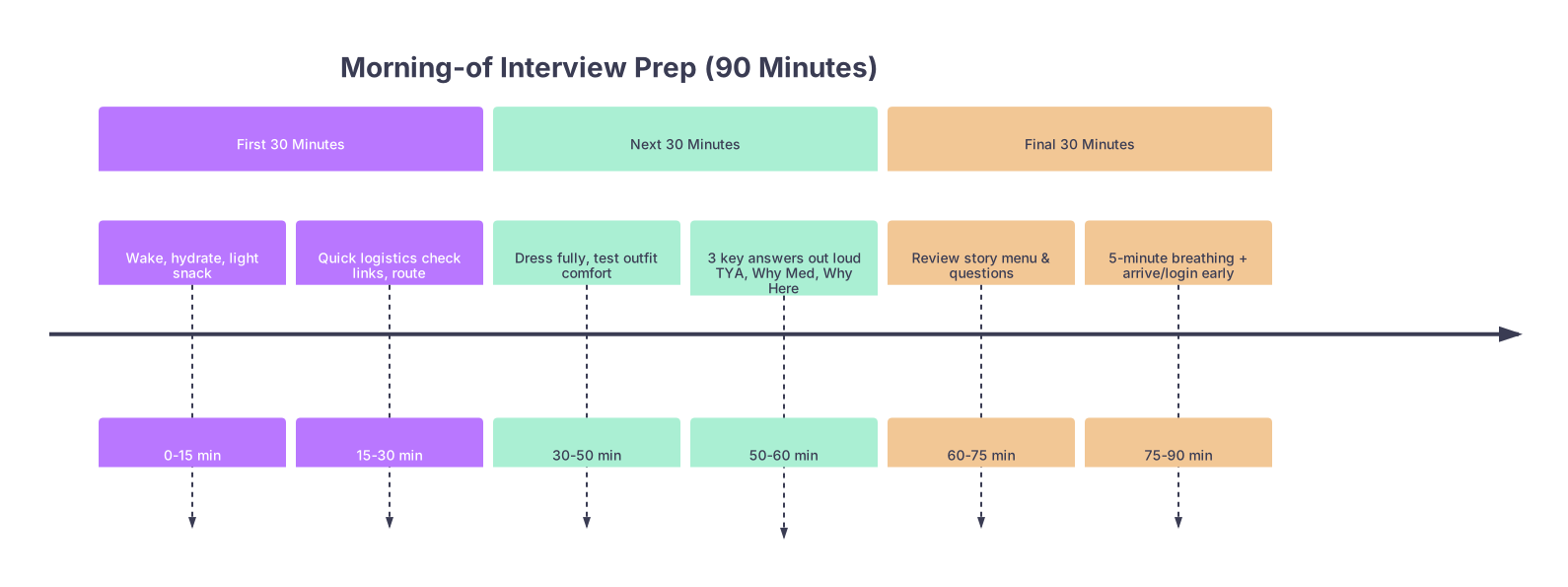
| Period | Event |
|---|---|
| First 30 Minutes - Wake, hydrate, light snack | 0-15 min |
| First 30 Minutes - Quick logistics check links, route | 15-30 min |
| Next 30 Minutes - Dress fully, test outfit comfort | 30-50 min |
| Next 30 Minutes - 3 key answers out loud TYA, Why Med, Why Here | 50-60 min |
| Final 30 Minutes - Review story menu & questions | 60-75 min |
| Final 30 Minutes - 5-minute breathing + arrive/login early | 75-90 min |
If you missed some day‑before steps, prioritize in this order:
- Logistics and tech check.
- Outfit and appearance.
- Big three answers out loud.
- Quick review of application + 2–3 questions you will ask.
Leave at least 10–15 minutes at the end to sit quietly and breathe before you walk in or log on.
Quick Day-Before Interview Checklist
Copy this into your notes and tick through it.
By 24–18 hours before:
- Confirm interview time, location/link, and format.
- Add address or link and contact info to calendar.
- For in‑person: plan route, parking, and backup plan.
- For virtual: test internet, platform, camera, mic, lighting.
By 18–12 hours before:
- Review primary/secondary/ERAS and mark 3 identity themes.
- Select 4–6 cornerstone experiences as your story menu.
- Build a 1‑page program snapshot (why them, why you fit).
By 12–8 hours before:
- Practice “Tell me about yourself,” “Why medicine/specialty,” and “Why this program” aloud and timed.
- Run 3–5 behavioral questions using your core stories.
- Record 2–3 answers and adjust for length and clarity.
By 8–5 hours before:
- Write 6–8 specific questions for faculty and students.
- Quick online presence sweep; lock or clean obvious red flags.
By 5–3 hours before:
- Do a full outfit rehearsal; lay out all clothing and accessories.
- Pack your bag or set up your desk with CVs, notes, and supplies.
By 3–1.5 hours before:
- Write your personal game plan: 3 words, 2 strengths, 1 pitfall.
- Light review of stories, program snapshot, and question list.
- Short movement + breathing or relaxation practice.
By 1.5–0 hours before bed:
- Set alarms and (if needed) hotel wake‑up call.
- Final quick sweep of logistics and space.
- Put phone on DND; no more interview content.
If you remember nothing else:
- The day before is about systems, not cramming: logistics, stories, and environment set.
- Short, focused practice beats endless question lists: master a few key answers and flexible stories.
- Protect your sleep and headspace: once the checklist is done, your only job is to show up rested and present.