They know if you’re “professional enough” before you finish your second answer.
Not at the end of the interview. Not after some mystical holistic assessment. Within ten minutes, most experienced faculty already have you mentally tagged: clearly professional, borderline, or “absolutely not.”
Let me tell you what actually happens on our side of the table.
What “Professional Enough” Really Means (Behind Closed Doors)
Students love vague words like “professionalism” because they sound noble and unmeasurable. Faculty do not. Behind closed doors, we’re brutally concrete.
We’re not asking: “Are you perfectly polished?”
We’re asking: “If I put this person on a real clinical team with stressed nurses, angry families, and tired residents, will they be safe, reliable, and not a problem?”
That’s it. “Professional enough” = low risk.
No one wants to be the faculty member who pushed through the student that made a nurse cry, disappeared from the unit, or wrote something insane in the chart. We’ve all seen it. Once you’ve filed a professionalism report on a learner, you start screening for red flags aggressively.
Here’s the part students underestimate:
Most of the metrics of professionalism are non-academic. We already have your GPA and MCAT. The interview is a stress-test of:
- How you handle discomfort
- How you handle people
- How you handle yourself
And we do not need an hour. Ten minutes is plenty.
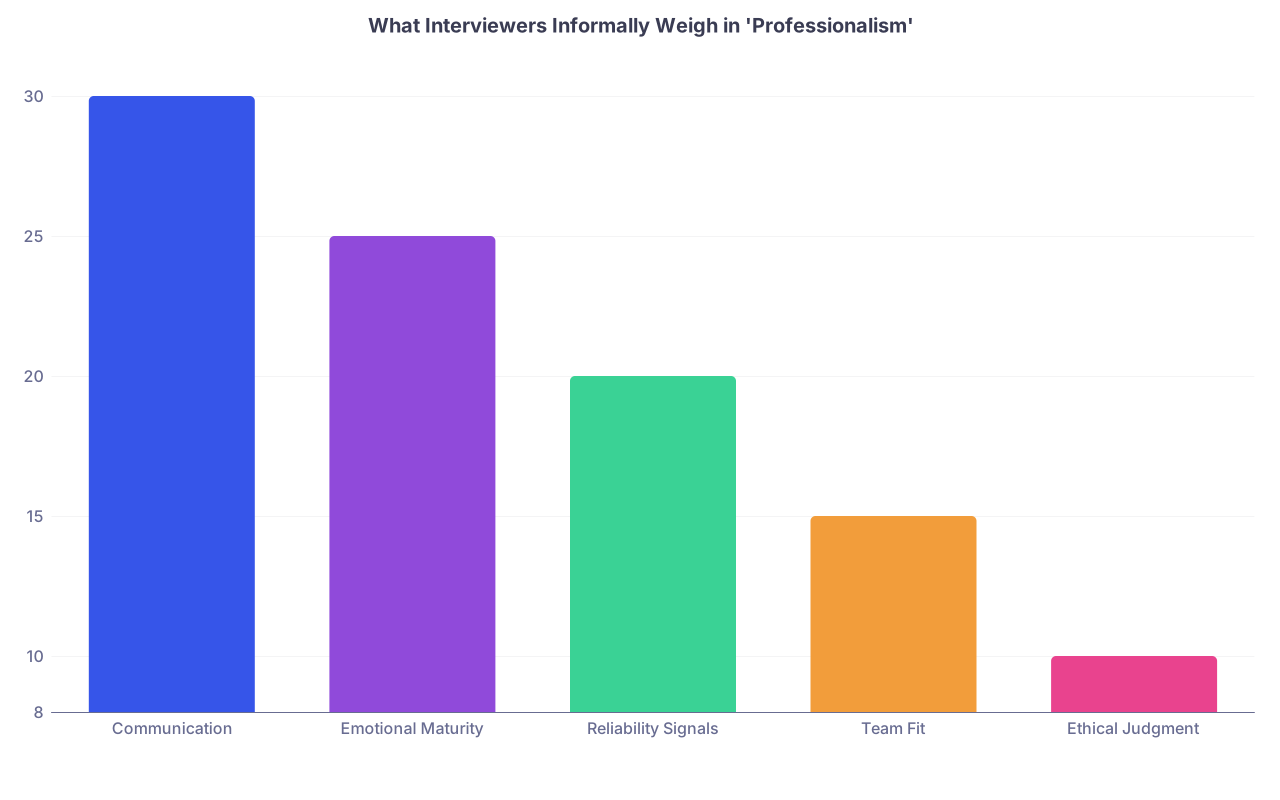
| Category | Value |
|---|---|
| Communication | 30 |
| Emotional Maturity | 25 |
| Reliability Signals | 20 |
| Team Fit | 15 |
| Ethical Judgment | 10 |
These aren’t official numbers. But if you sit in enough committee meetings, you can hear the pattern. People do not argue about your shadowing hours. They argue about whether you seem like someone they’d trust on the wards at 3 a.m.
Minute 0–2: The “Do I Relax or Stay on Guard?” Phase
The evaluation starts before you answer a single question.
I’ve sat in those pre-briefs where faculty flip through applicant lists. The language is rarely “Is this person brilliant enough?” It’s “Is this someone I’d want on my team?” That’s code for professionalism.
Arrival and the “Hidden” First Impressions
You think you’re being judged when you sit down. You’re wrong. It starts in the waiting room.
The staff at the front desk? The student ambassadors? The random coordinator who walks you to the interview room? We listen to them. Closely.
I’ve seen this exact thing:
- Applicant is charming with faculty, but snippy with the admin who asks them to re-sign a missing form.
- After the interview day, someone in the office says, “That guy was kind of rude earlier.”
- On committee, that one comment softens all the praise. The verdict becomes: “Technically good, but something about him…”
You’re done. Maybe not rejected outright, but you just moved down a tier.
Every program has stories:
- The applicant who rolled their eyes when asked to wait.
- The one on their phone during the welcome talk, not even pretending to care.
- The one who wore perfume so strong the standardized patient complained.
Nobody writes “unprofessional” in huge letters. They just mark you with “concern about maturity” or “not sure about team fit.” Same outcome.
Clothing and Grooming: What We Actually Notice
No, we are not fashion police. But we do scan for three things in about three seconds:
- Did you respect the formality of the situation?
- Are you distracting? (clothing, makeup, accessories, hair, smells)
- Did you at least try?
We don’t care if your suit is from Target. We care if it looks like you pulled it out of the trunk this morning. We don’t care if your haircut is simple. We care if it looks like you haven’t seen a comb in a week.
There’s a quiet rule: if we notice your outfit, something went wrong. “Professional enough” = nobody’s thinking about your appearance after the first 10 seconds.
Minute 2–6: The Micro-Behaviors That Decide Your Fate
Once you sit down, the real screening begins. Most interviewers start asking themselves a simple, fast question:
“Do I feel at ease with this person, or am I slightly on edge?”
That gut feeling isn’t magic. It’s the sum of dozens of tiny behaviors you barely notice you’re doing.
Your Greeting and First Question
You stand up, shake hands (or don’t, depending on context), say hello. The faculty member says something basic like, “How’s your day going so far?” That’s not small talk. That’s data collection.
We’re listening for:
- Can you hold basic, normal human conversation?
- Do you look at us when you speak, or at the floor?
- Do you sound robotic, rehearsed, or like an actual person?
I’ve watched interviewers write notes after that first exchange. Before the “Tell me about yourself,” they already have something written — usually one word: “stiff,” “natural,” “anxious, but kind,” “very polished,” “guarded.”
You don’t need to be charismatic. You need to sound like yourself, just slightly cleaned up. Over-rehearsed is just as bad as chaotic. If I can hear your canned answer revving up, I start to doubt your authenticity. That’s a professionalism hit.
The First Answer: Are You Trainable or a Problem?
The first real question is almost always low-risk:
“Tell me about yourself,” or “Why medicine?” or “Walk me through your journey here.”
The content matters less than how you behave while answering:
- Do you talk for five minutes straight with no pause, no awareness we might want to speak? That reads as self-focused and unaware.
- Do you give 20-second, clipped answers that force us to drag everything out of you? That reads as socially awkward, low communication skills.
- Do you name-drop your accomplishments with no sense of proportionality? That reads as ego.
The subtext we’re testing: Are you coachable? Because medicine is apprenticeship. We’re deciding whether we want to spend years correcting you.
A very clean initial impression sounds like this: thoughtful pace, makes eye contact, speaks clearly, answers the question without wandering, and stops in a way that invites the next question. Not perfect. Not TED Talk. Just… grounded.
Minute 6–10: The Stress Test of Maturity
Once we get past the story questions, many interviewers intentionally poke a little. Nothing dramatic. Just enough to see what leaks out of you when you’re slightly stressed.
How You Talk About Other People
This is where applicants quietly self-destruct.
When you describe a conflict, a difficult supervisor, a bad group project, a frustrating lab — we’re not evaluating them. We’re evaluating you.
Here’s what kills people:
- Blaming everyone else: “The PI was toxic,” “The attending was unfair,” “My group members were lazy.”
- Victim energy: You, always wronged, never owning a real piece of the mess.
- Self-righteousness: You were the only one who cared, the only one who worked hard, the only one who did the right thing.
In committee, the red-flag comment is short: “Tends to externalize.” That’s code for: when something goes wrong, this person will blame everyone but themselves. That is the opposite of “professional enough.”
A mature, professional-sounding answer does something different:
- Acknowledge others’ flaws without character assassination.
- Explicitly own your part, even if it’s small.
- Show what you learned and how you changed behavior.
If you can talk about a bad situation without poisoning the room, you look like someone we can trust with actual conflict on the wards.
How You Handle Imperfect Questions
Some interviewers are sloppy. Some ask redundant questions. Some misread your application and say, “So you did research at X?” and you’re thinking, “No, that wasn’t me.” This is intentional sometimes, accidental other times. We still watch your reaction carefully.
The question behind the question: “What happens when the attending is wrong?”
An amateur answer:
Correcting us sharply, visibly annoyed, defensiveness in your tone.
A professional answer:
Correcting gently, giving us an easy out, staying calm.
For example:
“I think you might have me mixed up with another applicant — I didn’t work at X, but I did do research at Y, which I really enjoyed because…”
You’ve just signaled: I can correct a superior without making them lose face. That is a huge professional skill. Residents and attendings talk about this constantly.
The Unspoken Rubric: What We Actually Judge
No one shows you this, but almost every school uses some version of a professionalism / interview rubric. It’s not as vague as you think.
Here’s what those categories often look like behind the scenes:
| Dimension | What High Scores Look Like |
|---|---|
| Communication | Clear, organized, normal conversational flow |
| Emotional Maturity | Handles stress, conflict, and critique calmly |
| Self-Awareness | Insight into strengths/weaknesses without dramatics |
| Reliability Signals | Concrete history of follow-through and responsibility |
| Team Orientation | Talks about “we” as much as “I”, respects others |
You’ll never see that table on a brochure. But sit through enough interviewer training sessions and it’s the same language over and over: communication, maturity, insight, reliability, team.
Let me walk you through how they get scored in practice.
Communication: More Than “Speaking Clearly”
We’re not English teachers. I don’t care if you say “like” occasionally. I care if:
- I can follow your train of thought
- You answer what was asked, not what you wish was asked
- You don’t ramble into nowhere when nervous
Interviewers will often write: “Very articulate,” “Scattered,” “Hard to follow,” “Overly rehearsed.” Those shorthand phrases translate directly into professionalism scores.
Big red flags: talking over the interviewer, interrupting, or constantly circling back to your favorite topic no matter what we ask.
Emotional Maturity: This Is Where People Get Exposed
This category kills borderline applicants.
We probe with questions like:
- “Tell me about a time you failed.”
- “Describe a time you received tough feedback.”
- “How do you handle stress or being overwhelmed?”
We’re listening for three specific things:
- Can you describe true failure without collapsing into drama or excuses?
- Can you talk about feedback without attacking the person who gave it?
- Can you name specific coping strategies that sound real, not brochure-level?
If your answer to failure is: “I work too hard” or “I care too much,” you sound fake. We’ve all heard that 500 times. It reads as low insight.
If your answer is a detailed, honest story where you misjudged something, got called out, took time to process it, and adjusted your behavior — that reads as adult.
“Professional enough” is basically “emotionally adult enough.”
Self-Awareness: The Quiet Differentiator
Top-tier applicants often have one thing in common: they know themselves. Not perfectly. But enough to talk about their blind spots without flinching.
An interviewer hears this and relaxes: “Oh, I won’t have to drag this person to insight. They’ll meet me halfway.”
Lack of self-awareness is dangerous in clinical care. That’s how you end up with the student who thinks they’re amazing but keeps offending patients and doesn’t see it.
On the application side, we test this with questions like:
- “What do you think your classmates would say frustrates them about you?”
- “What aspect of medicine do you think will challenge you most?”
If you can’t answer without getting defensive or cartoonishly self-deprecating, you don’t look ready.
Group Settings and MMI: Where the Mask Slips Fast
If you’re doing MMIs or group activities, the “professional enough” judgment speeds up. You might be tagged in under 5 minutes.
How You Treat Peers When We’re “Not Watching”
We are always watching.
In MMI circuits, there’s usually a student, coordinator, or staff member in and out of rooms. They see:
- Who dominates every discussion.
- Who ignores quieter applicants.
- Who rolls their eyes when others speak.
- Who visibly checks out when it’s “not their turn.”
I’ve literally been in debriefs where a student interviewer says, “He was nice to me but kind of dismissive to the other applicants.” That single sentence crushed his rank. No one wants that person on their team.
Ethical Scenarios: Judgment Under Pressure
MMI scenarios aren’t about getting the “right” answer. They’re about:
- Can you identify stakeholders?
- Can you see more than one side?
- Do you rush to judgment or pause to understand context?
- Do you show compassion, not just logic?
Unprofessional vibes in an MMI answer sound like:
- “Well, I’d report her, that’s it,” without empathy or process.
- “That patient is just noncompliant,” no curiosity about why.
- Overconfident answers as if you’re already an attending.
Professional vibes: messy, honest thinking out loud, acknowledging uncertainty, balancing policy with humanity.
How to Actually Come Across as “Professional Enough”
Let’s be blunt. You don’t need to be perfect. But you do need to cross a pretty clear bar.
Here’s what consistently separates the “safe bet” from the “not sure about this one” in those first ten minutes.
Before the Interview Day
Act like your reputation starts the second you send the first email. Because it does.
- Emails to coordinators: Proper greeting, full sentences, no “hey what’s up, just checking.” Sloppy communication before the interview seeds doubts.
- Reschedules and logistics: Be clear, polite, grateful. Last-minute chaos with no apology looks unreliable.
Day-Of Behavior That Signals Professionalism
This is the quiet stuff that faculty hear about:
- You show up early without making a show of it.
- You’re pleasant with everyone — staff, students, security.
- You keep your phone away in group settings instead of scrolling.
- You engage in the activities without performing.
Professionalism is pattern, not performance. If you’re only “on” when a faculty member is in the room, you’re going to slip. Someone will see it.
During the Actual Interview
Three practical behaviors that change how we rate you:
Own your story.
Don’t hide your missteps. Frame them maturely. “I struggled with X, here’s what I changed, here’s how I monitor myself now.” That’s professional.Protect others’ dignity.
When you talk about difficult people, don’t savage them. Show that you get complexity. We’re listening for whether you’ll trash colleagues and nurses behind their backs.Think as a future team member, not a solo hero.
Use “we” when you talk about past work. Credit others. Name mentors. You look like someone who understands medicine is a team sport, not a personal brand campaign.

| Step | Description |
|---|---|
| Step 1 | Applicant Arrives |
| Step 2 | Staff & Peer Impressions |
| Step 3 | Initial Greeting with Interviewer |
| Step 4 | First Answer: Communication & Poise |
| Step 5 | Follow-Up Questions: Maturity & Insight |
| Step 6 | Internal Tag: Professional / Borderline / Concern |
That’s the real flow. Not the brochure version. In reality, by the time you’re at node F, your professionalism label is mostly set. The rest of the interview just confirms or slightly adjusts it.
FAQ: Professionalism in Interviews
1. If I’m really nervous, will that make me look unprofessional?
No. Nervous is fine. Everyone expects it. What looks unprofessional is rudeness, arrogance, blaming others, or zero self-awareness. Anxious but kind, thoughtful, and honest beats slick and shallow every time.
2. How formal should I be in my communication style?
Aim for “respectful, not stiff.” Using full sentences, avoiding slang, and not swearing is baseline. You can still sound like a human. If you hear yourself giving a speech instead of having a conversation, loosen up a notch.
3. Can one small mistake (like forgetting a name or minor awkwardness) sink me?
Almost never. We’re human too. We forget names all the time. What matters is how you recover: smile, correct, move on. The pattern of behavior over the entire interaction, not a single stumble, drives professionalism judgments.
4. How honest should I be about past conflicts or failures?
Honest enough that it feels real, but filtered through maturity. You don’t need every messy detail. Choose examples where you can clearly show what you learned and how you changed. If your story makes you sound bitter or still angry, choose a different one.
5. What’s the fastest way to signal I’m “professional enough” early on?
Show up prepared and calm, treat everyone with respect, give grounded answers that own your part in both successes and failures, and talk like someone who sees medicine as a team effort. If an interviewer feels, “I’d trust this person on my team,” you’ve already cleared the bar.
Key takeaway: professionalism in interviews is not a mystery. It’s how you handle people, pressure, and your own flaws — condensed into ten minutes.
If you remember nothing else, remember this: they’re not asking, “Are you perfect?” They’re asking, “If this person shows up on my ward, will they make things better, or will they make problems?” Answer that with your behavior, and you’ll be fine.