
The answers that most premeds copy from Reddit are exactly the ones that make committees stop trusting you.
I’m going to walk you through seven medical school interview answers that sound polished but instantly trigger the “this is fake” alarm in the room. I’ve watched applicants lose otherwise strong files because they walked in with rehearsed, generic, or obviously manufactured responses.
If you’re smart (and you are), you don’t need to “perform.” You need to stop stepping on the landmines that make you look inauthentic.
Let’s go through the big seven.
1. The Over-Sanitized “Why Medicine?” Answer
This is the most important answer of your interview — and the one people ruin with fakery.
The fake version sounds like this:
“I’ve always wanted to help people. In high school I volunteered at the hospital and seeing the impact doctors had on patients inspired me to pursue medicine. I also love science and I want to combine my passion for science with service.”
On paper? Fine. Out loud? Completely forgettable. It sounds exactly like the last five people they interviewed. And the five tomorrow.
Why it sounds fake:
- It’s vague: “help people,” “love science,” “passion for service” — these are filler words.
- There’s no real conflict, doubt, or struggle. Real decisions about medicine are messy.
- It sounds like you wrote it for an interviewer, not like something you’d say to a friend at 1 a.m. when you’re tired and honest.
Here’s what committees are thinking when they hear the fluffy version:
- “Do they actually know what being a physician is like, beyond shadowing?”
- “Would they say the same thing if they were applying to PA, nursing, PT, or dentistry?”
- “This is a template answer. Where is this person in it?”
The mistake: You try to sound noble instead of true.
What works better: Your “why medicine” should have:
- A specific moment or short series of moments that made you pay attention, not a fake “lightning bolt” story you manufactured.
- Evidence that you’ve seen the hard parts and still want in.
- A clear thread between your past behavior and this career choice.
Example of a more real answer (structure, not exact words to copy):
“I didn’t decide on medicine because of one dramatic moment. Honestly, I resisted it for a while. My dad’s a nurse, and I saw how exhausted he was after night shifts. What changed for me was two years working as a scribe in the ED. I followed one patient — a guy in his 40s with uncontrolled diabetes — through multiple visits. What struck me wasn’t just the medicine, it was watching the attending sit down, at 2 a.m., and walk him through what would really have to change at home. It was messy, there were social issues, insurance issues, and he didn’t magically get better. But I liked being part of that ongoing, imperfect process, not just the quick fix. That was the first time I could see myself on the other side of the chart.”
Notice the difference:
- Imperfect.
- No fake heroism.
- Multiple exposures, not one saintly moment.
- Concrete details that only come from actually being there.
Red flag checklist for your answer:
- If you can swap “medicine” with “engineering” or “law” and it almost still works? Too generic.
- If it sounds like a mission statement, not a story? Too polished.
- If you removed all numbers, names, places, and it doesn’t change the answer? Too vague.
Fix this before interview day.
2. The “I Have No Weaknesses” (or the Fake Weakness) Answer
The classic disaster:
“My biggest weakness is that I care too much.”
Or: “I’m a perfectionist and I always want to do everything to the highest standard.”
Be honest: you hate hearing that from other people. So does the committee.
Why it sounds fake:
- It’s transparent spin. Everyone knows you’re trying to turn a strength into a weakness.
- There’s no risk in the answer. You’re not actually revealing anything.
- It suggests you’re not self-aware or you’re too scared to be honest.
What committees want here is not your soul. They want evidence that:
- You can see your own blind spots.
- You’ve done something concrete to improve.
- You won’t collapse the first time an attending says, “You handled that badly.”
A more honest (and stronger) structure:
- Name a real weakness that’s not disqualifying.
- Give a specific, short example of how it caused a real problem.
- Explain what you actually did to address it.
- Show where you are now (works in progress are fine).
Example:
“I have a tendency to avoid asking for help early because I want to prove I can handle things on my own. In my first semester of organic chemistry, I waited way too long to go to office hours, and I ended up barely scraping by on the first exam. After that, I forced myself to schedule weekly office hours and formed a study group, even when it felt uncomfortable. I’ve carried that into my clinical volunteering — if I’m confused about a process, I ask the nurse or resident early instead of trying to guess. I’m not perfect at it, but I’m much quicker to seek input now than I was two years ago.”
Why this sounds real:
- There’s minor embarrassment. Committees like that. It sounds human.
- There’s a clear “before and after.”
- You’re not pretending you’re done growing.
Avoid these fake-weakness pitfalls:
- “I work too hard / care too much / am too empathetic.”
- “I’m a perfectionist” with zero specific story.
- Anything that sounds like a line from a business self-help book.
If your “weakness” makes you look like a superhero, it’s fake. Pick something real but fixable.
3. The “Scripted Diversity” or “Tell Me About Yourself” Answer
This one gets people into trouble fast.
Typical fake-sounding version:
“I come from a diverse background and have been exposed to many cultures, which has shaped my passion for providing equitable care to underserved communities. Growing up, I learned the value of resilience and hard work…”
This could be anyone. It sounds like LinkedIn. It’s not wrong — it’s just hollow.
“Tell me about yourself” is code for:
- “How do you organize your story?”
- “What do you think matters about you?”
- “Can you talk like a human being for 2 minutes without sounding like an essay?”
Common mistakes:
- Reciting your AMCAS application chronologically like a resume.
- Speaking in abstract values: “resilience, leadership, passion, empathy.”
- Cramming every identity label into 90 seconds without depth.
What sounds real:
- A short, honest snapshot of who you are today and what has shaped that version of you.
- A few concrete details instead of 10 buzzwords.
- A natural structure — like how you’d introduce yourself to a new attending on day one.
Stronger structure:
- Start with your current “headline” as a person (student, role, focus).
- Briefly connect 1–2 formative experiences that shaped how you show up now.
- End with how that translates into who you’ll be as a med student/physician.
Example:
“I’m a first-generation college graduate from a small farming town, and right now I split my time between my biology major and working nights as a tech on a med-surg floor. I didn’t grow up around many physicians — my first real exposure was watching my grandmother navigate appointments where no one spoke Spanish to her. That pushed me into becoming a medical interpreter in college, and I ended up spending more time than I expected in exam rooms, watching how different doctors either included or ignored patients in decisions. I’m still figuring out the exact kind of physician I want to be, but I know I want my practice grounded in clear communication and making sure people like my grandmother are actually heard in the room.”
That feels like someone you can talk to. Not a brochure.
Litmus test: Record yourself answering “Tell me about yourself.” If you’d be embarrassed to play it for a friend because it sounds like a commercial, you rewrote your personality for the committee. That reads as fake.
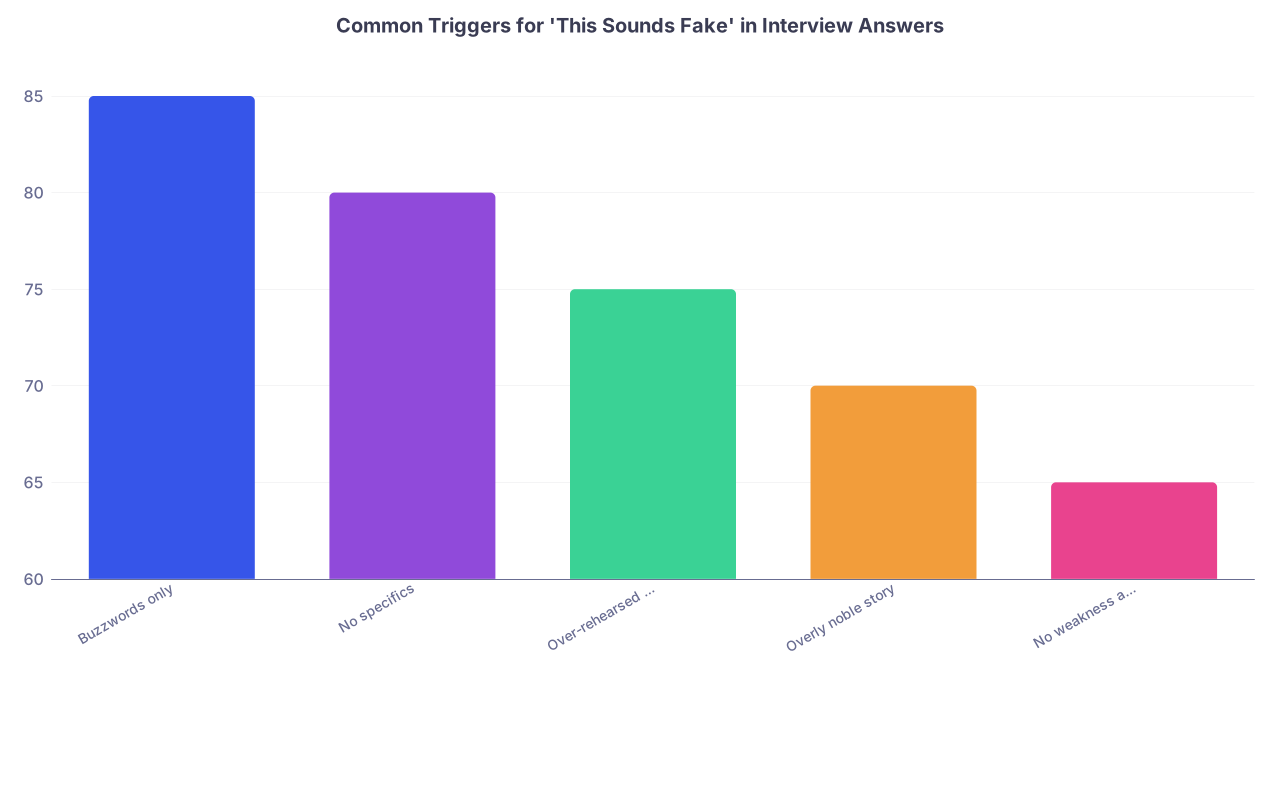
| Category | Value |
|---|---|
| Buzzwords only | 85 |
| No specifics | 80 |
| Over-rehearsed tone | 75 |
| Overly noble story | 70 |
| No weakness admitted | 65 |
4. The “Perfectly Selfless” Service Answer
Another one I see all the time:
“I volunteer because I love giving back to the community and making a difference in patients’ lives.”
Do you? Maybe. But that sentence means nothing.
Why it rings false:
- There’s no cost. No sacrifice. No tradeoff. Real service has a price.
- Everybody “loves helping people” in interviews. The question is: how and at what cost?
- If you never mention what you got out of the experience, it sounds performative — like you’re saying what you think they want.
The myth: Adcoms only want pure altruism.
The reality: They want maturity. People who understand that service is complex, often frustrating, and not always rewarding in the Instagram way.
A more credible approach:
- Acknowledge the parts that were hard, boring, or uncomfortable.
- Be honest about your motivations — including selfish ones (learning, skills, curiosity).
- Show what you learned about your limits, not just about “the underserved.”
Example:
“I originally signed up to volunteer at the free clinic because I thought it would be good clinical exposure. Honestly, I didn’t expect to stay long. The first few months were mostly paperwork and cleaning rooms, and I questioned whether it was worth it. What changed for me was when I started doing intake interviews and realized how much patients were trusting a 20-year-old with very personal information. I also became aware of how drained I felt after certain days, especially when we had to turn people away because we were overbooked. That tension — wanting to help but not being able to fix everything — is something I’m still wrestling with. It’s part of why I’m drawn to primary care and systems-level work, not just individual patient encounters.”
This sounds real because:
- Your initial motivation wasn’t perfectly noble.
- You admit boredom and doubt.
- You didn’t “save” anyone in your story.
The fake version is always too clean. The real version is slightly uncomfortable to say out loud.
5. The “Program-Flattery” Answer to “Why Our School?”
Here’s where applicants start reciting the website back at the committee.
Fake-sounding version:
“I’m really impressed by your commitment to serving underserved communities, your pass/fail curriculum, and your emphasis on student wellness. Your research opportunities are unparalleled and your match list is incredible.”
They’ve heard this 50 times. In the same words.
Why it sounds fake:
- You’re parroting marketing language.
- Nothing you said proves you’d choose them over the school down the street.
- It feels transactional: “You have things. I want those things.”
What they actually want:
- Proof that you’ve done your homework beyond the first two pages of their website.
- Some alignment between your specific interests and their specific offerings.
- A hint that you’d actually be happy there, not just using them as a stepping stone.
Better structure:
- One or two specific features that clearly matter to you (not just prestige points).
- A short explanation of how those fit with what you’ve already done or plan to do.
- Something about the culture/environment you expect there — ideally tied to something you’ve seen or heard, not imagined.
Example:
“What stands out to me here is the preceptorship model in first year — especially the continuity with one physician and patient panel. In my current work as a scribe in a family medicine clinic, I’ve seen how relationships over time change the dynamic in the room, especially for patients with multiple chronic conditions. Most schools talk about continuity, but your program actually schedules it longitudinally from the start. I also spoke with a current M2, Sarah Kim, who told me that even during busy exam weeks, attendings in the preceptorship were willing to sit and debrief difficult encounters. That combination of structure and mentorship is exactly what I’m looking for.”
Notice:
- You named a real student.
- You referenced a specific program, not just “research” or “service.”
- You tied it to your current experience.
If your “Why us?” answer could work word-for-word at 10 other schools, it’s fake.

| Step | Description |
|---|---|
| Step 1 | Question Asked |
| Step 2 | Grab rehearsed script |
| Step 3 | Pause 2-3 seconds |
| Step 4 | Generic, buzzword-heavy answer |
| Step 5 | Recall specific experience |
| Step 6 | Describe what you did, felt, learned |
| Step 7 | Connect to medicine or this school |
| Step 8 | Committee senses inauthenticity |
| Step 9 | Committee sees real person |
| Step 10 | You panic? |
6. The “Too-Polished” Ethical Scenario Answer
Ethics questions are traps for people who studied “model answers” off YouTube.
Fake-sounding version:
“I would respect the patient’s autonomy while also considering beneficence and nonmaleficence. I would talk to the team and make sure we uphold justice in our care.”
You just named the four principles. Congrats. You said nothing.
Why it sounds fake:
- It’s clearly memorized from a premed blog or ethics textbook.
- There’s no sign you’ve ever actually struggled with a moral dilemma in real life.
- You’re name-dropping vocabulary instead of thinking out loud.
What committees want:
- To see how you think, not whether you can recite ethics terms.
- To hear you acknowledge uncertainty.
- To watch you balance competing values without collapsing.
A better structure:
- Clarify the scenario and what’s at stake.
- State the tension in plain language (not Latin).
- Walk through what information you’d want and whose input you’d seek.
- Describe a reasonable course of action and acknowledge its drawbacks.
Example (for a classic scenario: a patient refusing a beneficial treatment):
“So the core conflict here is between what I think would medically help the patient and what they’re telling me they want. Before jumping to any decision, I’d want to understand why they’re refusing — is it fear, cost, cultural beliefs, a past bad experience? I’d involve the team — maybe the nurse who knows them better, possibly a social worker or interpreter if language is involved. If, after making sure they fully understand the risks and benefits, they still refuse, I think I’d have to accept that decision, even if it feels uncomfortable. I wouldn’t feel good about it, but forcing treatment on a competent adult crosses a line I’m not willing to cross.”
That sounds like a human wrestling with a real situation.
You can name principles briefly, but if your answer sounds like an exam essay, it’s fake.
Watch out for:
- Perfect, quick answers with zero hesitation.
- Anything that sounds like, “Step 1: identify stakeholders. Step 2: consider autonomy…”
- Answers where nothing is hard or uncomfortable.
A little visible struggle makes you more believable.
7. The “Zero Doubt, Zero Regret” Future Plans Answer
The last fake-sounding category: pretending you have your future perfectly mapped.
Fake version:
“In ten years I see myself as a cardiologist at an academic medical center, leading cutting-edge research while also providing compassionate care to diverse patients.”
You’re 21. You don’t know that. They don’t believe you. And it’s okay that you don’t know.
Why it sounds fake:
- There’s no humility about how little clinical exposure you’ve had.
- It feels like you built your answer backwards from what sounds impressive.
- It implies you’re rigid and inflexible, not someone who can grow and change as you learn.
What committees really want here:
- To know you’ve thought about your future beyond “get into med school.”
- To hear a few directions you’re curious about, grounded in what you’ve actually seen.
- To see that you’re open to being wrong.
A balanced, real answer:
“Right now, I’m drawn to internal medicine and possibly endocrinology, mostly because of my exposure to chronic disease management as a scribe in an outpatient clinic. I like the idea of following patients over years and getting to know their stories, not just seeing them once. That said, my clinical exposure is still pretty narrow, and I haven’t seen fields like surgery or psychiatry up close. So my honest answer is: I see myself in a role where I have longitudinal relationships with patients and some involvement in teaching or mentoring, whether that ends up being primary care, a subspecialty, or something I haven’t discovered yet.”
This works because:
- It’s specific enough to sound intentional.
- It’s open enough to sound real.
- It doesn’t pretend you know things you absolutely don’t at this stage.
Red flags that your answer sounds fake:
- “I’ve always known I wanted to be a neurosurgeon” — said by someone who’s never been in an OR.
- Overly grand visions about “changing healthcare” with no concrete path or concept.
- Zero mention of what you haven’t explored yet.

The Real Problem: You’re Over-Rehearsing the Wrong Way
Here’s the uncomfortable truth: most fakery isn’t malicious. You’re trying to be prepared. You read sample answers. You wrote scripts. You memorized them.
That’s the mistake.
- Stock phrases you repeat under stress.
- A sing-song tone that screams “I memorized this.”
- Answers that are technically good but emotionally dead.
You should rehearse. But differently.
Better practice habits:
- Bullet points, not scripts. Three anchor words per answer, not full sentences.
- Record yourself on Zoom. Watch once. Notice where you sound like an essay. Rewrite those parts in simpler language.
- Practice with a friend who will interrupt and ask, “Why?” or “For real?” when you drift into buzzword territory.
If you can’t answer follow-ups naturally without falling apart, your original answer was too fake.
Your Next Step (Today)
Pick one of these core questions:
- “Why medicine?”
- “Tell me about yourself.”
- “What’s your biggest weakness?”
Open a notes document. Write your current answer exactly the way you’d say it.
Now do three things:
- Underline every buzzword (“passionate,” “resilient,” “help people,” “underserved,” “diverse background,” “lifelong learner”).
- Next to each buzzword, write one concrete story, moment, or image that proves it, without using the buzzword.
- Rewrite the answer using only those concrete pieces and plain language — like you’re talking to a smart friend, not a committee.
That’s how you start stripping the fake out of your interview answers.
Do this today. Before you join the long line of applicants who sound perfect on paper and plastic in person.