
The way most applicants “practice” ethical questions is almost useless. Reading a few sample scenarios, skimming an ethics cheat sheet, maybe watching a YouTube breakdown. Then they are shocked when the actual MMI or traditional interviewer pushes back, changes the facts, or asks, “What else could you do?”
You do not need more content. You need a protocol for how to practice.
Here is a stepwise plan I would use with any serious applicant to get them from “I kind of know the four principles” to “I can walk through messy ethical questions under pressure and sound like a future physician, not a robot.”
Step 1: Build a Simple Ethical Framework You Can Actually Use
You cannot improvise ethics if your “framework” is a bunch of half-remembered buzzwords. Before you practice questions, you need one clean, repeatable structure.
Use this minimal backbone. No fluff. You will build everything on top of it.
Clarify the scenario
- Who is involved?
- What is the core conflict?
- What is at stake (outcomes, rights, trust, resources)?
Identify stakeholders
- Patient
- Family
- Healthcare team
- Institution / system
- Society / public health
Apply the four principles
- Autonomy – respect for patient’s choices.
- Beneficence – promote well-being.
- Non-maleficence – avoid harm.
- Justice – fairness, resource allocation, equity.
Consider constraints
- Legal (reporting requirements, capacity, consent law)
- Institutional policy
- Cultural / religious issues
- Practical limitations (time, resources, safety)
Generate options
- List at least 3 plausible actions.
- For each: who benefits, who is harmed, what principle wins or loses?
Choose and justify
- State your decision clearly: “I would…”
- Justify it using:
- Stakeholders
- Principles
- Real-world practicality
Mitigate downsides
- Acknowledge trade-offs.
- Describe how you would reduce harm or support those disadvantaged by your choice.
If you memorize anything, memorize this structure. You can literally have it as a mental checklist in an MMI station.
Now you practice into that structure. Not the other way around.
Step 2: Create a Focused Ethics Topic Bank (So You Stop “Random Practicing”)
Random questions lead to random performance. The reality is that most ethical MMI and traditional questions cluster into predictable themes.
You should build a topic bank and ensure you have seen and practiced each category multiple times.
Core categories to cover:
- Patient autonomy and capacity
- Refusal of treatment
- Minors vs parents disagreeing
- Patients demanding inappropriate treatments
- Confidentiality and reporting
- Disclosing serious diagnoses
- Reporting impaired colleagues
- Breaking confidentiality for safety (self-harm, abuse, driving risks)
- Resource allocation and justice
- ICU bed allocation
- Transplant lists
- Rural vs urban resources
- Professionalism and boundaries
- Unprofessional colleague behavior
- Social media
- Gifts from patients or industry
- Informed consent and truth-telling
- How much to disclose
- Dealing with “do not tell the patient” family requests
- End-of-life and advanced directives
- DNR, withdrawing vs withholding treatment
- Futile care
- Public health vs individual rights
- Mandatory vaccination / isolation
- Quarantines
- Reporting infections
- Equity and bias
- Treating patients from marginalized groups
- Language barriers
- Implicit bias and stereotypes
Make a simple spreadsheet or note document. One column per category. Drop in 3–5 prompts per category from:
- Official MMI guides (e.g., UBC, McMaster, UK medical schools)
- Books like “Doing Right” (Canada) or Beauchamp & Childress summaries
- Your premed/med school’s practice materials
- Online question banks from trusted advising sites
Your goal: by the time the interview comes, no new question feels like a totally new kind of problem. Just a variation on a category you know.
Step 3: Learn a Speaking Template That Works For BOTH MMI and Traditional
Ethical answers fall apart when applicants ramble, talk in circles, or panic after 90 seconds. You need a simple speaking template that fits both:
- MMI station (6–8 minutes total)
- Traditional or semi-structured interview (1–5 minute answer)
Here is a flexible template you can drill:
One-sentence summary
- “This scenario raises a conflict between patient autonomy and my duty to prevent harm.”
Stakeholders + core tension (20–30 seconds)
- “The main stakeholders are X, Y, Z… The core tension is between A and B.”
Relevant principles (30–45 seconds)
- “Key ethical principles are autonomy, beneficence, non-maleficence, and justice. In this case, autonomy supports…, but beneficence and non-maleficence push toward…”
Information gathering (very underused) (20–40 seconds)
- “Before deciding, I would clarify…”
- This is where you show you do not jump straight to action without facts.
Options and trade-offs (45–60 seconds)
- “There are several options:
- Option 1: … Pros / cons…
- Option 2: … Pros / cons…
- Option 3: … Pros / cons…”
- “There are several options:
Decision + implementation (45–60 seconds)
- “I would choose Option 2 because…”
- “In practice, I would do this by…”
- Include communication strategy: listening, empathy, shared decision-making.
Mitigation and reflection (20–30 seconds)
- “This does have downsides, especially for… I would mitigate by…”
- If time: connect to professional duties or how you would seek help (senior, ethics consult).
That structure gives you 2.5–4 minutes of coherent content. For a longer MMI station, you slow down and deepen steps 4–7. For a quick follow-up in a traditional interview, you compress.
Practice until you can run this template under pressure without staring at notes.
Step 4: Build a 4-Week Ethical Question Practice Plan
“Practice more” is useless advice. You need a time-boxed, structured plan.
Assume you have 4 weeks before interviews start and can commit about 3–5 hours per week specifically to ethics.
| Week | Focus | Sessions/Week | Session Length |
|---|---|---|---|
| 1 | Framework + Categories | 3 | 45–60 min |
| 2 | Basic Drills (Solo) | 3–4 | 30–45 min |
| 3 | Live Practice (Peer/Mentor) | 3 | 45–60 min |
| 4 | Mixed MMI + Traditional | 3–4 | 45–60 min |
Week 1: Framework and Foundation
Goal: You should never again answer an ethical question without consciously using your framework.
Concrete steps:
Session 1
- Write your version of the 7-step framework from Step 1.
- Take 3 ethical scenarios (any category).
- For each, do a written outline only, no speaking:
- Stakeholders
- Principles
- Options
- Decision
- Time-box: 10–12 minutes per scenario.
Session 2
- Build your topic bank (Step 2).
- Label each question with a category.
- Identify 2–3 categories where you feel weakest.
Session 3
- Record yourself answering 2 ethical questions aloud, using the speaking template.
- Allow yourself up to 4 minutes per answer.
- Re-listen and mark:
- Where you rambled.
- Where you repeated yourself.
- Where you forgot stakeholders or principles.
Do not chase perfection. Week 1 is about laying rails so you stop “winging it.”
Week 2: Solo Drills with Time Pressure
Now you train like it is test day.
You will do short, sharp drills:
- Prompt → 2-minute planning → 4-minute answer.
Try this format, three times per session:
- Read the question. Start a 2-minute timer.
- In those 2 minutes, write:
- Stakeholders
- Core conflict
- 3 principles you will reference
- 2–3 options
- Your likely decision
- Then start a 4-minute timer and speak your answer out loud, no pauses.
Rotate categories so you hit all of them during the week.
By end of Week 2, you should:
- Always mention stakeholders.
- Usually integrate at least 2–3 principles.
- Have a clear decision in every answer.
If you catch yourself talking without a decision—“on the one hand, on the other hand”—you are not ready yet.
Step 5: Switch to High-Fidelity Practice – MMI Style First
MMI ethical stations punish disorganization. So you train with structure: timed, seated, with someone watching.
If you cannot find a physician or admissions person, use:
- A classmate or co-applicant
- A family member who can read instructions off a page
- A premed advisor or mentor
- Online MMI practice partners (forums, group chats, etc.)
How to Run a 3-Station MMI Practice Block
You want quality, not 12 sloppy stations in a row.
Do this 2–3 times per week in Weeks 3–4.
For each block:
Station 1 – Classic ethical dilemma (8–10 minutes)
- Example: “A 14-year-old wants birth control; parents are opposed.”
- 2 minutes to read / think.
- 6–8 minutes of discussion with your “interviewer.”
- Your partner’s job: ask “Why?” and “What else?” repeatedly.
Station 2 – Professionalism / colleague issue
- Example: “You see a resident cutting corners, potentially risking patient safety.”
- Same structure: 2 minutes prep + 6–8 minutes discussion.
Station 3 – Public health or resource allocation
- Example: “One ventilator, two patients with different prognoses.”
After each station, spend 3 minutes on feedback:
Your partner answers:
- Did you:
- State the conflict clearly?
- Identify more than one stakeholder?
- Use ethical language without sounding like a textbook?
- Reach a clear decision?
- Address downsides of your plan?
You answer:
- What part felt shaky?
- Did you run out of content or out of clarity?
Record at least one station per session. Review later; you will catch yourself doing things (nervous fillers, long digressions) you did not notice live.
Step 6: Adapt the Same Skills to Traditional Interviews
Ethical questions in traditional or semi-structured interviews are more conversational, but the underlying work is identical. The trap is that people suddenly shorten their thought process and give shallow answers.
Examples you will hear in traditional formats:
- “Tell me about an ethical dilemma you have faced.”
- “What would you do if a patient refused life-saving treatment?”
- “How should physicians handle requests for unnecessary antibiotics?”
Your plan:
Use the same framework, just compressed.
- Stakeholders and principles in 1–2 sentences each.
- 1–2 options instead of 3.
- Emphasis on communication and professionalism.
Integrate personal experience without making it a monologue.
- For “tell me about a time” questions:
- Use STAR structure (Situation, Task, Action, Result) but layer in:
- Ethical principles (even if you did not know the terms at the time)
- Stakeholder awareness
- What you would do differently now as a future physician
- Use STAR structure (Situation, Task, Action, Result) but layer in:
- For “tell me about a time” questions:
Practice transitions between personal and hypothetical.
- For example:
- “In my volunteering at the clinic, I faced a situation where…”
- “In a hospital context, I would apply the same principles by…”
- For example:
Practical drill:
- Take 5 ethical questions from your bank.
- For each, limit yourself to a 2–3 minute answer.
- Include:
- 20–30 seconds of context.
- 60–90 seconds of ethical analysis.
- 20–30 seconds of reflection or connection to medicine.
Get used to being concise. Long-winded ethical answers in a traditional interview are a red flag for poor clinical communication habits.
Step 7: Train Flexibility – When Interviewers Push, Change, or Challenge
Most applicants can survive a simple, static ethical prompt.
What separates strong candidates:
- They do not panic when the interviewer changes the facts.
- They can adjust when new information appears.
- They handle pushback calmly.
You must deliberately practice getting derailed.
Here is how.
The “Curveball Protocol”
When you run mock stations with a partner, instruct them to add twists at planned times:
At 3 minutes: New information.
- “Now imagine the patient does not have decision-making capacity.”
- “Now imagine the hospital is severely short-staffed.”
- “Now imagine the family disagrees openly.”
At 5 minutes: Direct challenge.
- “I disagree with your approach. You are undermining autonomy.”
- “That sounds naïve. What if the patient still refuses?”
- “You are prioritizing one group unfairly. Justify that.”
Your job is to:
- Explicitly acknowledge the new information or challenge.
- Briefly reassess using the same framework:
- “With this new information, the balance shifts because…”
- Either:
- Adjust your decision, and explain why, or
- Defend your original decision, with stronger justification.
You do not get points for stubbornness. You get points for reasoned adaptation.
If you train this, by interview day, a mid-station change in facts will not rattle you. It will feel familiar.
Step 8: Fix the Most Common Ethical Answer Mistakes (Before They Cost You)
I have seen the same 6 problems repeatedly in ethical practice sessions. If you fix these, you immediately look more competent than most applicants.
No decision
- You analyze beautifully then never say what you would do.
- Fix: Force yourself to say the words: “I would do X because…” in every single practice question.
Overuse of buzzwords
- You say “autonomy” and “beneficence” every other sentence but never translate them into concrete actions.
- Fix: For every principle you mention, tie it to a behavior:
- “Respecting autonomy here means clearly explaining options and accepting a refusal if the patient is capacitated.”
Ignoring feasibility
- You propose calling an ethics committee, three specialists, and holding a family conference at 2am in a rural ER.
- Fix: State resource limits:
- “In a small community hospital at night, there may not be an ethics committee available. I would instead consult…”
Centering yourself instead of the patient/public
- You talk about how awkward you would feel or how hard it would be for you.
- Fix: Always redirect to:
- Patient well-being
- Safety
- Trust in medicine
- Fairness
Being too rigid or too casual
- Rigid: “The rule says X, so I must do X,” with zero empathy.
- Casual: “I would probably just talk to them and see what happens.”
- Fix: Combine:
- Legal/policy awareness
- Genuine effort to understand the patient’s perspective
- Concrete next steps
Moralizing instead of reasoning
- You call a behavior “wrong” without analysis.
- Fix: Replace judgments with rationale:
- “This undermines patient trust because…”
- “This could cause harm by…”
Walk through your recorded answers and mark every time you did one of these. Then deliberately overcorrect in your next 5–10 practice questions.
Step 9: Add a Simple Day-Before and Day-Of Routine
Performance on ethical questions tanks when you are tired, scattered, or rushing.
You do not need a huge ritual. You do need consistency.
Day Before
- Do 2–3 ethical questions only, not 20.
- 1 autonomy/capacity scenario
- 1 resource/justice scenario
- 1 professionalism scenario
- Focus on:
- Clarity of structure
- Calm pacing
- Skim a 1-page summary of:
- The 4 principles
- Mandatory reporting basics (e.g., abuse, threats to others, impaired driving – jurisdiction dependent)
- End-of-life basics (DNR, capacity, surrogates)
Stop heavy prep by early evening. You want a quiet brain, not an overloaded one.
Day Of
Right before your interview:
- Spend 5 minutes mentally rehearsing your framework:
- Stakeholders
- Principles
- Options
- Decision
- Mitigation
- Do one short mental run-through:
- Example: “Parent refusing vaccination for a child.”
- No notes, just in your head, 2 minutes.
- Remind yourself:
- You are not expected to know every law.
- You are expected to think clearly, care about people, and justify your reasoning.
That mindset shift alone reduces panic.
Step 10: Use Tools Without Sounding Like You Memorized Them
People worry about sounding “scripted.” They should. Many do.
You avoid that by focusing on how you think, not memorized lines.
Here is how:
Never memorize full answers.
Memorize:- Framework
- Principles
- A handful of phrases you like (e.g., “I want to respect the patient’s autonomy while still honoring my duty to prevent harm.”)
Vary your order purposely when practicing.
- Sometimes talk stakeholders first, then principles.
- Sometimes lead with information-gathering.
- This keeps your brain flexible.
Practice with new, slightly weird scenarios.
- Ethical issues in AI in medicine.
- Resource allocation for expensive new drugs.
- Vaccine passports.
- If your structure is solid, the content can be anything.
Avoid generic filler phrases.
- “That is a great question.”
- “I would handle this very carefully.”
- These add nothing. Cut them.
If you sound like a switched-on human who is thinking in real time, they will forgive minor imperfections in content.
A Quick Visual: Where Your Practice Time Should Go
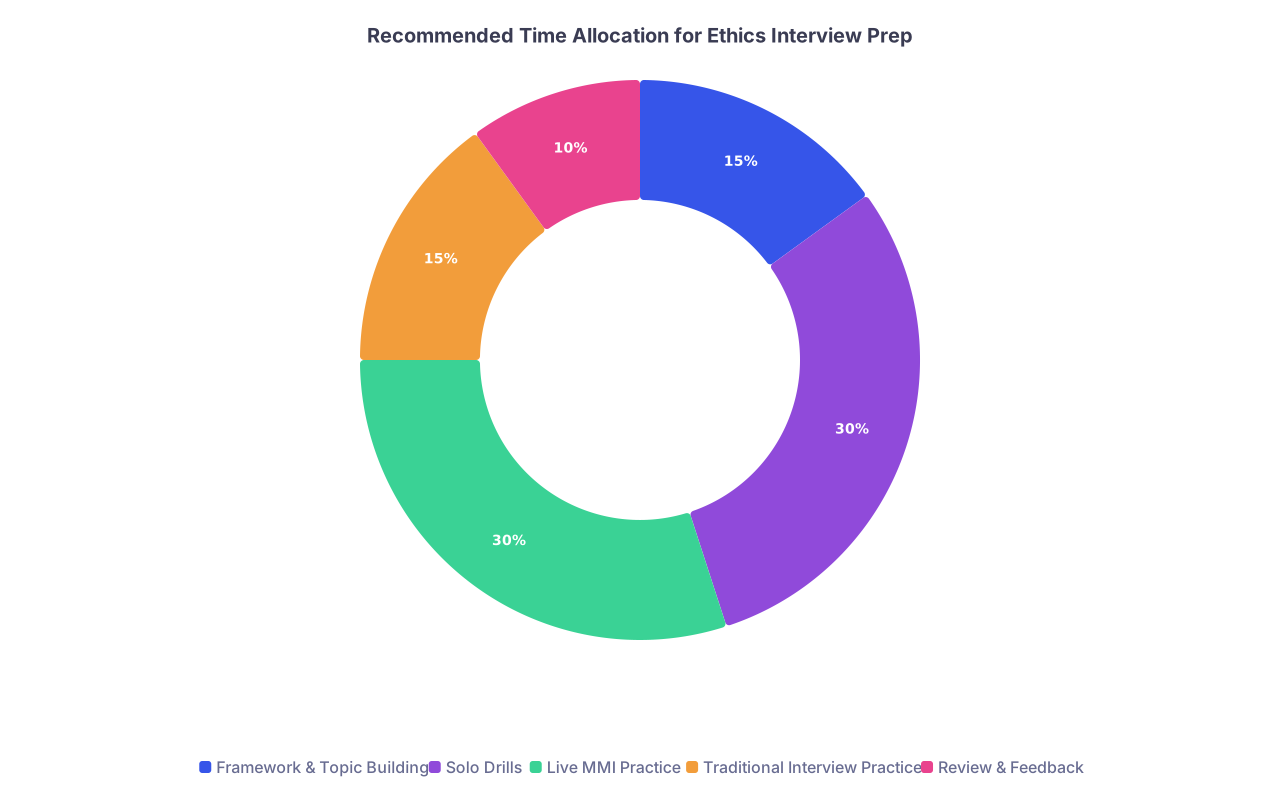
| Category | Value |
|---|---|
| Framework & Topic Building | 15 |
| Solo Drills | 30 |
| Live MMI Practice | 30 |
| Traditional Interview Practice | 15 |
| Review & Feedback | 10 |
Putting It All Together
You do not need to be an ethicist to crush ethical questions in MMI and traditional interviews. You need a repeatable way of thinking and enough reps that nothing feels completely new.
If you remember nothing else, keep these three points:
- Use a consistent structure. Stakeholders, principles, options, decision, mitigation. Every time. No exceptions.
- Practice under real conditions. Timed, out loud, with pushback and changing facts. Solo drills are not enough.
- Aim for clear, justified decisions, not perfect answers. Programs are selecting for thought process, empathy, and professionalism, not encyclopedic knowledge of bioethics.
Follow the steps above for four focused weeks, and you will walk into ethical stations knowing you have already done the hard part: training your brain to think like a future physician when the scenario is messy, uncertain, and high stakes.

| Step | Description |
|---|---|
| Step 1 | Build Framework |
| Step 2 | Create Topic Bank |
| Step 3 | Solo Timed Drills |
| Step 4 | MMI-Style Practice |
| Step 5 | Traditional Interview Practice |
| Step 6 | Curveball & Pushback Training |
| Step 7 | Fix Common Mistakes |
| Step 8 | Day-Before & Day-Of Routine |