
Most applicants lose medical school interviews not because they lack stories, but because their stories are a disorganized mess.
You do not need 100 answers. You need about 10 excellent, reusable stories—what I will call a “10‑story bank”—and a system to deploy them on command.
This is how you stop rambling, stop blanking, and start sounding like someone programs will trust with patients.
The Core Idea: Win Interviews With a 10‑Story Bank
Let me be blunt: if you are walking into interviews “winging it,” you are doing it wrong.
Successful applicants do one thing consistently: They pre-build a small set of powerful stories and then adapt them to almost any question.
Here is what your 10‑story bank must do:
- Cover the big evaluation domains admissions committees care about
- Be mapped to common question types (strengths, weaknesses, conflict, failure, leadership, etc.)
- Be rehearsed, not memorized; flexible, not robotic
- Be tagged with themes (empathy, resilience, communication, ethics, curiosity, teamwork, etc.)
Once this is done properly, “any question” stops being a threat. It becomes a simple routing problem:
- Identify what type of question you just heard
- Pull 1–2 relevant stories from your bank
- Deliver them in a clean structure (we will use a modified STAR+Reflection format)
The rest of this article is the playbook to build that system from zero.
Step 1: Know What Interviews Are Actually Testing
Most applicants misread interviews. They over-focus on sounding smart and under-focus on sounding safe, coachable, and human.
Medical school interviews generally evaluate the same core buckets:
| Domain | What They Want to See |
|---|---|
| Motivation | Why medicine, why now, why you |
| Interpersonal | Communication, empathy, listening |
| Ethics/Judgment | [Integrity, responsibility, insight](https://residencyadvisor.com/resources/med-school-interview-tips/how-interviewers-test-your-integrity-without-you-realizing-it) |
| Resilience | Handling setbacks and uncertainty |
| Teamwork | Working with difficult people |
| Leadership | Initiative, influence, followership |
Your 10 stories must collectively cover all of these. If you have 10 stories about research and zero about conflict or failure, you are setting yourself up to struggle.
The 6 High-Yield Question Families
Nearly every question fits into one of these families:
- Motivation & Identity – “Why medicine?”, “Tell me about yourself.”
- Strengths & Weaknesses – “What are your strengths?”, “Tell me about a weakness.”
- Challenge & Failure – “Tell me about a time you failed / struggled.”
- Leadership & Teamwork – “Time you led a team / worked with a difficult teammate.”
- Ethics & Conflict – “Witnessed something wrong?”, “Disagreed with a superior?”
- Adaptability & Growth – “Time you changed your mind / adapted to change.”
Your story bank should have:
- At least 1 strong story for each family
- 2–3 flexible, “multi-use” stories that can fit multiple families
We will architect that on purpose.
Step 2: Inventory Your Raw Material (Without Overthinking It)
You already have more stories than you think. The problem is they are scattered in your head in half-remembered fragments.
You will fix that in 60–90 minutes.
2.1 Brain Dump Exercise
Grab a document or notebook. Set a 30-minute timer. No editing while you write.
Create these headings and list bullet points under each:
Academics:
- Hardest course?
- Worst grade?
- Most rewarding academic experience?
- Time you helped a struggling classmate?
Clinical / Volunteering:
- First patient encounter that stuck with you
- Time something felt ethically uncomfortable
- Moment you felt useful
- Moment you felt completely out of your depth
Research:
- Project that went sideways
- Conflict with a PI, postdoc, or lab mate
- Boring or tedious work you still did well
- An experiment that failed and what you did
Work / Leadership / Activities:
- Any job: retail, tutoring, scribing, EMT, etc.
- Time you led something (club, event, project)
- Time you had to manage someone unreliable
- Time you improved a process or system
Personal Life:
- Non-academic challenge (family, health, finances)
- A serious mistake you made and owned
- Learning something hard outside school (instrument, language, sport)
- A value-defining event (moving, loss, culture shock)
You are not writing full stories. Just bullets like:
- “Orgo 2 – bombed first midterm, went to office hours weekly → A- in course”
- “Free clinic – mispronounced pt’s name repeatedly, attending corrected me, learned to ask and repeat”
You should end with 30–60 bullet points. Ugly, disorganized. Perfect.
Step 3: Select and Shape Your 10 Core Stories
Now you will carve a sharp 10‑story bank out of that messy pile.
3.1 Story Criteria: What Makes the Cut
Pick stories that:
- Show change or growth – You ended different than you started
- Show action, not just feelings – You did something observable
- Show other people – Not just you alone in the library
- Show a clear tension or problem – Something actually happened
- Can be told in 60–120 seconds once trimmed
Avoid:
- Pure “success reels” with no struggle
- Anything that makes you sound bitter, blameful, or arrogant
- Stories that are so personal you cannot discuss them without losing composure
You are building a professional toolkit, not a therapy session.
3.2 Suggested 10-Story Layout
Here is a simple template that works for almost everyone:
Why Medicine Anchor Story
- A clinical or life experience that clearly links to your motivation.
- Not: “I’ve always wanted to help people.”
- Yes: “At the free clinic, I watched a physician navigate a complex social situation with a non-English speaking patient and realized…”
Identity / Background Story
- Family, upbringing, or major identity shaper.
- Use for “Tell me about yourself,” diversity, resilience, empathy.
Academic Challenge Story
- Course or exam where you struggled, changed your strategy, improved.
- Great for “failure,” “resilience,” and “weakness” questions.
Leadership Success Story
- Where you led something and it went well after initial friction.
Leadership / Team Conflict Story
- Time you worked with a difficult teammate or balanced conflicting views.
Ethical Tension Story
- Witnessed something off and had to decide what to do. Could be in research, clinical, or work.
Patient / Service Story
- Direct service where you learned something about empathy, humility, or bias.
Research or Long-Term Project Story
- Shows curiosity, perseverance, dealing with uncertainty.
Personal Setback Story
- Outside academics. Illness, family issue, financial problem, etc., and your response.
Adaptability / Changed Perspective Story
- You held a belief, encountered new information or people, and changed.
Map your raw bullets to this list. You may have multiple candidates; choose the ones that:
- Give you the best chance to show maturity
- Make you sound like someone others would want on their team at 2 a.m. on a call night
Step 4: Put Each Story Into a Tight Structure (STAR+R)
Now you will stop telling 5-minute wandering monologues.
Use a modified STAR with an explicit reflection at the end:
- S – Situation: Brief context (1–2 sentences)
- T – Task: What you were supposed to do / the goal
- A – Action: What you did (your decisions, behaviors)
- R – Result: Outcome (quantitative or qualitative)
- +R – Reflection: What you learned, how it changed you, and how you apply it now
If you hit all five, you sound composed and self-aware. If you skip reflection, you sound like you are just reciting events.
4.1 Example: Academic Challenge Story (Before vs After)
Bad version (how most people answer):
“So I took organic chemistry my second year. It was really hard, and I did not do well on the first exam, and I felt really discouraged. But I studied more and went to office hours, and I ended up doing better. It taught me to work harder.”
Now the structured version:
Situation:
“In my second year, I took Organic Chemistry II while working 20 hours a week as a tutor. I assumed I could manage it the same way as previous science courses.”Task:
“The first midterm came back as a 62%, well below the class average, and I needed at least a B in the course to stay on track for my major.”Action:
“I met with the professor and realized I had been memorizing mechanisms instead of understanding patterns. I cut one of my tutoring shifts, set up a weekly study group, and started doing timed problem sets every other night, focusing on explaining my reasoning out loud.”Result:
“My next exams were in the high 80s and low 90s, and I finished the course with an A-. More importantly, I stopped cramming and built a consistent, active study routine.”Reflection:
“That experience forced me to confront that ‘working hard’ and ‘working effectively’ are not the same thing. Since then, I build systems early—calendars, spaced repetition, peer teaching—that I know I will need in medical school where the volume will only increase.”
You can deliver that in about 90 seconds. Clear, specific, mature.
Do this for all 10 stories. Yes, it takes a few hours. It is still faster than bombing one interview and having to reapply an entire year later.
Step 5: Tag Each Story So You Can Reuse It
Your 10 stories are now structured. But the power is in reusability.
You will tag each one with:
- Primary theme(s): resilience, leadership, empathy, integrity, curiosity, etc.
- Question families it answers: failure, conflict, “why medicine,” weakness, etc.
- Risk flags: anything sensitive (mental health, family issues, grades) you must handle carefully.
Create a simple table for yourself like this:
| Story # | Context | Themes | Question Types Covered |
|---|---|---|---|
| 1 | Free clinic pt | Empathy, Motivation | Why medicine, tell me about pt |
| 3 | Orgo II struggle | Resilience, Growth | Failure, weakness, challenge |
| 5 | Group project | Conflict, Communication | Teamwork, difficult colleague |
| 6 | Lab data issue | Ethics, Integrity | Ethics, disagreement, judgment |
| 9 | Family illness | Resilience, Priority | Setback, stress management |
Now, when someone asks:
- “Tell me about a time you worked with someone difficult.”
- “Describe a leadership experience.”
- “Give an example of a time you had to adapt.”
You are not starting from zero. You are scanning your internal tags: Leadership + conflict… that is Story 5. Adaptation… Story 3 or 10.
Step 6: Connect Stories to the “Big 5” Questions
There are five questions you will almost certainly see in some form. You should know exactly which stories you will pull for each.
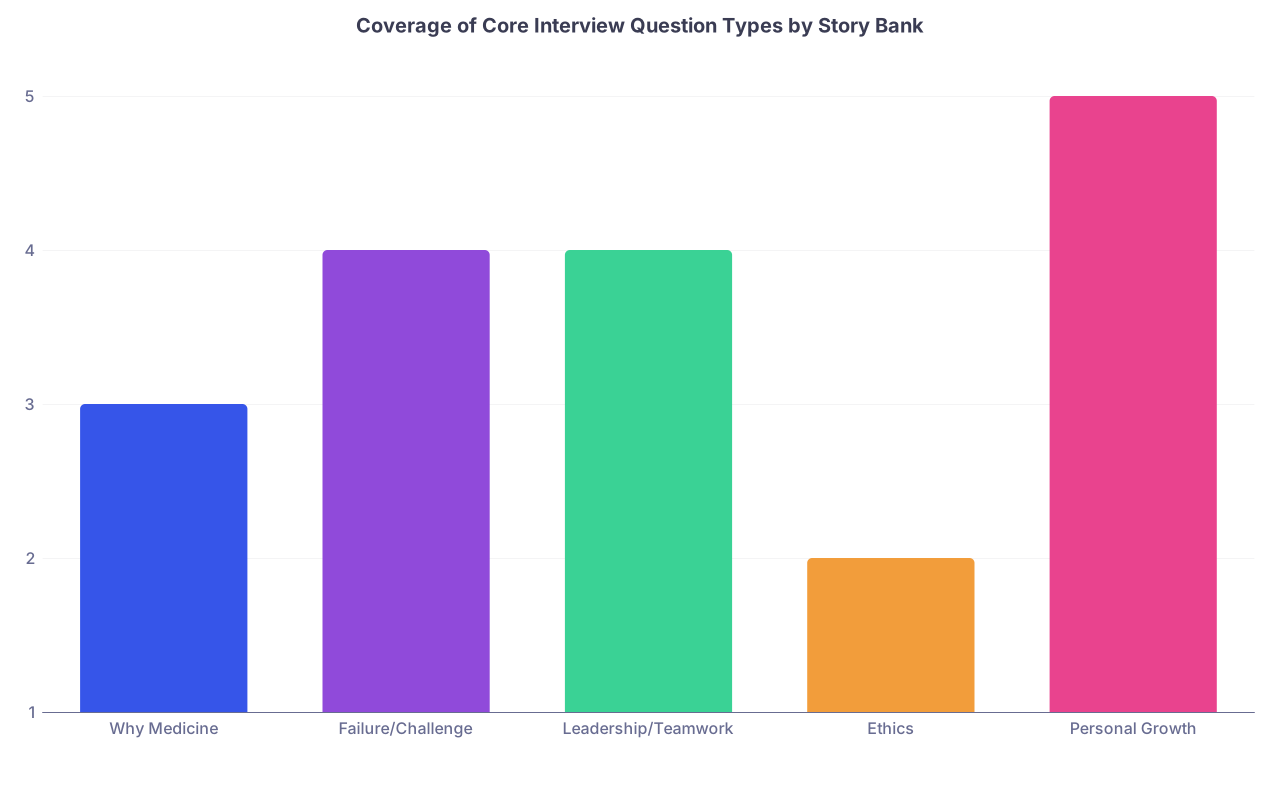
| Category | Value |
|---|---|
| Why Medicine | 3 |
| Failure/Challenge | 4 |
| Leadership/Teamwork | 4 |
| Ethics | 2 |
| Personal Growth | 5 |
6.1 “Tell Me About Yourself”
This is not “recite your CV.” It is a coherent narrative.
Use:
- Story 2 (Identity / Background) as the spine
- Briefly attach 1–2 other micro-stories (e.g., one academic, one clinical) that show how that background led you to medicine.
Structure:
- Who you are now (major, current role)
- A key background element that shaped you (family, geography, early responsibility)
- 1–2 turning points (research, clinic, teaching)
- Where you are headed (why medicine, why now)
You are aiming for 1.5–2 minutes. If it is 4 minutes, it is too long.
6.2 “Why Medicine?”
This should not be “because I like science and helping people.” That is the baseline, not a differentiator.
Use:
- Story 1 (Why Medicine Anchor) as your core answer
- Secondary support from Story 7 (Patient/Service) or Story 8 (Research), depending on your angle
Build it like:
- Intellectual pull (science, problem-solving)
- Human/patient pull (specific clinical or service story)
- Why physician, not nurse/PA/researcher only (level of responsibility, combining science and longitudinal relationships)
- How your past experiences show you understand realities, not just ideals
6.3 “What Is Your Greatest Weakness?”
Most people lie badly here. Or they present a “fake weakness” like “I work too hard.”
Do this instead:
- Pick a real but non-fatal weakness
- Anchor it in one of your stories where you clearly show progress (Story 3 or 10 often fit)
- Emphasize your system for managing it now
Example flow:
- Name the weakness clearly (e.g., difficulty delegating, overcommitting, trouble speaking up early)
- Brief story showing how it caused a real problem
- Concrete steps you have taken
- How you are continuing to monitor it
You are not aiming to sound perfect. You are aiming to sound coachable and self-aware.
6.4 “Tell Me About a Time You Failed / Faced a Challenge”
Use:
- Academic Challenge (Story 3) or
- Personal Setback (Story 9) depending on which shows better growth and less red-flag risk.
Key traps to avoid:
- Blaming everyone else
- Choosing something trivial (“I got a B+ instead of an A”)
- Choosing something catastrophic that you have not processed
Hit the full STAR+Reflection. End with what you do differently now.
6.5 “Tell Me About a Time You Had a Conflict / Worked with a Difficult Person”
Use:
- Leadership / Team Conflict (Story 5) or
- Ethical Tension (Story 6) if interpersonal conflict is central.
Show:
- You tried to understand their perspective
- You communicated directly and calmly
- You involved appropriate resources when necessary
- You did not gossip, retaliate, or go nuclear
The subtext: “Would I trust this person to work on a care team without generating drama?”
Step 7: Practice the Right Way (Not Just in Your Head)
Silent rehearsal in your head does not work well. You need real reps.
7.1 Build a “Question → Story” Drill
Take a list of 30–40 common questions (you can easily find these from med school prep resources).
Then:
- Randomly pick a question
- Identify:
- Question family
- 1–2 stories in your bank that match
- Answer out loud in 60–120 seconds using STAR+Reflection
- Record yourself on your phone or laptop
You are training three skills at once:
- Rapid mapping (question → story)
- Structured delivery under mild pressure
- Not sounding robotic while being prepared
Do 3–5 questions per session, a few times a week.
7.2 Get External Feedback—but Filter It
Ask:
- A mentor
- A friend who is not afraid to be honest
- A premed advisor, if you have one who actually knows interviews
Have them watch or listen to 3–4 answers. Ask for:
- Moments where you sounded rehearsed or fake
- Points where they got lost or bored
- Any red-flag moments (defensive, blaming, oversharing)
You will hear patterns. Fix those across the whole bank.
Step 8: Handle Ethical and Emotional Landmines Carefully
Some of your best stories may touch on sensitive topics: mental health, family illness, discrimination, academic probation.
You do not have to avoid them. But you must handle them with precision.
8.1 Three Questions to Vet a Sensitive Story
For any “heavy” story in your bank, ask:
Do I become emotionally overwhelmed every time I tell this?
- If yes, it is not ready for an interview.
Can I clearly show growth and stability since then?
- If it ends with “and I am still in the middle of the chaos,” skip it.
Could a risk-averse interviewer see this as a reliability concern?
- If you cannot clearly show systems and support in place, pick a different story.
If a story fails any of these, keep it for your own reflection, not the interview.
8.2 Ethics Stories: Do This, Not That
Bad ethics answers:
- “I saw cheating and did nothing because I did not want drama.”
- “I immediately went above everyone’s head without trying to understand.”
Strong ethics stories show:
- You noticed something that felt off
- You sought clarification (policy, mentor, supervisor)
- You balanced loyalty with responsibility
- You acted proportionally and documented when needed
Again, STAR+Reflection. The reflection here is often the most important part.
Step 9: On Interview Day – How to Deploy Your Story Bank
Your stories are ready. Now let’s talk about game day.
9.1 Build a 1-Page “Story Map” Cheat Sheet (For Prep, Not the Room)
Create a single sheet with:
- Story #, short name (e.g., “Clinic – complex pt,” “Lab – data issue”)
- 3 tags: themes + question types
You do not bring this into the interview. You use it the week before to mentally rehearse.
By interview day, you should be able to:
- Hear a question
- Silently say to yourself: “This is a Failure/Resilience + Teamwork question → I will use Story 3.”
9.2 Use “Mini-Stories” for Follow-Ups
Sometimes, you will want a second, shorter example when they probe deeper.
Example:
“That is helpful. Can you give me another situation where you handled a disagreement?”
This is where your extra bullets from Step 2 come in. Have 3–5 “mini-stories” in your back pocket—30–45 second situations with minimal setup, mostly just Action + Result + Reflection.
You do not need to pre-write these as fully as your top 10. But you should know they exist.
Step 10: Avoid the 5 Common Story Bank Mistakes
I have seen people sabotage themselves with the same predictable errors.
Here is what not to do:
Ten versions of the same story.
- If 7 of your 10 stories are from the same hospital, same club, or same PI, you sound one-dimensional.
- Fix: Diversify across contexts.
Zero vulnerability.
- If every story is a home run where you are the hero, you sound fake.
- Fix: Include at least 3 stories where you were clearly struggling at first.
Oversharing trauma without a professional frame.
- Interviewers are not your therapists.
- Fix: If in doubt, lighter story with clearer reflection beats heavy story you cannot handle smoothly.
Monologues with no reflection.
- You are not a court reporter. They want meaning, not just facts.
- Fix: Always end with “What I took from this is…” or equivalent.
Trying to memorize scripts word-for-word.
- You will sound robotic and panic when you go off script.
- Fix: Memorize beats (S/T/A/R/R) and transitions, not specific sentences.
A Quick Visual: How Your Story Bank Fits the Interview Process

| Step | Description |
|---|---|
| Step 1 | Question Asked |
| Step 2 | Story 1 or 2 |
| Step 3 | Story 3 or 9 |
| Step 4 | Story 4 or 5 |
| Step 5 | Story 6 |
| Step 6 | Story 10 |
| Step 7 | STAR+Reflection Answer |
| Step 8 | Identify Type |
Once this becomes automatic, your cognitive load drops. You can focus on connecting with the interviewer instead of scrambling for content.
Implementation Plan: Build Your Bank in 7 Days
You do not need months. You need one focused week.
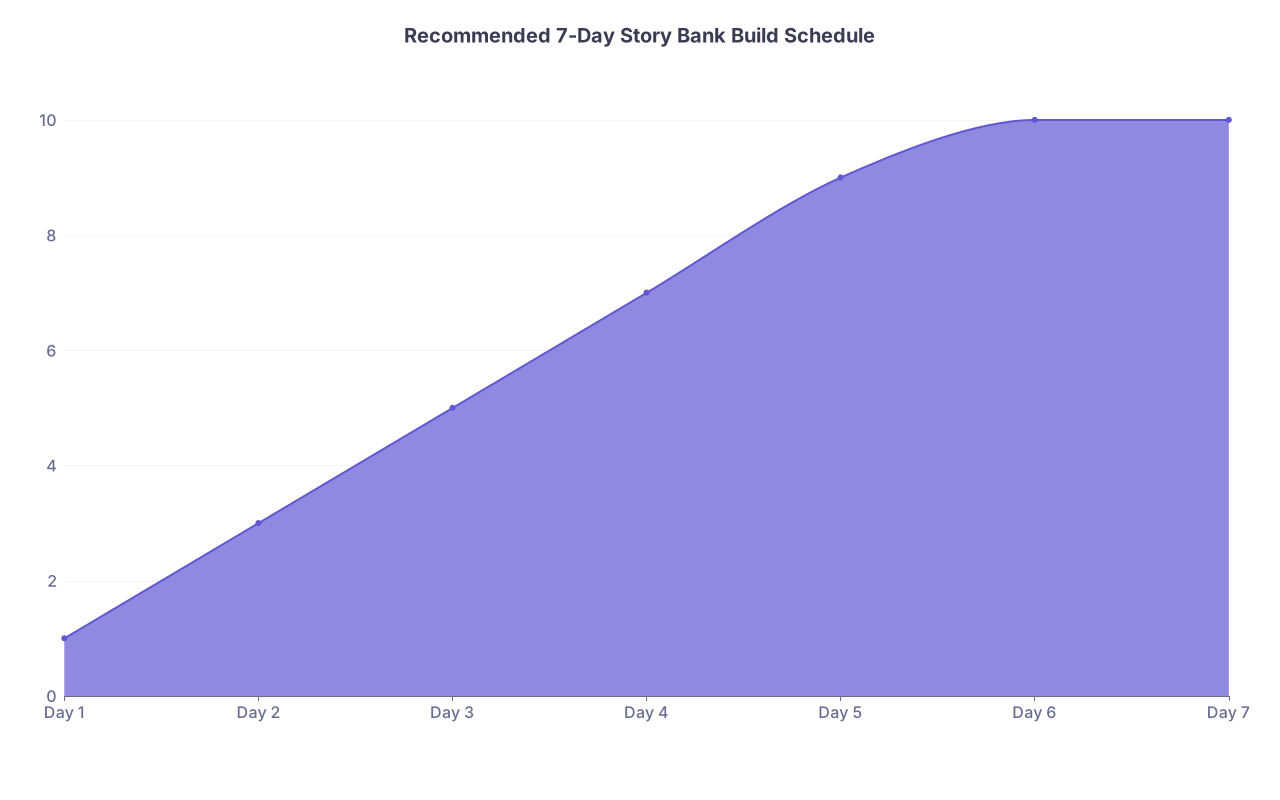
| Category | Value |
|---|---|
| Day 1 | 1 |
| Day 2 | 3 |
| Day 3 | 5 |
| Day 4 | 7 |
| Day 5 | 9 |
| Day 6 | 10 |
| Day 7 | 10 |
Day 1:
- Do the full brain dump (30–60+ bullets)
Day 2:
- Choose your 10 core stories
- Roughly assign them to roles (Why med, leadership, failure, etc.)
Day 3–4:
- Put each story into STAR+Reflection
- Aim for 1 minute versions first, then expand to 90–120 seconds where needed
Day 5:
- Tag each story (themes + question families)
- Build your 1-page story map
Day 6:
- First full practice: 8–10 random questions, recorded
- Note any stories that feel weak or awkward; revise structure
Day 7:
- Second full practice with a friend or mentor
- Fix your top 3 problems: length, clarity, or tone
After this week, you do not “wing it” anymore. You maintain and polish.
Your Next Step Today
Do not start by reading more lists of “100 common interview questions.” That is how you stay busy and unprepared.
Do this instead:
Right now, open a blank document and spend 20 minutes doing the brain dump from Step 2.
List every potential story—academic, clinical, research, work, personal—without editing.
Once that raw material exists, building your 10‑story bank becomes straightforward. Without it, you will keep trying to invent answers on the spot, and interviewers can hear the panic in every sentence.