
You Blank. Now What?
You are three questions into your medical school interview. Things were fine. You nailed “Why medicine?” You had a decent answer for a time you failed.
Then it happens.
“Can you explain the main ethical considerations in allocating scarce ICU beds during a pandemic?”
Your brain: static.
You know you have heard this in a bioethics lecture, maybe a podcast, maybe Twitter. But right now: nothing. Just the word “pandemic” echoing in your skull.
You feel your face get hot. You look at the interviewer. They are waiting. You have two options:
- Spiral and ramble into nonsense.
- Pivot with skill and show them you can think under pressure.
This article is about option 2. How to recover in the moment when you blank. And how to train for that so you are not improvising under fire.
I am not going to tell you “just be yourself” or “relax.” That is useless. You need specific phrases, exact micro-moves, and a practice protocol.
Let us break it down.
Step 1: Kill the Panic Spiral in 5 Seconds
Blanking is not the problem. Staying blank is.
The first job is not “find the perfect answer.”
The first job is “stop your brain from shutting down.”
Here is what I want you to do in those first 5 seconds.
1. Physically interrupt the panic
You feel your heart rate jump, thoughts scatter. Do this:
- Exhale slowly once.
- Briefly look down, then back at the interviewer.
- Place both feet flat on the floor and feel the contact.
You are basically telling your nervous system: we are not dying, we are talking.
You can do all of this in 2–3 seconds. Nobody will think it is weird. Interviewers read it as “thoughtful pause,” not “meltdown.”
2. Use a “stall phrase” that buys you time (without sounding lost)
You need one or two default lines pre-loaded in your brain.
Use one of these:
- “That is a great question. Let me think for a moment.”
- “I want to give you a structured answer, so I am going to take a second to gather my thoughts.”
- “There are several angles to this. I am just organizing how to approach it.”
Say it calmly. Not rushed. Then actually pause for 3–5 seconds.
You are doing three things at once:
- You signal maturity: you think before speaking.
- You buy time.
- You reset the interaction from “panic” to “reflection.”
3. Decide which of these three situations you are in
While you are pausing, quickly classify what is happening:
- You understand the question but cannot recall details.
(Typical for science/health policy/ethics prompts.) - You are not sure what the interviewer is actually asking.
(Question is vague, long, or oddly phrased.) - You truly do not know the content.
(Out-of-left-field health policy detail, obscure law, specific statistics.)
The way you pivot depends on which bucket you are in. That is the core skill.
Step 2: If You Understand the Question but Your Mind Went Blank
This is the most common scenario. You get the idea of the question but you cannot access the “nice answer” you thought you had.
The fix: switch from “perfect recall mode” to “simple structure mode.”
1. Slap a structure on the answer
Give your brain rails to run on. Pick one of these simple frames:
- Two- or three-part list:
“I see three main considerations…” - Pros/cons:
“I would look at benefits and potential downsides…” - Past–present–future:
“I will answer that by talking about where we were, where we are, and where we might be heading.”
Once you say the structure out loud, your brain tends to fill the space.
Example with the ICU bed question:
- “I see three main considerations:
First, fairness and transparency in how decisions are made.
Second, maximizing patient benefit with limited resources.
Third, communicating with families and staff in a humane and consistent way.”
Do you need the “official” bioethics framework? No. You just need something coherent that shows you can reason.
2. Start from first principles instead of specific jargon
When you blank, your brain may be frantically searching for key terms: “utilitarianism, justice, autonomy.” Forget the jargon. Start from basic human logic:
- Who is affected?
- What are the competing goods or harms?
- What would a reasonable person worry about here?
Then speak from that.
Example continuation:
- “On fairness and transparency, I think it is critical that any triage policy is applied consistently and not based on subjective judgments like who seems more ‘deserving.’ That might involve clear criteria agreed upon by a team, not one person.”
This is simple, rational, and enough. The interviewer wants to see how you think, not a philosophy exam answer.
3. Acknowledge limits without apologizing
If you genuinely feel your answer is “basic,” you do not need to sell yourself short. But you can show self-awareness:
- “I am not an expert in formal triage protocols, but at a high level I would focus on fairness, maximizing benefit, and clear communication. If I were on a team facing this, I would want to lean on institutional guidance and ethics consultation rather than improvising.”
This is professional. You are not pretending to know more than you do, and you are still answering the question.
Step 3: If You Are Not Sure What They Are Asking
This is where students sabotage themselves. They do not fully understand the question, panic, and then ramble off-target.
Do not do that.
Your move here: clarify confidently, then answer.
1. Reflect back a simplified version
You are allowed to say:
- “Just to make sure I am answering what you are asking…”
- “When you say X, do you mean more in the sense of Y or Z?”
- “Are you asking more about my personal experience with this, or my general thoughts?”
Concrete examples:
- “When you ask about ‘healthcare reform,’ are you thinking more about insurance coverage changes, or about cost control in general?”
- “When you say ‘conflict with a supervisor,’ do you mean clinical or non-clinical, like research or campus jobs?”
This does three things:
- Shows that you listen carefully.
- Narrows the target.
- Gives you a few more seconds.
2. Use “anchor and expand”
Once you understand the question, anchor it to something you do feel comfortable with.
Suppose the question is:
“What changes would you make to the US healthcare system?”
You blank on policy specifics. You can do:
- “That is obviously a huge topic, so I will focus on one area I know a bit more about: access to primary care for underserved communities. One change I would support is…”
You took a broad, intimidating question and made it manageable. That is exactly what physicians do with complex problems.
Step 4: If You Truly Do Not Know the Answer
Yes, there are times you actually do not know. That is not fatal. Faking it is.
Worst moves:
- Making up statistics.
- Dropping buzzwords randomly.
- Talking for three minutes and saying nothing.
Better move: state what you do not know, then show how you would think through it.
1. Use a “humble + thinking” combo
Template:
- Acknowledge the gap.
- Share what you do know or suspect.
- Show how you would approach filling the gap.
Example (health policy detail you have not heard of):
- “I am not familiar with the specifics of that particular policy. My understanding in general is that policies in this area try to balance cost control with maintaining access. If I were actually involved in this, I would want to look at data on outcomes and who is most affected before having a strong opinion. Broadly, my bias is toward protecting access for vulnerable patients, even if it is more complex to implement.”
That is honest, reflective, and still shows values and reasoning. Interviewers respect that.
2. Avoid the “soft apology loop”
Do not say:
- “Sorry, I should know this.”
- “I am really bad at policy questions.”
- “I am probably way off.”
One brief acknowledgment is fine. Repeated apologizing makes you look unconfident, and worse, it eats time you could be using to construct something coherent.
Use one clean line instead:
- “This is not an area I have deep knowledge in, but I can tell you how I am thinking about it.”
Then move on.
Step 5: The Exact Pivots You Can Memorize
I will give you a small arsenal. These are lines you can literally memorize and practice out loud.
A. When your mind goes blank but you know the topic
- “Let me take a second to organize my thoughts.”
- “I see two main points here: first…, and second…”
- “At a high level, I would think about this in terms of X and Y.”
B. When the question feels huge and abstract
- “That is a broad question, so I will focus on one aspect I have thought about more: …”
- “There are many angles to this. I will start with the one I have seen most directly, which is…”
C. When you truly do not know
- “I am not familiar with that specific policy/study, but in general I understand that…”
- “I do not know the precise statistics, but directionally my understanding is that…”
- “I am not sure about the formal term for that, though the way I think about it is…”
D. When you need clarification
- “To make sure I am answering your question, are you asking more about X or Y?”
- “When you say [term], what definition are you using?”
If you internalize even four of these phrases, your brain will have somewhere to go besides total freeze.
Step 6: Train This Like a Skill (Not a Personality Flaw)
Blanking is not a sign that you are “bad at interviews.” It is your nervous system doing exactly what nervous systems do under pressure.
You can train it. Systematically.
1. Do “blank drills” with a partner
You probably practice content. You need to practice failure.
Set up a 20–30 minute session with a friend, mentor, or even alone with a question list. The explicit goal: practice recovering when you do not know what to say.
Protocol:
- Have them ask you realistic questions, including some curveballs.
- Any time you feel stuck, you must:
- Use a stall phrase.
- Take a breath and pause.
- Either ask for clarification or pick a structure (three points, pros/cons, etc.).
- After each question, debrief for 30–60 seconds:
- Did you panic?
- Did you stall gracefully?
- Did you start rambling?
You are building a reflex: stall → structure → speak. I have watched students improve drastically in one week if they do this deliberately.
2. Record and rewatch yourself
Painful, yes. Necessary, also yes.
Use your phone. Do 5–6 questions in a row. Watch the recording and look for:
- Do you freeze longer than 3–4 seconds in silence?
- Do your eyes dart around when you are lost?
- Do you start everything with “Umm, so yeah…”?
Then re-record the same questions, explicitly inserting your pivot phrases and pausing calmly. Compare. You will see a difference.
3. Build “mental templates” for common question types
A lot of “blanking” comes from facing a new question type you have not mentally rehearsed.
You do not need 50 different strategies. You need 4–5 templates you can plug almost anything into:
Template 1: Behavioral (“Tell me about a time when…”)
- Situation
- Your role
- What you did
- What changed
- What you learned
Memorize that structure. If you blank on the example, you can still talk through something coherent.
- Stakeholders involved
- Competing values
- What you would do
- Why, and how you would communicate it
Template 3: Policy / “big picture”
- Briefly define the issue
- One or two key pros
- One or two key cons
- Where you lean and why
- Acknowledge that experts may disagree
If you have these frameworks pre-loaded, then even when content fails, form saves you.
Step 7: Fixing the Rambling After a Blank
Sometimes you do not fully freeze. You do something worse: you start talking and cannot stop.
You realize mid-sentence that you are not actually answering the question, but you feel trapped, so you keep going. This is where interviews go to die.
You need a “reset switch.”
1. Use a mid-answer reset line
You are allowed to stop yourself. Interviewers actually appreciate the self-correction.
Try:
- “Let me pause and re-center on your actual question.”
- “I realize I am getting a bit in the weeds here. To answer you more directly…”
- “Stepping back for a second, the main point I want to make is…”
Then give a one- or two-sentence clear answer. Short and tight.
Example:
- “I realize I am giving a lot of background. To answer the question directly: if I disagreed with a supervisor’s decision, I would first seek to understand their reasoning privately, then raise my concerns respectfully, focusing on patient safety rather than on being ‘right’.”
That is far more impressive than plowing through three minutes of fluff.
2. Watch your “answer length”
Most interview responses should be 60–90 seconds. Up to 2 minutes for complex scenarios if you are structured.
If you notice yourself drifting past that, default to:
- “To summarize my view in a sentence: …”
That line forces you to compress, which pulls the answer back into focus.
Step 8: What Interviewers Actually Care About When You Blank
Let me be blunt. Interviewers do not care if you can flawlessly answer every question. That is not the job.
- Can you stay composed under mild stress?
- Can you think out loud in a structured way?
- Are you honest about what you do and do not know?
- Do you default to humility and curiosity, not defensiveness or arrogance?
When you blank, they are getting real data on those traits.
If you say, “I am not sure, but here is how I would think through it,” many interviewers will actually rate you higher than the student who regurgitates a memorized policy speech.
They have seen enough applicants to know: Medicine is full of unknowns. They want people who can handle that instead of faking omniscience.
Quick Comparison: Bad vs Good Responses After a Blank
| Scenario | Weak Response Example | Strong Response Example |
|---|---|---|
| Complex ethics question | Long silence, then “Umm, I am not sure…” | “Let me think for a moment. Two key issues come to mind…” |
| Unknown policy detail | Makes up statistics and terms | “I am not familiar with that specific policy. In general…” |
| Vague giant question | Rambles aimlessly about many topics | “That is broad. I will focus on X aspect I know best…” |
| Off-track mid-answer | Keeps talking to fill time | “Let me pause and answer you more directly: …” |
You do not need to be perfect. You do need to be this kind of strong.
A Simple Weekly Practice Plan Before Your Interview
You do not fix blanking by reading. You fix it by reps.
Here is a lean, practical plan for the 2–3 weeks before interviews:
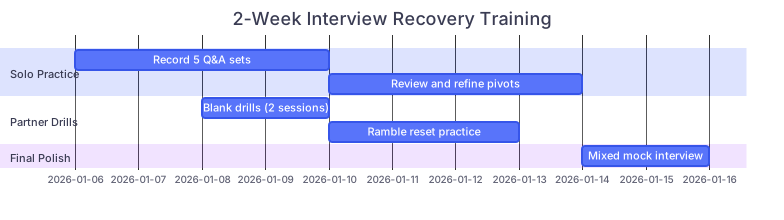
| Task | Details |
|---|---|
| Solo Practice: Record 5 Q&A sets | a1, 2026-01-06, 4d |
| Solo Practice: Review and refine pivots | a2, after a1, 4d |
| Partner Drills: Blank drills (2 sessions) | b1, 2026-01-08, 2d |
| Partner Drills: Ramble reset practice | b2, after b1, 3d |
| Final Polish: Mixed mock interview | c1, 2026-01-14, 2d |
Twice a week (30–40 minutes):
- 10 minutes: Solo practice with random questions
- Focus on inserting stall phrases and structures.
- 20–30 minutes: Partner mock
- Ask them deliberately to throw at least 3–4 curveball questions.
- Your job is not to know everything; it is to pivot cleanly.
By interview day, you want the experience of blanking and recovering to feel familiar. Not new.
One More Thing: Your Story about the Blank Matters
You will probably walk out of at least one interview thinking, “I ruined it on that one question.”
You almost certainly did not.
Most committees do not tank an otherwise strong applicant over a single imperfect answer, especially if you handled it with composure and honesty.
The real danger is you internalizing, “I am bad at interviews” and carrying that energy into the next one.
Do this instead:
After any interview where you blanked:
- Write down the question.
- Write the answer you wish you had given, using the structures from above.
- Practice that answer out loud once.
- Move on.
You have just converted a painful moment into a prepared script for next time. That is how you get better.
Final Takeaways
- Blanking is not the problem; staying frozen or rambling is. Your sequence should be: stall phrase → brief pause → simple structure → honest answer.
- Train the skill deliberately with blank drills, recorded practice, and a handful of memorized pivot phrases so recovery becomes automatic.
- Interviewers care far more about your composure, reasoning, and honesty than about perfect content. Use moments of “I do not know” to demonstrate exactly those traits.