
The standard advice about “having stories ready” for interviews is vague and mostly useless.
You don’t need 50 stories. You don’t need one story for every possible question. You need a small, tight set of versatile stories you know cold and can adapt on the fly.
Here’s the number you’re looking for:
You need 8–10 well‑developed personal stories for medical school and premed interviews.
And if you do it right, those 8–10 can cover 90% of the questions you’ll ever get.
Let me break down exactly which stories, how to build them, and how to make them stretch across a ridiculous number of questions.
The Core Number: 8–10 Stories (And No, That’s Not Arbitrary)
Here’s the honest breakdown.
You need:
- 3 “who I am” foundation stories
- 3 “challenge and growth” stories
- 2 “team and conflict” stories
- 1–2 “why medicine / values” stories
That’s it. That’s your arsenal.
Think in categories, not in random memories. Because interview questions are predictable. They’re all just different doors into the same rooms: motivation, character, resilience, maturity, and fit for medicine.
| Story Type | Target Number | Main Use Case |
|---|---|---|
| Identity/Foundation | 3 | Tell me about yourself, background |
| Challenge/Resilience | 3 | Weaknesses, failures, growth |
| Teamwork/Conflict | 2 | Collaboration, communication, conflict |
| Medicine/Values | 1–2 | Why medicine, ethics, professionalism |
If you’re reading this and thinking, “I have like 25 things I could talk about,” that’s the problem. Scatter. You’ll ramble or blank when it counts.
If instead you can say: “I have 9 dialed-in stories that I can bend into almost any question,” you win.
Step 1: The 3 Foundation Stories (“Tell Me About Yourself” Fuel)
These are the stories that define you. The ones that answer:
- Who are you?
- Where did you come from (not just geographically)?
- What actually matters to you?
You want three of these, each from a different angle. For example:
Origin/Identity Story
- How you grew up, a key influence (family member, community, early experience).
- Example: First-gen college student watching your parents work two jobs, shaping your view of service and grit.
Academic/Intellectual Story
- A class, project, or research experience that shows how you think and what engages you.
- Example: A tough biochemistry course where you went from memorizing to truly understanding—and how that changed how you study and teach others.
Outside-of-Medicine/Passion Story
- Something that has nothing to do with resumes: music, sports, art, debate, caregiving, etc.
- Example: Coaching youth soccer and learning how to communicate with anxious kids and frustrated parents.
These three can answer:
- “Tell me about yourself.”
- “What’s something not in your application?”
- “What shaped you most as a person?”
- “How do you spend your time outside academics?”
- “What should I remember about you after this interview?”
If you can’t answer those clearly, no amount of “what’s your biggest weakness” prep will save you.
Step 2: The 3 Challenge and Growth Stories
If you’ve ever sat on an admissions panel, you know: everyone says they’re resilient. Very few can prove it.
You want three different stories where things didn’t go your way.
Categories that work well:
Academic or Performance Setback
- Rough exam, bad semester, failed project, MCAT disappointment.
- Show: self-awareness, taking responsibility, concrete adjustment, outcome.
Personal or Emotional Challenge
- Burnout, overcommitting, dealing with anxiety, family issues while in school.
- Show: insight, boundaries, coping skills, support-seeking, maturity.
Leadership/Responsibility Gone Wrong
- You led something that didn’t succeed. Lab group drama, a club that fell apart, miscommunication that was your fault.
- Show: you owning it, fixing processes, not blaming everyone else.
These can be reused for:
- “Tell me about a time you failed.”
- “What’s your biggest weakness?”
- “Tell me about a setback and how you handled it.”
- “Describe a time you were criticized.”
- “Tell me about a stressful situation and how you coped.”
One trap: premeds love to share fake-failures. “I got a B+ and I’m very perfectionistic.” Don’t do that. I’ve watched adcoms roll their eyes at that answer in real time.
Pick something that actually stung. Then show growth, not self-pity.
Step 3: The 2 Team and Conflict Stories
Medicine is a team sport. Schools and programs are paranoid about people who can’t work with others.
You need two stories here:
Great Teamwork Story
- You worked with others on something that mattered (clinic, lab, group project, volunteer event).
- Show: communication, role clarity, support, humility, you giving credit.
Real Conflict Story
- A genuine disagreement or tension: lazy teammate, harsh supervisor, clashing approaches.
- Show: you staying professional, addressing the issue directly, not trash-talking, and learning from it.
These answers should handle:
- “Tell me about a time you worked on a team.”
- “Tell me about a conflict with a coworker or teammate.”
- “How do you handle disagreement?”
- “Describe a time you had to work with someone very different from you.”
If your conflict story is “my friend and I disagreed about where to eat,” start over.
Step 4: The 1–2 Medicine/Values Stories
You absolutely need at least one strong patient- or service-related story that makes your “why medicine” answer real.
Ideally, you have two:
Direct Patient/Clinical Story
- From shadowing, scribing, EMS, CNA, hospice, free clinic, etc.
- This should not be trauma porn. Focus on what you saw about the physician’s role, your reaction, and what it clarified about the kind of doctor you want to be.
Service/Values Story (Not Necessarily Clinical)
- Long-term volunteering, teaching, community work.
- Shows your core values: service, advocacy, equity, humility.
These plug into:
- “Why medicine?”
- “Why not nursing/PA/public health?”
- “Tell me about a meaningful clinical experience.”
- “Describe a patient interaction that impacted you.”
- “What kind of physician do you want to be?”
If your answer to “why medicine?” is basically your personal statement re-read out loud, you’re missing the point. These stories should give fresh angles and depth, not a verbatim repeat.
How 8–10 Stories Cover 90% of Questions
Here’s the trick no one tells you: questions are reusable prompts.
Example with just one story:
Let’s say you have a strong story about nearly failing organic chemistry, changing your study habits, seeking help, and eventually tutoring the course.
You can use that SAME story for:
“Tell me about a challenge you faced.”
→ Focus on the struggle and self-doubt.“What’s your biggest weakness?”
→ Emphasize your original issue (overconfidence, procrastination, doing it alone).“Tell me about a time you received critical feedback.”
→ Focus on the TA/prof calling you out and how you reacted.“Tell me about a time you helped someone learn something.”
→ Focus on how you later tutored students using what you learned.
One story. Four questions. Different angles.
Your job is to know your 8–10 stories so well that, the second you hear a question, your brain goes, “Ah, this is a challenge-type question → I can use Story #4 or Story #6.”
How Deep Each Story Needs To Be
You don’t need a novel. You need clear, flexible skeletons.
For each story, write out:
Context (1–2 sentences)
- When/where, who was involved.
Tension/Problem (2–4 sentences)
- What went wrong, what was hard, what the stakes were.
Your Actions (3–6 sentences)
- Specific decisions you made, conversations you had, what you tried.
Outcome + Reflection (3–5 sentences)
- What happened, what you learned, how you’ve applied it since.
That’s enough for a 1.5–3 minute answer, which is the sweet spot for most questions.
Don’t script word-for-word. You’ll sound robotic. Script beats and key phrases, then practice out loud until you can tell it naturally.
Common Mistakes With Interview Stories (That Will Hurt You)
I’ve seen variations of these in almost every bad interview.
All stories from the last 6 months
- Makes you look shallow or like you just started caring when you applied. Mix in college and earlier if relevant.
Every story is about achievement, not struggle
- “I started a club, I led a project, I fixed everything.” No. That reads as self-congratulatory and fake. Programs want humility, not a highlight reel.
Zero non-medical stories
- If every example is hospital, clinic, research, shadowing, you come off as one-dimensional. They’re admitting a human, not a robot.
Stories where you’re the victim, not the agent
- If the takeaway is always “everyone else was the problem,” that’s a red flag.
Overly dramatic patient stories used as emotional props
- You can talk about hard things. But if the emotional payoff of your story is “look at this tragic patient” instead of “here’s what I understood about the physician role,” you’ve missed the ethical line.
How To Actually Practice These Stories (So You Don’t Freeze)
Knowing “I should have 9 stories” is useless if you never rehearse them.
Use this simple loop:
List your 8–10 story titles on paper.
- Example: “Grandma’s diabetes,” “Org chem failure,” “Free clinic translator,” “Soccer coaching conflict,” “Research miscommunication,” etc.
Pick 5 common questions. Say them out loud:
- Tell me about yourself.
- Why medicine?
- Tell me about a time you failed.
- Tell me about a time you had a conflict.
- What’s a weakness you’re working on?
For each question, choose a story and answer out loud.
- Record yourself. Don’t write it first.
Listen once, adjust, repeat.
- Cut the fluff. Add reflection. Make sure you’re answering the actual question, not just telling a cool story.
Do this 2–3 times and you’ll feel the flexibility kick in. You’ll stop panicking, “I’ve never been asked this exact question before” and start thinking, “Okay, this is a values/conflict/growth question. Which story fits?”
How This Changes Across Phases (Premed vs. Med Student)
If you’re premed:
- Heavier emphasis on:
- Volunteering
- Shadowing
- Early research or leadership
- Identity/trajectory (why medicine from your vantage point now)
If you’re in medical school interviewing for residency:
- Your categories are the same, but your story pool shifts toward:
- Clinical rotations
- Shelf/Step struggles
- Teamwork on wards
- Specific patient encounters as a student
- Professionalism and ethics issues
The number doesn’t really change. You still want about 8–10. The content matures.
Visualizing the Story Mix
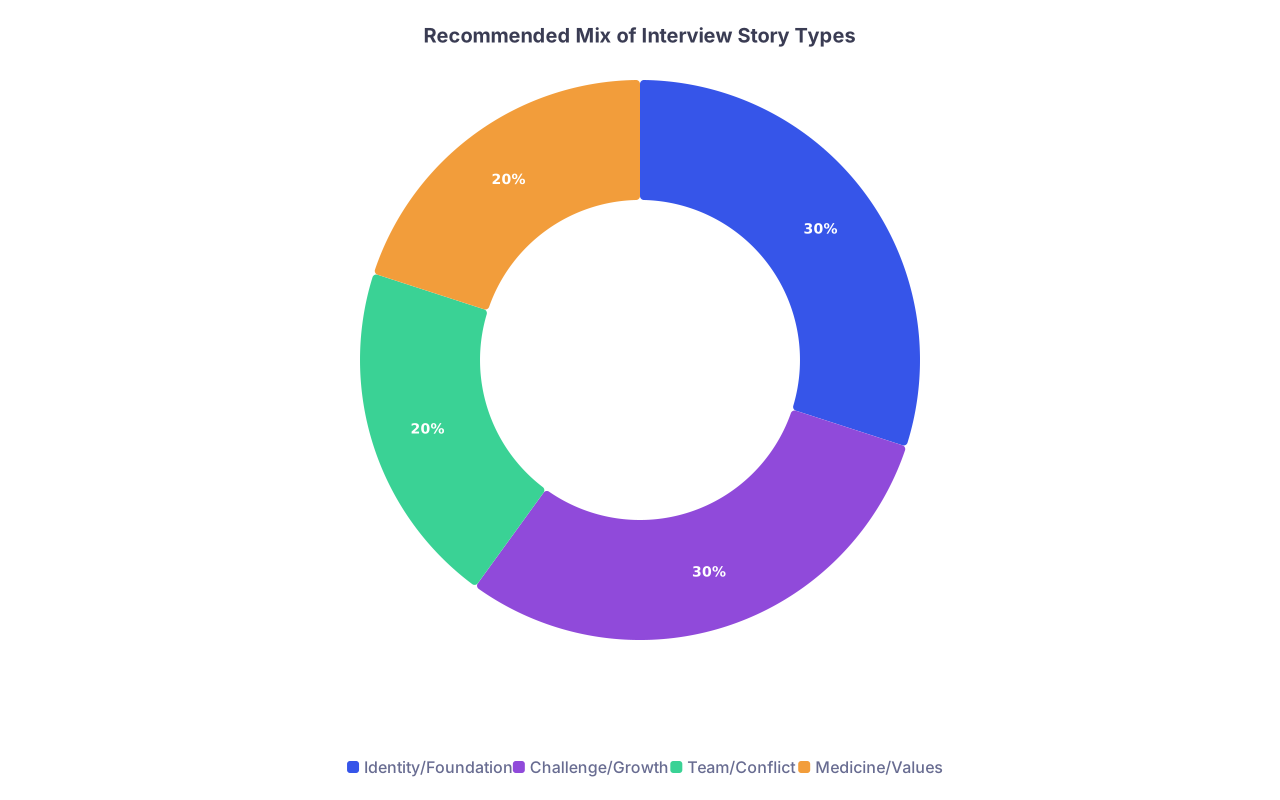
| Category | Value |
|---|---|
| Identity/Foundation | 3 |
| Challenge/Growth | 3 |
| Team/Conflict | 2 |
| Medicine/Values | 2 |
Example Story Map (So You See How This Looks)
Let me sketch a sample set for a strong premed:
Identity/Foundation
- Growing up translating for parents in medical visits
- Discovering a love for teaching as a physics TA
- Playing violin in a community orchestra for 8 years
Challenge/Growth
- Bombing first college midterms and overhauling study habits
- Struggling with burnout while doing EMT shifts + full course load
- Failing to organize a campus health fair well the first time
Team/Conflict
- Navigating tension in a research lab between two senior students
- Handling a conflict with a clinic volunteer who wasn’t following protocol
Medicine/Values
- Longitudinal experience with a free clinic patient with uncontrolled hypertension
- Volunteering at a crisis text line and learning how to listen non-judgmentally
From that set alone, I can cover:
- Tell me about yourself
- Why medicine
- Why not a different health profession
- Tell me about a time you failed
- Tell me about a time you were overwhelmed
- Tell me about a conflict
- Tell me about an ethical dilemma
- What do you do for fun
- Tell me about a leadership experience
- What’s a weakness you’re working on
That’s the point: small set, high leverage.
Quick Story-Building Framework You Can Use Today
Use this for any story: CPTOR
Context → Problem → Tension → Outcome → Reflection
- Context: One sentence. “During my sophomore year, I was an EMT doing night shifts while taking a full premed load.”
- Problem: “After a few months, my grades slipped and I was exhausted.”
- Tension: “I started dreading shifts and snapping at my roommates, but I didn’t want to quit.”
- Outcome: “I cut back shifts, met with my advisor, and rebuilt my schedule. My grades recovered and I was more present on the ambulance.”
- Reflection: “I learned that protecting my bandwidth actually makes me more reliable for my team and future patients. Now I plan my commitments with that in mind.”
That’s a 90-second backbone you can expand or contract.
FAQs
1. What if I don’t have enough “dramatic” stories?
You don’t need drama. You need honesty and reflection. A story about learning to ask for help in a tough class is better than some forced, heroic narrative about “saving” a patient as a volunteer. Depth beats drama every time.
2. Can I reuse stories from my personal statement?
Yes—and you should. But don’t just recite the essay. Use the same underlying experience from a different angle, or go deeper into one moment you only briefly mentioned in your personal statement.
3. Are multiple stories from the same activity okay (e.g., all from my free clinic)?
Yes, as long as they highlight different themes: one for teamwork, one for a mistake you made, one for a patient interaction that shaped your “why medicine.” Just don’t make it seem like it’s the only thing you’ve ever done.
4. How long should an interview story answer be?
For most questions, aim for 60–180 seconds. Under a minute usually feels shallow. Over three minutes and most interviewers mentally check out. If you’re going long, you’re adding unnecessary detail in the context or problem; cut there.
5. What’s one red-flag move with personal stories?
Blaming everyone else. If every story ends with “and they were unfair / incompetent / immature,” that’s a huge red flag. You should always be able to identify at least one thing you could’ve done differently or learned—even if others were also at fault.
Open a blank document right now and list 10 potential stories by title only—no paragraphs, just labels. Then categorize them into: foundation, challenge, team, or medicine. If you can’t fill those 8–10 slots yet, that’s your homework for the week.