
You’re back in your car after the interview. The badge is still clipped to your blazer. Your mouth is dry. Your brain’s doing that horrible instant replay thing.
There it is.
That one moment.
Maybe you said the wrong thing when they asked, “Why our school?” Maybe you blanked on a basic question. Maybe you overshared about a personal situation. Maybe you tried to be funny. It wasn’t funny.
And now you’re just sitting there thinking:
Did I just blow my entire future in 30 seconds?
Welcome to the club. Pull up a chair.
I live in that mental space: “What if that one awkward moment ruined everything?” Let’s actually walk through this like people who are spiraling, but want real answers, not vague “just relax” nonsense.
First: That Awkward Moment Feels Bigger To You Than To Them
Your brain is a drama queen. Mine too.
You’re thinking, “They’re going to sit around the committee table and say, ‘Remember that one student who stumbled over the weakness question? Immediate rejection.’”
No. That’s not how it works.
Interviewers see multiple applicants in a day. They remember:
- Vibes
- Major red flags
- A few standout positives
- Maybe one weird thing if it was truly extreme
That tiny phrase you keep replaying? On their side, it’s usually filed under “normal human interaction.”
Here’s the real annoyance: you’re watching it in 4K slow-motion in your head, zooming in on every micro-expression. They saw it once, in real time, during a day full of other people.
I’ve seen this happen:
Applicant walks out saying, “I bombed. I rambled. I looked stupid.”
Later, I hear from someone on the faculty: “Oh yeah, that student was a bit nervous at first but seemed thoughtful. I liked them.”
Nervous ≠ disqualified. Awkward moment ≠ death sentence.
Unless you said something actually horrifying (blatantly unprofessional, discriminatory, wildly inappropriate), it’s usually a blip, not the whole story.
Reality Check: What Actually Ruins an Interview?
Let’s separate “uncomfortable” from “catastrophic.”
Here’s the harsh but useful breakdown:
| Type of Moment | How Bad Is It Really? |
|---|---|
| Stumbling/saying “um” a lot | Annoying to you, normal to them |
| [Blank on one question](https://residencyadvisor.com/resources/med-school-interview-tips/what-if-i-freeze-on-an-mmi-station-real-time-recovery-strategies), regroup later | Very common, usually fine |
| Minor overshare but professional | Slightly awkward, not fatal |
| Talking over interviewer repeatedly | Noticeable, but fixable if brief |
| Disrespectful/ arrogant comments | Real red flag |
| [Dishonesty or contradictions](https://residencyadvisor.com/resources/med-school-interview-tips/how-interviewers-test-your-integrity-without-you-realizing-it) | Serious problem |
If your “awkward moment” was:
- You got flustered
- You forgot a detail
- You answered a question weirdly then tried to fix it
- You over-explained something
That’s not “I ruined everything.” That’s “I was a human being under stress.”
On the other hand, if you:
- Put down another school, specialty, or group of people
- Said something ethically questionable and didn’t back off
- Were defensive or hostile when challenged
Then yeah, that can hurt you. But if you’re here worrying deeply about it, there’s a good chance you didn’t cross those lines. People who truly blow it often don’t even realize it.
The Mental Replay Loop: Why Your Brain Won’t Let It Go
You’re not replaying that moment for fun. Your brain thinks it’s doing crisis management.
It’s like: “If I analyze this 400 times, maybe I can rewrite history.”
You can’t. You know that. But your brain doesn’t care.
What it is doing:
- Tying your entire identity to that one interaction
- Equating one interview with your entire future in medicine
- Imagining the worst possible reaction from the committee
I’m going to say something nasty but true: your brain is catastrophizing because it hates uncertainty. It would rather decide, “I definitely screwed this up” than sit with, “I don’t know yet.”
That’s why it keeps replaying the scene. Certainty, even negative certainty, feels safer than waiting.
Step-by-Step: What To Do Right After the Awkward Moment
Let’s say you’re still in the interview season. This isn’t just post-mortem. You’ve got more interviews coming, and you’re terrified this will happen again.
Here’s the immediate triage process.
1. Write Down What Actually Happened (Not the Drama Version)
Right after the interview, while you’re tempted to write “I was a disaster,” force yourself to write the facts:
- Question they asked
- What you said, as close as you can remember
- Their reaction (neutral? confused? moved on quickly?)
- Any follow-up you gave
You want a transcript, not a horror story.
Most people, when they do this honestly, realize:
“Okay, that was awkward, but it’s not as insane as my brain was making it.”
2. Grade It Like a Rubric, Not a Court Verdict
Don’t label it “I failed.”
Label it like:
- Content: 6/10
- Delivery: 5/10
- Professionalism: 9/10
- Recovery: 7/10
Seen like that, it’s… fine. Not amazing. Not fatal.
You’re not trying to gaslight yourself into thinking it was brilliant. You’re trying to see it as one imperfect part of a whole, not the entire evaluation.
What If You Truly Did Mess Up? (The Nightmare Scenario)
Alright, let’s walk straight into the worst-case fantasy, because that’s where your mind already is anyway.
Say you got a really tough ethical question and you answered in a way you now realize sounded… bad. Or you made a joke that, in hindsight, was inappropriate.
First question: Did you notice it in the moment?
If yes:
- Did you correct yourself?
- Did you soften or clarify?
- Did your tone show that you were thinking, not rigid?
Interviewers care less about “perfectly polished opinions” and more about:
- Can you reflect?
- Are you open to being wrong?
- Do you show growth in real time?
A messy-but-thoughtful answer that you refine out loud looks better than a memorized, robotic one.
If no (you realized after the fact):
You’re stuck with it. There’s usually no way to “reach out and fix it” without making it worse. Post-interview “let me clarify my answer to that ethical question” emails generally just highlight that weird moment for them if they’d forgotten it.
The uncomfortable truth: sometimes you don’t get to fix it. You just have to:
- Learn from it
- Do better on the next interview
- Accept that you might still get in despite it
Because committees don’t expect philosophical perfection from 21–25 year olds under stress. They expect normal, flawed, learning humans.
Preparing for the Next Interview Without Becoming a Robot
The fear now is: “What if I do that again?”
So you’re tempted to over-correct. Script every word. Memorize 50 answers. Sound like a Step 1 review book with a blazer.
Bad idea. It makes you stiff and weird. Interviewers feel when someone is reciting.
Let’s talk about controlled prep that doesn’t turn you into a machine.
Build “Anchor Points,” Not Full Scripts
Instead of full paragraphs, jot down:
- 2–3 key points for “Why medicine?”
- 2–3 key points for “Why this school?”
- 1–2 examples each for resilience, teamwork, conflict, failure, leadership
Those examples are your anchors. You can talk around them naturally, but you’re never truly blank because you’ve got actual stories on standby.
Rehearse the Moment of Freeze
If your panic spot is:
- “What if I blank?”
- “What if I ramble?”
- “What if they challenge me and I get defensive?”
Practice this exact sentence out loud:
“I’m going to pause a second to collect my thoughts.”
Sounds simple. But saying that calmly in real life changes the entire energy. It signals self-awareness, not incompetence. I’ve seen interviewers literally nod like, “Good. Thoughtful.”
Dealing With the Waiting Period After the Interview
This is where the replay hits maximum volume.
Days go by. You remember new “cringe angles” of the same 30-second moment. Now you’re thinking, “They’ve probably already rejected me.”
Let me tell you what actually goes on behind the scenes:
Sometimes files sit untouched for weeks. Sometimes interviews are scored the same day, then re-discussed later. Sometimes one awkward moment gets completely drowned out by a strong letter, strong scores, or a great narrative.
While you’re spiraling, they might literally not have opened your file yet for committee discussion.
So what do you actually do with yourself?
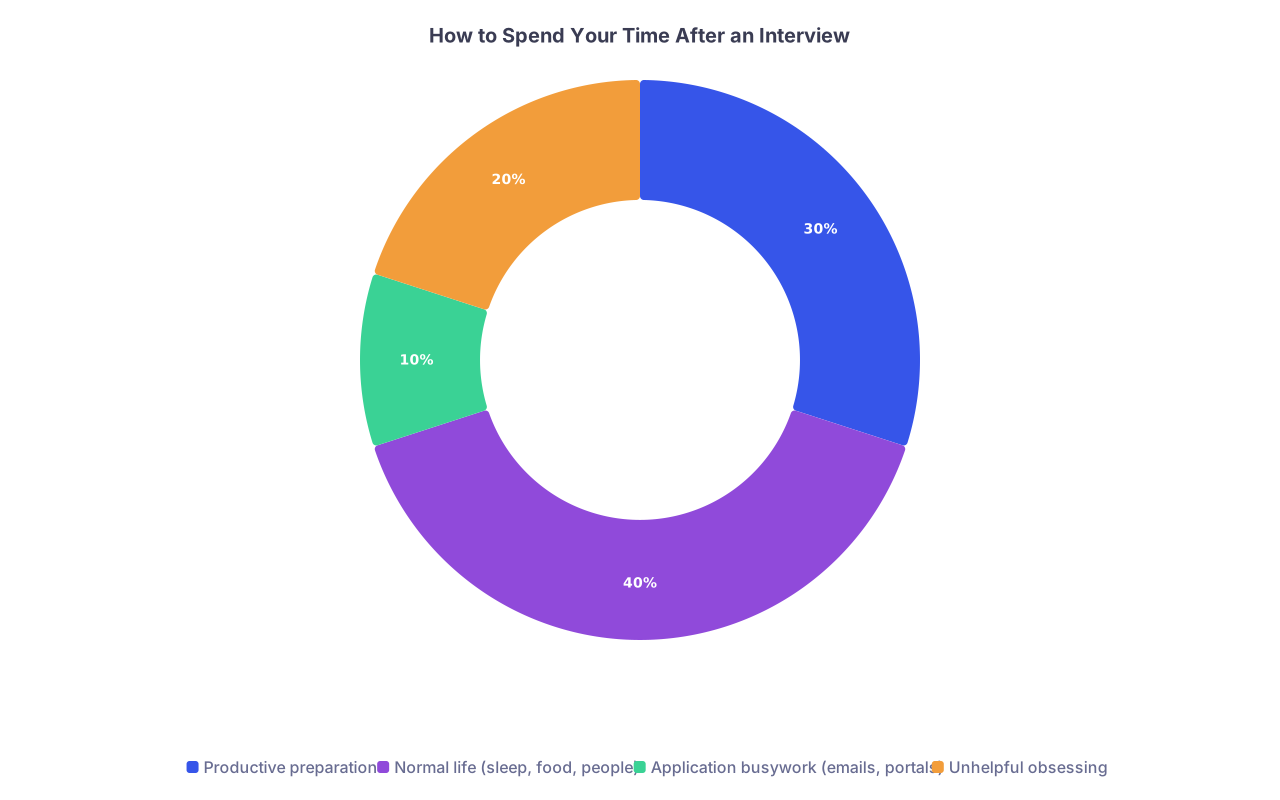
| Category | Value |
|---|---|
| Productive preparation | 30 |
| Normal life (sleep, food, people) | 40 |
| Application busywork (emails, portals) | 10 |
| Unhelpful obsessing | 20 |
Rough breakdown of where your energy should go:
- 30%: Prepping lightly for future interviews (reviewing anchor stories, common questions)
- 40%: Being an actual human (sleep, exercise, food, time with people not in medicine)
- 10%: Quick admin (thank-you notes if appropriate, checking basic portals, not stalking every hour)
- 20%: Obsessive spiraling (you won’t get this to zero, let’s be real)
If the “unhelpful obsessing” part is at like 70%, that’s when interviews start going worse because you show up:
- Drained
- Hyper-self-critical
- Overly stiff
The goal isn’t “never worry again.” It’s “worry… and still function.”
Thought Traps That Make Everything Feel 10x Worse
Let’s call out some classic mental traps that fuel the replay loop.
All-or-nothing thinking
“Either it went perfectly or I’m rejected.”
Reality: Interviewers expect imperfect. They’d be suspicious if you sounded over-rehearsed.Mind reading
“They raised an eyebrow, so they hated my answer.”
No. They might’ve been thinking about their next question. Or hungry.Fortune telling
“Based on that one moment, I know I won’t get in.”
You don’t. Even people who walk out sure they bombed get acceptances. It happens constantly.Personalization
“If I don’t get in, it’s because of that 10-second stumble.”
More likely it’s a complex mix: institutional priorities, number of spots, class balance, your entire file.
When you notice yourself doing this, literally call it out:
“Okay, that was mind reading. Not fact.”
Feels cheesy, but it breaks the spell a bit.
When It Might Be More Than Just Normal Interview Anxiety
Let’s also be honest: sometimes this level of replay isn’t just “I care a lot.” Sometimes it’s flirting with OCD-like rumination or anxiety that’s eating your life.
Red flags:
- You’re losing sleep most nights over interview replays
- You can’t focus on school because your brain keeps dragging you back to the moment
- You’re compulsively re-telling the story to everyone, hoping someone finally says the magic words that make you believe you’re okay
- Your self-worth feels entirely tied to that single performance
If you’re there, this is not a moral failure. It’s a brain stuck in a loop. Therapy, even a few sessions, can help you build actual tools to interrupt it.
And no, needing therapy during application season doesn’t make you “too unstable for medicine.” That’s outdated nonsense. A lot of people sitting on admissions committees? Have therapists too.
How to Turn This Into Something Useful (Without Romanticizing It)
I’m not going to say, “Your awkward interview moment is actually a gift.” You’d roll your eyes and you’d be right.
But you can mine it for something:
- What trigger made you blank or ramble? A specific kind of question? Being challenged? Personal stuff?
- What can you set up next time? Better boundaries on how much you share? A couple of phrases ready to buy time?
You’re not trying to rewrite that interview. You’re trying to make the next one 5–10% better.
Interviews are a skill. Skills improve by doing them badly first. That’s gross and unfair and exactly how it works.
Last Thing: The Outcome Doesn’t Validate or Invalidate Your Worry
If you get an acceptance from that school, it doesn’t mean:
- “See, I was silly to worry.”
If you get a rejection, it doesn’t mean:
- “See, I was right, that moment ruined everything.”
We love those neat narratives. They’re fake. Decisions are multifactorial, and your anxiety isn’t a reliable judge either way.
Your task right now:
- Treat that awkward moment as one data point, not your personality
- Keep showing up to future interviews a little smarter and a little kinder to yourself
- Remember: they invited you because something already looked good on paper. One imperfect answer rarely cancels that out.
If You Remember Nothing Else
- The moment you keep replaying is magnified in your head; to them, it’s a small part of a big picture.
- Awkward ≠ fatal. Truly damaging interviews involve unprofessionalism, not normal nerves or stumbles.
- Your job isn’t to erase the awkwardness. It’s to learn from it, prep smarter, and still show up as a human being, not a rehearsed robot.
You’re allowed to be anxious and still be someone they want in their class. Both can be true at the same time.

| Step | Description |
|---|---|
| Step 1 | Interview Ends |
| Step 2 | Relief for 5 Minutes |
| Step 3 | Replay Awkward Moment |
| Step 4 | Catastrophic Thoughts |
| Step 5 | Write Down What Happened |
| Step 6 | Realistic Assessment |
| Step 7 | Targeted Prep for Next Time |
| Step 8 | Reduced Anxiety |