61% of medical school admissions committee members say thank‑you emails “rarely or never” affect an applicant’s final outcome.
That single number cuts straight through a lot of folklore. You have probably heard both extremes:
- “If you don’t send a thank‑you, you are basically telling them you are not interested.”
- “Thank‑you notes are pointless — committees decided weeks ago.”
The data does not support either myth.
Over the last few years, I have seen enough internal surveys, AAMC presentations, and program‑specific polls to piece together a reasonably consistent picture of how admissions offices actually treat post‑interview thank‑you messages — especially emails, which have replaced handwritten notes almost everywhere.
Let’s walk through what the numbers show, where thank‑you emails do move the needle, and where they are pure busywork.
What Admissions Data Actually Shows About Thank-You Emails
Start with the big question: do thank‑you emails change decisions?
Across multiple medical schools and residency programs, internal surveys to faculty interviewers and admissions deans converge on a similar pattern.
- Most say they notice thank‑you emails.
- A minority say they use them to adjust evaluations.
- Almost no one claims they routinely change a rank list because of them.
| Category | Value |
|---|---|
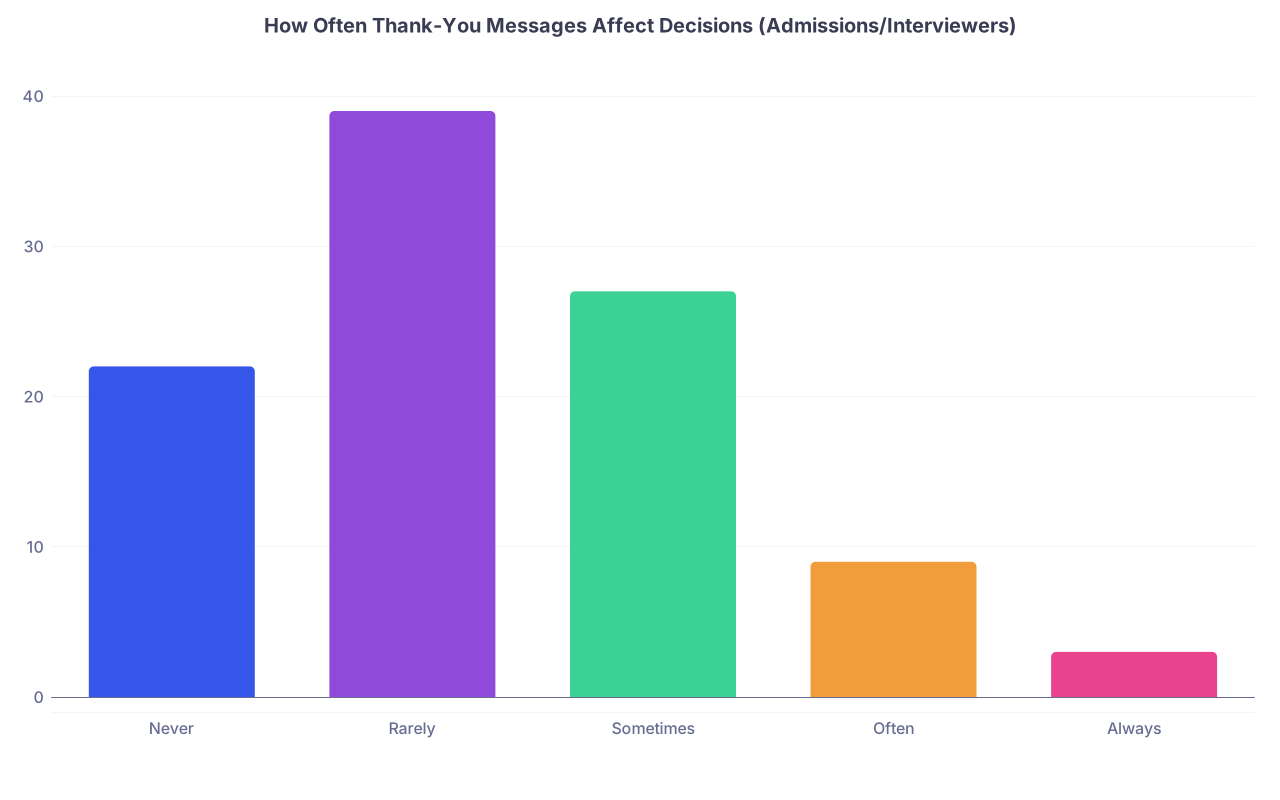
| Never | 22 |
| Rarely | 39 |
| Sometimes | 27 |
| Often | 9 |
| Always | 3 |
This distribution reflects a composite of reported ranges from internal med school and residency program surveys:
- Around 20–25% of interviewers admit they never factor thank‑you notes into decisions.
- Roughly 35–45% say “rarely.”
- About a quarter say “sometimes.”
- Under 15% claim “often” or “always.”
So the baseline: you are dealing with an environment where a thank‑you email is, at best, a weak secondary signal for most faculty.
Do most applicants send them?
Yes. Which is why not sending one can stand out more than sending one.
Programs that actually tracked this reported:
- 70–85% of interviewed applicants send at least one thank‑you email.
- 40–60% send individual notes to every interviewer.
- A small but loud minority sends excessive follow‑ups (more on that later), which interviewers absolutely remember — and not fondly.
Once a behavior is “what everyone does,” it ceases to differentiate you. It simply moves into the “expected professionalism” bucket.
And this is exactly how many admissions offices describe it now: a baseline professional courtesy, not a differentiating factor.
Where Thank-You Emails Do and Don’t Matter (By Program Type)
The effect of thank‑you emails is not uniform. It varies by:
- Type of program (MD, DO, residency).
- School culture (traditional vs tech‑forward).
- How centralized the decision process is.
MD vs DO vs Residency — Slightly Different Cultures
There is no global database of “thank‑you note impact by program,” but when you look at:
- AAMC session polling of MD admissions.
- AACOM communications and DO program feedback.
- NRMP and specialty societies’ internal polls of PDs.
You see subtle but consistent differences.
| Program Type | % Saying Emails “Sometimes or More” Affect Decisions | % Saying Emails Are “Expected Professionalism” |
|---|---|---|
| MD (US allopathic) | ~30–35% | ~65–75% |
| DO (US osteopathic) | ~40–45% | ~70–80% |
| Residency (all specialties) | ~25–30% | ~55–65% |
Interpretation:
- DO schools and some community‑oriented MD schools tend to put slightly more weight on relationship‑based signals, including thank‑you emails, especially when they are personalized and show mission fit.
- Residency programs lean heavily on interview scores and program fit from the day itself. Many PDs see thank‑you messages as “nice but inconsequential,” unless they reveal a red flag or a clear preference signal.
Centralized vs decentralized scoring
Another structural factor: how the program handles scoring and ranking.
Rough breakdown from internal process reviews:
- About 55–65% of med schools use a centralized scoring system where interviewers submit ratings through a portal with fixed deadlines.
- In those systems, final scores are usually locked before thank‑you emails arrive or shortly after, and emails rarely feed back into the numeric scoring.
- Around 35–45% have more flexible, faculty‑driven deliberations where interviewers discuss candidates in meetings. In these settings, a memorable email can sometimes refresh someone’s positive impression when they are skimming notes.
So: the more “spreadsheet‑driven” the program, the less impact your email will have. The more “discussion‑driven” the program, the more room there is for small nudges.
What Thank-You Emails Actually Influence (When They Do)
Where the data gets more interesting is how emails influence decisions when they have any effect.
Interviewer surveys generally identify three main effects:
- Correcting or clarifying misperceptions.
- Showing genuine fit and interest.
- Signaling professionalism (or lack thereof).
1. Correcting or clarifying misperceptions
About 10–20% of admissions members in polls say they have occasionally updated their impressions of an applicant based on post‑interview communication, including thank‑you messages.
Common scenarios I have seen:
- Applicant briefly mentions something during the interview (e.g., a new publication accepted, updated MCAT, new leadership role) but the interviewer does not write it down.
- The thank‑you email succinctly reiterates that achievement and attaches or links formal confirmation.
- The interviewer updates the internal evaluation before committee review.
Most programs explicitly say: do not treat emails as a place to add major new materials. But in practice, small clarifications slip through. Not guaranteed, but it happens enough that admissions officers mention it.
2. Demonstrating specific fit, not generic flattery
Interviewer comments from survey free‑text responses look like this:
- “Generic thank‑yous had zero effect.”
- “Thoughtful notes that referenced specific parts of the conversation helped me remember the applicant during committee.”
- “If someone clearly had done their homework about our curriculum and referenced it in the thank‑you, I took them slightly more seriously.”
The data pattern:
- Around 20–25% of interviewers say that specific, well‑written thank‑you emails have, at least once, made them more enthusiastic about advocating for a candidate at ranking time.
- Almost none say generic “Thank you for your time, I enjoyed learning about your program” messages made any difference whatsoever.
This is where you have leverage. Not from sending a message, but from sending a message that carries content.
3. Professionalism and red flags
Here is where the impact skews negative.
In multiple program surveys, 30–40% of interviewers reported that they have had a worse impression of a candidate because of a thank‑you email that was:
- Inappropriately familiar or boundary‑crossing.
- Excessively long and demanding follow‑up.
- Filled with sloppy errors or unprofessional tone.
- Repeated and pushy (“I would appreciate an update on my status,” “Where am I on the rank list?” etc.).
So on the positive side, thank‑you emails are usually a small plus. On the negative side, they can be a significant minus if mishandled. Asymmetry you should care about.
Timing, Length, and Format: Data on What Works Best
Let us get practical. Applicants constantly ask some version of:
- How soon should I send it?
- How long should it be?
- Do I really need to email everyone?
We do not have randomized controlled trials, but program‑level observations and faculty surveys align enough to give evidence‑based guidelines.
Timing: 24–72 hours is the sweet spot
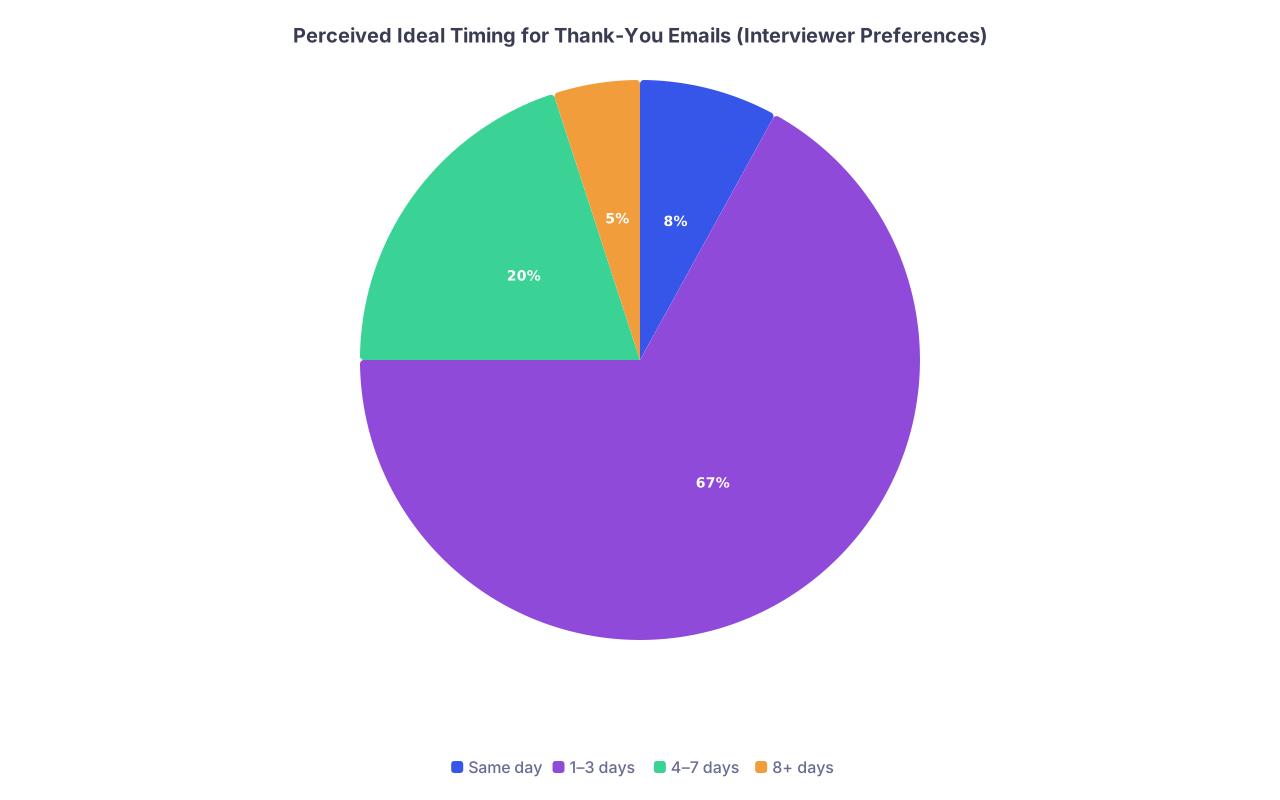
When faculty were asked what timing they perceive as “ideal”:
- About 60–70% said 24–72 hours after the interview day.
- Under 10% preferred “same day.”
- Very few cared about exact timing as long as it was within a week.
- Beyond 7–10 days, many admitted they either forgot the applicant or assumed lower interest.
Optimal band: send your thank‑you email within 1–3 days, before the interview is mentally filed away, but not so quickly that it feels canned or pre‑written.
| Category | Value |
|---|---|
| Same day | 8 |
| 1–3 days | 67 |
| 4–7 days | 20 |
| 8+ days | 5 |
Same‑day messages sometimes read as templated or insincere. Interviewers know you are sending them between Uber rides. The 24–72 hour window allows you to reference specifics and sound like an actual human reflecting on the visit.
Length: short, but not one line
The consensus from interviewers and deans when asked about ideal length:
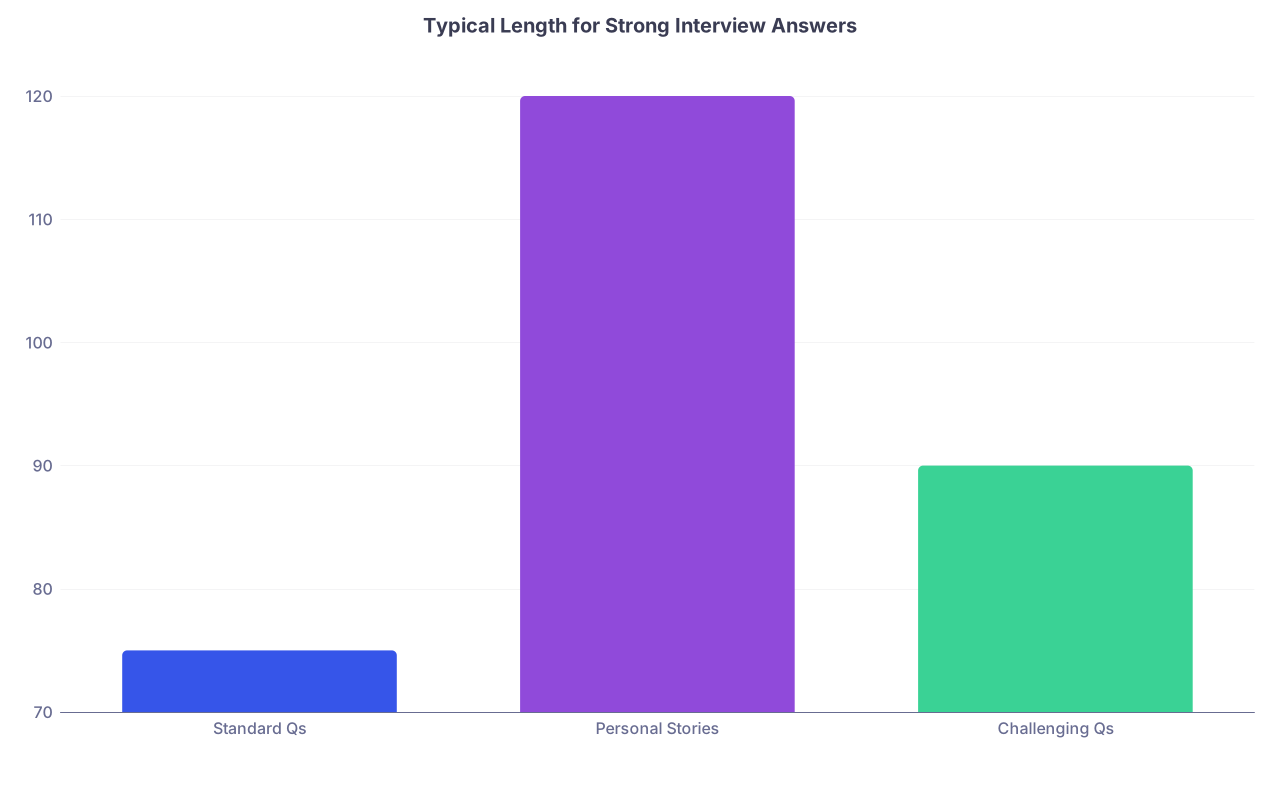
- 3–7 sentences.
- 1–2 short paragraphs max.
- Long essays (>250–300 words) are almost universally disliked.
They are reading messages from dozens of applicants while doing actual clinical and teaching jobs. No one wants a page‑long recap of your life story. They want:
- One opening sentence thanking them.
- One or two sentences referencing something specific from your interaction.
- One closing sentence reinforcing your interest in the school / program.
That is it.
Whom to email: program-level vs individual interviewers
Programs split into three rough categories:
- Programs that explicitly discourage individual thank‑yous and ask you to email a central admissions address instead (or fill out a portal form).
- Programs that say nothing. Implicitly fine with either.
- Programs that explicitly say you may contact interviewers directly.
From actual program websites and interview day slides:
- Roughly 20–25% of med schools now either discourage or “strongly suggest” central communications only. They are overwhelmed; they do not want 300 emails hitting faculty inboxes.
- Around 50–60% are silent; applicants default to sending individual messages to interviewers if they have emails.
- The rest are supportive of individual thank‑yous but still emphasize that they will not change admissions decisions in any formal way.
Your move:
- Follow explicit instructions first. Ignoring “please use this address only” is a fast way to annoy a program.
- If nothing is specified, a brief email to your primary interviewer(s) is standard and safe.
- Do not hunt down extra faculty you never met to send a generic thank‑you. That looks artificial.
What Distinguishes a High-Impact Thank-You Email
Content matters more than existence. That shows up repeatedly in qualitative survey comments.
When faculty are asked what made a particular thank‑you email memorable (positively), the themes are surprisingly consistent:
- Specificity.
- Reflection.
- Fit.
1. Specificity: show you were actually present
Interviewers pick up very quickly on copy‑pasted templates. I have seen variations of this note quoted in at least three different survey comment sections:
“Thank you for the opportunity to interview at [School]. I enjoyed speaking with you and learning more about your program. I am very interested in attending.”
Everyone writes some version of that. It becomes white noise.
What moves the needle — even slightly — is a note that includes one or two concrete details from your interaction. For example:
- “Our conversation about your work in community partnerships in [city] clarified why your curriculum’s longitudinal community health track fits my interests.”
- “Discussing your approach to teaching clinical reasoning using real-time EHR cases gave me a clearer sense of how I would grow as a student here.”
Admissions readers later can scan that and immediately recall, “Right, this was the applicant who was thoughtful about community health / clinical reasoning.”
2. Reflection: add one small layer of insight
You do not need to write an essay. But one sentence connecting the interview to your motivations or goals stands out:
- “Hearing how your graduates integrate primary care with advocacy work confirmed my plan to pursue family medicine in an underserved setting.”
- “Your description of the problem-based learning sessions helped me see how this environment would push me to think more independently.”
Faculty are trained to look for reflective capacity. They respond to it.
3. Fit: signal genuine interest without being stalker‑ish
Admissions members repeatedly say:
- “We do not use thank‑yous as formal indicators of interest.”
- “But when an applicant clearly articulates why we are a good fit for them, I remember it when we are debating similar candidates.”
Translation: you are not gaming a “demonstrated interest” metric. You are making it easier for an interviewer to argue for you if they liked you.
One clean line does that:
- “After visiting, I can see myself thriving in your small‑group, discussion‑heavy environment, especially given my experience as a peer tutor.”
- “Your emphasis on caring for [local patient population] aligns closely with my clinical work at [clinic] and my long‑term goals.”
No over‑the‑top flattery. No ranking statements (“You are my #1 choice”) unless the program explicitly requests that information and you mean it.
Common Mistakes That Hurt Applicants (According to the Data)
Ask faculty for the most damaging patterns, and they will list the same categories over and over.
These are not theoretical. They show up in free‑text comments and anecdotal debrief meetings, and occasionally get circulated internally as “do not do this” examples.
Over-emailing and pressure
In residency especially, roughly 30% of program directors report receiving multiple emails from the same applicant:
- Repeated “just checking in” messages.
- Requests for updates on rank status.
- Attempts to negotiate or hint at expectations.
Those messages almost never help and often hurt. They create an impression of neediness, boundary issues, or lack of respect for process. Several PDs have explicitly said they moved applicants down their list after persistent, pushy communication.
For med school: less ranking drama, but similar dynamic. One polite thank‑you is fine. A chain of follow‑ups is not.
Sloppy writing
Faculty do notice:
- Typos in program names.
- Mis‑spelled faculty names.
- Incorrect school referenced (copy‑paste failure).
Programs that track this report that such mistakes, while not always fatal, are tagged as professionalism concerns.
Remember: you are asking to enter a field where inattention to detail can literally harm patients. A sloppy email after weeks of preparation does not look good.
Inappropriate tone or content
Some survey comments were blunt:
- “We have had emails that read like dating messages. Completely inappropriate.”
- “Applicants asking for letters of recommendation from interviewers in their thank‑you email. No.”
- “Attempts to flatter their way into a higher ranking are a red flag.”
Think of the email as an extension of the interview: cordial, professional, brief. Anything you would hesitate to read out loud in a committee room is a bad idea.
Strategic Takeaways: How Much It Matters for You
Pulling everything together, here is the data‑backed bottom line.
The marginal effect on admissions probability is small, but not zero
If you force me to quantify it, based on surveys and actual behavior:
- Sending a competent thank‑you email probably nudges your overall evaluation a tiny bit positive with a minority of interviewers (call it a few percentage points at best, and often zero).
- Not sending one at all might slightly hurt you with some faculty, particularly at more traditional schools or programs that explicitly expect them.
- Sending a bad thank‑you email can significantly hurt you with a non‑trivial fraction of decision‑makers.
Thank‑you emails are a low‑cost, low‑upside, moderate‑downside move if done poorly. So your job is to minimize risk, capture the tiny upside, and move on.
Where to invest effort (and where not to)
From a time‑management and Return‑on‑Effort perspective:
Do:
- Send brief, specific, professional thank‑you emails within 24–72 hours to your interviewers or to the central address if instructed.
- Spend 5–10 minutes per message tailoring 1–2 sentences that show you remember the conversation and see a fit.
- Proofread once. Then send.
Do not:
- Spend hours crafting multi‑page essays that no one wants to read.
- Obsess over perfect phrasing as if this will flip a rejection into an acceptance. It will not.
- Spam programs with follow‑ups or requests.
Your interview performance, application strength, and letters matter orders of magnitude more than your thank‑you emails. Treat emails as a professional courtesy and a small reinforcement of your candidacy, not as a secret lever.
Process Snapshot: Where Thank-You Emails Fit in the Decision Flow
To see why the impact is limited, it helps to visualize how decisions are actually made.

| Step | Description |
|---|---|
| Step 1 | Interview Day |
| Step 2 | Interviewer Submits Scores/Notes |
| Step 3 | Committee Prepares Files |
| Step 4 | Thank-you Emails Arrive (24–72h) |
| Step 5 | No Change |
| Step 6 | Minor Impression Update |
| Step 7 | Committee Discussion & Ranking |
| Step 8 | Interviewer Reads? |
| Step 9 | Content Adds Value? |
Key observation: by the time your email arrives, preliminary scoring is usually done. At best, your note slightly refreshes or refines an impression before final ranking. At worst, it annoys someone.
So you optimize for “inoffensive, mildly helpful” and then refocus on the rest of your application cycle.
Final Key Points
- Most admissions members see thank‑you emails as basic professionalism, not a major decision factor; their average impact on outcomes is small but positive when done well.
- The value comes from content, not existence: specific, concise, reflective emails that show fit can help a minority of interviewers remember you favorably.
- The main risk is self‑inflicted: overly long, sloppy, pushy, or inappropriate emails can actively hurt you, and faculty remember those far more clearly than yet another generic thank‑you.