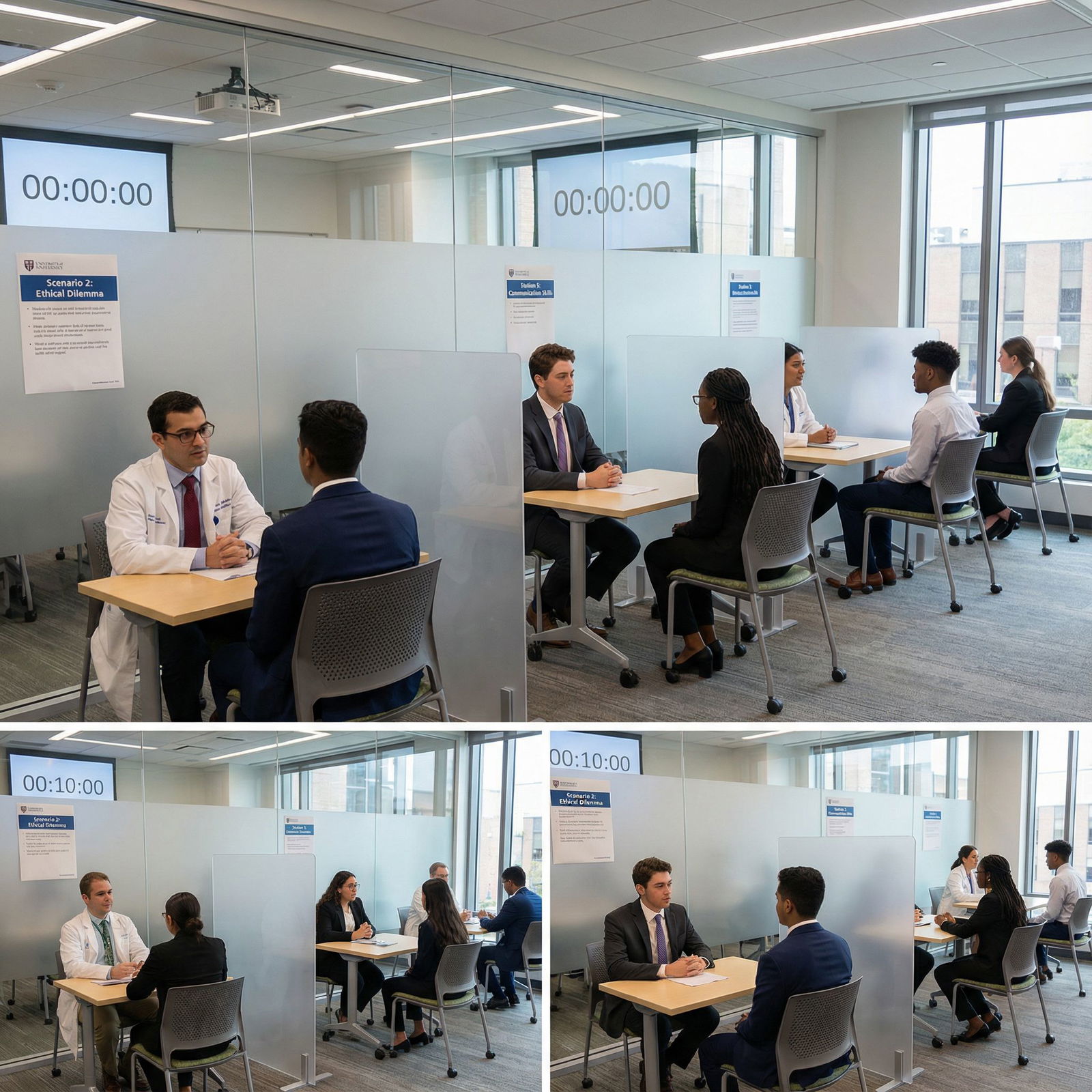
The common belief that “a strong interview predicts a strong medical student” is only half true—and sometimes flatly wrong. The data show a much messier, conditional relationship between interview scores and academic success in medical school.
What We Actually Mean by “Interview Scores” and “Academic Success”
Before we start throwing correlations around, we need clear variables. Vague metrics create fake relationships.
Most medical schools quantify interviews in at least one of these ways:
Traditional panel/one-on-one scores
- 1–5 or 1–10 Likert scales on domains like:
- Communication skills
- Professionalism
- Motivation for medicine
- “Overall impression” or “global rating”
- Often averaged across interviewers, sometimes weighted.
- 1–5 or 1–10 Likert scales on domains like:
MMI (Multiple Mini-Interview) scores
- Multiple short stations, each scored independently.
- Domains might include:
- Ethical reasoning
- Communication
- Teamwork
- Empathy
- Composite MMI score = sum or average across stations.
Composite interview index
- Some schools normalize scores, adjust for interviewer “stringency/leniency,” and generate a z‑score or percentile.
“Academic success” in medical school is also multidimensional. The meaningful, measurable endpoints tend to be:
- Pre-clinical performance
- Course exam averages
- Basic science GPA or pass/fail with internal rankings
- Standardized exam performance
- USMLE Step 1 (older cohorts)
- USMLE Step 2 CK
- NBME subject exams
- Clinical performance
- Clerkship evaluations (often ordinal: honors / high pass / pass)
- OSCE (Objective Structured Clinical Exam) scores
- Long-term outcomes
- Graduation on time
- Remediation events or academic probation
- Matching to residency, especially competitive specialties
When researchers test “correlation,” they usually mean Pearson r between interview scores and one of those outcomes, or odds ratios for outcomes like “honors in clinical years” versus “no honors.”
What the Data Actually Show About Correlation Strength
Let me skip the suspense. Across multiple studies over 20+ years, the correlation between interview scores and hard academic outcomes is:
- Modest at best
- Often weaker than MCAT and GPA for pre-clinical exams
- Stronger for clinical performance and professionalism-related outcomes than for raw test scores
Numbers first.
| Predictor / Outcome Pair | Typical Correlation (r) |
|---|---|
| Traditional interview → Pre-clinical exam avg | 0.00 to 0.15 |
| Traditional interview → Clinical clerkship evals | 0.10 to 0.25 |
| MMI score → Pre-clinical exam avg | 0.05 to 0.20 |
| MMI score → OSCE / clinical skills | 0.20 to 0.35 |
| [MMI score → Professionalism issues (inverse)](https://residencyadvisor.com/resources/med-school-interview-tips/how-interviewers-test-your-integrity-without-you-realizing-it) | -0.20 to -0.30 |
These are ballpark ranges pulled from multiple published studies and internal analyses I have seen in real admissions committees. Single studies may report slightly higher or lower, but the pattern is consistent:
- Interview scores barely predict first- and second-year exam performance.
- They do moderately predict clinical skills and professionalism-related outcomes.
- No one is seeing correlations like 0.6 or 0.7. That fantasy belongs in admissions brochures, not in the data.
To visualize the relative predictive power, compare interview scores with MCAT/GPA for early academic outcomes:
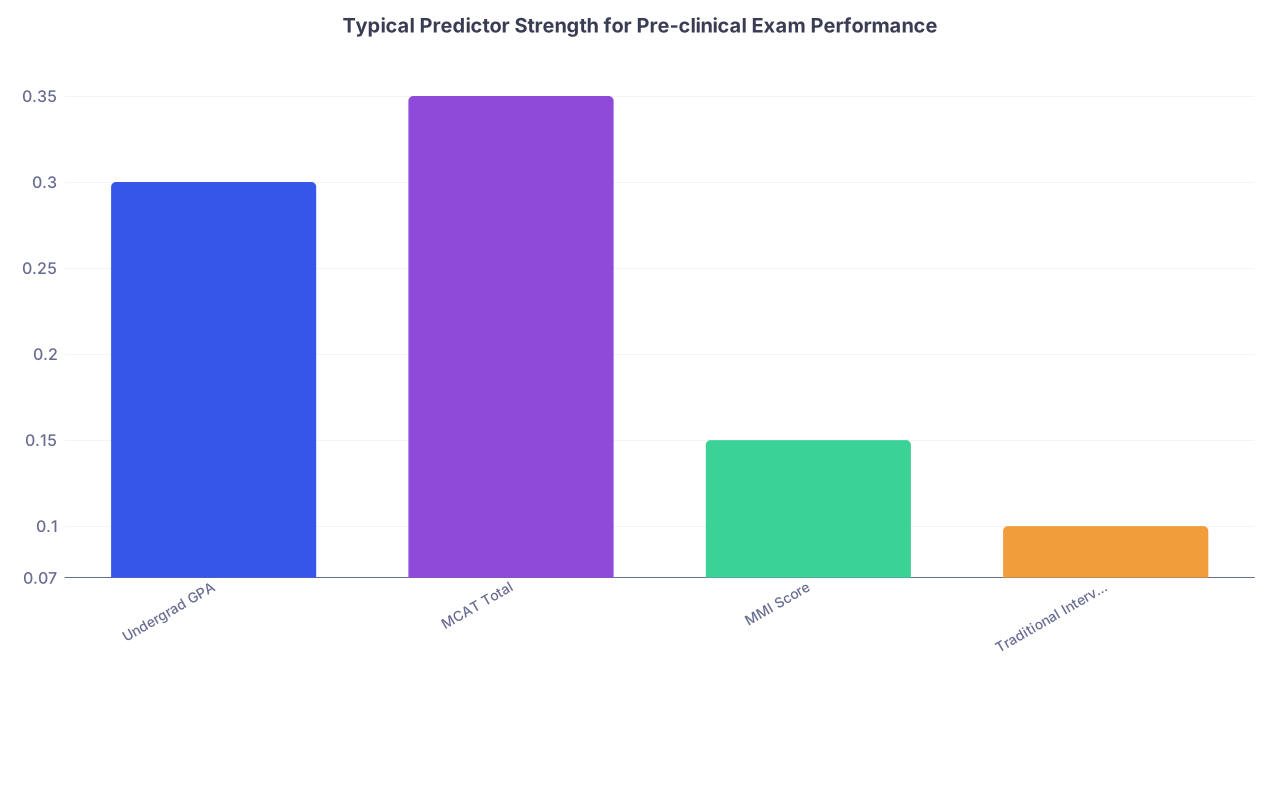
| Category | Value |
|---|---|
| Undergrad GPA | 0.3 |
| MCAT Total | 0.35 |
| MMI Score | 0.15 |
| Traditional Interview | 0.1 |
You can argue about a few hundredths here or there, but the rank ordering rarely changes:
- MCAT
- Undergraduate GPA
- MMI
- Traditional interview
So if your question is: “Does a high interview score guarantee high exam scores?” The data answer: No. Not even close.
If your question is: “Does a high interview score slightly increase the odds of better clinical performance and fewer professionalism problems?” Now the answer is: Yes, weakly to moderately.
Why The Correlations Are Not Higher
On paper, interviews should correlate strongly with success. You are evaluating communication, ethics, motivation—things that matter for physicians. But the measured correlations remain stubbornly modest. Here is why.
1. Measurement noise and interviewer bias
A lot of variance in interview scores is not about the applicant at all. It is about:
- Interviewer “style”: hard-graders vs soft-graders.
- Halo effects: strong early impression inflates all later domain scores.
- Contrast effects: a stellar previous applicant makes the next one seem weaker.
- Fatigue: afternoon applicants get lower scores than morning ones at some schools; yes, people have actually run that regression.
I have seen internal reliability analyses where the same applicant, if hypothetically “duplicated,” would get a ±1 point spread on a 10‑point global score just from random interviewer assignment. That level of noise caps any possible correlation with downstream outcomes.
MMIs reduce this somewhat by averaging many short, independent ratings. This is why you see slightly higher correlations with clinical skills from MMIs than from traditional single-panel interviews.
2. Restricted range of admitted students
By the time someone is in the data set (i.e., admitted), they have:
- MCAT in a relatively narrow, upper range
- GPA above some threshold
- Major red flags filtered out
Statistical consequence: range restriction. If you only include the top ~10–15% of all applicants, variance in predictors shrinks. Correlations with outcomes shrink alongside.
You might be thinking: but we only care about admitted students, so who cares? That is precisely the point. Within that already-strong cohort, interviews are trying to distinguish between “competent” and “excellent.” Statistically, that nuance rarely yields massive correlations.
3. Academic outcomes are only partially driven by interview-measured traits
First-year biochemistry does not care how polished your ethical reasoning sounds in a 7‑minute MMI station.
Exam scores are primarily predicted by:
- Baseline academic preparation
- Study habits
- Test-taking skills
- Raw cognitive ability (yes, still matters)
Interviews measure:
- Interpersonal skills
- Reflection and self-awareness
- Empathy
- Stress communication performance
The overlap between those sets exists but is not dominant. That is why we see low r values with pre-clinical exams but better r values with OSCEs and clerkship narrative evaluations.
4. Interviews are often poorly aligned with measured outcomes
Many schools never explicitly designed their interview rubrics around the outcomes they care about.
Example I have seen repeatedly:
- Admissions committee says: “Our number one priority is producing excellent clinicians and minimizing professionalism issues.”
- Interview score sheet includes:
- “Knowledge of health policy”
- “Interest in our city”
- “Understanding of our curriculum”
- But no structured items linking directly to the professionalism rubrics used in clerkships.
Mismatched predictor–outcome constructs yield weak predictive power. Shockingly predictable.
MMI vs Traditional Interviews: The Numbers-Based Verdict
Let’s be concrete. Where schools have switched from traditional interviews to MMIs and tracked outcomes, the patterns look like this.
| Metric | Traditional Interview | MMI |
|---|---|---|
| Reliability (inter-rater consistency) | Low–Moderate | Moderate–High |
| r with pre-clinical exams | ~0.00–0.15 | ~0.05–0.20 |
| r with OSCE / clinical skills | ~0.10–0.20 | ~0.20–0.35 |
| Prediction of professionalism issues | Weak | Moderate |
The results are not magical, but they are directionally consistent: MMIs do a better job, especially for clinical and professionalism-linked outcomes.
Here is a simplified visualization of how well each interview format predicts clinical skills ratings:
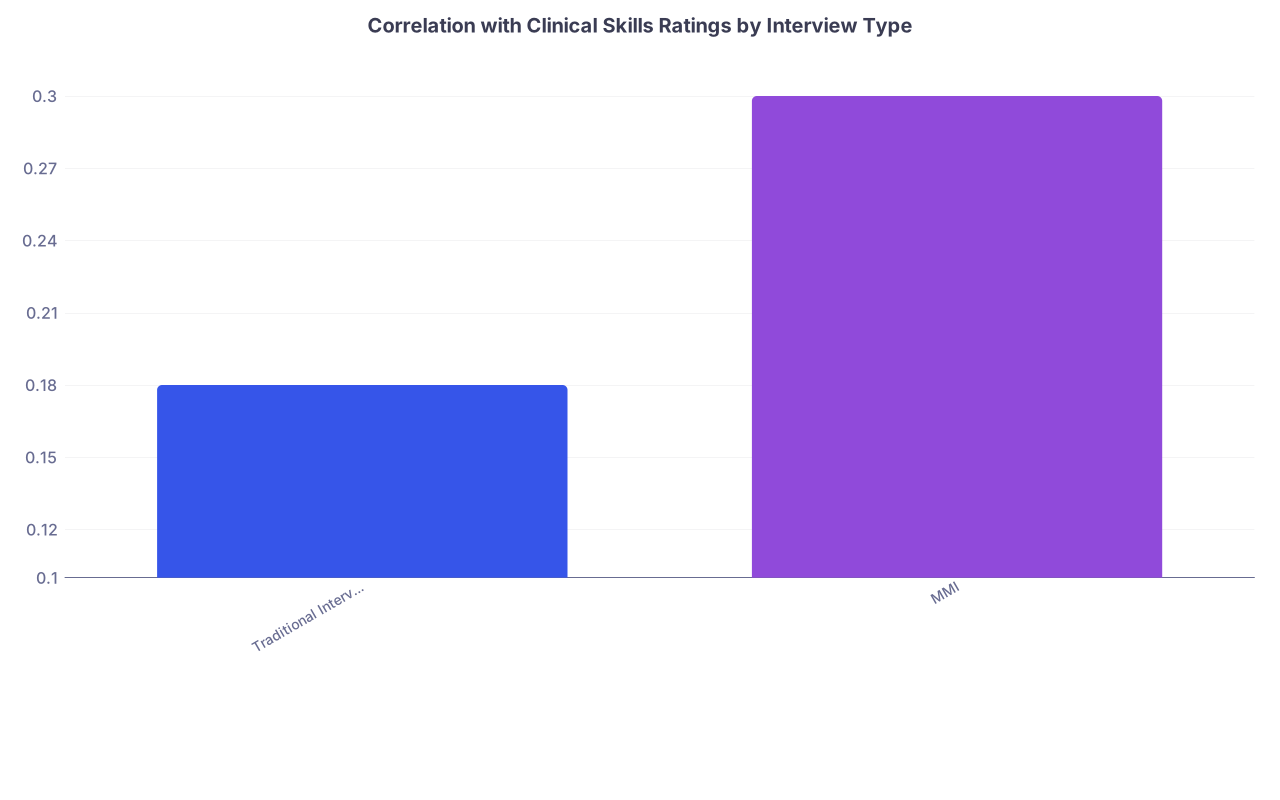
| Category | Value |
|---|---|
| Traditional Interview | 0.18 |
| MMI | 0.3 |
Translation into practical terms:
- If your school uses MMIs, the top quintile of MMI scorers is more likely to:
- Perform better on OSCEs.
- Receive higher clerkship evaluations.
- Avoid professionalism citations.
- But within that top group, you still have plenty of variation. A great MMI score is a probabilistic nudge, not destiny.
For Applicants: What The Data Imply About How Much Interviews “Matter”
You care less about abstract correlations and more about: “If I crush the interview, does that predict my med school performance, or just my odds of admission?”
Hard distinction:
- Correlation with academic success = how your score predicts future performance.
- Weight in admissions decisions = how much committees care about that score right now.
Interviews can have high admissions weight even if their predictive validity is modest. And they often do.
Admissions reality
At many schools:
- Admissions formulas combine:
- Academic index (GPA + MCAT, sometimes weighted 60–70%)
- Interview score (20–40%)
- “Contextual factors” (essays, letters, mission fit, sometimes 10–20%)
I have seen several internal weighting schemes where:
- An outstanding interview can “rescue” an applicant with mid-range MCAT/GPA.
- A poor interview can sink an otherwise numerically strong applicant.
The irony is clear: the strongest academic predictor (MCAT/GPA) can be partially overridden by a weaker predictor (interview). This is more about values and optics (“we select whole people”) than about raw predictive accuracy.
As an applicant, though, you play the game you have, not the game you wish existed.
What a high interview score really buys you
Based on the data and how committees behave, a very strong interview score:
- Substantially increases your probability of admission at that school.
- Slightly increases the probability that you will:
- Perform well in clinical years
- Avoid professionalism trouble
- Does not guarantee high pre-clinical exam scores or top board performance. That domain is still dominated by your study discipline and baseline academics.
From your perspective: Treat the interview as a high-leverage, high-noise gatekeeper for getting in, not as a label of your future academic value.
For Schools: How To Make Interview Scores Less Useless
If you are on the admissions or curriculum side, you probably care less about applicant psychology and more about: Are we using interviews in a rational, data-driven way?
Right now, many schools are not. They use interviews heavily, then never rigorously link those scores back to actual performance.
Here is a blunt framework I recommend.
1. Decide what outcomes you actually want to predict
Pick 2–4 institutional priorities and operationalize them as measurable outcomes:
- Clinical excellence:
- Clerkship honors rate
- OSCE global ratings
- Professionalism:
- Number of professionalism citations per cohort
- Remediation or probation events
- Academic stability:
- On-time graduation rate
- Fewer Step 1/Step 2 CK failures
Then stop pretending that unstructured “tell me about yourself” chats are targeting those outcomes.
2. Link interview domains directly to those outcomes
If you care about professionalism and clinical skills, then your interview rubric must:
- Explicitly score:
- Integrity under ambiguous pressure.
- Teamwork and conflict management.
- Receiving feedback.
- Empathy with boundaries, not just sentimentality.
Then, crucially, run the numbers 3–5 years later:
- Correlate each interview domain score with:
- OSCE performance
- Clerkship ratings
- Professionalism incidents
- Drop or redesign domains with near-zero predictive value.
I have watched committees proudly defend a “knowledge of healthcare systems” interview domain that had an r of ~0.02 with everything they cared about. But it felt intellectually satisfying to ask.
3. Use structured formats and multiple raters
To push predictive power out of the statistical noise floor:
- Prefer MMI or structured interviews with standardized questions and anchored rating scales.
- Ensure:
- Multiple raters per applicant
- Independent scoring (no consensus rating discussions that destroy variance)
- Train interviewers with real examples, not vague adjectives. Show them:
- Sample responses at 1/3/5 on the scale.
- Video clips if possible.
Reliability (consistency of measurement) sets the ceiling on validity (predictive power). If your reliability is poor, good luck finding correlations with anything.
4. Use interviews for what they are actually good at
The data suggest interviews are better for:
- Screening out high-risk professionalism issues
- Identifying communication red flags
- Modestly sorting likely stronger clinicians from average ones
They are worse for:
- Distinguishing 250 vs 260 board scorers
- Predicting who will get honors in pre-clinical blocks
So do not pretend the interview adds “rigor” to academic prediction. Use it as a distinct tool for affective and behavioral traits—and validate it on exactly those endpoints.
For Premeds and Med Students: How To Prepare, Given the Data
You are in the “INTERVIEW PREPARATION” category phase. You care about return on effort.
Here is the efficient, data-aligned strategy.
1. Understand what is truly being tested
Despite the talk about “fit,” the scoring usually boils down to:
- Can you communicate clearly under pressure?
- Do you show mature reasoning when stakes and ethics collide?
- Do you seem like a professionalism risk?
- Will you work with others without being a nightmare?
Those are the traits that show moderate correlation with later clinical performance and professionalism. Align your preparation accordingly:
- Practice short-case ethical reasoning: autonomy vs beneficence, resource allocation, confidentiality vs safety.
- Speak your thought process out loud. Concise, structured, not rambling.
- Get feedback explicitly on:
- Clarity
- Respectfulness under disagreement
- Ability to acknowledge uncertainty without crumbling
2. Do not treat the interview as a test of medical knowledge
There is almost no evidence that detailed medical knowledge at the interview stage predicts anything useful beyond what MCAT already captured.
If you are spending hours memorizing obscure health policy stats for your interview instead of refining your ability to listen, pause, and respond logically, you are gaming the wrong variable.
3. Treat interviews as practice for your future OSCEs and clerkships
Because the correlation with clinical skills is stronger than with exam scores, interview practice doubles as early training for:
- Presenting information to patients and colleagues
- Handling unexpected questions gracefully
- Demonstrating empathy without losing structure
That way, your effort is not just “for admissions.” It is building the actual skills that OSCE examiners and clinical attendings will later score.
The Bottom Line: What the Numbers Say
Condensed to essentials:
- Interview scores show weak to modest correlation with med school academic success, strongest for clinical skills and professionalism, weakest for pre-clinical exam and board performance.
- MMIs and structured interviews outperform traditional unstructured formats in both reliability and predictive validity, but the effect sizes are still moderate, not dramatic.
- For applicants, interviews matter profoundly for admission decisions but only modestly for predicting your later academic outcomes; use them to demonstrate communication and professionalism, not to “prove” you will ace every exam.