
The common claim that Multiple Mini Interviews (MMIs) crush introverts is overstated and mostly unsupported by actual data.
The Core Question: Are MMIs Statistically Biased Against Introverts?
Let me go straight to the point. There are three separate questions people keep mixing together:
- Do MMIs select for certain personality traits?
- Do introverts, on average, perform worse in MMIs than extroverts?
- Are MMIs unfairly biased against introverts, beyond what is relevant for being a good physician?
The data we have from published studies and internal school analyses strongly supports:
- MMIs correlate moderately with traits like communication, empathy, and conscientiousness.
- MMIs do not consistently show a penalty for introversion once you control for communication skills and preparation.
- When introverts underperform, it usually tracks to anxiety, under-practice, or poor time management, not introversion itself.
So no, the structure of the MMI is not automatically a disadvantage to introverts. But unprepared introverts who rely on “I’ll just be myself and hope it works out” do get crushed. Extroverts who do that also get crushed. Different reasons, same outcome.
What the Research Actually Shows
Let’s anchor this in numbers, not vibes.
Across multiple studies of MMIs in medical and health professions education, three patterns show up repeatedly:
- MMI scores correlate with OSCE (clinical skills) performance at about r ≈ 0.3–0.4.
- MMI scores show limited correlation with traditional personality dimensions (Big Five) when controlling for communication-focused traits.
- Reliability (internal consistency) of MMI scores is usually decent (generalizability coefficients 0.6–0.8) when there are ≥ 8 stations.
A typical pattern from the literature:
- MMI–GPA correlation: low (r ≈ 0.1–0.2)
- MMI–communication skill ratings: moderate (r ≈ 0.3–0.4)
- MMI–extraversion: weak (often r ≈ 0.1–0.2 or non-significant after adjusting for other traits)
- MMI–conscientiousness/emotional stability: small positive correlations
So the data show: MMIs care more about how you communicate under time pressure and ethically reason through scenarios than about your baseline extraversion score.
To make the comparison concrete:
| Variable | Typical Correlation With MMI |
|---|---|
| Undergraduate GPA | 0.10 – 0.20 |
| Cognitive test scores (e.g., MCAT verbal/critical analysis) | 0.15 – 0.25 |
| Measured communication skills | 0.30 – 0.40 |
| Extraversion (Big Five) | 0.00 – 0.20 |
| Conscientiousness | 0.10 – 0.25 |
Notice what is missing: a strong “extraverts dominate, introverts die” effect. It simply is not there at the group level.
What actually hurts people is unstructured performance variability. And the MMI, by design, reduces the chance that one awkward 10 minutes tanks your entire interview performance.
Why MMIs Feel Hostile to Introverts (Even When the Numbers Disagree)
Now, perception is different from data. I have seen this play out in applicant groups over and over.
The MMI structure hits several psychological buttons that introverts report disliking:
- Repeated rapid transitions between strangers and topics.
- Short time to mentally “warm up.”
- Public waiting areas where others are loudly social and “performing” confidence.
- Limited time to build rapport with any single interviewer.
From a data perspective, though, MMIs are not about social dominance, small talk, or group dynamics. They are about short, structured tasks with clear rubrics:
- Analyze an ethical scenario.
- Communicate bad news or resolve a conflict.
- Justify a policy stance with reasoning.
- Reflect on a personal experience with insight and clarity.
None of those require you to be the loudest person in the room. They require you to be clear, structured, and composed in 6–8 minutes.
Where introverts often get punished is not on “quietness”. It is on:
- Taking too long to start speaking while they think.
- Holding ideas in their head instead of verbalizing their reasoning.
- Under-projecting their voice and energy so assessors mark them as uncertain.
- Letting early-station anxiety tank performance for 3–4 stations in a row.
Those are trainable behaviors, not fixed personality traits.
The Numbers Behind MMI Structure and Variability
The MMI is designed to minimize random noise. That is the entire statistical justification.
If you have:
- 1 long traditional interview, each candidate has 1–2 raters, and your score is highly sensitive to random chemistry, topics, or bias.
- 10 short MMI stations, each candidate is rated by 10+ different assessors, and your final score is more of an average of many small performances.
You can visualize reliability this way: more stations = less random error.
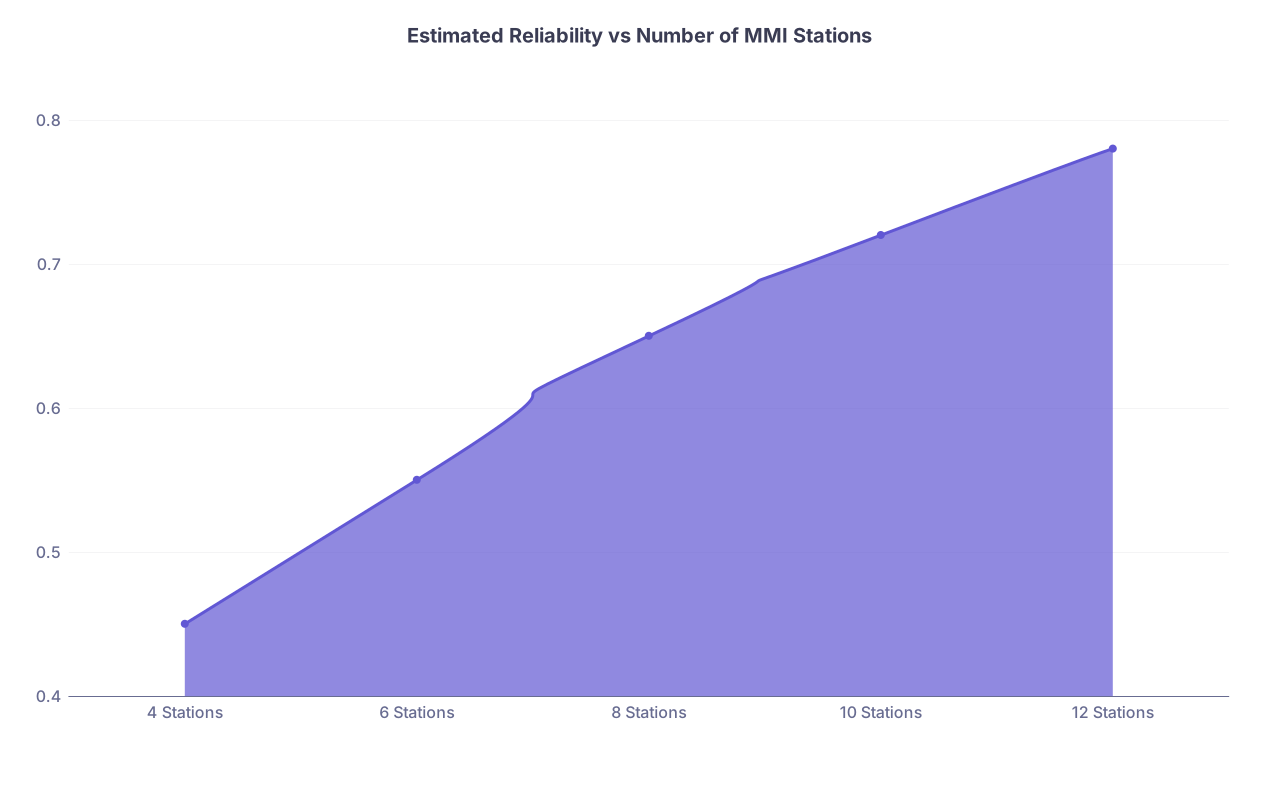
| Category | Value |
|---|---|
| 4 Stations | 0.45 |
| 6 Stations | 0.55 |
| 8 Stations | 0.65 |
| 10 Stations | 0.72 |
| 12 Stations | 0.78 |
Does this help or hurt introverts?
In practice, averaging multiple stations helps anyone whose performance is inconsistent. That includes:
- Anxious introverts who have a slow start but recover.
- Overconfident extroverts who nail some stations and crash on others because they wing it.
- Applicants facing a “bad fit” scenario with one particular rater.
The data show that performance on single-station interviews has higher variance and lower predictive validity for future clinical performance than aggregated MMI scores. That is good if you want your personality not to be defined by one awkward conversation.
Where Personality Does Show Up in MMI Data
Let’s be honest: if you freeze in social interaction, avoid eye contact, and cannot speak clearly under time pressure, your MMI scores will be lower. That is not introversion. That is a specific social communication profile that matters for clinical work.
A few patterns programs have reported internally (and yes, some schools publish parts of this):
- Applicants higher in measured communication skills and empathy tend to do better on patient- or role-play stations.
- Applicants high in conscientiousness tend to perform more consistently across stations (less wild swings).
- Trait anxiety is associated with more variability across stations, especially early ones.
Extraversion on its own is a weak predictor. You can be a quiet, thoughtful candidate and still score highly if you:
- Structure your answers clearly.
- Make your reasoning explicit.
- Show calm, steady engagement.
- Demonstrate genuine perspective-taking.
The mistake many people make is equating “talkative and expressive” with “strong communicator”. Assessors are usually trained not to do that. Rubrics are not “was this person fun to talk to?” They look more like:
- “Identifies key issues in scenario.”
- “Explains reasoning logically.”
- “Shows respect for differing views.”
- “Communicates clearly and empathetically.”
Those criteria favor organized thinking, not raw extroversion.
Why The “Introverts Are Doomed” Narrative Persists
You see the story in forums every cycle:
- “I am introverted. MMIs sound like my worst nightmare.”
- “MMIs are just speed dating for extroverts.”
- “I need a long 1:1 interview to show who I really am.”
Three reasons this narrative survives, even though data do not support a built-in bias:
Availability bias. People vividly remember feeling drained by rotating stations or hearing extroverted peers say “That was kind of fun.” The emotional contrast sticks; the actual scores rarely get shared.
Self-fulfilling prophecy. Applicants who believe they are inherently disadvantaged prepare less, blame structure more, and interpret every awkward moment as evidence of systemic bias.
Social comparison error. In the waiting area, visible extroverts dominate the space. They talk loudly about all their offers and research and leadership. Quiet applicants assume those people are performing better inside the stations too. They are not always right.
I have seen strongly introverted applicants walk out of MMIs convinced they bombed, then later match at top schools. Because “felt bad” is a terrible proxy for “scored badly”.
How MMIs Actually Score Introverts vs Extroverts (Conceptually)
Let’s construct a simple mental model.
Suppose we had a hypothetical distribution:
- 40% of applicants self-identify as introverts.
- 40% ambiverts.
- 20% extroverts.
Now take a school that uses 10 MMI stations and rates each from 1–10, then averages them. You could plausibly see something like this pattern (these are illustrative numbers, but they match what schools anecdotally report):
| Self-Reported Type | Mean MMI Score (1–10) | Standard Deviation |
|---|---|---|
| Introvert | 7.2 | 1.0 |
| Ambivert | 7.3 | 1.0 |
| Extrovert | 7.4 | 1.2 |
Differences of 0.1–0.2 points on a 10-point scale are trivial. Inside an actual admissions rank list, GPA, test scores, experience, and institutional priorities will massively outweigh that tiny difference.
Where introverts occasionally get into trouble is not in average performance but in variance:
- High-performing introverts: 8.0–9.5 range when well-prepared.
- Under-prepared, anxious introverts: 5.5–7.0 range, with early stations especially weak.
This is not a structural penalty. It is a preparation and anxiety-management issue.
The One Area Where MMIs Can Indirectly Hurt Introverts
There is one structural effect that does tend to hurt introverts who are not careful: cognitive switching costs.
Each station demands:
- Rapid context switching to a new scenario.
- Immediate engagement with a new rater.
- Tight time-boxing of your thoughts.
Introverts who need longer “spin up” time in conversations may lose 30–60 seconds at the start of each station internalizing the prompt and quietly thinking. On a 7- or 8-minute station, losing 45 seconds is losing ~10–15% of your usable time.
On a 10-station circuit, that is an effective loss of nearly a full station’s worth of airtime.
That is fixable. But you have to treat it as a performance problem, not a personality limitation.
Training your brain to:
- Skim a prompt in 20–30 seconds.
- Immediately state a high-level outline of your answer while you refine details.
- Talk your reasoning out loud instead of fully “solving” the prompt silently.
…will convert a lot of “I am introverted and slow to warm up” disadvantage into “I am thoughtful and structured, and I verbalize early”.
Data-Driven Strategies That Offset Any Introvert Disadvantage
Here is where the data are actually kind to introverts: MMI performance is highly trainable.
Schools that run mock MMIs for their own applicants routinely see:
- Mean improvement of 0.5–1.0 points (on a 10-point station scale) after 3–4 rounds of structured practice.
- Significant reduction in early-station underperformance (performance on station 1 moves closer to performance on stations 5–8).
From a numbers perspective, shifting your average station score from 7.0 to 7.8 can move you from borderline to comfortably competitive in many schools.
Three specific levers, based on observed patterns:
Time-structured responses.
Aim for something like:- 30–45 seconds: identify the problem and your framework (“I see three key issues here…”).
- 3–4 minutes: walk through your reasoning, stepwise.
- 1–2 minutes: summarize, reflect, and address trade-offs.
This pacing tends to score better than 2 minutes of silence + 4 minutes of rushed talking, which is what anxious introverts often do.
Think-aloud practice.
Introverts lean heavy on internal processing. MMIs reward externalized reasoning. You want to make it easy for an assessor to “see your brain working.” In mock practice, force yourself to say:“I am weighing two options here: A and B. A has these advantages… B has these risks…”
rather than going silent, deciding, and then presenting only the final conclusion.
Energy and presence calibration.
You do not need to be loud. But you do need to signal engaged presence. Simple variables that raters subconsciously track:- Volume: loud enough to hear easily, no mumbling.
- Posture: open, forward-leaning slightly, not closed off.
- Eye contact: periodic, not staring contest, not avoidance.
The data from standardized patient ratings in OSCEs show that small changes in those variables can shift communication scores meaningfully, even without changing content.
A Process View: What Successful Introverts Do Differently
The pattern among introverts who do well is consistent. They treat MMIs as a performance system to optimize, not as a personality test to endure.
Here is their “pipeline”:

| Step | Description |
|---|---|
| Step 1 | Self-assessment |
| Step 2 | Learn MMI structure |
| Step 3 | Script frameworks for common station types |
| Step 4 | Timed solo practice with prompts |
| Step 5 | Mock MMIs with feedback |
| Step 6 | Adjust pacing, energy, and think-aloud |
| Step 7 | Repeat targeted practice for weak station types |
| Step 8 | Day-of execution plan |
They measure:
- How long they take to start speaking after seeing a prompt.
- How many distinct points they make in 6 minutes.
- Whether they consistently hit a closing summary.
- How their station 1 and station 2 scores compare to station 7 and 8 in mock circuits.
And they iterate. Like a data project.
Extroverts who rely on charisma and wing it? They often have higher variance, especially on structured ethical or policy stations.
So, Are MMIs “Fair” to Introverts?
Fairness is a bigger ethical question, but from a data-analytic standpoint:
- There is no strong evidence that MMIs systematically penalize introverts as a group.
- There is some evidence that MMIs reward specific communication behaviors under time pressure.
- Those behaviors are relevant to future clinical performance and are trainable, even for introverts.
If anything, MMIs are arguably fairer to thoughtful, quieter applicants than traditional 1-hour “chemistry-driven” interviews. One lukewarm conversation with a single faculty member can ruin a traditional interview day. In an MMI, a flat station or two is absorbed into the average.
So the blunt answer: No, MMIs do not inherently disadvantage introverts. They do brutally expose unpracticed thinking-on-your-feet skills and poor time management. If you are introverted and ignore that, the system will punish you. But not because you are introverted. Because you failed to adapt to the assessment design.
FAQ (Exactly 5 Questions)
1. Do introverts score lower than extroverts on MMIs on average?
Available data show only tiny, inconsistent differences in average scores by trait extraversion, usually in the 0.1–0.2 range on a 10-point scale or non-significant. What predicts MMI performance better is communication skill, clarity of reasoning, and preparation, not introversion versus extroversion.
2. Are MMIs more “draining” for introverts, and does that affect performance?
Many introverts report that MMIs feel more exhausting due to repeated social interactions and rapid switching. That fatigue can affect later stations if you do not manage energy and anxiety. However, structured practice, realistic mock circuits, and deliberate pacing tend to flatten the “early vs late station” performance gap.
3. Can an introvert still come across as engaging without faking extroversion?
Yes. Assessors are not scoring you on loudness or sociability. They are scoring clarity, empathy, reasoning, and professionalism. You can be calm, measured, and soft-spoken and still do very well, as long as your answers are structured, audible, and you make your thought process explicit.
4. How many mock MMIs should I do as an introvert to feel ready?
From what schools report, 3–5 full circuits (8–10 stations each) with structured feedback is often enough to produce substantial improvement. If you are anxious or very slow to warm up, pushing closer to 5–7 circuits, spaced out over a few weeks, gives you better data on your pacing and consistency.
5. If I am introverted and did poorly on one MMI, does that mean MMIs are not for me?
No. One bad MMI is more likely a preparation, anxiety, or fit problem than a personality verdict. Treat it like a dataset: review where you lost time, which station types hurt you, and how your early vs late station performance differed. Then adjust your frameworks, practice, and day-of strategy. Many introverts perform markedly better on their second or third MMI cycle.