
Virtual interviews do not automatically favor awkward introverts or disadvantaged applicants. They shift the playing field—and a lot of people are misreading which way.
Medical schools and residency programs love to talk about “equity,” “access,” and “leveling the field” with virtual interviews. Applicants repeat those lines as if they’re gospel. But if you actually look at the data, survey results, and what committees are doing behind closed doors, a more uncomfortable truth emerges:
Virtual and in‑person interviews advantage different types of applicants, and most people are optimizing for the wrong battlefield.
Let’s take this apart properly.
The Myth: “Virtual Interviews Are More Fair”
The popular story goes like this: travel is expensive, cities are unequal, and some people are naturally better “in person,” so virtual must be more fair. Less money. Fewer logistics. Less bias.
Nice story. Half true.
Here’s what actually changes with virtual interviews:
- Cost and logistics get massively easier.
- Nonverbal cues get flattened and compressed.
- Schools see you in a controlled but constrained context.
- Programs can scale up the number of interviews with less pain.
- You can interview at far more places—if you are strategic.
That’s not “more fair.” That’s just a different set of advantages and failure modes.
Let’s put some numbers on what’s really happening.
| Category | Value |
|---|---|
| More Fair | 45 |
| About the Same | 35 |
| Less Fair | 20 |
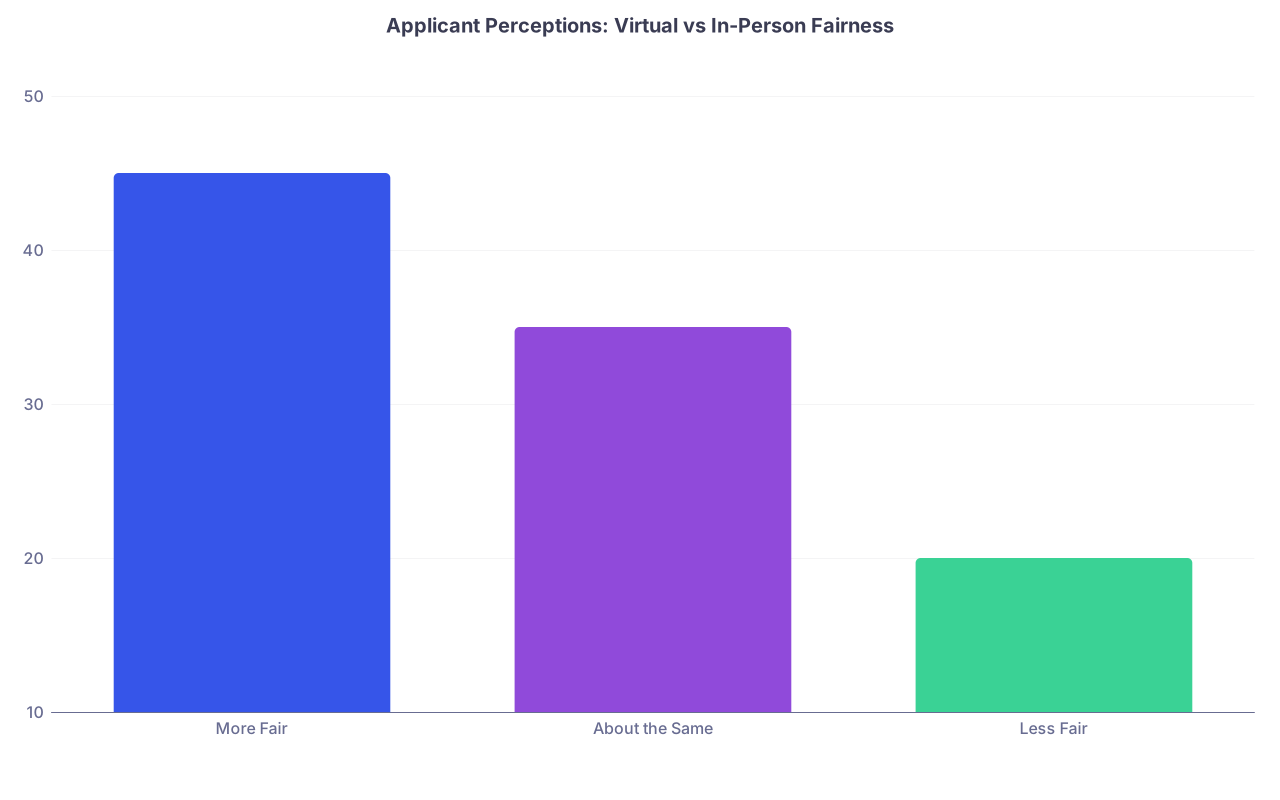
In multiple surveys (AAMC, NRMP, specialty organizations), roughly 40–50% of applicants say virtual interviews feel “more fair,” about a third say “no difference,” and the rest say “worse.” That split alone should tell you: this is not a slam dunk in either direction.
So who wins where?
Who Actually Benefits from Virtual Interviews?
There are three big buckets of advantage with virtual interviews: money, volume, and control. Whether they help you depends on how you sit in those buckets.
1. Money and Logistics: The Obvious But Overrated Benefit
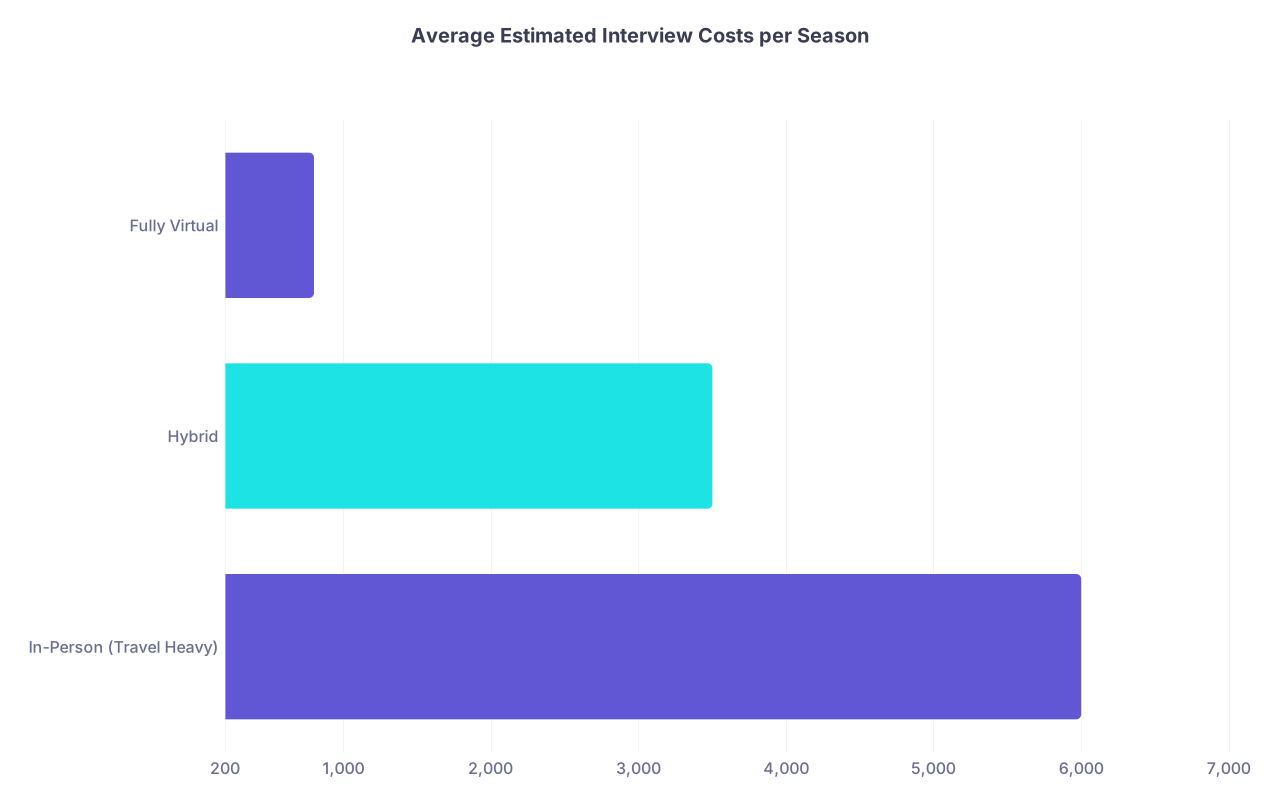
Let’s not pretend this one is controversial: virtual interviews save money. A lot of it.
| Category | Value |
|---|---|
| In-Person (Travel Heavy) | 6000 |
| Hybrid | 3500 |
| Fully Virtual | 800 |
If you’re a premed living in a rural state, or a first-gen applicant with no financial safety net, those numbers aren’t just theoretical. I’ve watched students decide whether they can afford to attend an interview at all. Flights booked on points. Sleeping on a friend’s floor. Choosing between two interviews in different time zones because they literally cannot pay for both.
For that group, virtual clearly opens doors.
But here’s the piece people skip: on the program side, that cost drop removes their informal “travel filter.” In the old days, if someone spent $400 and a day of their life to fly in, there was a decent chance they were truly interested. Now? Clicking “accept” on ten Zoom invites costs almost nothing.
So programs inflate their interview pools. The result: more interviews per applicant, more applicants per program, and a weaker connection between who interviews and who is actually competitive.
That “access” you gained? You share it with hundreds of other people who also gained it.
2. Volume: The Hidden Arms Race
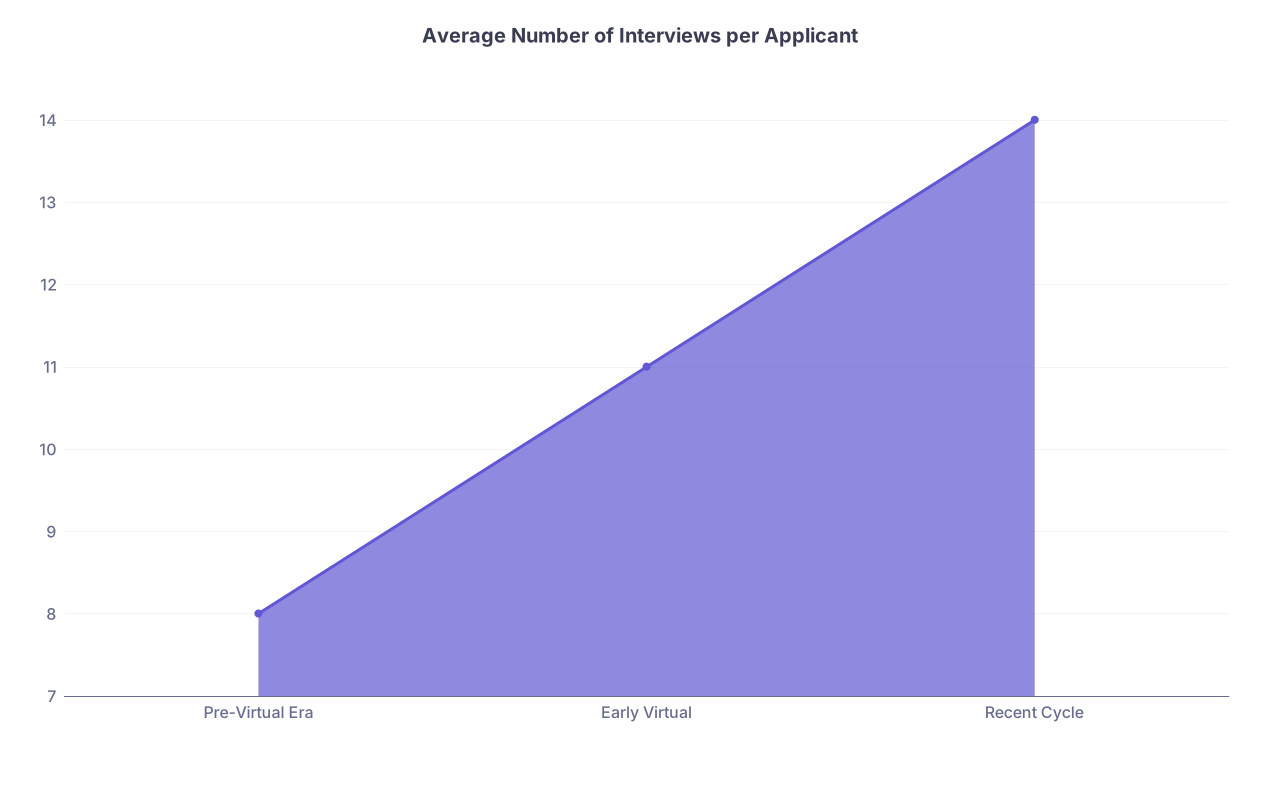
Virtual interviews make it dramatically easier to overapply and over-interview. And guess what? People do.
| Category | Value |
|---|---|
| Pre-Virtual Era | 8 |
| Early Virtual | 11 |
| Recent Cycle | 14 |
When the marginal cost of one more interview drops near zero, students keep saying yes. I’ve seen premeds with 18+ virtual med school interviews, residents with 25+ ERAS interviews. They’re exhausted, not thoughtful.
That shift benefits a certain kind of applicant:
- The highly organized, high-bandwidth person who can show up sharp for interview #17 at 7:30 a.m. on a Tuesday.
- The metrics-strong applicant who just needs enough at-bats for someone to bite.
- The applicant who can do aggressive scheduling games (stacking multiple interviews in a week, bouncing between time zones) without their performance dropping.
If your energy, affect, or anxiety fall off a cliff when you stack 4–5 interviews in a week, virtual volume works against you.
In-person at least forced selectivity. You had to choose. You had to prioritize.
3. Control of Environment: Introverts Win… Sort Of
A big claim you keep hearing: “Virtual interviews favor introverts.”
Correct… partially.
Virtual favors people who can:
- Curate their environment (lighting, background, camera, audio).
- Self-regulate nerves without the contagion of a crowded interview day.
- Maintain eye contact with a camera and project warmth through a little square.
There are introverts who thrive here. They rehearse, control variables, and perform better off their home desk than in a strange conference room.
But there’s another group that loses hard: the “vibe” people.
Every admissions committee has stories of candidates who were fine on paper but came alive on campus. The person who interacted warmly with the staff, lit up during the tour, connected with students over lunch. That entire channel becomes narrower on Zoom. Your ability to read the room, absorb the culture, and have organic side conversations—slashed.
So if your real superpower is in-person charisma and presence, virtual does not favor you. It mutes your biggest advantage.
What About Bias and Holistic Review?
One of the most persistent myths: virtual interviews reduce bias.
I wish that were fully true. The reality is messier.
Virtual changes the flavor of bias:
- Less bias from physical presence and height and handshake.
- Different bias from environment (your room, your tech), bandwidth, camera quality.
- Continued bias from name, accent, race, gender—those do not vanish just because you’re in a little box.
There’s some evidence that virtual formats standardize the process slightly, especially when schools use structured questions and multiple short interviews. But anyone claiming virtual inherently “fixes” bias is selling PR, not data.
I’ve literally heard on committees:
- “Her internet kept dropping; I’m not sure she can handle stress.”
- “His background looked messy; I worry about professionalism.”
- “He just felt flat on camera; hard to see him connecting with patients.”
In person, those same applicants might have projected differently. Or transportation and housing inequities might have hurt them instead. It cuts both ways.
The In-Person Advantage No One Wants to Admit
Here’s the contrarian take people avoid because it sounds classist: in-person interviews tend to favor applicants who are:
- Comfortable traveling
- Socially flexible
- Good at small talk and informal interactions
- Able to absorb and respond to subtle social cues in real time
That sounds like “privilege” language, and often it is. Students from affluent backgrounds, with lots of prior exposure to professional environments, do better here.
But it’s not only about money or background. Some first-gen, low-income students are phenomenal in person because they’ve been improvising in unfamiliar settings their whole lives. And some wealthy, hyper-online applicants are much better when they can rehearse alone in a quiet room.
The real in-person advantage: more data points.
Faculty see how you walk into a room. How you treat the staff. How you interact with other applicants. How you handle a late shuttle or a scrambled schedule. They see your stamina over a full day, not just a 30–60 minute window.
That complexity cuts both ways. It can expose bad fits—but it can also rescue “borderline” applicants who interview better than their paper stats.
Virtual compresses all of that into a tiny, curated slice.
For Premeds and Med Students: Who Should Prefer Which?
Let’s stop thinking in terms of moral superiority (“virtual is fair, in-person is elitist”) and instead ask the only question that matters: where do you perform better?
You should lean into virtual if:
- Your finances are tight enough that flights and hotels would straight-up limit your options.
- You’re good on camera and can project warmth through a screen.
- You’re disciplined enough to treat each virtual interview like a big event, not “another Zoom call.”
- You need the flexibility to stack more interviews and cast a wider net because your stats are borderline for your target tier.
You should lean into in-person (or fight for hybrid options) if:
- Your biggest strength is interpersonal presence and real-time connection.
- You tend to feel wooden, flat, or overly rehearsed on camera.
- You want to evaluate them as much as they evaluate you: seeing the hospital, the vibe, the city.
- You have the financial and logistical ability to travel without completely melting down.
Most applicants never ask themselves that question honestly. They just accept whatever the cycle gives them and whine about format afterward.
The Tactical Reality: You Don’t Control the Format—But You Control Your Edge
Right now, premed and med school interviewing sits in an awkward middle ground. Many med schools and residencies are staying virtual for primary interviews. A subset are pushing for hybrid or optional in-person “second looks.” Policy arguments are still raging.
You, unfortunately, are not deciding this.
What you can do is stop buying the lazy narrative and adapt like a grown-up.
For virtual interviews:
- Treat tech and environment as part of your application, not an afterthought. Decent external mic, stable internet, neutral background, eye-level camera. Fixed.
- Practice specific camera skills: looking at the lens, modulating your energy so you do not seem bored or robotic, leaning slightly forward when listening.
- Build a pre-interview ritual at home. Clothes, water, silence, a 5-minute warmup. You need to flip your brain into “this matters” mode, or you’ll sound like a Zoom zombie.
For in-person interviews:
- Use the full day strategically. Lunch with students is not a break; it is data—for both sides.
- Remember that every interaction is part of the evaluation. Shuttle drivers. Coordinators. The random MS2 showing you the sim lab. Word gets back.
- Do reconnaissance beyond the tour. Walk a few blocks. See what food you can actually get at 9 p.m. when you’re post-call and starving. You are also interviewing them.
So Which Actually Favors Applicants?
Here’s the blunt answer:
Neither format “favors applicants” in some global moral sense. Each format favors different attributes. The question is whether the attributes that are rewarded match yours.
Virtual interviews favor:
- Applicants constrained by money and geography
- Those who are highly organized and can handle high interview volume
- People who can be engaging and clear through a screen, in a controlled environment
In-person interviews favor:
- Applicants whose superpower is real-world presence and interpersonal warmth
- Those who want and know how to read program culture and are willing to invest in that
- People who handle travel and long, social days without their performance tanking
Most of the discourse pretends there’s a universally “fair” format. There is not. There is only: where do you personally gain an edge, and how do you exploit it within the constraints you’re given this cycle.
If you remember nothing else, keep these three points:
- Virtual vs in-person is not about good vs bad; it’s about which strengths get amplified and which get muted.
- Cost savings and “access” from virtual interviews are real—but they come with an arms race of more interviews and a diluted signal.
- Your job is not to argue which format is fairer. Your job is to brutally assess where you perform best on the dimensions that matter, then train for that battlefield.