Do You Really Need to Be Extroverted to Ace Medical School Interviews?
Why does everyone quietly panic that “I’m too introverted, I’ll bomb my med school interviews” while the loudest, most performative people on interview day often don’t match the strongest outcomes?
Let me be blunt: the idea that you have to be extroverted to crush medical school interviews is a persistent, lazy myth. It’s repeated by anxious applicants, well-meaning advisors, and that one loud kid in your premed club who thinks talking more equals doing better.
The data — and what interviewers actually say behind closed doors — paint a different story.
You do not need to be extroverted.
You need to be: coherent, authentic, and able to connect like a functional adult.
That’s it. Anything beyond that is optimization, not a personality transplant.
What Programs Actually Look For (Not What You Think)
Most applicants imagine interviewers grading “charisma” like it’s a talent show. That’s fantasy.
Look at what schools say they evaluate: professionalism, communication skills, empathy, ethical reasoning, teamwork, motivation for medicine. None of that requires you to enjoy big parties or love talking to strangers.
Here’s the more uncomfortable truth: extroversion helps if you already have substance. It’s a multiplier, not a substitute. But substance without flash absolutely gets accepted.
You don’t have to take my word for it. Multiple studies on MMI and traditional interviews show that structured scoring rubrics focus on:
- Clarity and organization of thought
- Evidence of empathy and perspective-taking
- Ethical reasoning and judgment
- Professional behavior under mild stress
Not “talks the most” or “sounds like a TED Talk.”
In MMIs, especially, standardized rubrics dampen the advantage of pure social charm. Raters are trained to judge what you say and how you handle scenarios, not whether you’d host a great dinner party.
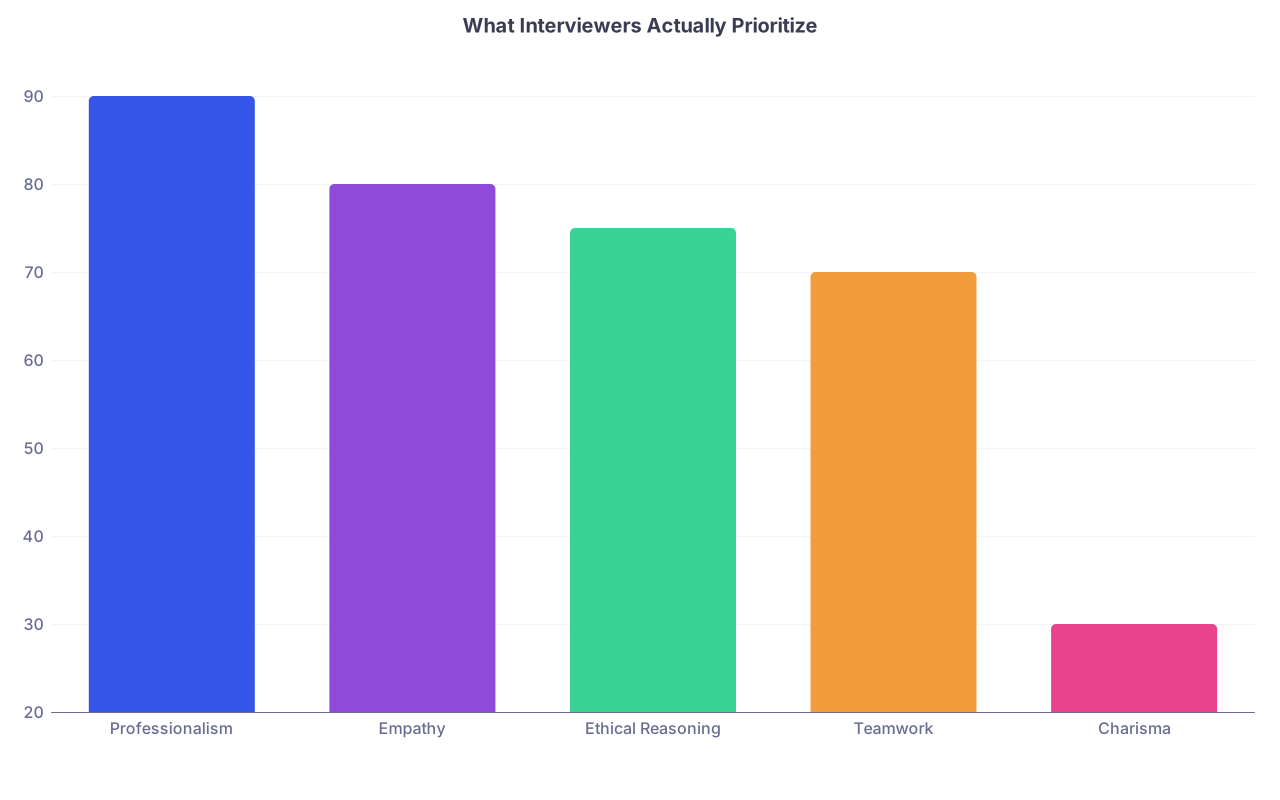
| Category | Value |
|---|---|
| Professionalism | 90 |
| Empathy | 80 |
| Ethical Reasoning | 75 |
| Teamwork | 70 |
| Charisma | 30 |
Are these exact percentages from one magical master study? No. But they mirror the consistent pattern in the literature and in real scoring rubrics: charisma is a bonus category, not the backbone.
The Big Myth: “Introverted = Bad Interviewer”
Here’s the real problem: people confuse social anxiety, lack of preparation, and low energy with introversion.
Introversion just means you get drained by too much social interaction and prefer depth over breadth. That’s it. It does not mean:
- You can’t make eye contact
- You can’t tell a coherent story
- You can’t show warmth or empathy
- You can’t advocate for yourself
I’ve seen plenty of so-called extroverts give awful interviews. Rambling. Interrupting the interviewer. Trying to be funny and landing somewhere between awkward and inappropriate. Treating it like a casual chat instead of a professional evaluation.
Just because someone is talkative does not mean they’re effective.
On the flip side, I’ve watched quieter applicants absolutely nail it. They:
- Pause, think, then answer clearly
- Ask intelligent, specific questions about the program
- Show they’ve actually reflected on why medicine, why this patient, why this choice
Who would you trust with a suffering patient: the one who performs, or the one who listens and thinks?
That’s the same calculus many interviewers are doing — even if they’re not saying it out loud.
What the Evidence Actually Shows About Personality and Performance
There’s research on personality traits and medical performance. Extroversion is not the superstar here.
Across multiple studies:
- Conscientiousness (being reliable, organized, disciplined) consistently predicts better academic and clinical performance.
- Agreeableness and emotional stability relate more to teamwork and patient satisfaction.
- Extroversion has a mixed relationship. It sometimes helps with communication ratings. It sometimes correlates with overconfidence or impulsivity.
For interviews specifically, some data suggest that slightly more extraverted applicants might feel more comfortable. But comfort does not always equal higher ratings. Programs that use structured interviews and MMIs blunt that advantage because they’re scoring specific behaviors, not vibes.
Medical schools know loud ≠ good doctor.
They’ve seen enough loud residents flame out.
And then there’s the ultimate proof: every year, plenty of more reserved applicants match at top schools while charismatic, hyper-extroverted applicants are rejected. If extroversion were a requirement, that simply would not happen.
Where Introverts Actually Have an Edge
Let me flip the script.
Being naturally more inward-focused can actually be an advantage in several parts of the interview:
Listening
Many extroverts default to “perform” mode. Introverts tend to listen, pick up subtle cues, notice when an interviewer leans in on a topic. That lets you tailor your answer in real time.Depth of reflection
Interviewers are allergic to canned, generic answers. Introverts usually have richer inner narratives: specific patient stories, nuanced ethical reflections, more thoughtful “why medicine” answers.Not over-talking
One of the most common negative comments on eval forms: “Talked too long, didn’t answer the question directly.” Introverts rarely have this problem once they’re prepared. Short, clear, and done beats theatrical monologue every single time.Handling MMIs
In scenario-based MMIs, being calm, deliberate, and respectful often scores better than being high-energy and chatty. You’re judged on reasoning and communication, not charm per minute.
The trick is not to become more extroverted. It’s to make your strengths legible in a 20–30 minute interaction.
The Real Skill: Adaptive Social Competence
You don’t need to be extroverted. You do need to be able to act like a socially competent professional for a few hours.
That’s not faking your personality. That’s a skill. Same way you’ll behave differently in a family dinner versus a code situation versus a morbidity and mortality conference.
I’ve watched introverted applicants transform when they understand this: your goal isn’t “be outgoing,” it’s “show I can work with humans.”
That requires:
- Basic warmth: eye contact, occasional smile, not looking like you’re about to be executed
- Clear communication: structured answers, not mumbling, not trailing off
- Engagement: asking a couple of real questions, responding to what the interviewer says
You don’t need to dominate the conversation. In fact, doing that can hurt you.

| Step | Description |
|---|---|
| Step 1 | Self-Concept: Im Introverted |
| Step 2 | Anxiety Before Interview |
| Step 3 | Overcompensate or Withdraw |
| Step 4 | Awkward or Flat Interview |
| Step 5 | Poor Self-Assessment |
| Step 6 | More Anxiety Next Time |
| Step 7 | Reframe: I Just Need Competent Social Performance |
| Step 8 | Targeted Practice & Structure |
| Step 9 | Calmer, Clearer Interview |
| Step 10 | Confidence From Evidence |
The shift from “I’m broken, I’m introverted” to “I just need to practice social performance like any other skill” changes everything.
What Actually Hurts Interview Performance (And It’s Not Introversion)
Let’s talk about what really tanks interviews. I’ve seen all of these:
Under-prepared answers
The applicant hasn’t seriously thought about common questions: “Tell me about yourself,” “Why this school,” “A time you failed.” No structure, no story, just word salad.Memorized, robotic scripts
Overcorrecting. They sound like ChatGPT on a bad day: “My greatest weakness is that I care too much.” No real person talks like that.Unmanaged anxiety
Shaking hands, racing speech, entire answer lost in a nervous blur. This is not introversion; it’s unaddressed performance anxiety. Different problem, different solution.Low insight
Can’t reflect on mistakes, can’t analyze ethical situations beyond clichés, can’t show any growth. Quiet or loud, this is fatal.Unprofessional behavior
Trashing former schools, making edgy jokes, oversharing, talking more about prestige than patients. Sometimes seen more in over-confident extroverts, ironically.
None of this is tied to where you fall on the introversion–extroversion spectrum. These are skill and mindset gaps, period.
How Introverted Applicants Can Play to Their Strengths (Without Pretending)
You don’t need a fake high-energy persona. You need guardrails so your natural style shows up as calm, thoughtful, and engaged — not flat, monosyllabic, or shut down.
A few very practical tactics that work consistently:
1. Script your structure, not your sentences
Outline how you’ll answer common questions, but don’t memorize exact wording. For example, for “Tell me about yourself”:
- 10–15 seconds: where you grew up / quick context
- 30–45 seconds: academic + key interest in medicine
- 20–30 seconds: one defining experience
- 10–15 seconds: why that leads you to this school
That keeps you from rambling without forcing you into a robotic script.
2. Do “exposure reps” before interview season
Practice 10–15 minute mock interviews with classmates, mentors, even on Zoom with friends. Introverts often think they’re disastrous on camera or in person — until they watch themselves and realize: “Oh, that was actually fine. Just needed to slow down.”
3. Pre-plan your questions for the interviewer
Introverts sometimes freeze when it’s their turn to ask something. Don’t improvise. Have 3–5 real questions about the program, not questions you could’ve Googled. That makes you look engaged without forcing you to generate small talk from thin air.
4. Manage your energy on interview day
This is where introverts actually differ. Extroverts can chat nonstop in the applicant lounge and still peak during the actual interview. You probably can’t. So don’t.
Be polite. Make light conversation. But if you need to step out, refill water, or sit quietly between sessions, do it. Protect your best energy for the actual evaluations, not the hallway performance.
5. Make friendlier face your default
This sounds shallow, but it’s real. Some quieter applicants have a “neutral face” that reads as unhappy, annoyed, or checked-out. Practice tiny adjustments: a slight natural smile when listening, nods to show you’re following, a bit more eye contact. Those are learnable micro-skills, not personality traits.

Stop Blaming Introversion for Problems You Can Fix
One more hard truth: “I’m too introverted” is often a convenient, respectable excuse to avoid confronting fixable weaknesses.
It sounds better than:
- “I haven’t actually thought seriously about my application story.”
- “I get crushed by performance anxiety and haven’t addressed it.”
- “I never practiced aloud, I just read answers in my head.”
Blaming your temperament feels permanent and fatalistic. Which conveniently absolves you of doing the less glamorous work: reps, feedback, restructuring your answers.
The applicants who do best are not the most extroverted. They’re the ones who treat interviewing like a skill they can train, just like organic chemistry or clinical reasoning.
You wouldn’t say, “I’m just not a science person” and then walk into the MCAT cold. But some of you are doing exactly that with interviews. Then blaming introversion when it goes badly.
That’s not personality. That’s strategy failure.
So, Do You Really Need to Be Extroverted?
No. You need to be socially functional, reasonably self-aware, and prepared.
Extroversion might make parts of the experience feel easier. It might give a small edge in comfort. But medical school interviews are increasingly structured to reward thoughtfulness, professionalism, and real communication — not raw social volume.
If you’re introverted, your job isn’t to rewrite your personality. It’s to:
- Build clear, structured answers instead of hiding behind “I’m quiet.”
- Practice enough that your nerves don’t drown your content.
- Use your natural strengths — listening, reflection, depth — as assets.
Key points to remember:
- Programs are not selecting for extroverts; they’re selecting for functional, reflective future physicians.
- Communication skill is trainable. Personality is not the main limiter — lack of preparation is.
- You can be quiet and still ace interviews. What you cannot be is unprepared, unreadable, or entirely inside your own head.