It's 2:17 p.m. You’re on your third interview of the day. You’ve already explained why you want to be a doctor twice, you’ve smiled at residents on the tour, you’ve nodded through the “curriculum overview” slide deck. You sit down with a soft‑spoken faculty member who seems… nice. Harmless. He glances at your file, looks up, and says:
“So tell me about this ‘family hardship’ you mentioned in your personal statement.”
You relax. You’ve practiced this story. You start talking.
What you do in the next three minutes is not about your hardship. It’s about your integrity. That’s what he’s really scoring.
I’m going to walk you through how medical school and residency interviewers quietly test your integrity—without labeling it that way—and how people tank their chances while thinking they “nailed it.”
And I’m going to be blunt: integrity is not a soft, feel‑good attribute in these rooms. It’s a safety issue. Programs get burned once by a dishonest trainee, and they never forget it.
The Uncomfortable Truth: They Don’t Trust What You Wrote
Let me start with the part most applicants never hear.
Behind closed doors, when faculty review applications, there’s a recurring line:
“Looks impressive… if it’s real.”
Not “if it happened.” “If it’s real.” As in: is it exaggerated, strategically framed, or straight‑up inflated?
This is why interviewers probe your integrity from the moment you walk in. They know three things:
- A chunk of applicants embellish their research and leadership.
- A smaller but very real chunk fabricate or heavily distort experiences.
- The consequences of a dishonest med student or resident can be catastrophic.
So interviews become stress tests for truthfulness. Not just “are you lying?” but “do you consistently choose the honest, responsible version of events—even when there’s an easier, flashier version available?”
Here’s the first behind‑the‑scenes trick:
The “Paper-to-Mouth” Consistency Check
Interviewers routinely pick something on your application that’s just detailed enough to be testable.
That “first author manuscript in preparation”?
That “co‑founder of a nonprofit”?
That “led a team of 10 volunteers”?
They’ll ask very simple‑sounding questions:
- “Walk me through your role on that project.”
- “What exactly did you do day-to-day?”
- “Where is that manuscript now in the process?”
- “What does your nonprofit actually do each month?”
They’re not testing your memory. They’re looking for one thing: alignment between what’s on paper and what comes out of your mouth when you’re not reading from a script.
When someone wrote “first author” but can’t explain the study design in coherent detail or confuses inclusion criteria? The word that comes up in the debrief isn’t “unprepared.” It’s “integrity question.”

The Micro-Tests You Don’t Notice While You’re Talking
Let me walk through the common integrity tests that occur in medical school and pre-residency interviews. None of these are labeled as such. They’re embedded in “normal” questions.
1. The “Tell Me About a Time You Failed” Trap
This one gets abused by applicants more than any other.
Interviewers ask:
“Tell me about a time you failed or made a mistake.”
They’re listening for:
- Do you pick a real failure?
- Do you clearly own your role in it?
- Do you resist the urge to sanitize it into a fake success?
What they actually hear, far too often:
- “I care too much.”
- “I studied so hard I burned out.”
- “I’m just such a perfectionist.”
On paper, these sound safe. In the room? They sound like someone who can’t be honest about their flaws. That’s an integrity red flag.
The best answers I’ve seen share three things:
- A concrete failure that mattered. Not earth‑shattering, but real.
- Clear ownership: “I made a bad call here because…”
- Specific changes you made that sound plausible and not heroic.
What raises eyebrows is when the story is too polished, too convenient, or clearly designed to paint you as secretly amazing.
Faculty talk like this when they debrief:
- “She never really admitted doing anything wrong.”
- “His ‘failure’ was that he cares too much. Give me a break.”
- “I didn’t believe half of that story.”
That’s integrity being scored, not storytelling.
2. The “Ethics Scenario” with No Perfect Answer
Every cycle, interviewers pull out ethical hypotheticals. You’ve probably practiced these.
A patient refuses life-saving treatment.
A colleague is cutting corners.
You see a classmate cheating.
You think you’re being tested on whether your answer matches some “ethics textbook” solution. That’s not actually the point.
Here’s what’s happening behind the scenes:
They give you a scenario where:
- There’s no perfect solution.
- Every option has downsides.
- One or two options are clearly expedient but ethically lazy.
They watch what you prioritize out loud. And how you reason.
For example:
“You’re a medical student and you see a resident consistently documenting physical exam findings that you’re pretty sure they didn’t actually perform. What do you do?”
Weak integrity answers:
- “I’d probably just mind my own business, it’s not my place.”
- “I think I’d maybe talk to them if I felt comfortable, but I’d have to see.”
- “I’d need to see more before doing anything, I wouldn’t want to rock the boat.”
Strong integrity answers don’t sound heroic. They sound uncomfortable but firm:
- “I’d first double-check my understanding to make sure I’m not misinterpreting. If I’m confident something’s wrong, I’d talk to the resident privately. If it continues, I’d escalate to a supervisor, even though I know that could make my life harder.”
What’s being scored is not “ethics knowledge.” It’s: will you act when acting is inconvenient and potentially costly?
And yes—programs have had residents who falsified documentation. Who lied about procedures performed. Who altered notes. That experience sits in the back of their minds when they listen to you answer.
3. The “Casual” Character Probes
Some of the most revealing integrity checks are phrased like small talk:
- “What would your classmates say is one thing they can always count on you for?”
- “Tell me about a time you had a serious disagreement with someone on your team.”
- “What frustrates you most about working with other students?”
They’re watching for these patterns:
You blame entire groups of people.
You always paint yourself as the enlightened one.
You consistently position yourself as the victim of everyone else’s incompetence.
A subtle but deadly sign is the applicant who weaponizes “professionalism language” to trash other students.
“I take my responsibilities very seriously, and I get frustrated when others don’t share the same commitment to professionalism.”
That sounds polished. In the room, it often lands as: you’re judgmental, self‑righteous, and probably distort stories to protect your image.
There’s a simple principle: people who habitually distort blame in conversation will distort facts in a chart. Or in an incident report. Or when something goes wrong on the wards.
Interviewers know that.
4. The “Soft Inconsistency” Test
Here’s one applicants rarely realize is happening.
Some programs share notes between interviewers. Others don’t, on purpose. But both styles create opportunities to test consistency.
Common tactic:
Interviewer A asks detailed questions about your research.
Interviewer B asks about the same research, but from a different angle.
If the story grows—your role gets more central, your impact expands, your responsibilities increase—that’s not “good framing.” That’s dishonesty, even if you call it “emphasis.”
I’ve seen debrief meetings where someone says:
- “Interesting, with me he said he was mainly doing data entry. With you, he was apparently leading the project?”
- “Her description of that leadership role was very different from what I heard. I’m concerned.”
That word again: concerned. Code for “Do we want to stake our reputation on this person?”
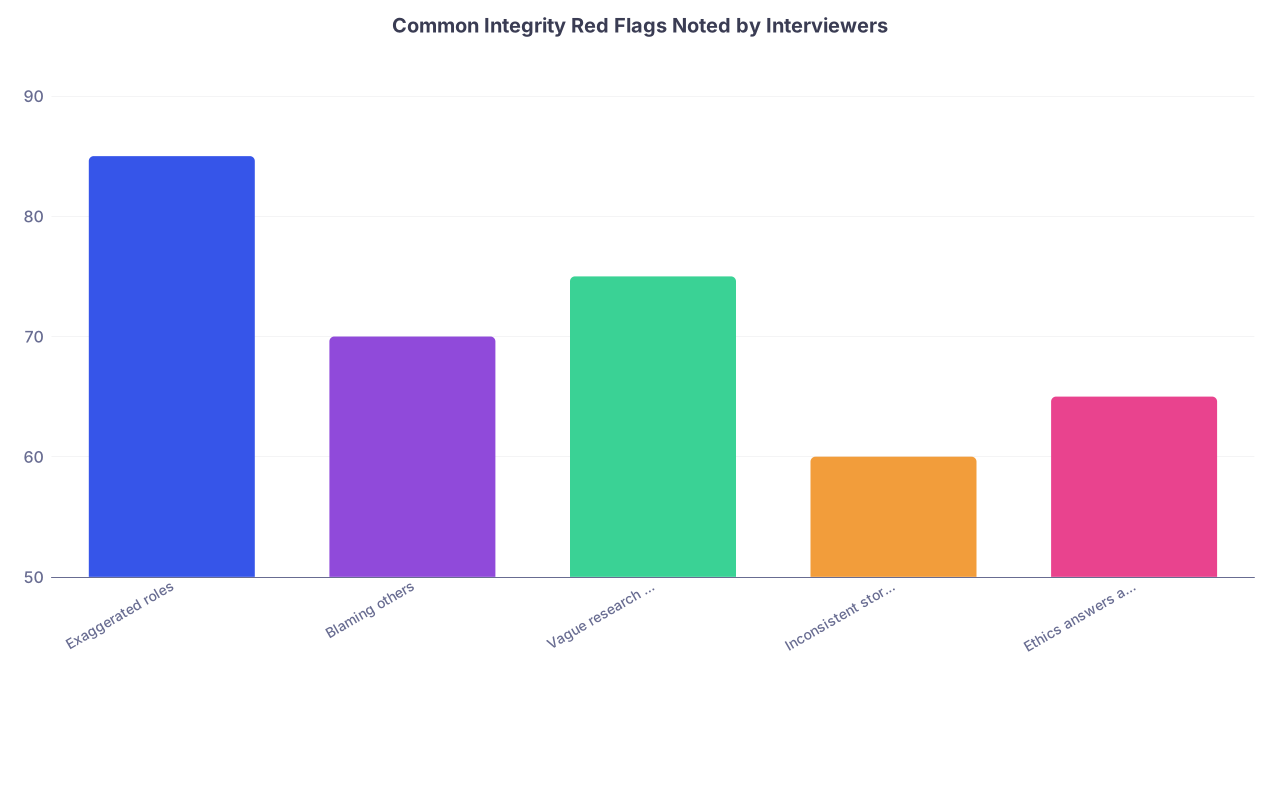
| Category | Value |
|---|---|
| Exaggerated roles | 85 |
| Blaming others | 70 |
| Vague research details | 75 |
| Inconsistent stories | 60 |
| Ethics answers avoiding action | 65 |
How They Use Your Own Achievements Against You
Programs aren’t only suspicious of obvious weak spots. They also scrutinize the “shiny” parts of your file.
Big research output.
Founding organizations.
Extensive leadership titles.
Those are magnets for integrity testing.
The “Founder” Scrutiny
If you wrote “Founder” or “Co‑Founder” of anything, expect it to be poked.
Questions you’ll hear:
- “Why did this organization need to exist? What gap were you filling?”
- “How many people are involved now?”
- “What exactly do you personally do month to month?”
- “If you disappeared tomorrow, what would actually stop happening?”
You’d be shocked how many “founders” can’t answer those last two cleanly. Because their “organization” is a logo, a GroupMe, and one volunteer event.
They’re not grading you on scale. They’re grading you on honesty about scale.
Here’s the line that kills trust:
“We have over 100 members.”
Press a bit, and it turns out:
- 100 people signed up for an email list once.
- 12 show up to events.
- 3 people do any of the real work.
Is that a lie? Depends how you phrase it. To interviewers who have seen this pattern repeatedly, it’s misrepresentation.
The Research Reality Check
Another favorite hot zone: research.
If your CV screams “research powerhouse” and you stumble over basic questions like:
- “What was the primary outcome of your study?”
- “What question were you actually trying to answer?”
- “What changed in your thinking because of that project?”
They don’t think “nervous.” They think “decorative name on a paper.”
I’ve watched PIs on admissions committees get visibly annoyed by this. They’re not offended for themselves; they’re offended for the discipline. There’s a sense of, “If you’re going to claim this work, respect it enough to actually know what you did.”
That annoyance translates into, “I don’t fully trust this applicant’s representation of their experiences.”
And once that seed is planted, it infects everything else in your file.
The Moment They Decide You’re Not Trustworthy
There’s a misconception that interviewers sit there, adding up pluses and minuses like a math problem.
That’s not how it feels in the room.
What actually happens a lot: there’s one moment where trust fractures.
- The applicant contradicts themselves flatly.
- They obviously dodge responsibility in a story.
- They claim something that’s implausible to a seasoned clinician.
- They throw someone else under the bus to look good.
After that moment, the interviewer spends the rest of the time unconsciously collecting evidence to support their new hypothesis: “This person is not fully honest.”
Let me give you an example.
Applicant: “I’m very committed to patient‑centered care and listening deeply to patients’ concerns.”
Later, unprompted, same applicant proudly recounts how they “fixed” a difficult patient by telling them, “You just need to trust the doctors; we know what’s best.”
The disconnect is obvious. They’re unaware. The interviewer isn’t thinking “hypocrisy” abstractly; they’re thinking “this person tells me what sounds good but doesn’t notice their own contradictions.”
That’s the integrity issue: lack of alignment between declared values and real behavior, even in stories.
How to Actually Show Integrity (Instead of Performing It)
Now the part you probably want: what to do differently.
The answer is not to sound more “ethical.” It’s to commit to accuracy, proportion, and accountability in how you talk about yourself.
1. Stop Overselling. It’s Transparent in the Room.
If your role was moderate, call it moderate.
“I was one of several volunteers working on data collection and basic analysis. I learned a lot from seeing how the PI structured the project.”
That line actually builds trust, because it sounds like someone anchored in reality. Adcoms are drowning in hyperbole. A straightforward, modest description of your involvement stands out.
2. Be Precise About What You Don’t Know
The most trusted applicants are not the ones who have an answer to everything. They’re the ones who can say, cleanly:
“I don’t know the answer to that, but here’s how I’d think about it.”
Or:
“I was involved in this part of the project, but the statistical analysis was handled by others, so I can’t speak to the details there.”
That is integrity on display: clear boundaries around your knowledge and contribution.
The insecure, slippery version:
“I kind of helped with the analysis and also did some of the design…”
But then they can’t answer basic questions about either.
Interviewer translation: you want credit for things you didn’t actually do.
3. Tell the “Ugly” Part of the Story Too
When you share experiences, especially conflict or failure stories, include at least one unflattering detail about your own behavior.
That sounds counterintuitive, but here’s what it signals:
- You have self‑awareness.
- You don’t feel the need to curate a perfect image.
- You value truth over optics.
For example:
“Initially, I was more focused on proving I was right than on actually understanding my classmate’s perspective. That escalated the tension. I had to step back and realize I was contributing to the problem.”
That’s the kind of sentence that relaxes interviewers. They think, “Okay, this person can see their own role honestly.”
The applicant who never once admits to a real, specific misstep? That’s not a “strong” candidate. That’s a risk.
4. Align Your Demeanor with Your Claims
This is the subtle piece nobody teaches you.
If you talk a lot about humility but your tone is arrogant, they believe your tone.
If you talk about teamwork but you never say “we”—only “I”—they believe the pronouns.
If you claim compassion but your stories drip with contempt for “difficult” patients, they believe the contempt.
Interviewers are not perfect lie detectors, but they’re very attuned to mismatch. They’ve watched hundreds of students and residents whose words and actions didn’t align. They remember how that played out: complaints, near‑misses, remediation, sometimes dismissal.
So they’re hypersensitive to early signs of misalignment.

| Step | Description |
|---|---|
| Step 1 | Applicant Application |
| Step 2 | File Review |
| Step 3 | Targeted Probing Questions |
| Step 4 | Standard Questions |
| Step 5 | Consistency & Detail Check |
| Step 6 | Advocates on Committee |
| Step 7 | Concerns Raised |
| Step 8 | Red flags or big claims? |
| Step 9 | Trust Built or Fractured? |
The Silent Record: How Integrity Comments Follow You
You need to understand one last thing.
Those short narrative comments interviewers write? They’re not throwaway.
Programs absolutely remember when someone writes:
- “Questionable insight into own limitations.”
- “Some concern about accuracy of self‑reported experiences.”
- “Deflected responsibility when discussing conflict.”
- “Ethics scenario response avoided action.”
Nobody writes: “This person is a liar.” They don’t need to. The more subtle version is plenty to sink an applicant in a competitive pool.
And if you’re applying to the same institution for multiple phases (undergrad to med, med to residency, residency to fellowship), those patterns can echo. People who sit on multiple committees talk. They remember names that came with integrity concerns.
What This Means for You, Starting Now
If you’re still premed or early in medical school, this is the part where you actually have leverage.
Integrity in interviews is not something you “turn on” with clever phrasing. It’s the visible output of how you’ve been operating for years.
The habits that will serve you later:
- Don’t take credit you haven’t earned. Not in group projects, not in research, not in volunteering.
- Don’t “pad” your roles with fancy titles that don’t match reality.
- Don’t dodge responsibility every time something goes poorly.
Because those habits calcify. People assume they’ll “fix it later” and then discover, in front of an interviewer, that their first instinct is still to bend the story.
You want the opposite: your default is to tell the unvarnished version, and the “polishing” is just organization and clarity, not distortion.
| Question Type | Integrity-Weak Answer | Integrity-Strong Answer |
|---|---|---|
| Failure story | "I just care too much and work too hard." | "I overcommitted, missed a deadline, and owned it." |
| Research role | "I led the project." | "I handled data collection; PI led the design." |
| Ethics scenario | "I'd probably just stay out of it." | "I'd verify, then address it, even if uncomfortable." |
| Leadership claim | "We have 200 members." | "200 signed up; ~20 participate regularly." |
| Conflict with peer | "They were unprofessional, not me." | "I escalated it; I also realized I'd been dismissive." |
FAQ (Exactly 3 Questions)
1. What if I already exaggerated something on my application—am I doomed?
You’re not doomed, but you’re on thin ice. The worst thing you can do is double down in the interview. Scale your description back to reality when you talk about it. If something is truly inaccurate (wrong hours, wrong role), you can say, “On my application I framed it as X, but in retrospect a more accurate description is Y.” That kind of correction actually shows integrity and self‑correction. It’s uncomfortable but far better than compounding the dishonesty.
2. How do I handle an ethics question when I genuinely don’t know the “right” answer?
Say that. Then reason through it out loud. Anchor yourself in core principles: patient safety, honesty, respect for autonomy, responsibility to the team. Something like, “I’m not entirely sure what the perfect answer is, but my priorities would be A, B, and C, so I’d probably start by doing X…” That shows honest uncertainty with a clear moral compass. It’s far more convincing than a memorized, rigid “ethics” speech you barely understand.
3. Can being too honest ever hurt me in an interview?
Brutal confession of every insecurity? Yes, that can hurt you. But that’s not integrity, that’s oversharing. What works is selective, relevant honesty: clear about your real role, your real mistakes, your real growth. Don’t confess every bad thought you’ve ever had. Do avoid polishing away every rough edge of your stories. Programs are not looking for flawless; they’re looking for trustworthy. Two different things.
Remember:
- They’re not just judging what you’ve done; they’re judging how faithfully you describe what you’ve done.
- One obvious distortion in an interview can outweigh ten impressive achievements.
- The safest, smartest interview strategy long‑term is simple: tell the truth, in detail, with ownership.