
The way most premeds answer “Tell me about yourself” is sabotaging their entire interview.
Not because they are bad applicants. Because they give rambling life stories, generic “I’ve always loved science and helping people” speeches, or worse—recite their AMCAS activities like a shopping list. Interviewers tune out in 20 seconds. And once you lose them at the opener, you spend the rest of the interview trying to claw your way back.
You need a formula. Not vibes. Not improvisation. A clear, repeatable structure that works for:
- Medical school interviews
- Post-bacc / SMP interviews
- Premed committee interviews
- Even residency and fellowship interviews later
Here is the 5-step medical interview formula I use to fix this for students who hate talking about themselves.
The Real Job of “Tell Me About Yourself”
Let me be blunt. This question is not about your chronological biography.
Interviewers are using it to answer three things in the first 2–3 minutes:
- Who are you now in one sentence? (Professional identity and focus)
- Why medicine, and why you specifically? (Motivation + differentiation)
- Where are you going next? (Direction and maturity)
If your answer does not do those three jobs, it fails. Even if it sounds “nice.”
Here is the most common failure pattern I see:
- Starts with: “So I was born in…” or “My parents immigrated…”
- Wanders through random high school or early college experiences
- Mentions wanting to help people and liking science
- Ends with: “…and that is why I am excited to be here”
You have burned two minutes and told them nothing they could not have guessed from any other applicant.
The 5-step formula fixes this by forcing you to:
- Start with a sharp professional snapshot
- Anchor your story around 1–2 defining themes
- Connect those themes to medicine with concrete examples
- Land clearly on why this stage (med school) makes sense now
Let us walk through it.
Step 1: Open with a 1-Sentence Professional Snapshot
You have 5–7 seconds to establish a frame in their mind: who you are right now and what you are about.
Most applicants completely waste this and start with childhood or family. Wrong move.
You start in the present.
Template:
“I am a [year/role] at [institution] with a focus on [specific interests or themes], and I am applying to medical school with a particular interest in [broad area or population].”
Concrete examples:
- “I am a senior biology major at UCLA, with a focus on community health and peer education, and I am applying to medical school with a particular interest in primary care in underserved communities.”
- “I am a career-changer coming from five years in software engineering, where I worked on healthcare analytics tools, and I am applying to medical school with an interest in using data and technology to improve patient care.”
- “I recently completed a post-bacc at Columbia after serving four years as an Army medic, and I am pursuing medical school to continue working in high-acuity, team-based care.”
This does three things fast:
- Tells them where to file you: traditional / nontraditional / military / career-change, etc.
- Plants your main themes: community health, tech, teaching, service, leadership.
- Signals intentionality. You did not “end up” here. You have direction.
What not to do in the first sentence:
- “I was born in…”
- “My parents are from…”
- “Ever since I was little…”
- A joke. You are not auditioning for stand-up.
If your first sentence could apply to half the applicant pool, fix it.
Step 2: Pick 1–2 Core Themes, Not Your Life Story
“Tell me about yourself” is not permission to dump your autobiography.
You choose your story. Explicitly.
Think of yourself as a character in a novel. The interviewer needs a quick sense of:
- What drives you
- How you operate
- Where you add value
You pick two themes. Maximum. That will run through your story like a thread.
Examples of strong themes:
- Service to marginalized communities
- Teaching and mentorship
- Problem-solving and systems thinking
- Resilience and growth from setbacks
- Curiosity and love of complex problem spaces
- Team leadership in high-stress environments
Weak, generic “themes”:
- “I am hardworking”
- “I care about people”
- “I am passionate about science”
Of course you work hard and like science. That is the price of admission. Not your hook.
How to select your themes:
- List your 5–7 most meaningful experiences (research, clinical, personal).
- Look for patterns: Where were you most alive? Most stretched? Most useful?
- Translate those patterns into 1–2 phrases that feel specific.
Example:
- Experiences: EMT work, free clinic, tutoring, leading a campus mental health group
- Pattern: Working directly with people in crisis; staying calm; building trust
- Themes: “working in high-stress, patient-facing environments” and “helping people access care when the system ignores them”
Once you have your themes, you actually say them.
“Two themes that have really shaped me are [theme 1] and [theme 2].”
You will build the rest of your answer around those.
Step 3: Use 2–3 Specific Experiences to Show, Not Tell
This is where most people start babbling.
Your job: pick two, maybe three experiences that best embody your themes and your path to medicine.
You are not trying to re-summarize your entire AMCAS. That is what the interviewer read already (or did not—assume they skimmed at best). You are trying to give them a mental movie.
Formula for each experience:
- Brief context (1 sentence)
- What you actually did (1–2 sentences)
- The “turning point” or insight (1–2 sentences)
Example #1 – Service / underserved theme:
“That interest in community health really deepened through my work at the South LA Free Clinic. I started as an intake volunteer, then trained as a patient advocate. I spent most of my shifts sitting with patients while we figured out transportation, medication vouchers, or how to talk to a supervisor about unpaid sick time. Over time I realized that what kept me coming back was not just ‘helping’ but seeing how small, very concrete actions could change whether someone actually got care.”
Example #2 – Research / curiosity theme:
“On the research side, I spent two years in a cardiology lab studying arrhythmia mechanisms. At first I was pipetting and running assays, but my PI pushed me to design a small subproject. That process—reading everything I could find, failing repeatedly at the bench, and then finally seeing a clean data set that supported our hypothesis—showed me that I enjoy slow, iterative problem-solving. I am less interested in basic science long-term, but that experience changed how I think and how I approach clinical questions.”
Note the structure:
- Context: where / what role
- Concrete actions: what you actually did, not just your title
- Insight: what changed in your thinking or direction
Keep each experience to 4–5 sentences maximum. If you go longer, you are wandering.
Common mistakes here:
- Listing 6–7 activities by name only (“I did research, I volunteered, I shadowed…”)
- Getting lost in technical detail (especially research)
- Giving zero insight (“It was very rewarding”)
If a sentence could be copied into any other applicant’s answer, cut it or make it specific.
Step 4: Tie Directly to “Why Medicine” in One Clear Bridge
If you do Steps 1–3 correctly, “Why medicine?” is already half-answered.
But you still need a short, explicit bridge that connects:
- Who you are + your themes
- What you have done
- Why medicine specifically, as opposed to nursing, PA, social work, PhD, etc.
This is where interviewers are listening the hardest. They want to know: Are you choosing medicine for clear, grounded reasons?
Avoid:
- “I love science and helping people.”
- “I want to give back.”
- “I watched a doctor save my grandfather’s life.” (Fine as part of your story, terrible as the only reason.)
Better structure:
“Those experiences pushed me toward medicine because they showed me that [specific type of impact] requires someone who can [specific functions of a physician]. I considered [real alternative paths], but I kept coming back to the physician role because [specific explanation].”
Example:
“Those years at the free clinic made it clear that a lot of the problems my patients faced were medical and social at the same time. I looked seriously at social work and public health, and I still see myself collaborating closely with those fields. But I kept coming back to medicine because I want to be the person who can both understand the pathophysiology and medications and also sit in the room with a patient, explain what is happening, and help them make decisions that fit their life. The physician role sits at that intersection in a way that fits how I think and how I want to contribute.”
Notice: alternative paths are mentioned. That signals maturity. It shows you did not blindly pick the “top of the pyramid.” You made a choice.
For a nontraditional candidate:
“Working as a software engineer in healthcare tech, I loved building tools that could predict readmissions, but I was always one or two steps removed from the people behind the data. I explored staying on the tech side, maybe doing a master’s in data science, but I realized I was not satisfied optimizing systems from a distance. The physician role aligns with both my analytical side and my need to sit with patients directly, interpret the data in front of me, and help them decide what to do.”
No drama. No savior complex. Just a clear, adult explanation.
Step 5: Close with a Forward-Looking Statement
Most applicants end with: “So that’s me.” Or they just trail off.
You close by:
- Reaffirming the direction you are heading
- Connecting that to what med school will let you do next
- Leaving them with a clear, crisp sense of your trajectory
Template:
“So at this point, I see myself bringing [theme 1] and [theme 2] into medicine, likely in [broad area, not a locked-in specialty], and I am excited to train in an environment that values [one or two things about the school / program if appropriate].”
Examples:
- “So at this point, I see myself bringing that background in community advocacy and peer education into medicine, likely in a primary care field, and I am excited to train at a school that takes serving the local community seriously.”
- “Going forward, I want to build on my engineering background and my clinical experiences to work at the intersection of patient care and health systems improvement, probably in an internal medicine field, and I am looking for a program that will challenge me both clinically and intellectually.”
You are not signing a contract for a specialty. You are showing that you have thought beyond “get into med school.”
The Whole 5-Step Formula, Assembled
Let me stitch this together into a full answer so you can hear the rhythm.
Target length: 90–150 seconds. Beyond two minutes, you start losing them.
“I am a senior neuroscience major at the University of Michigan, with a focus on peer mental health support and community-based care, and I am applying to medical school with an interest in working with underserved adolescent populations.
Two themes that have really shaped me are showing up for people in moments of crisis and trying to make complex problems understandable.
On the service side, I have spent the last three years as a crisis line volunteer and later a shift supervisor. Most of my calls are with teenagers dealing with anxiety, depression, or family conflict. The training taught me how to listen without jumping in with solutions, and the repetition of hearing similar stories from very different kids made me see how structural issues—school pressure, lack of access to therapy, stigma—play into individual crises. What kept me coming back was realizing that even a short, honest conversation at 2 a.m. could be the difference between someone feeling completely alone and feeling like there was a next step.
Academically, I was drawn to neuroscience because I wanted to understand what is actually happening in the brain when someone is in that kind of distress. I joined a lab studying adolescent risk-taking, where my project involved running participants through decision-making tasks and analyzing behavioral data. I enjoyed the process, but I also saw the gap between statistically significant findings and what my callers were living. That tension—between data and lived experience—pushed me toward a role where I could integrate both.
I considered clinical psychology and social work seriously, and I have a lot of respect for those professions. What draws me to medicine is the opportunity to combine an understanding of neurobiology and pharmacology with longitudinal relationships with patients and families, and to work in teams that can address both mental and physical health. I want to be in the room, helping a teenager and their parents make sense of a new diagnosis, deciding together what treatment path makes sense for them.
So at this point, I see myself bringing that crisis work background and love for explaining complex ideas into medicine, likely in pediatrics or psychiatry, and I am excited to train at a school where I can develop both strong clinical skills and a deeper understanding of how to care for adolescents in the context of their communities.”
That answer:
- Starts with a sharp professional snapshot
- Names two clear themes
- Uses two specific experiences with insights
- Bridges explicitly to “why medicine, not X”
- Ends looking forward
No filler. No clichés. No life story recitation.
Timing, Delivery, and Practice Protocol
Even with a perfect structure, poor delivery will sink you. Here is how to fix that.
Aim for 90–150 seconds
You want:
- Short enough that they stay engaged
- Long enough to actually set the frame for your interview
Use your phone. Record yourself. Time it.
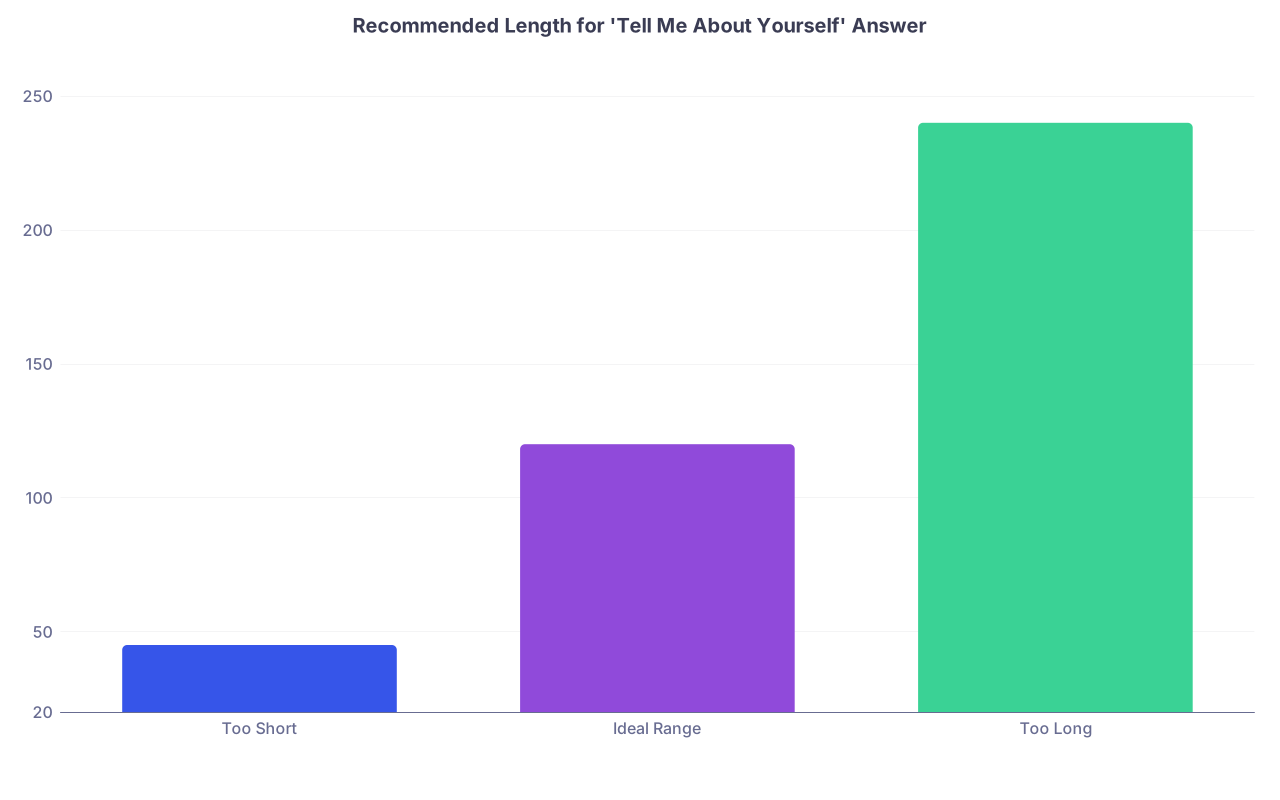
| Category | Value |
|---|---|
| Too Short | 45 |
| Ideal Range | 120 |
| Too Long | 240 |
Interpretation:
- Under ~45 seconds: you are being vague and superficial
- 90–150 seconds: ideal window
- Over ~180 seconds: you are rambling or oversharing
Trim relentlessly. If you cannot say it in two minutes, you do not understand your own story well enough yet.
Script, then unscript
The worst advice I hear: “Just be yourself, do not overprepare.”
That is how you end up with rambling, incoherent answers. Instead:
- Write out a full script following the 5 steps.
- Read it out loud 3–4 times and edit for clunky phrases.
- Turn script into a bullet outline, something like:
- Present snapshot
- Theme 1 + crisis line example
- Theme 2 + research example
- Why MD vs psych / SW
- Forward-looking close
- Practice from the outline, not the script, until it sounds natural.
You want structured spontaneity—same skeleton every time, slightly different wording depending on the moment.
Fix common delivery problems
Most common issues I see in mock interviews:
Talking too fast: you sound nervous and unreflective.
- Fix: Intentionally pause for half a second between steps. It feels long to you. It feels normal to them.
Monotone voice: you sound bored with your own story.
- Fix: Mark 3–4 phrases you want to emphasize. Slightly slow down or increase volume on those.
Up-speak at the end of sentences: everything sounds like a question.
- Fix: Practice “downbeats”—ending your key sentences with a firm, slightly lower tone.
Over-smiling or under-smiling:
- Over: looks performative.
- Under: looks flat or disinterested.
- Fix: Aim for “engaged neutral” face; genuine smiles when you mention people or moments that matter.
Do at least 3–5 recorded practice runs. Watch yourself. It is painful. Do it anyway.
Adapting the Formula for Different Interview Contexts
You are not doing 5 versions of this formula. You are doing one core version with small, smart tweaks.
Medical school vs post-bacc vs SMP
- Post-bacc/SMP: highlight academic turnaround, readiness for rigorous science, and why you need this step before med school.
- Traditional med school: focus more on your clinical/service themes and readiness for patient care.
The skeleton is the same. You adjust which experiences you highlight.
Multiple Mini Interview (MMI) stations
Sometimes you will still get “Tell me about yourself” in an MMI, especially at the beginning of a circuit or in a traditional station.
Here, go short. Use a compressed version:
- 1-sentence snapshot
- 1 theme + 1 experience
- 1-sentence why medicine
- 1-sentence forward look
Aim for 45–60 seconds. You do not want to eat the whole station with your intro.
Late-cycle or reapplicant interviews
You must acknowledge the reality without sounding defeated.
Weave in one line about growth:
“I applied previously and did not receive the offers I hoped for. Since then, I have [specific actions: post-bacc coursework, new clinical role, etc.], which has clarified for me that [updated insight].”
Then go straight back to the formula. No apology tour. No over-explaining.
Quick Reference: 5-Step “Tell Me About Yourself” Map
| Step | Core Task | Target Length |
|---|---|---|
| 1. Snapshot | Present who you are now | 1–2 sentences |
| 2. Themes | Name 1–2 defining themes | 1–2 sentences |
| 3. Experiences | 2–3 concrete examples with insight | ~6–10 sentences |
| 4. Why Medicine | Explicit bridge vs alternatives | 2–3 sentences |
| 5. Forward Look | Direction + fit with med school | 2–3 sentences |
Print that. Put it above your desk while you practice.
A Simple Practice Schedule That Actually Works
If your interview is 4 weeks away, here is how I would structure practice for this one question.
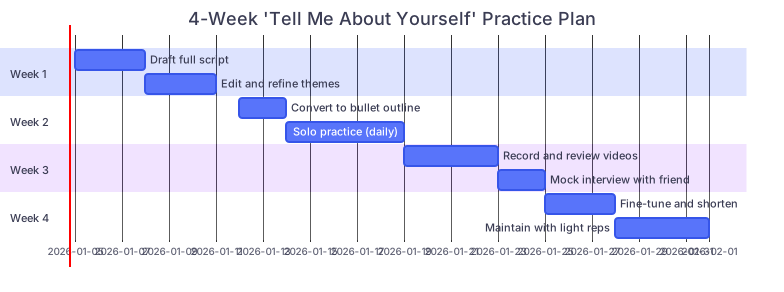
| Task | Details |
|---|---|
| Week 1: Draft full script | a1, 2026-01-05, 3d |
| Week 1: Edit and refine themes | a2, after a1, 3d |
| Week 2: Convert to bullet outline | a3, 2026-01-12, 2d |
| Week 2: Solo practice (daily) | a4, after a3, 5d |
| Week 3: Record and review videos | a5, 2026-01-19, 4d |
| Week 3: Mock interview with friend | a6, after a5, 2d |
| Week 4: Fine-tune and shorten | a7, 2026-01-25, 3d |
| Week 4: Maintain with light reps | a8, after a7, 4d |
You are not trying to memorize a monologue. You are building a muscle. By Week 4, you should be bored of your answer. That is good. Bored for you often sounds confident for them.
How to Stress-Test Your Answer
Before you walk into an actual interview, run your “Tell me about yourself” through these filters:
Could a random other premed say 50% of this answer?
- If yes, you are too generic. Add specific experiences, details, and insights.
Do I name at least one alternative career path I considered?
- If no, add one line. Shows maturity and informed choice.
Can I say it in under 2 minutes without rushing?
- If no, cut one experience or compress your insights.
Do I clearly state who I am now and where I’m headed?
- Snapshot at the start. Forward look at the end. If both are missing, fix them.
Do I sound like myself, just more organized?
- If it feels like you are “playing a character,” loosen the wording while keeping the structure.
Get one brutally honest friend or mentor. Ask them two questions after you give your answer:
- “What do you remember most from what I said?”
- “If you had to describe me to someone else in one sentence based only on that answer, what would you say?”
If their summary matches your intended themes, you are ready. If not, go back and refine.
When Your Story Is Messy (Gaps, Low Grades, Swerves)
Plenty of applicants have non-linear paths: failed classes, major changes, family obligations, illness, switching from another career. The temptation is to either:
- Over-explain and turn “Tell me about yourself” into a defense
- Or hide everything and hope they do not notice
Both are mistakes.
The formula still applies. You simply integrate one short, honest line where relevant.
Example (academic turnaround):
“My first two years of college were rough academically. I was juggling work and coursework and did not yet know how to study at this level. That changed after [specific turning point—advisor, new habits, etc.], and since then I have [concrete evidence of improvement]. That experience is part of why I now care so much about mentoring younger students who are the first in their families in college.”
You are not pretending it did not happen. You are showing growth and insight. Then you move on.
Example (career change):
“I spent six years in corporate finance before I could admit to myself that I had chosen a path that fit my skills but not my values. Volunteering at the hospital on weekends started as stress relief and turned into the most meaningful part of my week. That is what pushed me to step back, do a formal post-bacc, and commit to medicine.”
Brief. Direct. No melodrama.
Final Tightening Pass: Surgical Edits Before Interview Day
Two days before your interview, do a “surgical edit” of your answer:
- Strip out filler phrases:
- “I guess,” “sort of,” “kind of,” “like,” “you know”
- Replace vague adjectives with specifics:
- “Rewarding” → “It changed how I see X”
- “Challenging” → “I struggled with Y but learned Z”
- Check pronoun balance:
- If every sentence starts with “I,” add a few mentions of patients, teammates, mentors. Medicine is not a solo sport.
Then, one final step: practice starting cold.
Have someone randomly say, “Tell me about yourself” in the middle of your day. No warmup. You answer. That is what the real thing feels like.

Key points to remember:
- “Tell me about yourself” is not biography. It is a strategic, 90–150 second frame for your entire interview built on a 5-step structure.
- You win this question by picking 1–2 sharp themes, backing them with specific experiences and insights, and closing with a clear, adult “why medicine” and forward-looking statement.
- Script it once, turn it into an outline, and rehearse until it feels like you on your best, most organized day—not a robot, not a rambling monologue, but a focused, confident introduction that makes the interviewer think, “I want to learn more.”