The way most premeds “prep” for interviews is useless. You cannot cram communication skills the night before and expect to sound polished, coherent, and authentic. You build that in small, deliberate daily reps.
Here is the fix: a 20‑minute daily interview prep routine designed specifically for busy premeds and M1s. No fluff. No 2‑hour “maybe later” blocks. Just a tight, repeatable system.
The Core Idea: Tiny Reps, Every Day
You do not need marathon prep sessions. You need:
- Consistency
- Structure
- Feedback (even if it is just from your own recordings)
Twenty minutes a day is enough to:
- Lock in a strong story for “Tell me about yourself” and “Why medicine”
- Stop rambling and tighten your answers
- Sound confident under pressure, not like you are reading a LinkedIn bio
- Build muscle memory for ethical and behavioral answers
The routine below assumes:
- You have at least a phone with a camera and timer
- You can carve out 20 minutes most days (before bed, between classes, during lunch)
- You are applying (or will apply) to medical school, summer programs, special master’s programs, or competitive M1 roles (research positions, leadership roles, etc.)
If you actually follow this for 4–6 weeks, you will be noticeably better than your peers. I have watched average applicants jump an entire “tier” in how they come across, on nothing but consistent 20‑minute drills.
The 20‑Minute Daily Block: Exact Breakdown
Here is the skeleton you will repeat every day:
- Minute 0–2 – Set up & choose questions
- Minute 2–7 – Warm‑up question (one response + quick review)
- Minute 7–15 – Main drill block (2 focused questions)
- Minute 15–18 – Rapid‑fire micro‑drills (delivery, filler words, tone)
- Minute 18–20 – Debrief & one tiny improvement target
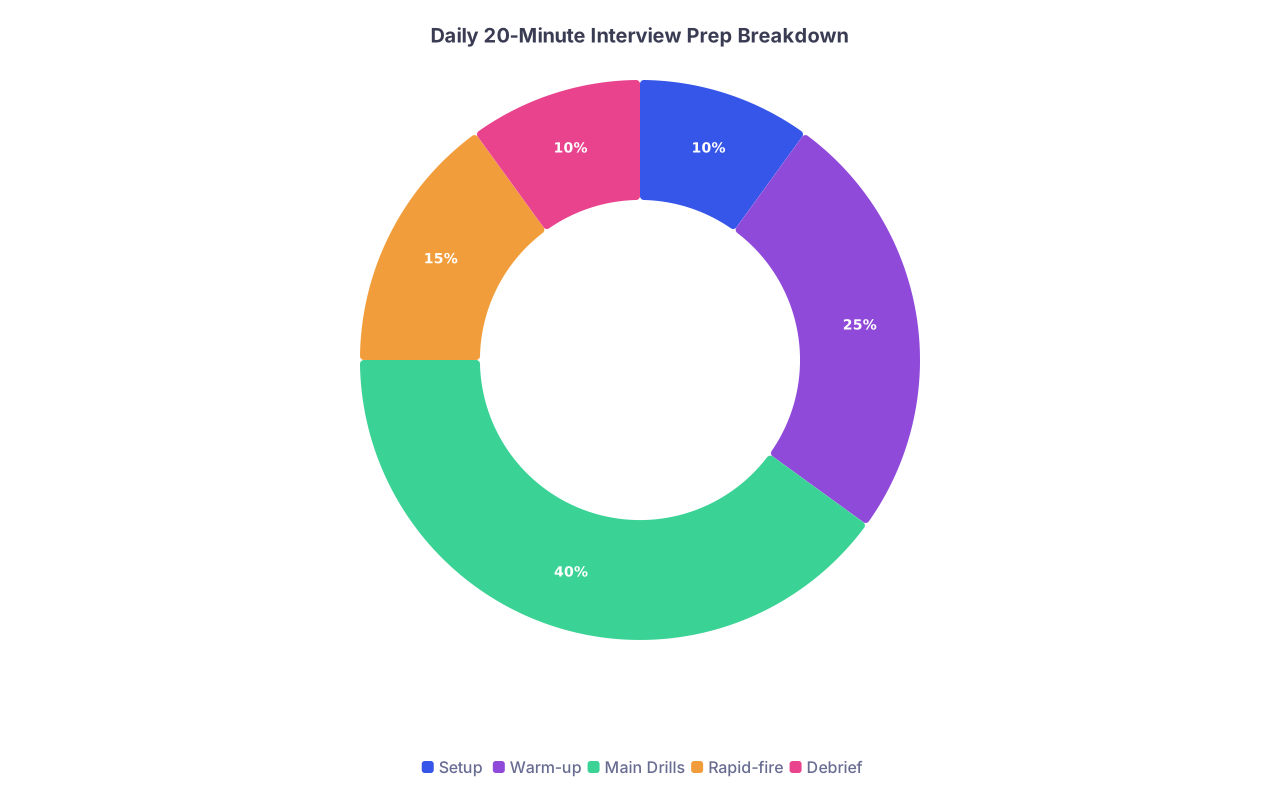
| Category | Value |
|---|---|
| Setup | 2 |
| Warm-up | 5 |
| Main Drills | 8 |
| Rapid-fire | 3 |
| Debrief | 2 |
You will rotate question types through the week so you hit everything without burning out.
Step 1 (2 minutes): Setup and Question Selection
Stop “winging it.” Two minutes of deliberate setup makes the rest efficient.
What you need:
- Phone with:
- Camera (video recording)
- Timer app
- A running question bank (keep it in Notes, Notion, Google Doc, or a small notebook)
- Today’s micro‑goal (one specific thing you are working on)
Build your question bank once, then reuse it. Here is a starter set:
| Category | Example Questions |
|---|---|
| Personal Story | [Tell me about yourself;](https://residencyadvisor.com/resources/med-school-interview-tips/struggle-with-tell-me-about-yourself-a-5-step-medical-interview-formula) Why medicine? |
| Motivation & Fit | Why this school/program? Why now? |
| Experiences | Tell me about a time you showed leadership. |
| Ethics | What would you do if you saw a classmate cheating? |
| Challenges | Tell me about a failure. How did you handle it? |
| MMI/Scenario | Address vaccine hesitancy with a worried parent. |
Your setup ritual (every day):
- Open your question bank.
- Pick:
- 1 warm‑up question (low stress, common)
- 2 main questions (1 behavioral/ethics, 1 personal/fit or vice versa)
- Set your phone up at eye level, hit record once, and keep it running for the whole 20 minutes.
- Set a 20‑minute countdown.
No more than 2 minutes for this. If you are tinkering with your setup, you are procrastinating.
Step 2 (5 minutes): Warm‑Up Question – Your “Anchor”
You need one answer so solid you could give it half-asleep. That is your anchor. Usually:
- “Tell me about yourself.”
- Or “Why medicine?”
You are going to cycle and refine this answer several times per week.
How to structure your anchor answer (3–4 minutes speaking)
Use this simple spine:
- Present – Who you are now (role + concise identity)
- Past – 1–2 key experiences that shaped your path
- Pivot to medicine – The “so what” of your story
- Future – The kind of physician/student you are aiming to be
Example skeleton:
- Present: “I am a senior at X University majoring in biology, and I split most of my time between research in a cardiology lab and volunteering in our student‑run free clinic.”
- Past: “Growing up in a rural town where we drove an hour to see a doctor made health care feel distant. In college, two experiences shifted that: shadowing in a community cardiology clinic and leading a campus blood pressure screening program…”
- Pivot: “Those experiences showed me both the complexity of cardiovascular care and how much impact a clinician can have by meeting patients where they are.”
- Future: “Long term, I want to work as an internist in a community setting, combining clinic work with preventive initiatives like the ones we ran on campus.”
Your task in this 5‑minute block:
- Answer your warm‑up question out loud (3–4 minutes).
- Immediately pause, no rewinding yet, and jot down:
- One thing that felt strong.
- One thing to tighten next time (too long on childhood, vague on future, etc.)
You will occasionally rewatch these at the end of the week. For daily work, prioritize repetition over constant replays.
Step 3 (8 minutes): Main Drill Block – 2 Focused Questions
This is where you get better. Two questions, 3 minutes each to answer, 1 minute each to reflect.
Breakdown:
- Question 1 (4 min)
- 3 minutes to answer
- 1 minute to reflect
- Question 2 (4 min)
- 3 minutes to answer
- 1 minute to reflect
For Behavioral Questions: Use a Tightened STAR
The classic STAR (Situation, Task, Action, Result) works, but most students over-explain the situation and task. You will not.
Aim for:
- Situation + Task – 20–25% of the answer
- Action – 50–60%
- Result + Reflection – 20–25%
Example behavioral question: “Tell me about a time you had a conflict on a team.”
Poor version: 2 minutes of backstory, 30 seconds of what you did, no reflection.
Better skeleton:
- Situation/Task (40–45 seconds): “In my sophomore year, I worked on a group project in organic chemistry where…”
- Action (90 seconds): “I scheduled a quick meeting, listened to both perspectives, summarized, and proposed…”
- Result/Reflection (45 seconds): “We submitted on time and scored well. More importantly, I learned to…”
For Ethics/Scenario Questions: A Simple 4‑Step Framework
When you get a scenario (e.g., cheating, impaired colleague, resource allocation), use:
- Identify the core issue(s) – ethics, professionalism, patient safety, fairness.
- Gather information – what do you need to know before acting?
- State your priorities – patient safety first, then honesty, policy, etc.
- Describe your action plan – stepwise, realistic, not overly dramatic.
Example: “You see a classmate cheat on an exam.”
You might say, in 2–3 minutes:
- “The key issues are academic integrity, fairness to other students, and what this implies about future patient safety if this behavior continues.”
- “I would want to be certain of what I saw—confirm details without jumping to conclusions.”
- “My priorities are to address the behavior in a way that protects the integrity of the program and respects due process.”
- “First, I would approach my classmate privately and give them a chance to explain. If it was clearly cheating and they refused to self‑report, I would feel obligated to bring it through the appropriate confidential channel…”
Your 1‑minute reflection after each question:
- Did I answer the actual question?
- Did I have a clear structure, or did I wander?
- Where did I waste time?
You are not rewriting essays here. Short notes only. One line per question.
Step 4 (3 minutes): Rapid‑Fire Micro‑Drills
This is the part almost everyone skips. It is also where your delivery improves.
You will do 3 micro‑drills, about 1 minute each:
Filler‑Word Purge (1 min)
- Pick a simple prompt: “Describe your hometown” or “What did you do last weekend?”
- Speak for 45–60 seconds with the explicit goal: no “um,” “like,” “you know,” “so yeah.”
- Slow down. Pause in silence instead of filling it. It will feel awkward. Good. That is the point.
Concise Version Drill (1 min)
- Take one answer from earlier (warm‑up or main question).
- Give a 30‑second version focused only on the main arc.
- You are training for MMI timing and for rescuing yourself when you start to ramble.
Energy & Tone Reset (1 min)
- Record a 30–45 second answer to: “Why are you excited about this opportunity?”
- Focus on:
- Eye contact with the camera
- Upright posture
- Slightly more vocal energy than feels natural
- This prevents the dead, flat Zoom-voice I see in half of virtual interviews.
You can rotate these micro‑drills, but something in this 3‑minute slot should always hit filler words, brevity, or tone.
Step 5 (2 minutes): Debrief and Micro‑Target for Tomorrow
The most common mistake: people “practice” but never close the loop.
Last 2 minutes:
- Quickly scan your notes from the session.
- Answer three questions in writing (just bullets):
- What went well today?
- What consistently tripped me up?
- What is my one target for tomorrow?
Examples of good micro‑targets:
- “Tomorrow: focus on giving clear results in my STAR stories.”
- “Tomorrow: practice 2 ethics questions; I keep freezing on those.”
- “Tomorrow: cut my ‘Tell me about yourself’ from 4:30 to under 3:30 without losing key points.”
That one target will dictate which questions you pick during setup next time.
Weekly Structure: What to Do On Each Day
You will not cover everything every day. You do not need to. Spread it out.
Here is a simple weekly rotation:
| Day | Main Focus |
|---|---|
| Monday | Personal story + Why medicine |
| Tuesday | Behavioral questions |
| Wednesday | Ethics / professionalism |
| Thursday | School/fit and “why here” |
| Friday | MMI‑style scenarios |
| Saturday | Mixed review + weak areas |
| Sunday | Light review or rest |
Breakdown by day (still 20 minutes):
Monday – Story Day
- Warm‑up: “Tell me about yourself.”
- Main drills: “Why medicine?” and “Tell me about a pivotal experience.”
- Micro‑drills: Concise 30‑second versions of both.
Goal: Your core narrative starts feeling natural, not memorized.
Tuesday – Behavioral Day
- Warm‑up: “Tell me about a strength.”
- Main drills: Two behavioral questions (leadership, conflict, failure, adaptability).
- Micro‑drills: Filler‑word purge + concise version of one behavioral story.
Goal: You have at least 3–5 polished stories you can adapt for multiple prompts.
Wednesday – Ethics Day
- Warm‑up: “What qualities make a good physician?”
- Main drills: Two ethics scenarios (cheating, confidentiality, impaired colleague, resource allocation).
- Micro‑drills: 30‑second “issue + priorities” summaries for each.
Goal: You stop panicking at ethical questions because you have a framework.
Thursday – Fit Day
- Warm‑up: “Why this school/program?”
- Main drills:
- “What can you contribute to our community?”
- “What do you look for in a medical school?”
- Micro‑drills: Tone/energy reset focusing on enthusiasm without sounding fake.
Goal: Your answers sound tailored, not copy‑pasted between schools.
Friday – MMI / Curveball Day
- Warm‑up: Light question (“What do you do for fun?”).
- Main drills:
- One MMI‑style communication task (“Explain a complex concept to a 10‑year‑old”).
- One opinion/health‑policy question (“Should vaccines be mandatory for school entry?”).
- Micro‑drills: 30‑second “position + reasoning” for the policy question.
Goal: You learn to structure opinions clearly and stay calm with odd prompts.
Saturday – Mixed Day
- Warm‑up: Either “Tell me about yourself” or “Why medicine” (whichever is weaker).
- Main drills: One behavioral + one ethics or fit question.
- Micro‑drills: Your choice, targeting the week’s biggest weakness.
Sunday – Optional or Light
You are a human. You can take a break. But if anxiety is high:
- Do a 10‑minute light version:
- 1 warm‑up
- 1 main question
- 1 micro‑drill
How to Use Recordings Without Wasting Time
You are recording every day. You are not rewatching every day. That is how you avoid turning this into a 60‑minute ordeal.
Here is a simple system:
- Daily: Reflect from memory (as above). No playback.
- Twice per week (e.g., Wed and Sat, 10 extra minutes max):
- Watch one warm‑up answer and one main question answer.
- While watching, note:
- Do I look engaged or bored with myself?
- Do I ramble? Where?
- Any distracting habits? (touching face, looking off‑screen, nervous laughter)
You are looking for patterns, not tearing yourself apart.
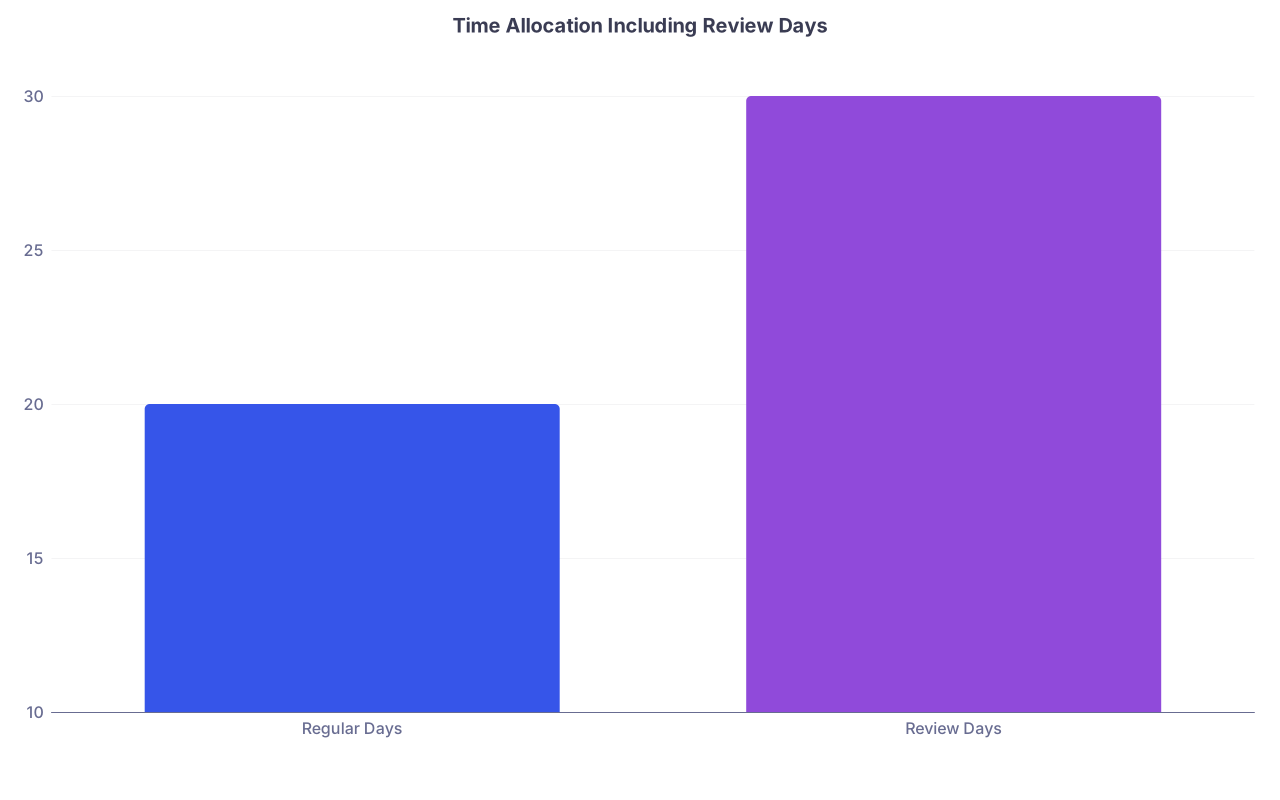
| Category | Value |
|---|---|
| Regular Days | 20 |
| Review Days | 30 |
Integrating This With a Packed Premed / M1 Schedule
Here is the block I see in successful students’ calendars:
- Option A – Morning: 7:30–7:50 a.m. right after breakfast.
- Option B – Between commitments: 20 minutes between classes or before lab.
- Option C – Night: 9:30–9:50 p.m., right before you shut your laptop.
You do not wait for a “free afternoon.” That day is not coming.
Some practical tricks:
- Pre‑load tomorrow’s questions: At night, pick your 3 questions for the next day. That saves decision time.
- Use audio‑only on bad days: If you truly cannot stand video that day, record audio. Still better than nothing.
- Pair it with a habit you already have: After brushing your teeth at night, you hit “record.” Non‑negotiable.
If you are an M1 drowning in anatomy or renal physiology: remember these interviews determine where you train. Twenty minutes is a justified investment.
How Premeds and M1s Should Adjust the Routine
You are in different phases, but the core routine works for both. You just shift emphasis.
| Aspect | Premed Focus | M1 Focus |
|---|---|---|
| Content | Why medicine, college experiences | Clinical curiosity, early med school growth |
| Ethics | General professionalism, preclinical | Patient safety, team dynamics, clerkship prep |
| Scenarios | Med school interviews, MMIs | Research positions, summer programs, leadership roles |
| Stories | Shadowing, volunteering, campus roles | Preclinical projects, small-group dynamics |
For premeds:
- Load your question bank with:
- AMCAS/AACOMAS common questions
- Service/volunteering stories
- Handling academic challenges and time management
- Emphasize:
- “Why medicine?”
- “Why our school?”
- Behavioral stories from undergrad work, leadership, and community service
For M1s:
- Anticipate:
- Research mentor interviews
- Summer programs (e.g., NIH, clinical research fellowships)
- Leadership positions (student council, interest group boards)
- Emphasize:
- How your view of medicine has evolved during M1
- Handling the transition to medical school workload
- Working in teams in small‑group or anatomy lab settings
Same drill. Different stories.
Tracking Progress So You Do Not Quit
If you cannot see improvement, you will stop. So make it visible.
Create a very simple tracking sheet (paper or digital) with columns like:
- Date
- Warm‑up question
- Two main questions
- Micro‑target for tomorrow
- 1–10 confidence rating for the day
Every 2 weeks, skim your log:
- Are your confidence ratings trending up?
- Are you repeatedly avoiding certain question types (ethics, failure, “why this school”)? That is your next focus.
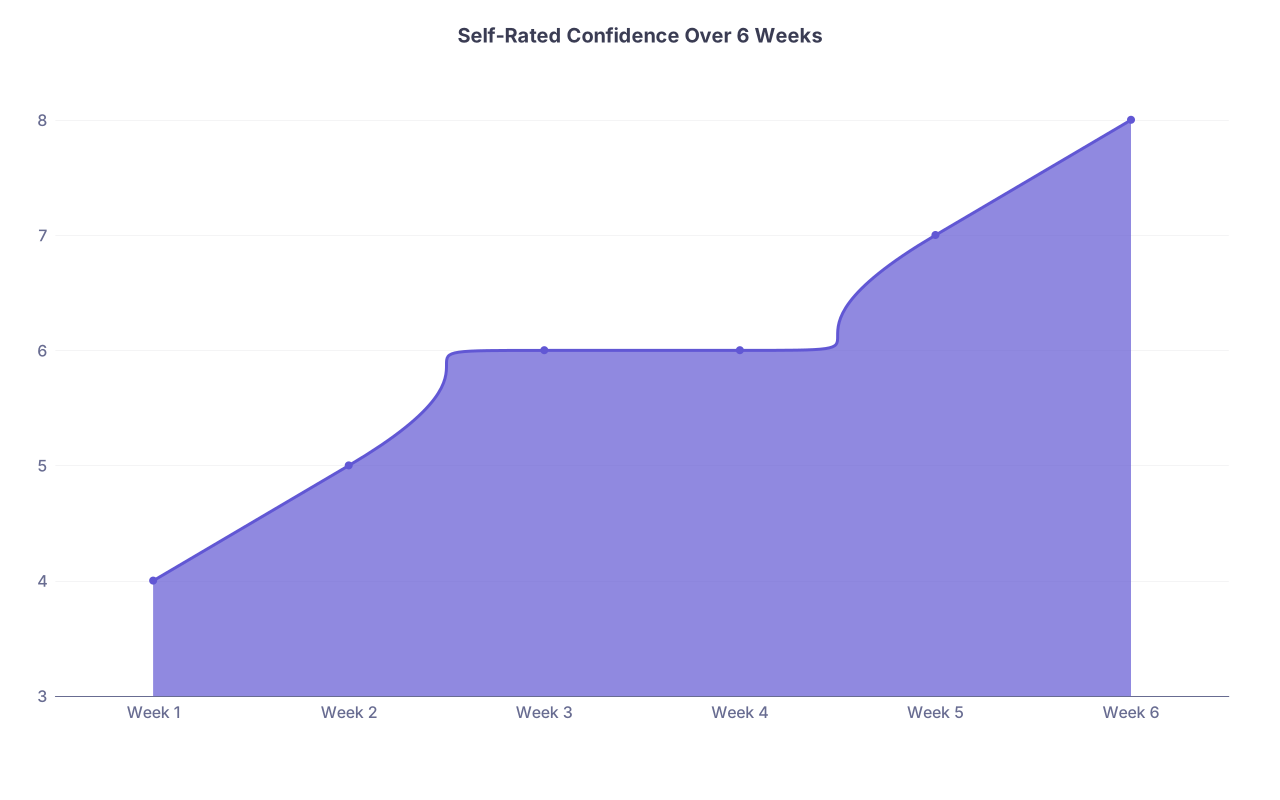
| Category | Value |
|---|---|
| Week 1 | 4 |
| Week 2 | 5 |
| Week 3 | 6 |
| Week 4 | 6 |
| Week 5 | 7 |
| Week 6 | 8 |
I have seen students go from “I freeze and ramble” to “I kind of enjoy interviews now” in 6–8 weeks with nothing more than this log and the 20‑minute block.
Common Pitfalls and How to Avoid Them
Let me be blunt about where people mess this up:
Trying to memorize scripts
- You start sounding like a robot reading Cue Cards in your head.
- Fix: Memorize structures and key points, not full sentences.
Practicing only “Tell me about yourself” and ignoring the rest
- Then you collapse on your first ethics or challenge question.
- Fix: Stick to the weekly rotation. No skipping ethics/behavioral days.
Not timing yourself
- You think your answers are “about 2 minutes” and they are actually 5+.
- Fix: Always time. Use the phone timer, not your “sense” of time.
Never watching yourself
- You have no idea you look annoyed or bored.
- Fix: Twice‑weekly playback, 10 minutes total, non‑negotiable.
Overloading instead of consistency
- One 2‑hour session the week before the interview does almost nothing.
- Fix: Guard the 20 minutes like a meeting with your future self.
Your Next Step: Build Tomorrow’s 20‑Minute Plan
Do not file this away as “nice advice.” Use it.
Right now, do this:
- Open Notes (or grab a piece of paper).
- Create your question bank with at least:
- “Tell me about yourself.”
- “Why medicine?”
- Three behavioral prompts (leadership, conflict, failure).
- One ethics scenario.
- Pick tomorrow’s three questions:
- Warm‑up
- Main Q1
- Main Q2
- Block one 20‑minute window in your calendar for tomorrow and label it:
- “Interview Reps – Non‑negotiable.”
Then tomorrow, sit down, set a 20‑minute timer, hit record, and run the routine exactly as laid out.
You do not need motivation. You need a repeatable system. This is it.