
The biggest waste in interview prep is this: students collect feedback and then do absolutely nothing systematic with it.
You do a mock MMI station. Or a Zoom interview with your prehealth advisor. They say, “Great job overall—just tighten your answers and be more specific.” You nod. You feel mildly reassured. Then you repeat the exact same mistakes next week.
That is not preparation. That is practice theater.
If you want actual progress, you need feedback loops. Tight, structured, repeatable loops that turn vague comments into specific changes in how you speak, think, and perform.
Here is how to build those loops, step by step, so your mock interview notes translate into real movement—from “I hope this goes well” to “I know exactly what I’m doing in that room.”
Step 1: Fix the Way You Collect Feedback
You cannot build a reliable feedback loop on sloppy data. Most mock interviews fail right here.
“Good job,” “pretty strong,” and “just be yourself” are useless. You need targeted, scored, and written feedback.
1.1 Define the categories that actually matter
For premed and medical school interviews, most assessors are looking at a similar set of domains. You should force all feedback into these buckets:
- Content
- Did you actually answer the question?
- Did you show insight, reflection, and depth?
- Structure
- Was there a clear beginning, middle, and end?
- Did you avoid rambling?
- Delivery
- Eye contact / camera presence
- Voice (pace, volume, confidence)
- Filler words, awkward pauses
- Professionalism
- Maturity, judgment
- Respectful language
- Appropriateness of examples
- Fit & Insight
- Understanding of the school/program
- Alignment with mission, values, specialty choice
- Self-awareness
Turn that into a simple scoring sheet for every mock:
| Domain | Rating Scale | Target Score |
|---|---|---|
| Content | 1–5 | ≥ 4 |
| Structure | 1–5 | ≥ 4 |
| Delivery | 1–5 | ≥ 4 |
| Professionalism | 1–5 | ≥ 4 |
| Fit & Insight | 1–5 | ≥ 4 |
Tell your evaluator before you start: “Can you rate me 1–5 in each of these categories and give at least one concrete example for each low score?”
If they say, “yeah, we’ll see,” push: “I’m really trying to track specific improvement over time. A structured sheet helps me a lot.”
You are not being annoying. You are being intentional.
1.2 Force written examples, not just vague impressions
For each category, you want evidence:
- Content: “When asked about a time you failed, you gave an example of getting a B in orgo and did not explain what you changed afterwards.”
- Structure: “Your answer to ‘Why this school?’ wandered. You jumped between research, location, and diversity without a clear arc.”
- Delivery: “Said ‘um’ 17 times in a 2-minute answer. Voice volume dropped at the end of sentences.”
- Professionalism: “You referred to a previous physician as ‘kind of clueless’—this was risky.”
- Fit & Insight: “Your answer to ‘Why medicine?’ focused heavily on prestige and family expectations, not patient care.”
No example = no real feedback. Make that your rule.
Step 2: Build a Simple Feedback Tracking System
Random notes in five different notebooks will not drive change. You need a single place where patterns can emerge.
Use a spreadsheet, Notion page, or even a simple Word table, but keep it consistent.
Here is a structure that works:
| Date | Format (MMI/Panel/1:1) | Station/Question Type | Domain Scored < 4 | Key Problem | Specific Example | Next Action |
|---|---|---|---|---|---|---|
| 2026-01-05 | Zoom 1:1 | Tell me about yourself | Structure, Delivery | Rambling intro | 3+ minutes, unclear arc | Rewrite and rehearse 90-sec version |
Every mock interview → one row per major question or station.
If that sounds tedious, good. The whole point is to see your weaknesses repeatedly until you get sick of them and fix them.
2.1 Use a simple code system
To speed this up, use short codes in your “Domain Scored < 4” and “Key Problem” columns:
Examples:
- ST = Structure
- CT = Content
- DL = Delivery
- PR = Professionalism
- FT = Fit & Insight
- RAM = Rambles
- VAG = Vague answer
- FIL = Too many fillers
- NRS = Not reflective enough
- NSC = No school-specific detail
Now you can scan five rows and immediately see: “I’m getting ST+RAM on almost every open-ended question.”
Step 3: Turn Feedback Into Concrete Practice Tasks
This is where most people fail. They read feedback. They nod. Then they go right back to “just practicing more questions.”
You will do the opposite: convert each repeated problem into a specific training drill.
Here is the rule:
If a weakness shows up 2+ times in your log, it earns its own drill.
3.1 Example: Rambling answers
Your feedback patterns:
- “Too long. No clear point.”
- “Took 3 minutes to get to the actual answer.”
- “Conclusion was missing.”
Your drill:
- Pick 5 common questions:
- Tell me about yourself.
- Why medicine?
- Why our school?
- Tell me about a time you failed.
- What is your greatest weakness?
- For each:
- Write out a three-part structure (e.g., Hook → Core story/points → Take-home message).
- Aim for 60–90 seconds max.
- Use a timer:
- Record yourself answering each question.
- Stop at 90 seconds regardless.
- Review each recording:
- Did you hit your structure?
- Did you state your core answer in the first 15–20 seconds?
- Repeat until you can consistently hit:
- Clear arc.
- Under 90 seconds.
- No meandering side stories.
“Be more concise” is useless. “Train with 90-second structured drills 3x a week” is not.
3.2 Example: Vague, generic answers
Feedback patterns:
- “Answer felt canned.”
- “You sound like you memorized Reddit responses.”
- “Not enough specific detail.”
Your drill:
- Take your 3 most common vague answers (usually “Why medicine,” “Why this school,” “Tell me about yourself”).
- For each answer, force yourself to:
- Add one concrete detail:
- A specific patient (de-identified).
- A specific moment in a volunteer shift.
- A specific program element at that school (course name, clinic, track).
- Add one concrete detail:
- Practice using the Rule of One:
- One main story.
- One main theme.
- One clear takeaway sentence.
- Record yourself:
- If someone cannot repeat one key line from your answer, it is too generic.
3.3 Example: Weak delivery (fillers, speed, low volume)
Feedback patterns:
- “You speak too fast when you get nervous.”
- “Too many ums and likes.”
- “Hard to hear you.”
Your drill:
- 2-minute slowing drill:
- Pick any question.
- Answer at half your normal speed.
- Exaggerate pauses between sentences.
- Filler-word awareness drill:
- Record 3 short answers.
- Count “um/like/you know” on playback.
- Write the number down.
- Replace fillers with intentional pause:
- Practice stopping mid-sentence for 1–2 seconds instead of filling space with noise.
- Volume and energy:
- Stand up while answering.
- Put a sticky note on your laptop: “End sentences strongly.”
- Consciously lift your voice at the beginning and speak through the end of your sentence (no trailing off).
Aim: reduce your filler count by 50% over 3–4 sessions. Track it.
Step 4: Build a Formal Feedback Loop After Every Mock
A feedback loop is not “get feedback → feel something → move on.” It is a cycle with defined stages.
Here is the cycle you will use every single time:
- Mock interview
- Immediate debrief
- Update your log
- Select one priority problem
- Run a targeted drill
- Re-test that specific skill
Let me map that concretely.
4.1 The 24-hour rule
Within 24 hours of any mock interview:
- Re-watch or re-listen to at least two answers:
- One you felt went well.
- One you felt went badly.
- Compare your perception with written feedback:
- Did they think your “good” answer was actually weak?
- Did they praise an answer you felt unsure about?
- Fill your tracking sheet:
- Domains < 4
- Concrete examples
- One-sentence summary of your worst habit that day.
4.2 Pick one priority per cycle
This is where people sabotage themselves. They see 10 problems and try to fix all 10 at once. That guarantees nothing changes.
For each mock:
- Circle one priority:
- “Today’s target: structure on behavioral questions.”
- Or “Today’s target: decreasing filler words.”
- That becomes your training objective until the next mock.
You will not ignore the other issues. You just will not delude yourself into thinking you can rewire everything in a week.
Step 5: Use Time-Boxed Practice Blocks
You do not need 3-hour marathon sessions. You need focused 25–40 minute blocks, each with a clear goal tied to your feedback.
Here is a weekly structure that works extremely well, especially during busy premed or M2 schedules:
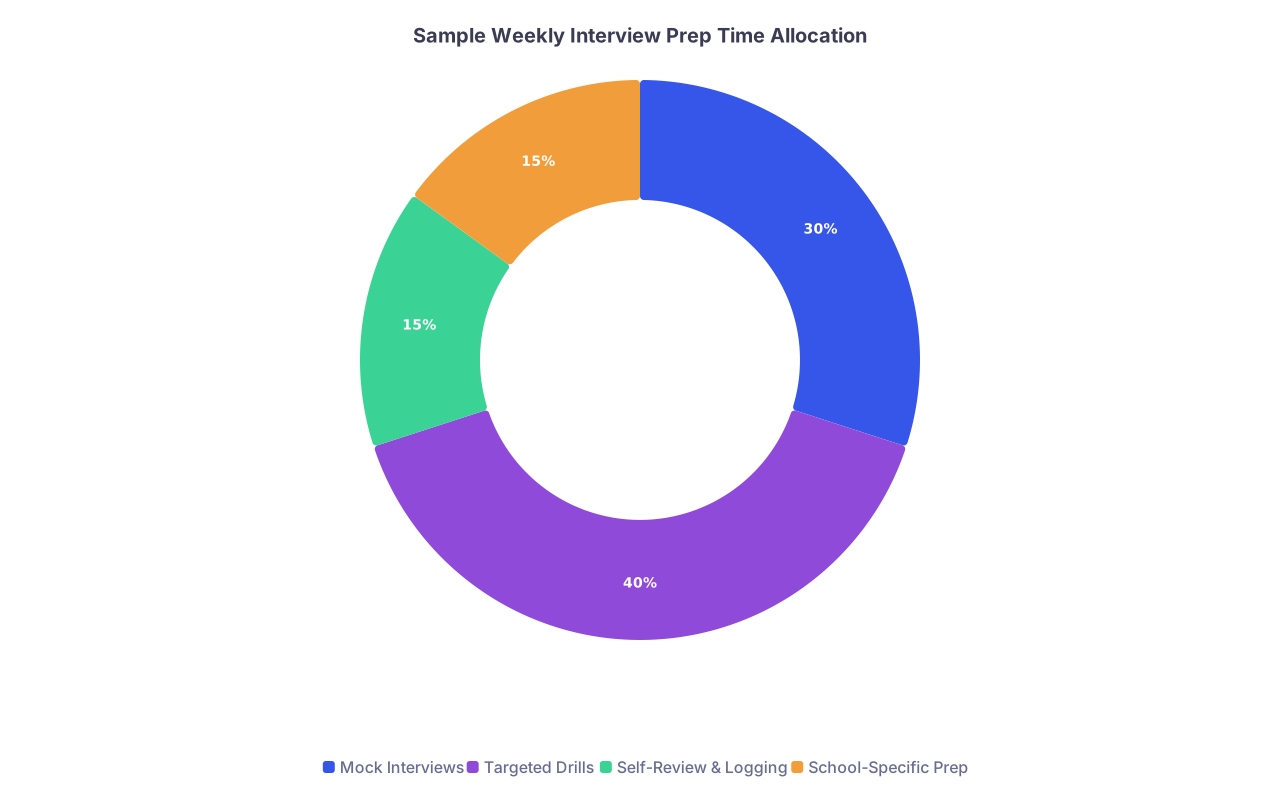
| Category | Value |
|---|---|
| Mock Interviews | 30 |
| Targeted Drills | 40 |
| Self-Review & Logging | 15 |
| School-Specific Prep | 15 |
Example weekly plan (6–7 weeks before interviews)
Day 1 – Mock + Debrief (45–60 min)
- 20–30 min: Live mock (advisor, friend, mentor, or recorded self-mock).
- 10–15 min: Immediate oral feedback.
- 10–15 min: Fill in your tracking sheet.
Day 2 – Targeted drills (25–40 min)
- 1–2 drills based on your priority issue.
- Record yourself briefly.
- Quick self-assessment.
Day 3 – School-specific work (20–30 min)
- Read up on one school:
- Mission, curriculum structure, unique programs.
- Update your “Why this school?” talking points.
- Practice 1–2 answers plugging in real details.
Day 4 – Focused re-test (25–40 min)
- Short, self-recorded mini-mock:
- 3–4 questions, all involving your target skill for the week.
- Watch immediately.
- Ask: “Did this week’s drills actually fix anything?”
Day 5+ – Optional second mock
- If time allows, do another shorter mock and repeat the cycle.
The key: each week has one main change you are pushing.
Step 6: Match Feedback Type to Interview Format
A lot of students train generically and then get blindsided by format. MMI vs traditional. Closed file vs open file. Ethical vs personal.
Your feedback loops need to be format aware.
6.1 MMI-style stations
Common issues:
- Running out of time.
- Shallow ethical reasoning.
- Not using the prompt details properly.
Targeted MMI drills:
- 8-minute timer training:
- 1 minute: silent reading + outline.
- 6 minutes: answer.
- 1 minute: quick self-grade.
- Use a simple ethical framework consistently:
- Identify stakeholders.
- State the conflict.
- Explore options (pros/cons).
- State your recommendation and why.
- Feedback loop focus:
- Track: “Did I mention at least 2 perspectives?”
- Track time left: Are you always rushing at the end?
6.2 Traditional 1:1 or panel interviews
Common issues:
- Overly rehearsed answers.
- Poor conversational flow.
- Weak follow-up questions to the interviewer.
Targeted drills:
- “Messy answer” practice:
- Respond to a question once without notes.
- Then refine, restructure, and answer again.
- This builds real-time thinking, not just memorization.
- Follow-up question notebook:
- Keep a list of school-specific questions to ask interviewers.
- Ask a friend to role-play interviewer for 10 minutes and practice weaving questions in naturally.
Step 7: Track Improvement Like You Track Grades
You are a premed or medical student. You understand metrics. Use that brain.
No, this is not overkill. It is how you stop gaslighting yourself (“I think I’m getting better?”) and start knowing.
7.1 Create a simple progress dashboard
Once you have done at least 3–4 mocks, summarize:
- Average score in each domain (Content, Structure, Delivery, Professionalism, Fit).
- Trend: Are scores rising, flat, or erratic?
Even a simple 1–5 average week-over-week helps.
If you want to be more precise:
- Track filler words per 2-minute answer.
- Track average time per response.
- Track how many questions per mock you:
- Directly answered vs partially dodged.
- Could link back to the school’s mission or your main themes.
7.2 Interpret patterns like an adult, not a victim
If:
- Delivery improves (4–5 range),
- But Content is stuck at 3,
This means you look polished while saying not much. You need to shift practice from “how” to “what.”
If:
- Content and Structure are strong (4–5),
- But Delivery and Professionalism are 3,
You likely need mentorship on tone, maturity, and presence. Not more flashcards.
Stop guessing. Read your own data.
Step 8: Leverage Multiple Feedback Sources Strategically
One more mistake: relying entirely on one type of evaluator.
Your friends may overpraise you. Faculty may focus on tiny details. Advisors may be rushed.
You want a mix:
- At least one:
- Prehealth advisor or dean-level evaluator.
- At least one:
- Peer or fellow applicant (good for pattern recognition).
- At least one:
- Clinician or resident (better feel for professionalism and “would I work with this person?”).
But here is the protocol:
You do not treat every comment as equal.
8.1 Weight feedback by domain
Rough guide:
- Content and Structure:
- Give more weight to experienced interviewers, advisors, faculty.
- Delivery:
- Almost anyone can reliably comment on this with video evidence.
- Professionalism:
- Trust clinicians and faculty more than your roommate.
- Fit & Insight:
- School-specific people (current students, alumni) carry heavier weight.
If three different sources tell you the same thing, it is not a stylistic preference anymore. It is a problem.
Step 9: Avoid the Two Big Traps
There are two predictable ways students sabotage feedback loops.
9.1 Trap 1: Emotional defensiveness
You hear:
- “You sounded arrogant when you said that.”
- “Your ‘failure’ example is not an actual failure.”
And you immediately start explaining why they are wrong.
Here is the fix:
- You do not have to agree.
- But you do have to ask: “If an interviewer heard this the same way, would that hurt me?”
Your rule: Argue later. Capture now.
Write the feedback down first. Process it after you are calm.
9.2 Trap 2: Endless consumption, no testing
You “prepare” by:
- Reading 50 pages of common interview questions.
- Watching YouTube breakdowns.
- Listening to other people’s answers.
And you never put yourself on the spot.
Fix:
- For every 30 minutes of passive learning, you must do at least 15 minutes of active practice:
- Recording yourself.
- Getting real-time feedback.
- Updating your log.
If that ratio slips, your brain is tricking you. You feel productive, but your actual performance is static.
Step 10: Simulate Pressure, Not Just Content
Interview performance is not just what you know. It is how your brain behaves under scrutiny.
So yes, your feedback loops must include pressure testing.
Examples:
- Back-to-back questions:
- Have a friend ask you 5 rapid-fire questions with zero prep time.
- Track how often you default to rambling vs pausing and structuring.
- “Curveball” round:
- Ask your evaluator to throw in at least one uncomfortable question:
- “Why did you get a C in this course?”
- “What concerns do you have about becoming a doctor?”
- Ask your evaluator to throw in at least one uncomfortable question:
- Distraction tolerance:
- Do a practice session in a slightly noisy environment.
- See if your delivery falls apart or if you can maintain composure.
Then log:
- What changed under pressure?
- Did previous weaknesses get worse?
- Did new weaknesses emerge?
Those findings become fuel for your next cycle of drills.
What To Do Today (Not Next Month)
You do not need a full consulting package. You need one concrete move.
Do this today:
- Create a one-page feedback sheet with:
- The five domains (Content, Structure, Delivery, Professionalism, Fit & Insight).
- 1–5 rating boxes.
- Space for “Best example” and “Biggest problem” for each.
- Schedule one 20–30 minute mock in the next 3–5 days:
- With an advisor, friend, or mentor.
- Or record your own if nobody is available.
- After that mock:
- Fill a simple tracking table (you can copy the one above).
- Circle exactly one priority weakness.
- Build one 20-minute drill based on that.
Run that loop once. Then again next week. That is how this stops being theory and becomes real progress.