The first 60 seconds of your medical school interview are judged more harshly than anything you say about ethics, research, or healthcare disparities. And yes—many interviewers have essentially decided your “bucket” before you ever sit down.
I’ve sat in those debrief rooms. I’ve heard the casual, offhand comments that decide who’s “polished,” who’s “awkward but promising,” and who’s “no way.” None of that is written on the website. But it controls who gets in.
Let me walk you through what’s actually happening in that first minute—from the other side of the door.
The Reality: Your File Got You In the Room. Your First Minute Decides the Tone.
By the time you walk into that office or log into that Zoom room, the interviewer usually knows three things:
- Roughly where you sit academically (broadly: strong/average/weak on paper).
- Whether you have any “flags” (low score, gap, major life event, professionalism issue, etc.).
- Their own mood and schedule that day.
What they do not know is what you are like as a real person and whether you’re going to be painful or pleasant to talk to for 30–60 minutes.
So they’re doing a rapid risk assessment in the first minute:
- “Is this going to be awkward or smooth?”
- “Does this person feel like a real future colleague or like a teenager at a school presentation?”
- “Is this someone I’d trust in front of my patients?”
They are not consciously grading your first steps with a rubric. They’re pattern-matching. And they are frighteningly fast at it.
I’ve watched attendings walk out of a 30-minute interview and say, “I knew in the first ten seconds.” Exaggerated? Yes. Completely made up? Not at all.
What They Clock Before You Say a Single Word
You think you start at “Hello.” You don’t. You start before that.
If it’s in-person, the interviewer will often see some of this:
- How you walk down the hall with the student host.
- How you interact with staff when they say, “They’re ready for you.”
- How long they’re waiting after your scheduled time.
If it’s virtual, it’s:
- What your name shows up as when you enter (“MedStudent2026” vs “Alex Chen”).
- Whether your camera is on and framed correctly the moment the meeting opens.
- Whether they’re staring at your ceiling fan for 30 seconds while you fumble with audio.
Let me break down what’s silently recorded in those few seconds.
1. Punctuality and “Ready State”
Faculty do not care about your carefully memorized answer to “Why medicine” if they were sitting alone at 8:00 a.m. while you join at 8:05, breathless.
Here’s the internal monologue I’ve actually heard:
- “If this is their job interview, what are they going to be like on rounds?”
- “If they can’t handle a 30-minute scheduled call, how are they handling a 28-hour call?”
You get maybe one excuse:
Flight delay. Platform meltdown. Campus parking disaster.
But you’d better look prepared and apologetic, not casual.
What they note in the moment:
- Were you in the waiting area / Zoom room a few minutes early?
- When they opened the door or unmuted, were you clearly ready—not rummaging, not repositioning, not mid-conversation?
- Did you apologize appropriately if there was a delay, or act like it was nothing?
They’re scoring reliability, subconsciously. And that’s hard to undo.
The First Visual: How You Occupy Space
Let me be blunt: your suit color is not what they care about. But how you inhabit that suit? That’s a different story.
What’s actually on their radar:
2. Posture and Movement
You don’t need some power pose nonsense. Faculty are not doing a TED talk on you. They’re feeling out one thing: Does this person look like a functioning adult who can interact with patients and colleagues?
In the first few steps or camera seconds, they notice:
- Are your shoulders up by your ears or relaxed?
- Do you enter the room decisively, or hover awkwardly in the doorway waiting to be rescued?
- Do you sit when they gesture, or do they have to explicitly say, “Go ahead and have a seat”?
Online:
- Are you centered in the frame, or are they talking to half of your forehead?
- Are you sitting still, or are you spinning slightly in a swivel chair? (Yes, this gets mentioned after.)
- Is the camera shaking because you’re using a laptop on a bed or soft couch? They notice.
I watched a very strong applicant tank their perception in 10 seconds because they half-knelt, half-sat, adjusted their chair three times, then laughed nervously and said, “Sorry, I can’t get comfy.” The attending wrote one line: “Very immature vibe, may struggle with professionalism.”
Brutal? Yes. But that’s what happens.
3. Facial Expression and “Baseline Energy”
They’re not looking for a permanent smile. They’re checking: Are you someone patients will trust?
In that first look they note:
- Do you look like you want to be there—or like you’d rather be anywhere else?
- Is your resting face openly hostile, blank, or gently engaged?
- Are you scanning the room like you’re terrified, or making steady, normal eye contact?
The best first 5 seconds usually look like this:
You walk in or appear on screen. You make brief, warm eye contact. You have a small, natural smile, not a toothy grin frozen in place. Your body looks settled, not rigid.
That’s it. No theatrics. Stable. Adult. Present.
The Greeting: Where Most Applicants Quietly Lose Points
Here’s where the first 60 seconds really crystallize.
4. The Handshake / Verbal Greeting
In-person, the handshake is still alive in many places, but there’s more variability post-COVID. Here’s what interviewers actually note:
- Do you wait to see if they offer a hand, or do you launch forward into their space?
- If you do shake, is it limp, bone-crushing, or normal? (Yes, this absolutely gets remembered.)
- Do you pair it with clear eye contact and a straightforward “Nice to meet you, Dr. ___”?
I have seen faculty write, “Very awkward introduction, looked at floor while shaking hand,” in their evaluation. That’s not a death sentence, but it colors everything else.
If they don’t offer a handshake, do not panic. You just give a simple, “Hi, Dr. Smith, I’m Maya Patel. Thank you for taking the time to meet with me today,” and sit when they indicate.
Online, here’s the equivalent:
- Do you greet by their name quickly and correctly?
- Do you say hello clearly and audibly—or mumble something half off-mic?
- Do you acknowledge any audio delay gracefully without turning it into a bit?
The internal scoring is simple: “Would I feel comfortable having this person introduce themselves to a patient or consultant?”
5. Tone of Voice
Nobody tells you this, but physicians are hypersensitive to vocal tone. Years of talking to anxious patients will do that.
In the first sentence they hear:
- Do you project enough volume to be heard without straining?
- Is your pace frantic, or too slow and halting?
- Do you end sentences like questions? (“I’m really excited to be here?”)
The worst combination: low volume + rushing + up-speak.
It screams uncertainty. Faculty interpret that as “immature,” “uncomfortable,” or “not ready.”
You want: slightly slower than your normal conversational speed, clear diction, and stable tone.
What They Infer About Your Professionalism in Seconds
This is the part applicants underestimate badly.
6. How You Handle Micro-Awkwardness
Every interview has one small awkward moment right at the start. The door sticks. The camera glitches. You both talk at once.
Faculty don’t care that it happened. They care what you do next.
If you:
- Freeze and apologize five times
- Make a big self-deprecating joke about how “awkward” you are
- Blame tech repeatedly
…they file that under “does not handle small stressors gracefully.”
What impresses them is boring competence:
You laugh lightly, say “Go ahead,” or “No worries,” or “I think we both started there,” then move on without dwelling. That’s it. That’s someone they can see on wards when monitors beep and phones ring.
I’ve literally heard attendings say, “The tech cut out at the start, but they stayed calm and rolled with it. I liked that.”
7. Respect Signals (Subtle, but Very Real)
Interviewers absolutely pick up micro-signals of respect or entitlement in the first minute.
Things they clock even if they’ll never admit it publicly:
- Do you sit only after they gesture, or do you flop down immediately without any social awareness?
- Do you immediately put your water bottle and phone on the table like it’s your personal desk?
- Are you calling them “Doc” or using their first name uninvited?
I’ve seen an applicant walk in, drop their backpack loudly on the floor, pull out a giant hydroflask, and say, “Sorry, it’s been a long morning.” The interviewer looked at me later and said, “He’ll be that student eating a full meal on rounds while I’m examining a patient.”
Is that a little unfair? Maybe. But these are the associations that happen.
The File vs. The Human: How Your First 60 Seconds Shift the Frame
Here’s a secret you won’t find in any official guideline: many interviewers skim your file right before you walk in and then decide what they want to confirm or challenge.
They walk in with a mental picture. Your first 60 seconds either reinforce it or scramble it.
8. “Strong on Paper, Weak Presence” vs “Okay on Paper, Surprisingly Great”
This is where a lot of borderline applicants win—or high-stat applicants quietly lose ground.
If your file is excellent and your presence is stiff, overly rehearsed, or childish, the thought is:
- “Ah. Fantastic numbers, but I do not want to deal with this person on a team.”
- “Bright, but not socially mature yet.”
If your file is solid but not elite, and your first minute is calm, likable, and professional, the thought is:
- “Not the top score, but I’d enjoy working with them.”
- “Patients will love this person.”
And when they’re ranking later, that matters more than you think.
| File Profile | First 60 Seconds | Typical Internal Label |
|---|---|---|
| High stats, stiff/awkward | Cold, rehearsed, tense | Brilliant but risky fit |
| High stats, warm/grounded | Calm, adult, present | Strong recruit |
| Average stats, strong presence | Warm, engaging, confident | Hidden gem / great colleague |
| Borderline stats, weak presence | Disorganized, immature | Probably not worth the risk |
That table is brutally simplified, but it’s closer to reality than the official “holistic review” paragraphs you’ve read.
What You Can Actually Control Before You Walk In
No, you can’t change your height, natural shyness, or the fact that your hands get clammy. But you have more control than you think.
9. The Pre-Entrance Reset
The smartest applicants I’ve seen do one thing right before the door opens or the Zoom starts: they reset.
Deep breath. Exhale slowly. Shoulders down. One clear thought: “I’m going to talk to another human for 30 minutes. That’s all.”
You’re not delivering a monologue. You’re not defending your existence. You’re having a conversation.
Walking down the hall as if you’re going to talk to a nervous patient, not take the MCAT again, shifts your whole demeanor.
Online, this looks like:
- Logging in 10 minutes early to test mic, camera, and framing.
- Sitting still, both feet on the floor, hands relaxed on the desk.
- Looking at the camera for 5 seconds and practicing: “Hi, Dr. ___, it’s nice to meet you,” out loud once.
Yes, out loud. Not in your head. That’s how you avoid the weird first-sentence stumble.
10. Default Script for the First 10 Seconds
No, you don’t need anything elaborate. In fact, the simpler the better.
In-person:
“Hi Dr. Smith, I’m Jordan Lee. It’s really nice to meet you. Thank you for taking the time to speak with me today.”
Then: small smile, sit when gestured, hands relaxed in your lap or lightly on the armrests.
Online:
“Good morning, Dr. Smith. I’m Jordan Lee. Can you hear and see me okay?”
Wait for confirmation.
“Great, thank you for meeting with me today.”
This does a few things:
- Confirms tech and avoids 30 seconds of “Can you hear me?” chaos.
- Signals respect and appreciation without sounding like you wrote a speech.
- Buys you a small pocket of structure before the real questions start.
Behind Closed Doors: How Interviewers Talk About You Afterwards
Let me show you how attendings actually talk about candidates—because this is where those first 60 seconds come back.
I’ve sat in a room where three faculty went through a list of 15 interviews from the day. The comments, almost verbatim:
- “She was nervous at first but settled quickly. Very genuine. I liked her.”
- “He’s sharp, but super intense. Felt like I was being interviewed. Might be hard to supervise.”
- “Honestly, first impression was rough. He didn’t really look me in the eye until halfway through. I’m not sure how he’d do with patients.”
- “Fantastic presence. She walked in like a colleague, not a kid.”
Notice what they did not say:
“Her answer to the question about the ACA was the best I’ve heard all season.”
Content matters, yes. But presence is the frame your content sits in. And the frame is built in the first minute.
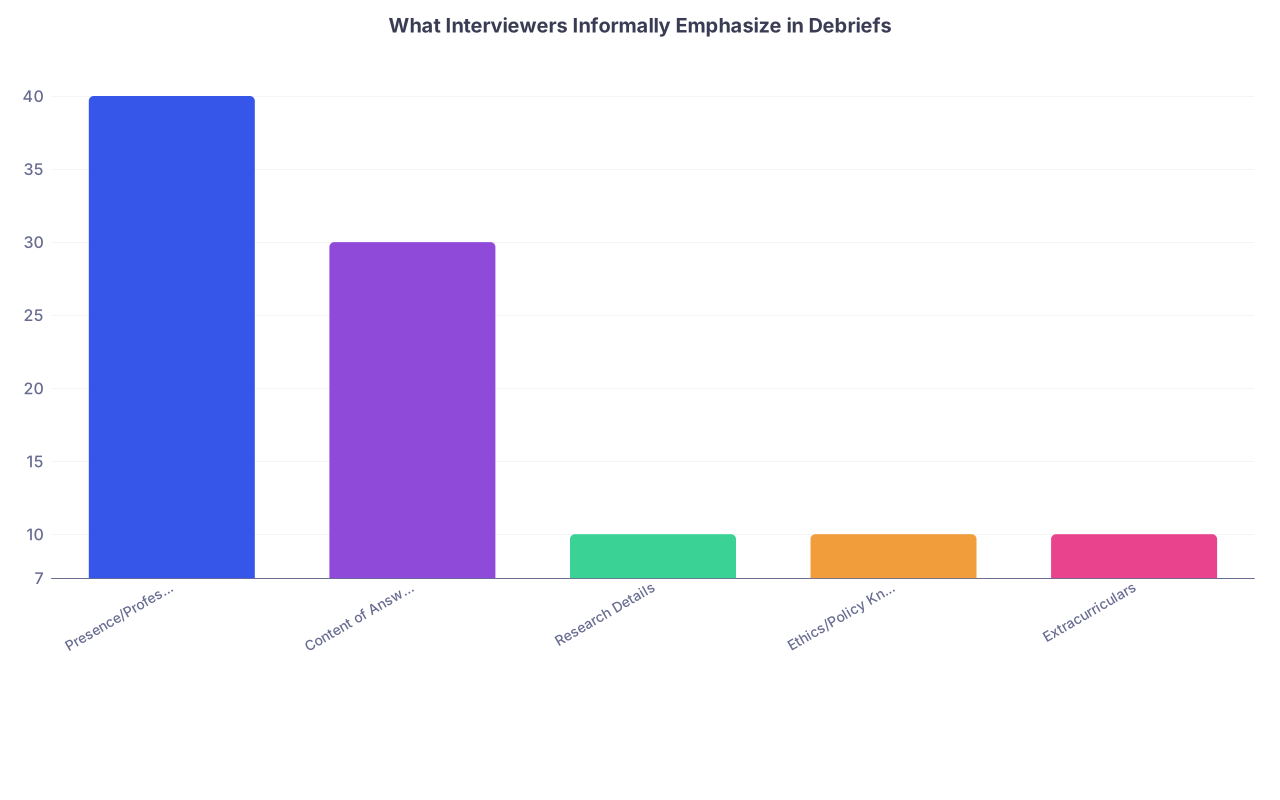
| Category | Value |
|---|---|
| Presence/Professionalism | 40 |
| Content of Answers | 30 |
| Research Details | 10 |
| Ethics/Policy Knowledge | 10 |
| Extracurriculars | 10 |
Those numbers aren’t official. But they’re pretty close to how much time and energy people actually spend talking about each category behind closed doors.
Fixing Common First-60-Second Mistakes (Without Becoming a Robot)
You’re not trying to become a different person. You’re dialing back the noise that gets in the way of who you actually are.
11. If You’re Naturally Shy or Quiet
You can still make an excellent impression. I’ve seen quiet applicants ranked at the very top.
What you must do in that first minute:
- Make your first sentence 10–20% louder than feels natural. What feels loud to you is usually “normal” to them.
- Commit to eye contact for at least one full sentence at a time. Don’t dart away every half-second.
- Use a small, genuine smile when greeting. Not a grin. Just enough to soften your face.
Interviewers will often say, “A bit reserved, but very thoughtful and kind.” That’s fine. That gets you in.
12. If You’re Naturally High-Energy or Talkative
This group gets dinged more than they think.
You walk in big, talk fast, answer before the question is done. Some faculty love that. Many do not.
In that first 60 seconds:
- Slow your walking speed down a notch.
- Wait half a beat before answering their first question. Literally count “one” in your head before speaking.
- Keep your gestures smaller. Don’t knock over the water cup 20 seconds in. Yes, I’ve seen it.
The best high-energy applicants learn to contain it just enough that faculty think: “Great energy, but controlled. Patients will respond well to them.”
The Virtual Interview Wildcard
Online interviews changed the first 60 seconds more than anything else in the last decade. And many applicants still treat them like casual Zoom calls. Mistake.
Here’s exactly what faculty mentally flag in the first screen view:
- Background: Is it neutral and non-distracting, or are there unmade beds, posters, or roommates?
- Lighting: Are you a silhouette, or can they actually see your face?
- Eye line: Are you looking at your second monitor, your phone, or them?
If your lighting is terrible or your angle is weird, they might not say it out loud. But the impression is: “Did not take this seriously enough to test their setup.”
You’re not designing a studio. You’re removing barriers:
Neutral wall. Light in front of your face, not behind. Camera at eye level. That’s it.

| Step | Description |
|---|---|
| Step 1 | Interviewer opens room |
| Step 2 | Immediate visual impression |
| Step 3 | Greeting & name exchange |
| Step 4 | Seating/settling in |
| Step 5 | First small talk or opener |
| Step 6 | Interviewer forms initial bucket |
That “bucket” is exactly what you think it is: strong positive, neutral/undecided, or mild negative. They can move you later, but it takes effort.
FAQs
1. Can a bad first 60 seconds actually ruin a strong interview?
It can, but usually what happens is more subtle: a bad first minute makes the interviewer interpret everything else through a skeptical lens. If you start awkwardly and never really settle, they’ll say things like “seemed anxious throughout,” “not sure about maturity,” even if your actual answers were good. You can recover from a shaky first 10–15 seconds if you stabilize quickly. Staying awkward for the first third of the interview is where damage really sticks.
2. Should I tell them I’m nervous at the start?
A brief, human acknowledgment can be fine: “I’m a little nervous, but really excited to be here.” Then move on. What hurts you is turning it into a recurring theme—apologizing repeatedly, joking about how awkward you are, or making your anxiety the main character. Interviewers expect some nerves. They’re judging whether you can function with them.
3. How formal should my greeting be?
Err 10% more formal than your instinct. Use “Dr. [Last Name]” unless they explicitly say, “Please call me [First Name].” Thanking them for their time once at the beginning is appropriate; pouring on excessive flattery or sounding scripted is not. Think professional colleague in training, not fan meeting a celebrity.
4. What if something goes wrong technically in a virtual interview?
Two priorities: stay calm and be concise. If audio or video glitches, say clearly, “It seems my audio cut out for a moment—can you hear me now?” Fix what you can quickly. If it’s a larger issue, one simple apology and a straightforward plan (“I’m going to rejoin the call from my phone; this should take less than a minute”) shows you’re solution-oriented, not flustered. That response can actually help you if you handle it smoothly.
5. How much should I mirror the interviewer’s style or energy?
Light mirroring is natural and can help. If they’re soft-spoken and measured, you don’t want to come in like a game-show host. If they’re enthusiastic and informal, you can relax a bit. But do not contort yourself into a different person. The goal in the first 60 seconds is to present a stable, professional version of you that can flex slightly to the room—not to perform a character.
Two things to carry into your next interview.
First: the first 60 seconds are not about being impressive. They’re about proving you’re a stable, professional adult who can walk into a room, greet another human, and handle mild stress without falling apart.
Second: once you control that first minute—your entrance, your greeting, your presence—the rest of the interview gets easier. You’re no longer fighting a bad first impression. You’re just filling in the details of a story that already starts with: “Yes, I can see this person as a future colleague.”