
Most applicants do not get rejected for what they say. They get rejected for how they sit, look, and react while they say it.
You can have a 520 MCAT and a CV loaded with research, but if your body language screams “I would rather be anywhere else” or “I am better than this place,” an experienced interviewer will pick up on it in the first five minutes. And they will remember it.
I have watched plenty of capable premeds sabotage themselves in exactly this way. Not because they were actually arrogant or disengaged, but because their physical habits under stress sent the wrong signal.
Let me walk you through the specific body language mistakes that make you look arrogant, bored, or checked out in medical school and premed interviews—and how to avoid them before an interviewer quietly downgrades you.
Mistake #1: The “I’m Doing You a Favor” Posture
Bad posture in interviews is not about slouching vs. sitting up straight. It is about where your posture places you in the power dynamic.
Three common posture patterns that read as arrogant or disengaged:
The Lean-Back Throne
You sit far back in the chair, torso reclined, legs stretched out, maybe one ankle on the opposite knee. Relaxed? Sure. In a physician’s lounge? Maybe appropriate. In an interview? This can read as “I am in control here” or “I do not care enough to lean in.”The Chair-Ownership Sprawl
Elbows way out, legs wide, taking up more space than is natural for the chair. This is textbook dominance behavior. Against a stressed M1 classmate, maybe that works. Against a seasoned faculty interviewer? It just looks immature.The Slumped-Defensive Hybrid
Pelvis slid forward, back curved, head tilted up to look at the interviewer under your eyelids. It combines disengagement (slump) and resentment (head tilt, chin up). I have seen this when applicants feel interrogated. It does not help them.
What reads better:
- Sit all the way back in the chair, but angle your torso slightly forward when speaking or listening.
- Feet flat on the floor or crossed at the ankles, not sprawled.
- Shoulders relaxed but not collapsed inward.
You are aiming for “engaged professional conversation,” not “watching Netflix on a couch” or “CEO in a power meeting.”
If you naturally lean back when thinking, fine—but in an interview, anchor your default at neutral-upright. Tiny shift forward when you are listening closely or making an important point. That subtle lean alone often distinguishes “interested” from “indifferent.”
Mistake #2: The Dead Face and the Bored Eyes
If your face goes blank when you are nervous, read this twice. A flat affect in an interview is lethal.
Here is what interviewers often interpret when they see:
- Minimal expression
- Little to no eyebrow movement
- Eyes that do not light up at anything
They think:
- “This person seems disinterested.”
- “Hard to read. Will patients find them cold?”
- “Do they even want to be here?”
They might not say that to your face. But they will say it in the committee room.
Common errors:
- The “clinical mask” – You think looking serious makes you look professional. Instead, you just look emotionally unavailable.
- The “processing face” – You look blank because you are thinking hard. The interviewer cannot see the thought. They only see the blankness.
- The “I am tired” stare – Understandable during interview season. Still damaging.
You do not need to beam constantly. But you must show visible engagement.
How to fix it:
- Lighten your resting expression by a few degrees. Slight upward curve at the corners of your mouth, not a full smile.
- Use small, genuine reactions: brief nods when you understand, a short amused smile when appropriate, eyebrows slightly raised when something really interests you.
- When you talk about something meaningful (a patient, a service experience, a challenge), let that show physically. If you care, but your face stays frozen, the interviewer only sees the freeze.
If you are not sure how you look, record yourself answering 3–4 standard questions and watch it at 1.5x speed. At that speed, flat affect is painfully obvious.
Mistake #3: Avoidant or Dominant Eye Contact
Eye contact issues are one of the fastest paths to “arrogant” or “disengaged” labels.
Two extremes cause trouble:
Avoidant gaze
You frequently glance at the floor, the wall, the door, your hands, your portfolio—anywhere except the person in front of you.This often reads as:
- Disinterest (“they keep looking away when I talk”)
- Dishonesty (“they looked down when I asked about that GPA dip”)
- Lack of confidence
Dominant/staring gaze
You lock onto the interviewer’s eyes and almost never look away, or you hold eye contact too long during challenging questions. This can cross into confrontational.This often reads as:
- Aggressive
- Overly intense
- “Trying to win” the interaction
Interviewers are not counting your seconds of eye contact. They are reading comfort level and respect.
Aim for:
- Eye contact about 60–70% of the time when you are speaking.
- When you break eye contact, look briefly to the side or down, then back. Not a long drift around the room.
- If it is an MMI or panel, split your eye contact. Address the person who asked the question, then briefly include the others with short glances as you answer.
Watch for this specific red flag: you break eye contact precisely when questions get more personal or challenging. That pattern is memorable, and not in a good way.
Mistake #4: Fidgeting That Signals “I Want Out”
Fidgeting does not just say “I am nervous.” Often, it says “I am trying to escape this moment.”
The problem is not one movement. It is the repetition and speed.
Students underestimate how distracting this can be:
- Spinning a pen
- Clicking a pen (yes, people still do this in interviews)
- Tapping feet or bouncing knees
- Constantly adjusting glasses or jewelry
- Cracking knuckles or stretching fingers repeatedly
- Touching your face every few seconds
What this looks like from the interviewer’s chair: you cannot settle. You do not appear grounded. You might be impatient to leave.
Those behaviors are habits, not character flaws. But the committee does not write “likely has a leg-bounce habit from exam stress.” They write “seemed anxious and disengaged.”
Reduce this risk:
- Do not bring objects you are tempted to play with. No fidget toys, no clicky pens. Use a smooth pen if you must take notes.
- Plant your feet. Literally. Both feet flat, lightly pressing into the floor. This alone can reduce leg bouncing.
- Keep your hands either resting lightly on your lap or on the armrests, fingers relaxed. If you gesture naturally while speaking, that is fine. As long as the gesture matches your words and is not constant motion.
If you are a chronic fidgeter, rehearse answers while sitting on video and consciously practice stillness between sentences. Train your baseline.
Mistake #5: Closed-Off, Defensive Arm and Hand Positions
The classic mistake: crossed arms. Everyone has heard it is “bad,” yet I still see it in interviews.
Here is the nuance: crossed arms in real life can mean you are cold or self-soothing. In an interview, the default interpretation is defensive. That is not the frame you want as a future physician.
Other hand/arm behaviors that read as arrogant or disengaged:
- Hands shoved deep into pockets (if standing during a group activity or tour)
- Hands behind your head while seated (lean-back dominance pose)
- Palms down “chopping” motions while explaining something (comes across as lecturing, not discussing)
- Pointing fingers at the interviewer or gesturing directly into their space
Aim for open, calm, collaborative.
Better alternatives:
- Hands lightly resting on your legs or the table, palms usually facing in or slightly up.
- Natural, contained gestures that stay within your own body frame (chest width).
- If standing, hands loosely together in front at waist level or calmly at your sides. No “arms crossed barrier.”
One subtle arrogance signal: steepling your fingers (tips touching, palms apart) while explaining something. Some coaches actually tell students to do this to look confident. In medicine? With a 22-year-old premed talking to a professor who has been practicing longer than you have been alive? It can look like imitation authority. Avoid it.
Mistake #6: Bad Timing and Misaligned Nonverbal Reactions
Your words and your body have to tell the same story. When they do not, interviewers trust the body.
Here is where applicants go wrong:
- Smiling when describing a serious or painful event: a patient death, a family hardship, a mental health struggle. The mismatch reads as insincere or emotionally off.
- Staying expressionless when describing something that supposedly excites you (your community work, your future in medicine). That reads as rehearsed or hollow.
- Laughing reflexively when you are uncomfortable, including after tough questions about ethics or professionalism. This is common, and it does not play well.
I have seen applicants talk about being placed on academic probation while giving a small laugh and shrugging. Their words said, “I learned a lot from that experience.” Their body said, “I do not take this seriously.”
Practice aligning:
- When the content is serious, let your tone drop a bit, your pace slow, your expression soften. Still steady, but respectful.
- When the content is hopeful or energizing, allow more brightness in your voice and face. You are not performing; you are just letting your genuine reaction be visible.
If you are not sure, record three stories: one challenge, one achievement, one meaningful patient or service experience. Watch purely for whether your facial expression and posture fit the story you are telling.
Mistake #7: The “Checking Out” Signals During Group or MMI
Medical school interviews often include MMIs, group activities, tours, or student panels. Many applicants make a dangerous assumption: “If I am not formally being asked a question, I can relax my body language.”
Wrong. Some of the worst impressions are formed during the “unstructured” moments.
Behaviors that read as disengaged or arrogant:
- In MMIs, you stop listening to your partner as soon as you are done talking. Eyes wander, posture collapses, minimal response to what they say.
- During group scenarios, you lean back, cross your arms, and only jump in to correct others. Or you visibly disengage when the scenario does not center on you.
- On tours or student panels, you stare at your phone, or your eyes glaze over and you look at the ceiling while others ask questions.
A lot of schools specifically ask student interviewers and facilitators, “How did they seem in the group portion?” You do not see that checkbox. But it is there.
Treat every human interaction on interview day as part of the interview: shuttle driver, student tour guide, lunch host, the person checking you in.
At minimum:
- Maintain that same neutral-engaged posture even when someone else is speaking.
- Face the person talking. Angle your torso, not just your head.
- Show you are tracking: small nods, brief eye contact, a few fitting follow-up questions.
You are not putting on a show. You are proving you can stay present in a team environment. That matters far more in medicine than reciting a memorized answer about empathy.
Mistake #8: Overcompensating and Looking Fake
Once students realize body language matters, they sometimes swing too far. Over-smiling. Over-nodding. Over-gesturing.
That is just as damaging.
Common overcorrections:
- Smiling constantly, even while listening to neutral or serious content. This can read as ingratiating or inauthentic.
- Aggressive nodding: head bobbing quickly every few seconds while the interviewer speaks. It looks like you are trying to force them to like you.
- Exaggerated gestures: big arm movements, wide-open hands, leaning way forward on every sentence. That comes off as sales-y or manic.
The goal is not to “perform” good body language. The goal is to remove distractions that could be misread.
A simple rule: your nonverbal behavior should be about 15–20% more expressive than your normal calm conversation, not 200%. Slightly more open. Slightly more energized. Not theatrical.
If you feel like you are “acting,” you probably are. Dial it back.
Mistake #9: Ignoring Cultural and Contextual Expectations
There are cultural differences in eye contact, personal space, gesturing, and expression. You know that. Your interviewer knows that. But here is the harsh part: they still subconsciously expect a certain professional baseline.
You are not required to abandon your culture. But you need to translate it into a version that does not hurt your evaluation.
For example:
- If you were raised to avoid prolonged direct eye contact with elders, you do not need to stare. But you do need to look up regularly enough that they feel you are engaged.
- If your normal conversational distance is closer or farther than typical in the U.S., watch how others are sitting and match that approximate spacing.
- If your natural expression is very reserved, you do not need to become extroverted. But you should push yourself one small step more visible in your reactions when you care about something.
Do not rely on “they will understand my background.” They might. Or they might just think, “Quiet, disengaged, hard to read.” Do not let your habits be misinterpreted when you can adjust them slightly in this specific high-stakes context.
Mistake #10: Not Practicing Under Realistic Stress
You will not see your worst body language in a calm bedroom video. You will see it under stress.
The error: students over-practice content and under-practice presence. They drill answers to “Why medicine?” but never put themselves in a mock interview where someone interrupts, pushes back, or asks a question from left field while another person is scribbling notes.
Then on interview day, their body reacts. They lean back. They cross their arms. They stare at their hands. They do not even realize it.
Fix it properly:
- Do at least one mock interview with a stranger or a less familiar mentor, not your best friend. The slight discomfort helps reveal your real habits.
- Ask them specifically: “At any point did I seem arrogant, checked out, or defensive physically? Show me exactly when.”
- Record at least one of those mocks. Watch it on double speed focusing only on three things: posture, hands, eyes. Do not listen to your words at first.
The content of your answers you can tweak in a week. Your body language under stress takes longer. Start earlier.
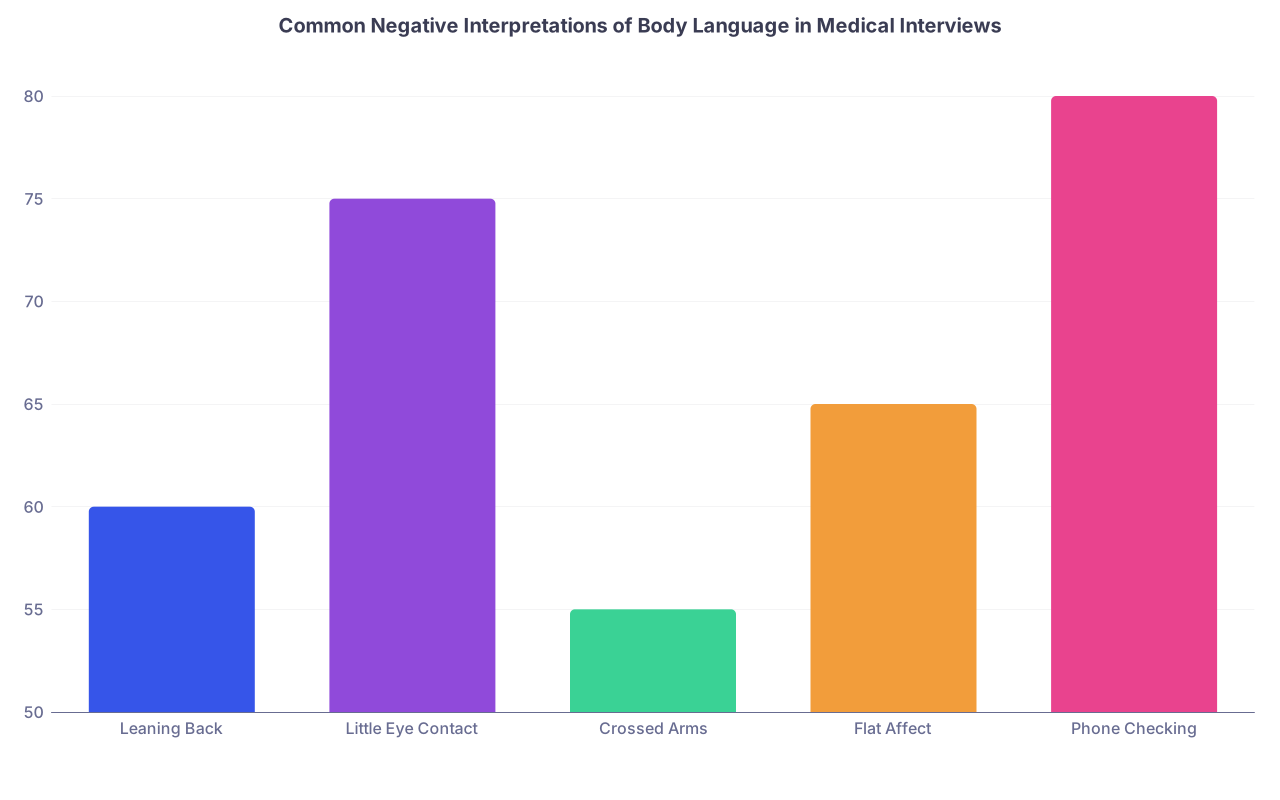
| Category | Value |
|---|---|
| Leaning Back | 60 |
| Little Eye Contact | 75 |
| Crossed Arms | 55 |
| Flat Affect | 65 |
| Phone Checking | 80 |
A Quick Reference: What Interviewers Actually See
Here is how typical behaviors get translated in an interviewer’s mind. You need to understand their lens, not your intention.
| Your Behavior | Likely Interpretation |
|---|---|
| Leaned back, ankle on knee | Arrogant, overly casual |
| Eyes frequently down or away | Disengaged, insecure, possibly evasive |
| Arms crossed most of the time | Defensive, closed off |
| Minimal facial expression | Cold, uninterested |
| Constant fidgeting (pen, foot) | Anxious, wants to escape |
You might mean none of those things. Interviewers do not know that. They only know what you show them.

| Step | Description |
|---|---|
| Step 1 | Record Yourself Answering Questions |
| Step 2 | Identify Problem Habits |
| Step 3 | Adjust Posture, Hands, Eye Contact |
| Step 4 | Do Mock Interview With Feedback |
| Step 5 | Refine Specific Triggers Under Stress |
| Step 6 | Maintain Calm, Open Presence On Interview Day |
The Bottom Line
You are not just evaluated on what you say in an interview. You are evaluated on whether your body matches the kind of physician they want to unleash on patients, colleagues, and students.
If you remember nothing else:
- Do not sit, stare, or fidget in ways that suggest arrogance or boredom. Neutral, open, and slightly forward-leaning beats relaxed dominance or collapsed disengagement every time.
- Make your face, eyes, and posture show that you actually care. Flat affect, avoidant eyes, and closed-off arms will quietly sink an otherwise strong application.
You worked too hard to let a slouched seat and a blank stare undo it. Fix the signals now, before an interviewer decides you are not someone they want in their hospital corridors at 3 a.m.