
It is 9:12 a.m. You are three minutes into your first medical school interview. Your suit fits, your MCAT score is solid, your research sounds impressive. Then the interviewer leans back and asks the question you knew was coming:
“So… why medicine?”
You launch into your answer. You hit compassion. You mention helping people. You nod to science. You talk for maybe 90 seconds and feel like you did fine.
On the other side of the table, the interviewer is thinking:
“I’ve heard this exact answer thirty times this week.”
Your file still looks good. But you just slid quietly from “memorable” to “generic.” And generic applicants do not get people fighting for them in committee.
This is where strong applicants sink themselves. Not with terrible answers. With safe, average, forgettable ones.
Let me walk you through the common “Why medicine?” responses that quietly damage otherwise strong applications—and how to avoid sounding like everyone else who will not be accepted.
The Single Biggest Mistake: Answering Like This Is a Normal Question
You already know “Why medicine?” is coming. That is the trap.
Because you expect it, you treat it like a box to check, not the fulcrum of the entire interview. You memorize a neat 2‑minute story and repeat it like a script. It sounds polished. And dead.
Interviewers are not just listening to what you say. They are listening for:
- Does this answer sound like 90% of other applicants?
- Does it show the applicant actually understands what physicians do?
- Does it reveal anything that explains why this person should be in medicine, not just “why medicine is good”?
- Does the answer align with the rest of the file, or does it feel tacked on?
Most “Why medicine?” answers fail on at least two of those.
So let’s get specific about the patterns that sink you.
Mistake 1: The “I Want to Help People” Non‑Answer
You know this one. You have probably said it.
“I want to help people. I have always been drawn to service and supporting others, and medicine will let me do that.”
On the surface, that sounds fine. Noble. Professional. Uncontroversial.
That is the problem. It could come from literally anyone. Your interviewer could paste that sentence into 80% of their notes without changing a word.
Here is why this response quietly kills you:
It does not differentiate medicine from any other helping profession
Nursing, social work, physical therapy, public health, teaching, EMS, psychology—every one of those careers “helps people.” If you cannot articulate why physician and not just healthcare, you sound like you picked medicine because it pays more and has prestige, and you are hiding that behind “helping people.”It suggests you have not wrestled with the costs
“Helping people” does not explain why you are willing to absorb years of training, 80‑hour weeks, night call, emotional burnout, litigation risk, and constant system dysfunction. Interviewers know the job is messy. If your answer sounds naïve, they will assume you are not ready.It is flat. Zero story. Zero evidence.
Anyone can claim they like helping others. Competitive applicants demonstrate it through very specific experiences that changed them, clarified their thinking, or forced a decision.
How to fix it:
Do not ban the phrase “help people.” Just never let it stand alone. Anchor it in a specific, concrete “this is where that became real for me” moment and then tie that directly to the physician’s unique role.
Bad:
“I want to help people and combine my love of science with service.”
Better:
“I thought I wanted to ‘help people’ in a vague way until I worked on the inpatient psych unit as a tech. One night a patient was discharged who everyone knew was going back to an unsafe situation. I could support them for a 12‑hour shift. The attending was the only person in that building who could change the actual treatment plan, coordinate with social work, and adjust meds based on a nuanced understanding of both biology and behavior. That combination of long‑term responsibility for a life and high‑level problem‑solving is what pulled me specifically toward the physician role.”
See the difference? Helping people is the starting point, not the answer.
Mistake 2: The Trauma Dump / “Tragic Origin Story” That Goes Nowhere
Another common pattern: the dramatic personal story that is all emotion and zero reflection.
“My grandmother died of cancer when I was 12 and that experience inspired me to pursue medicine.”
You describe the diagnosis, the hospitalizations, the grief. You may even tear up. The story is moving. The interviewer nods.
Then they write in their notes: “Personal illness in family. Wants to help like doctors helped them. Standard.”
The problem is not that your story is emotional or real. The problem is that you stop at “this happened to me” and never reach “and this is what it taught me about the physician’s role and why that role fits who I am and how I work.”
Two specific errors I see constantly:
The story is all about you as a victim, not you as an emerging professional
If the main point is “this bad thing happened and medicine comforted me,” you are explaining why you like doctors, not why you should become one.There is no transition from personal experience to sustained, adult engagement with healthcare
You go straight from “my parent had a stroke” to “so I chose premed.” Interviewers are asking themselves: “And what did you do with that motivation, concretely, over years?”
You do not get points just for surviving hard things. You get points for what those experiences pushed you to do and understand.
How to fix it:
If you use a personal or family illness story—and it can be powerful if done properly—follow a strict pattern:
Event → Insight about medicine → Action over time → Fit with who you are
Example:
“Watching my younger brother’s seizures in the ED at 3 a.m. made medicine personal. At 16 I only saw the terror. But over multiple admissions I started noticing the quiet logistics: the attending coordinating neurology, the resident explaining options in plain language, the nurse catching a subtle med error. That experience pushed me to volunteer in that same hospital for three years, then work as an EMT to see what acute care really feels like for providers. What stuck with me was how often the physician was the person holding ultimate responsibility when there were no good options. That level of accountability and longitudinal thinking fits the way I approach problems in every area of my life—from leading my EMT crew to running a student org where I answer for outcomes, not just tasks.”
If your “tragic origin story” does not lead clearly into adult choices and sustained exposure, it just sounds like trauma being used as a justification.
Mistake 3: The “I Love Science” Answer That Could Be an MD, PhD, or Engineer
Another quiet killer: the purely academic or “I just love science” answer.
“I want to go into medicine because I love biology and I am fascinated by how the human body works.”
Fine as a first sentence. Fatal as a full answer.
Here is why this version weakens you:
It does not explain why you want to practice, not just study
If you talk only about mechanisms and pathways, you sound like a future PhD. Med schools need physicians who can sit with suffering and ambiguity, not just recite signaling cascades.It ignores the human cost of tying your scientific interest to a clinical role
You can explore the sodium‑potassium pump without being paged at 2 a.m. to declare someone dead. If your motivation is purely intellectual, interviewers question your staying power.It usually feels disconnected from your clinical exposure
Many students with this answer have done research but limited real patient interaction. Interviewers notice that mismatch immediately.
How to fix it:
Tie the science to the human stakes and to your real experiences:
“Research in Dr. X’s lab got me obsessed with how a single base‑pair change in CFTR can alter an entire organ system. But what actually pushed me toward medicine rather than a PhD was working with adults with cystic fibrosis in clinic. The science explained their disease. The physician translated that science into moment‑to‑moment decisions about antibiotics, transplant timing, and even fertility counseling. What appeals to me is not just discovering mechanisms, but being the person who uses that knowledge under pressure, in front of a real human being who has to live with the consequences.”
Science is necessary. It is not sufficient. Your answer must show you understand medicine as applied science under ethical and emotional pressure.
Mistake 4: The “Shadowing Highlight Reel” With No Inner Life
This one sounds like:
“I shadowed Dr. Smith, a cardiologist, and I was inspired watching him save a patient’s life during a STEMI. That experience showed me that medicine is for me.”
You are describing scenes you observed. You are not explaining what was happening in your own head beyond “It was exciting.”
There are two big problems here:
You are just narrating. Not processing.
Interviewers do not need a play‑by‑play of someone else’s practice. They want to know what about the nature of the work fit or conflicted with your personality, values, and strengths.You cherry‑pick only dramatic, heroic moments
Shadowing is 95% mundane: clinic paperwork, insurance fights, annoyed patients. If your answer only features life‑or‑death action, you sound like you want the TV version of medicine, not the real thing.
How to fix it:
For every shadowing story, force yourself to answer three questions:
- What about the physician’s role in that moment actually appealed to you?
- What did you see that you did not like or that worried you?
- How did that experience push you to seek more responsibility, not just more observation?
Example:
“Shadowing in the ED, the most educational moment was not a dramatic trauma. It was a patient with vague abdominal pain that could have been 20 different things. Watching the attending reason through incomplete data, manage the patient’s anxiety, and communicate clearly with a tired resident and irritated nurse was eye‑opening. I realized I am drawn to that kind of messy, probabilistic decision‑making under time pressure. At the same time, seeing how many social issues—homelessness, addiction, lack of follow‑up—limited what we could offer pushed me to work in a free clinic, where I could actually participate in that long‑term problem‑solving rather than just observe.”
Stop giving highlight reels. Start giving evidence that your brain was actually on during those experiences.
Mistake 5: The Generic “Combination Answer” That Sounds Like a Brochure
Many applicants try to be comprehensive and end up sounding like an ad for the AAMC website:
“I want to go into medicine because I love science, I want to help people, and I value lifelong learning and teamwork.”
This sounds polished. Harmless. Safe.
It is also content‑free.
Here is what it tells an interviewer:
- You have read common‑sense advice.
- You know the buzzwords.
- You have not actually done the harder work of committing to one or two authentic, specific reasons that are grounded in your real experiences.
The quiet damage this does: It makes you sound replaceable. If your answer could be swapped with any other applicant’s and still make perfect sense, you are in trouble.
How to fix it:
Pick 1–2 core themes and go deep instead of skimming five surface‑level ones.
Maybe for you it is:
- Long‑term responsibility and continuity with patients, and
- Complex problem‑solving at the intersection of biology and social context.
Or:
- Advocacy for underserved communities, and
- Being comfortable making high‑stakes decisions.
Whatever your themes are, they must connect directly to what you have already done, not what you hope to do someday.
Mistake 6: Dodging the “Why Physician vs. Other Roles?” Question
Sometimes this is explicit:
“Why a physician and not a PA, NP, or nurse?”
More often, it is implicit: “Does this person understand what physicians actually do that is distinct?”
A surprisingly large number of applicants cannot answer this without sounding condescending or clueless.
Common bad answers:
- “Physicians have more knowledge.” (Makes you sound arrogant and dismissive of the rest of the team.)
- “Physicians are the leaders.” (Same problem, plus outdated understanding of team‑based care.)
- “Physicians can do more.” (Vague and shallow.)
If your “Why medicine” answer never touches why you chose the physician role specifically, you are leaving a hole in your story.
How to fix it:
Be precise and respectful. Focus on:
- Ultimate responsibility for diagnosis and treatment planning
- Depth and breadth of training in pathophysiology
- The role in managing diagnostic uncertainty and risk
- The ability to shape systems (policy, research, leadership) from that vantage point
Example:
“I seriously considered PA school after working with an excellent ED PA. What pulled me toward the physician path was the desire to be the person primarily responsible for integrating all the data—labs, imaging, history, social factors—into a final diagnostic and management plan, especially when the answer is not obvious. I want that level of training in pathophysiology and that degree of long‑term responsibility for clinical decisions, while still working closely with and learning from the rest of the team.”
That is honest. Specific. And it shows you have actually thought about the distinction.
Mistake 7: Over‑Rehearsed, Over‑Polished, Under‑Human
I have watched interviewers tune out halfway through a “perfect” answer.
The content is technically fine. But the delivery is memorized to death. Same cadence, same phrases, same fake smile every time.
Two issues here:
It feels inauthentic, even if everything you say is true
Interviewers are professional BS detectors. If it sounds like you pressed play on an internal recording, they assume you will present a persona, not a person, for the rest of the day.You cannot adapt to follow‑up questions
When someone interrupts your script and asks, “What part of that experience actually scared you?” or “What worried you about medicine after that?” you freeze. Because you only rehearsed the “right” version.
How to fix it:
Prepare components, not paragraphs. Know:
- The 1–2 key experiences you will draw from
- The 2–3 core themes you want those experiences to illustrate
- One sentence that ties it together at the end
Then practice answering in different ways. Short version. Long version. Casual version. Slightly more structured version.
If your wording never changes between practice and interview day, you over‑rehearsed. Aim to sound like you have told this story before, but you are still actually thinking as you tell it.
Mistake 8: Ignoring the Dark Side of Medicine Entirely
Some applicants go full Hallmark Channel:
“Medicine is the noblest profession. Doctors save lives every day. I want to be part of that and bring hope to patients and families.”
Interviewers have just come from a morning of arguing with insurance, telling a 36‑year‑old she has metastatic cancer, and filling out useless EMR templates.
If your answer has no acknowledgment that medicine is grueling, morally messy, and structurally broken in places, you sound naïve at best and delusional at worst.
No one expects you to be jaded as a 21‑year‑old. But they do expect evidence that you:
- Have seen some of the uglier realities
- Did not run from them
- Still chose medicine, eyes open
How to fix it:
Weave in one explicit nod to the hard parts, grounded in what you have actually seen.
Example:
“Working night shifts as a scribe, I have seen how much of a physician’s time is swallowed by documentation, arguing with insurers, and dealing with social issues medicine alone cannot fix. There were nights when that felt discouraging. What kept me coming back was seeing attendings who still found meaning in teaching residents, being honest with families about bad news, and pushing the system from the inside—even when it was exhausting. That combination of realism and persistence is what I want for myself, and why I still choose medicine knowing those challenges.”
You are not applying to be inspired by medicine. You are applying to practice in it.
Mistake 9: A “Why Medicine” That Does Not Match the Rest of Your Application
Some people give a beautiful answer that might as well belong to another applicant.
They talk about commitment to underserved communities… with no longitudinal, meaningful service on their CV.
They emphasize a passion for research… with one summer in a lab and no posters, no letters, nothing.
They claim to love primary care continuity… with zero primary care shadowing and only an ICU experience.
Interviewers absolutely notice this mismatch. In committee, you will hear: “Their story sounds good, but I do not see evidence of it in the application.”
How to fix it:
Before you finalize your answer, pull up your AMCAS or AACOMAS (or pre‑med CV if earlier in the process). Ask yourself:
“If someone read this application and then heard my answer, would they say, ‘Yes, that tracks’?”
Your “Why medicine” must feel like the natural emotional and intellectual summary of what you have actually done over the last 3–6 years. Not a separate marketing pitch.
Mistake 10: Forgetting That “Why Medicine” Is Also “Why You in Medicine”
One last, subtle problem: you talk all about why medicine is great, and not at all about what you bring that the field actually needs.
If your entire answer is:
- what inspired you
- what you like
- what you want to get out of medicine
…you are missing the part where you explain what medicine gets out of you.
No, you do not need some grandiose “I will cure cancer” statement. But you do need some sense of: “Here is how my temperament/skills/experiences position me to contribute in a specific way.”
Example:
“I am not the loudest person in the room, but I am relentlessly systematic. As an EMT crew chief, that meant being the one who calmly ran through checklists while others reacted emotionally. In shadowing and clinic work, I see that same quiet, structured persistence in good internists who follow problems over years, not days. That is the kind of physician I see myself becoming: thorough, reliable, and willing to sit with complex, chronic issues that do not have quick fixes.”
That is not arrogance. That is giving your interviewer a reason to remember you as more than “Applicant 17, nice kid, strong stats.”
A Quick Reality Check: What Interviewers Actually Hear All Day
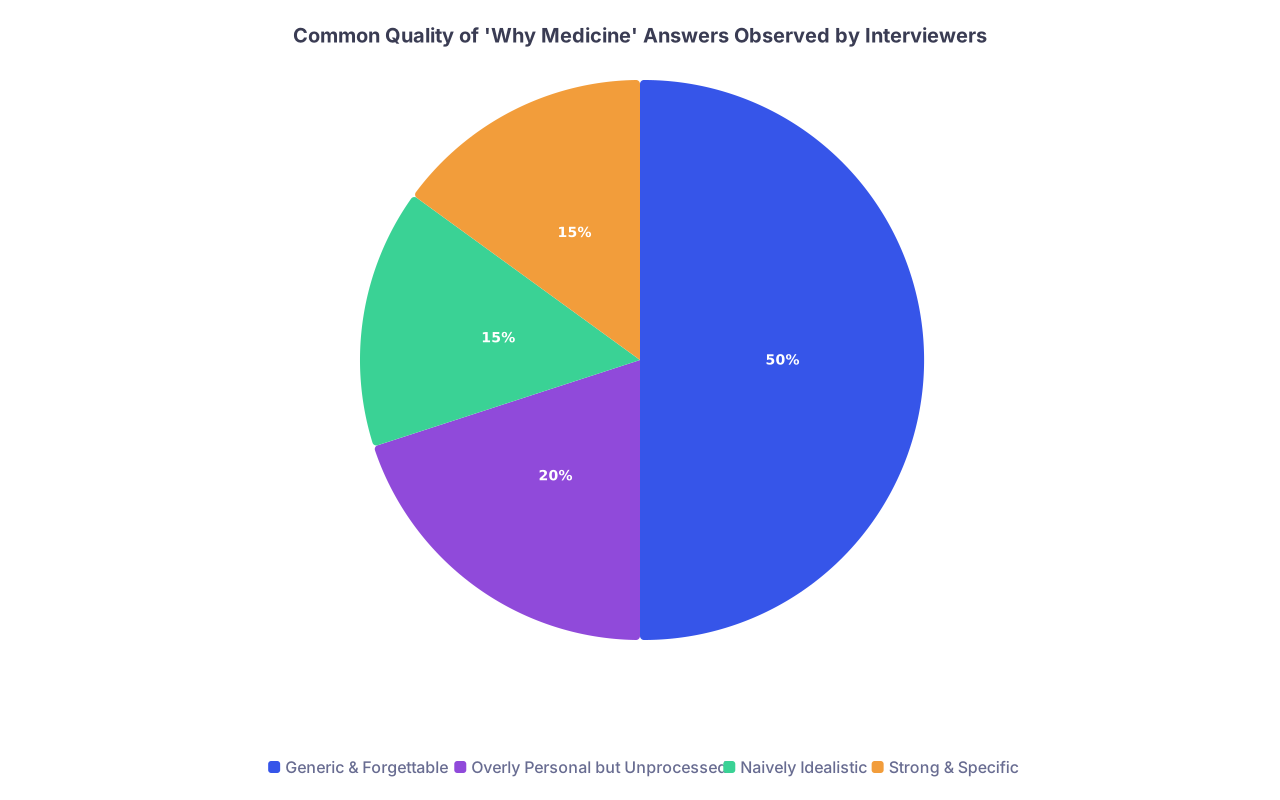
To make this concrete, here is the rough breakdown I have seen from people who sit on admissions:
| Category | Value |
|---|---|
| Generic & Forgettable | 50 |
| Overly Personal but Unprocessed | 20 |
| Naively Idealistic | 15 |
| Strong & Specific | 15 |
Half the answers are generic. A third are emotional but poorly integrated or naive. Maybe 10–15% are truly strong.
Your goal is not perfection. Your goal is to get out of that 85% bucket of “nothing special here.”
What a Strong, Non‑Sinking “Why Medicine” Actually Sounds Like
Let me stitch everything together in one example—not for you to copy, but to dissect.
“Medicine became personal when my father’s heart failure decompensated during my junior year of high school. At first I just remember fear and frustration—no one seemed to explain what was happening or why his meds kept changing.
Over time, sitting in clinic with him, I started noticing the cardiologist’s role differently. She was not just adjusting doses; she was integrating lab trends, imaging, my father’s work as a mechanic, and the realities of our limited insurance into a plan that would actually work. That blend of deep physiology and pragmatic problem‑solving stuck with me.
I did not decide on medicine immediately. I spent two years in undergrad working as an EMT, trying to see if I liked actual patient care when it was 3 a.m., the call was vague, and the system was strained. I learned that I gravitate toward high‑stakes decisions with incomplete information, and I like being the person others look to when things are chaotic.
Shadowing in our local safety‑net hospital, I saw both the best and worst of medicine—clinics overwhelmed, physicians fighting denials, patients coming back sicker because they could not afford follow‑up. It was discouraging, but it also clarified that I want to spend my career at that intersection of biology and structural barriers, probably in cardiology or primary care in a similar setting.
Ultimately, I am choosing the physician role because I want the depth of training and long‑term responsibility to manage complex, chronic disease in patients like my father, not just for a shift or an episode. I know the realities are hard; I have watched physicians on the verge of burnout. But I also see how much impact a thoughtful, persistent doctor can have over years, and that is the kind of work I am willing to commit my life to.”
Is it perfect? No. But it is specific. Coherent with a plausible application. Human. And it avoids every major pitfall we just walked through.
Your Next Step Today
Do this now, not “later when it slows down” (it will not).
Open a blank document and write your current “Why medicine?” answer as you would say it in an interview. No editing. No polishing. Just dump it out.
Then, with a different color font, mark:
- Every sentence that could be said by at least half of applicants (“I want to help people,” “I love science,” “lifelong learning,” etc.).
- Every place you mention an experience without explaining what it changed in your understanding or choices.
- Any claim about what you value that is not backed up by something concrete you have actually done.
If most of your answer lights up, you are in the danger zone.
Your task over the next week: replace every generic phrase with a specific story, insight, or decision from your actual life. Until your “Why medicine” would sound bizarre coming from anyone but you.