Most premeds ruin their interviews the moment they open their mouths to “tell a story” about shadowing.
Not because they are bad people. Because they use bad stories, told badly, that send the wrong message in ten seconds flat.
I’ve watched it happen in real interviews. Students walk in with impressive stats and solid applications. Then they launch into a shadowing anecdote that makes them sound:
- Naive
- Unprofessional
- Unethical
- Or just… boring
And that, not the MCAT score, is what quietly kills their chances.
Let me walk you through the mistakes that make your clinical shadowing stories backfire—and how to avoid sounding like someone no program wants near patients.
1. The “HIPAA Violation on a Platter” Story
This is the fastest way to make an interviewer wince.
You think you’re showing empathy and clinical exposure. What they hear is: “I don’t understand confidentiality and I’m willing to violate it in a high‑stakes interview.”
Common red flags in stories:
- Giving specific ages + diagnoses + locations + timing that clearly identify a patient
- Describing highly sensitive details (sexual assault, reproductive choices, mental health crises, immigration status) with enough context that the patient would recognize themselves
- Talking about “this undocumented patient with HIV who came in at 2 a.m. to [Local Hospital Name]…”
- Using the patient’s first name, even if changed: “I’ll never forget Maria…” (then giving enough detail that Maria would absolutely know)
If your interviewer starts subtly leaning back, crossing their arms, or their eyes harden a bit—that’s probably why.
How to avoid this mistake:
- Strip every story down and ask:
- Could anyone outside that room identify this patient?
- Would the patient be upset if they heard me tell this?
- Change or omit:
- Age (“middle‑aged” instead of “43”)
- Specific location (“a community ED” instead of “St. John’s downtown ED”)
- Exact timing (“last winter” instead of “January 2nd”)
- Rare conditions if they make the story obviously identifying
If your story only works because of all the sensitive detail? It’s a bad story for an interview.
2. The “I Was Basically the Doctor” Exaggeration
Interviewers have a sixth sense for inflated responsibility. You might not even realize you’re doing it. But they do.
Typical problem phrases:
- “We decided to intubate…”
- “I told the family we needed to…”
- “I reassured the patient that…”
- “I knew right away this was sepsis/MI/appendicitis…”
You were a premed, not a co‑attending.
When you take ownership for decisions you did not make, you come across as:
- Unsafe
- Immature
- Unaware of hierarchy and scope of practice
Here’s what an experienced clinician hears when you say, “We decided to take the patient to the OR” from your shadowing:
“I don’t understand how medicine actually works, and I can’t distinguish watching from doing.”
How to avoid this mistake:
Shift the verbs and the credit:
Bad: “I decided the patient needed imaging.”
Better: “The resident explained why they were ordering imaging, and I started to understand how they thought through risk.”
Bad: “I reassured the patient that we’d fix her problem.”
Better: “I watched how the physician reassured the patient. It made me realize how much communication matters, not just the procedure itself.”
The line is simple:
You observed and learned.
They decided and treated.
Stay on your side of that line.
3. The Trauma Spectacle: Using Suffering as Entertainment
Another huge problem: turning someone’s worst day into your dramatic monologue.
Common offenders:
- Graphic trauma descriptions: “His leg was twisted, there was blood everywhere, bone sticking out—”
- Emotional exploitation: “The mother was screaming, the family was collapsing, and I stood there, tears running down my face…”
- Shock value: leading with the most gruesome story from the ED/OR to show how “tough” you are
You might think you’re proving you can “handle” intense medicine. What you’re actually proving is that you’re comfortable centering yourself in other people’s pain.
This is the story that makes interviewers think:
- “Do they see patients as people or content?”
- “Are they chasing drama more than service?”
- “Are they going to be the person oversharing in the workroom or on social media?”
How to avoid this mistake:
- Skip gore. All of it. You do not need the blood to tell the lesson.
- Focus on what you learned about systems, communication, ethics, or your own limitations.
- If the main appeal of the story is “this was wild,” it does not belong in your interview.
Try this test:
If you removed all graphic detail, would the story still be meaningful?
If the answer is no, find a different story.
4. The “Look How Emotional I Am” Performance
Crying alongside a patient does not automatically mean you’re empathetic. Talking about crying in every answer guarantees you sound performative.
Common patterns:
- Every story ends with: “I went home and cried, but it confirmed my desire to be a physician.”
- Over‑emphasizing how you felt vs what the patient needed
- Turning the entire anecdote into a reaction shot of your own feelings
There’s a point where vulnerability crosses into self‑absorption. Interviewers see that line clearly.
No one minds if you felt something powerful. They worry when:
- You seem unstable under stress
- You seem more focused on your own emotional experience than patient care
- You sound like you expect medicine to be about your catharsis
How to avoid this mistake:
- Mention emotion briefly, then move to action and growth:
- “It stayed with me for days” is fine.
- A two‑minute description of your tears is not.
- Emphasize how you processed it: debriefing, reading, asking mentors questions, reflecting on boundaries
- Show that you can feel deeply and still function professionally
You’re not auditioning for a drama series. You’re interviewing to be trusted in crisis.
5. The Boring, Generic “I Saw a Doctor Be Nice” Story
Some stories don’t offend anyone. They just make the interviewer’s brain turn off.
You’ve heard them:
- “I saw how important empathy is.”
- “I realized doctors treat the whole person, not just the disease.”
- “I understood that communication with patients is vital.”
Yes. Obviously. Everyone says this. This is the “Google Docs template” of shadowing stories.
The mistake isn’t that the lesson is wrong. It’s that:
- There’s nothing specific
- There’s no tension, no decision point, no nuance
- You sound like you Googled “good qualities in a doctor” and built a story backwards
Interviewers won’t necessarily penalize you. They’ll just forget you. Which is its own kind of rejection.
How to avoid this mistake:
You need:
- A concrete moment (something specific actually happened)
- A real tension (conflicting priorities, uncertainty, something at stake)
- A clear personal takeaway that isn’t a fortune cookie
Bad:
“I saw a doctor comfort a scared child and realized how important empathy is.”
Better:
“A 6‑year‑old refused a blood draw, and the intern was about to call security for a hold. The attending paused everything, sat on the floor, and explained the procedure using the child’s stuffed animal. They waited an extra 10 minutes, but the kid stopped fighting. That was the first time I saw how slowing down could actually save time and trauma long‑term. I started asking myself: what feels efficient vs what actually works for patients?”
Subtle difference. Night and day impact.
6. The “I’m a Better Person Than Everyone Else” Story
If your shadowing story centers around you being the lone hero who “really cared,” you’ve got a problem.
Red flags:
- “No one else seemed to care about this patient, but I…”
- “The doctor didn’t really listen, but I could tell…”
- “The nurses were too busy, so I stepped in and…”
- Painting yourself as the only moral person in a system full of indifferent staff
Here’s why interviewers hate this:
- You’re trash‑talking the professionals you want to join
- You show a shallow understanding of workload, burnout, and systemic barriers
- You come across as judgmental, not collaborative
In medicine, you need people to trust that you won’t throw them under the bus to make yourself look good.
How to avoid this mistake:
- Do not pass moral judgment on attendings, residents, nurses, techs, etc.
- If you saw something problematic, frame it as:
- Complex
- Context‑dependent
- A prompt for you to ask questions, not deliver verdicts
Better framing:
- “I didn’t understand why the resident seemed rushed with this family, so I asked her about it later. She explained she was covering 20 patients and had already had two code blues that morning. That stuck with me: patients see only one interaction; physicians are juggling dozens. I realized compassion has to include empathy for our colleagues too.”
You can show moral awareness without moral superiority.
7. The “Scope of Practice? Never Heard of It” Error
This one is subtle but deadly: suggesting you did anything even approaching clinical care as a premed when you absolutely shouldn’t have.
Problem claims from shadowing/clinical experiences:
- “I adjusted the oxygen because the patient was short of breath.”
- “I helped change the medication dose.”
- “I recommended starting antibiotics.”
- “I held the retractors so the surgeon could see better” when you were just shadowing with no formal role/training
- Anything that sounds like independent medical judgement or hands‑on intervention beyond very basic tasks (taking vitals under supervision is fine)
You might think this shows initiative. To an interviewer, it shows danger.
How to avoid this mistake:
- Be brutally accurate about your role. If your job was:
- Observing
- Transporting patients
- Stocking supplies
- Taking vitals after training and under supervision
…say that. Nothing more.
- If your story feels boring once you remove the inflated heroics, that means it was never a strong story to begin with.
When in doubt: err on the side of underselling your clinical actions. Overselling can get you mentally red‑flagged.
8. The “Unexamined Bias” Story
This one is sneaky. You tell a story that unintentionally broadcasts bias you did not mean to reveal.
Patterns I’ve heard:
- Talking about a patient experiencing homelessness in a way that centers stereotypes about “noncompliance” and “poor choices”
- Describing a patient’s body size with disgust or judgment baked into your tone
- Using “non‑English speaking” as shorthand for “difficult”
- Implying that patients who use substances are less deserving of care
- Talking about “those people” with chronic pain, Medicaid, etc.
You aren’t trying to be cruel. But that’s exactly the point. It shows your default setting.
How to avoid this mistake:
- Read your story as if you were the patient or from that community. Would you feel respected? Or dissected?
- Strip judgmental language. Replace:
- “Noncompliant” → “struggled to follow the treatment plan”
- “Difficult patient” → “a patient whose needs were hard for the team to meet”
- Make your learning explicit:
- “This experience forced me to confront my assumptions about X…”
Interviewers know you aren’t perfectly bias‑free. They just want evidence that you notice your own blind spots and work on them.
9. The Rambling, Unstructured Monologue
Even a good story can die if you tell it like this:
- You start with unnecessary backstory (“So I was in my second summer, and because of my friend’s cousin I got this opportunity at…”).
- You jump timelines: “Before that… oh, and later I realized…”
- You never actually answer the question they asked.
The mistake: treating the interview like a casual conversation instead of a professional evaluation where time is limited and attention is expensive.
Here’s how that sounds in the interviewer’s head:
“If this is how they talk with 2 people in a quiet room, what happens during handoffs or family meetings?”
How to avoid this mistake:
Use a simple structure and stick to it:
- One‑sentence setup: where/role/context
- What actually happened (the moment)
- What you did/thought/asked
- What you learned and how it changed your behavior or goals
Example:
- “During my shadowing in a community clinic, I watched an intern handle a visit with a patient who had just lost insurance.”
- “The patient was angry and scared, and I expected the intern to focus on what couldn’t be done.”
- “Instead, she acknowledged the frustration, then spent time walking the patient through low‑cost options and social resources. I stayed late afterward to ask how she’d learned all of that.”
- “That was the first time I saw advocacy as part of everyday medicine, not a separate activity. It pushed me to volunteer with a local health access line so I could start learning the system from the inside.”
Clean. Focused. No fluff.
10. The “Wrong Story for the Question” Problem
This is where many otherwise strong candidates crash: they grab the nearest shadowing story and try to force it into every question.
Example mismatches:
- Question: “Tell me about a time you showed leadership.”
Answer: A story where you mostly observed a physician leading. - Question: “Tell me about a challenge you faced.”
Answer: A story about a patient’s challenge, not yours. - Question: “Why this school?”
Answer: Another generic hospital story that could apply anywhere.
The story might be great—just not for that question.
How to avoid this mistake:
Before you open your mouth, identify what the question is really asking for:
- Leadership
- Resilience
- Ethical reasoning
- Teamwork
- Motivation for medicine
- Fit with their mission
Then ask:
“Does my shadowing story show my behavior and growth in that specific area?”
If the answer is weak, pick another story, even if it feels less dramatic.
You’re not there to recycle your favorite anecdote. You’re there to answer their questions.
11. Safe vs Risky Shadowing Stories: A Quick Comparison
Use this as a quick mental check before you bring a story into an interview.
| Aspect | Safe Story Choice | Risky Story Choice |
|---|---|---|
| Patient details | De‑identified, minimal specifics | Rare disease + age + hospital + timing |
| Your role | Observer, learner, asks questions | Implied decision‑maker or direct care provider |
| Tone | Respectful, reflective | Dramatic, sensational, judgmental |
| Focus | Lesson, growth, system insight | Gore, shock value, your emotional performance |
| Others portrayed | Nuanced, contextualized | Dismissive, blaming, “no one cared but me” |
If your story leans heavily into the “risky” column, retire it.
12. How to Build a Shadowing Story That Actually Helps You
Let me give you a template that doesn’t sound robotic but keeps you out of trouble.
You want four beats:
Context (1–2 sentences)
- Where you were, what your role was, who you were observing
- “I was shadowing a family medicine physician in a rural clinic that served mostly under‑insured patients.”
The moment (2–4 sentences)
- The specific interaction or decision point
- No gore, no excessive detail
- “One morning, a patient came in furious about a bill and threatened to switch clinics. I expected the physician to get defensive or rush through the visit.”
Your observation and action (2–4 sentences)
- What you noticed, what questions you asked, how you engaged within your role
- “Instead, she acknowledged his frustration, pulled up the billing summary, and walked him through what was and wasn’t covered. After the visit, I asked how she’d learned to have those conversations without escalating conflict.”
Your takeaway (2–4 sentences)
- How this changed your understanding, behavior, or goals
- “That was the first time I understood how much financial literacy and communication shape patient trust. Since then, I’ve started volunteering with a community health navigator program, and I’m specifically looking for schools that emphasize health systems science, like your longitudinal curriculum in [XYZ].”
Notice what’s missing:
- No confidential identifiers
- No exaggerated responsibility
- No moral superiority
- No trauma spectacle
But it still says a lot about you.
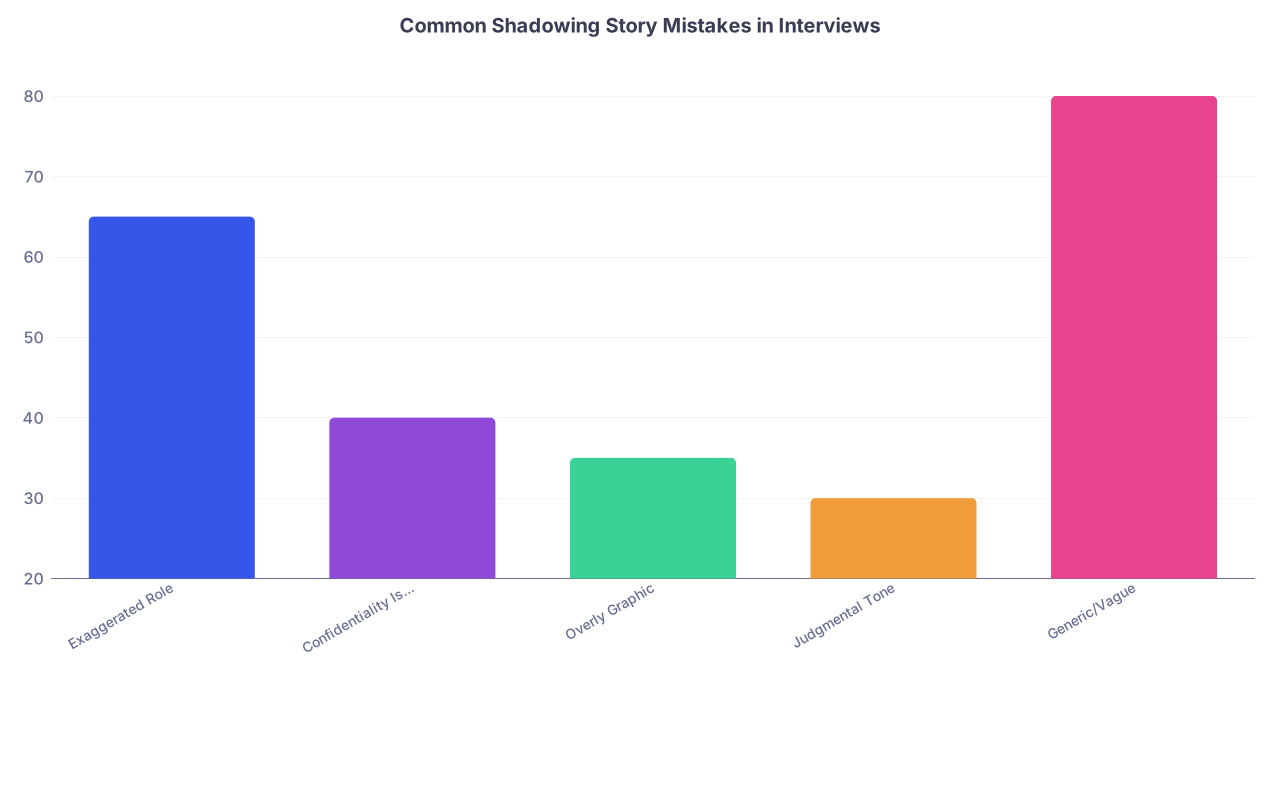
| Category | Value |
|---|---|
| Exaggerated Role | 65 |
| Confidentiality Issues | 40 |
| Overly Graphic | 35 |
| Judgmental Tone | 30 |
| Generic/Vague | 80 |
13. Practicing Without Sounding Scripted
Here’s where many high‑achievers blow it: they either wing it (and ramble) or memorize word‑for‑word (and sound robotic).
Both are mistakes.
Do this instead:
- Bullet your stories, do NOT write essays:
- Context (5 words)
- Moment (5–7 words)
- Your role (5 words)
- Takeaway (5–7 words)
- Practice ideas, not sentences
- Record yourself once or twice—listen specifically for:
- Overuse of graphic detail
- “I decided / I did” when you were just observing
- Judgmental language about patients or staff
- Emotional over‑performance
If you cringe at yourself? Good. Fix it now, not across from an admissions dean.

| Step | Description |
|---|---|
| Step 1 | Want to use shadowing story |
| Step 2 | Do not use. Change or cut. |
| Step 3 | Pick a better story |
| Step 4 | Safe to refine and use |
| Step 5 | Any confidentiality risk? |
| Step 6 | Exaggerating your role? |
| Step 7 | Relies on gore or drama? |
| Step 8 | Shows your growth clearly? |
Final Takeaways
Keep it simple:
- If your shadowing story makes you look confidentially sloppy, clinically inflated, or emotionally performative, it will hurt you more than silence would.
- The best stories are specific, de‑identified, humble about your role, and centered on what you learned—not how dramatic the case was.
- Structure your answers, pick the right story for the question, and scrub your language for judgment and exaggeration before you ever sit down in that interview chair.