
The way most premeds “prepare” for interviews is sabotaging them.
You’re not losing interviews because you’re dumb, boring, or unqualified. You’re losing them because you sound like a memorized brochure. Over-rehearsal is the silent killer of authenticity, and admissions committees are allergic to it.
Let me be blunt: the problem isn’t that you didn’t practice enough. It’s that you practiced the wrong way—writing scripts instead of building skills, memorizing instead of thinking, performing instead of conversing.
This is fixable. But only if you stop repeating the same interview prep mistakes everyone else is making.
Mistake #1: Writing Scripted Answers For Every Common Question
Here’s the classic premed disaster:
You google “top 50 med school interview questions.”
You paste them into a document.
You write paragraph-long “perfect” answers for each.
You “memorize” them.
Then you walk into the interview and sound like ChatGPT with nerves.
That entire strategy is a trap.
Script-writing creates three predictable problems:
- You sound robotic.
- You panic when the question is slightly different from your script.
- You’re so busy remembering words that you forget to be a human.
I’ve watched applicants freeze because they prepared an answer for “Why our school?” and got asked “Where else did you apply and why?” Same theme, different wording. Their brain: “Error 404: script not found.”
What to do instead
Stop scripting. Start outlining.
For any “common” question (Why medicine? Tell me about yourself. Biggest weakness?), you need:
- 2–3 key points you want to hit
- 1–2 specific stories or examples
- A rough sense of your opening and closing line, not full sentences
Think bullet points, not paragraphs. You should be able to glance at your notes and recall ideas, not sentences.
If your “prep” document looks like an essay collection, you’re doing it wrong. It should look like shorthand notes you’d scribble on a Post-it before a call.
Here’s the sanity check: If someone interrupted you mid-answer and changed the question, could you pivot without mentally crashing? If not, you’re over-scripted.
Mistake #2: Practicing For Performance, Not For Thinking
Most applicants rehearse like they’re preparing for a monologue. They focus on:
- Tone
- Eye contact
- Hand gestures
- Not saying “um”
Meanwhile, the part the interviewer actually cares about—your thinking—is underdeveloped and brittle.
You can’t hide shallow thinking behind polished delivery. Not from an academic who’s been interviewing students for a decade.
Over-rehearsal often exposes that shallowness. When you memorize answers, you never train the muscle of generating thoughtful, coherent responses on the spot. On interview day, the first unexpected question exposes the gap.
The right way to practice
You want to strengthen your thinking under mild pressure, not your ability to recite:
- Take a random ethics scenario from an MMI prep site.
- Give yourself 60 seconds to think, then talk out loud for 2 minutes.
- Record it.
- Listen back and ask: Do I have a clear structure? Did I consider multiple perspectives? Did I actually answer the question?
You’re training yourself to reason in real time, not to deliver a memorized essay. That’s the difference between someone who sounds alive vs. someone who sounds “prepared.”
If your practice never includes truly new questions, you’re not preparing. You’re just rehearsing.
Mistake #3: Over-Consuming Advice Videos And Copying Other People’s Phrases
There’s a YouTube problem nobody talks about: after 20 hours of med school interview videos, everyone starts sounding exactly the same.
You’ve heard it:
- “I want to practice holistic, patient-centered care…”
- “I’ve always been passionate about lifelong learning…”
- “I believe in advocating for underserved populations…”
These phrases weren’t born in your brain. They were downloaded from the internet.
Interviewers hear these canned lines from dozens of applicants every year. Once they detect one formula phrase, they start suspecting the rest. Over-rehearsal doesn’t just kill authenticity; it triggers interviewer skepticism.
How to avoid “generic premed voice”
If a sentence could appear in any applicant’s answer, it’s weak. Especially if it includes:
- “ever since I was a child”
- “I’ve always wanted to be a doctor because…”
- “I just really want to help people”
Strip those out. Replace them with something only you could say:
Not: “I want to help underserved communities.”
Try: “On my mobile clinic shifts in South LA, I started noticing the same three barriers over and over: transportation, language, and fear of the system. That’s when I stopped seeing ‘underserved’ as a label and started seeing it as a set of solvable problems.”
Same idea. Different depth. And clearly yours.
Rule of thumb: if you caught it from a YouTube video, toss it or radically rewrite it.
Mistake #4: Practicing Only With Friendly People Who Won’t Push You
Another over-rehearsal trap: you keep practicing with people who think you’re amazing.
Your roommate who already believes you’re destined for MD/PhD.
Your mom who cries when you say “patient care.”
Your pre-health advisor who says, “That sounded really polished!”
You know what “polished” often means? Over-rehearsed and boring.
Friendly mock interviews are fine to start. But if no one is:
- Interrupting you mid-answer
- Asking “Why?” three times in a row
- Challenging your assumptions
- Saying “That answer wasn’t actually clear”
…then you’re just running your script in front of a live audience. Still not thinking. Still not adapting. Still vulnerable.
You need at least one “uncomfortable” mock
Find someone who:
- Is willing to be blunt
- Isn’t emotionally invested in your ego
- Has seen real interviews (attendings, residents, someone who’s been on an admissions committee, or at least a tough professor)
Give them explicit permission: “Do not tell me I’m great. Tell me where I sound fake, confusing, or shallow.”
If every mock leaves you feeling “smooth,” you’re under-testing yourself. A good mock interview should sting a little. Not destroy you, but reveal weak spots you’d rather see before the real thing.
Mistake #5: Over-Memorizing Your Own Application
This one sounds weird at first, but I’ve seen it derail people.
You reread your AMCAS/AACOMAS activities and personal statement so many times you start trying to recreate those exact phrases in your interview.
The result: instead of talking like a person, you start quoting your own essay.
Interviewer: “Tell me about your research.”
You: “My research experience has truly been transformative because it taught me to think critically about…”
I can almost see the sentence boundaries from the page.
This is another over-rehearsal error. You’re trying to be consistent with your written work by copying it, instead of just being the same person who wrote it.
Better approach
Know the story beats, not the sentences:
- The problem you worked on
- Your specific role
- One challenge
- One concrete result or learning
If you can hit those, the wording can be different every time. And it should be.
If you catch yourself reciting exact lines from your personal statement, you’ve crossed into “performing my application” instead of talking about your life.
Mistake #6: Trying To Eliminate All “Imperfections” From Your Speech
Let me say this clearly: chasing a zero-“um,” zero-pause, perfectly fluent answer makes you sound fake.
Real humans:
- Pause to think
- Sometimes restart a sentence
- Occasionally say “that’s a good question, let me think about that”
- Have natural variation in speed and tone
Over-rehearsed applicants iron all of that out. They think sounding “prepared” means never stumbling, never hesitating, never searching for a word. It doesn’t. It just makes you sound like you’re on stage.
Interviewers would rather you pause and think than ramble through a pre-loaded answer.
The 80/20 of delivery
Aim for “clear and engaged,” not “flawless.”
Focus on:
- Not talking in one giant paragraph—use natural breaks
- Actually listening to the question before answering
- Keeping your answers 1–2 minutes unless they clearly invited a longer story
If you’re obsessively counting your filler words in practice, you’re misplacing your energy. That’s time you should spend sharpening your ideas.
Mistake #7: Over-Practicing The Same Few Questions Until You Sound Dead Inside
There’s a specific deadness that comes from answering “Why medicine?” for the 200th time.
You know exactly what I’m talking about—that zombie autopilot response that technically hits all your points but has zero emotional life in it.
You’ve repeated it so many times it stopped feeling true. And that’s a problem, because authenticity isn’t just what you say; it’s whether you sound like you still believe it.
Set a “practice cap” for core questions
Yes, you should practice key questions. No, you should not drill the same answer 50 times in a row.
Try this structure instead:
- Develop a bullet-point outline
- Do 3–5 full run-throughs spaced over days, not all at once
- Each time, change the exact wording but keep the same story and structure
If you catch yourself using the same sentence three practices in a row, change it on purpose. Force freshness. You’re training flexibility, not recitation.
When your own answer starts boring you, that’s a red flag. Time to step back, not push harder.
Mistake #8: Treating Every Station Like A Performance, Not A Conversation
MMI stations and traditional interviews both suffer when you over-rehearse a persona instead of showing up as a human.
The mindset mistake sounds like this in your head: “What do they want me to say?” instead of “What do I honestly think, framed professionally?”
Interviewers can feel that defensive, performative energy a mile away. It shows up as:
- Over-justifying everything
- Constantly name-dropping values (“integrity,” “compassion,” “leadership”)
- Dodging vulnerability—never admitting uncertainty, mistakes, or growth areas
Here’s the irony: the more you try to be perfect, the less trustworthy you seem.
Reframe the goal
Your job isn’t to “win” each interaction. It’s to:
- Show how you think
- Let them see your judgment and values through real examples
- Demonstrate that you’re coachable and self-aware
If you’re over-rehearsed, you protect your “image” instead of revealing your judgment. That’s the very thing they’re trying to assess.
Sometimes the most powerful, authentic moment is, “Honestly, I don’t know exactly what I’d do yet, but here’s how I’d start thinking about it…” That’s real. That’s teachable.
Mistake #9: Ignoring Non-Verbal Authenticity
Over-rehearsal shows up in your body before your mouth.
The giveaway signs:
- Holding your posture too rigid, like you’re in a passport photo
- Smiling at weird times because you’re “performing warmth”
- Nodding excessively while the interviewer speaks
- Overusing “professional” hand gestures you copied from someone else
When you over-prepare the content, your anxiety leaks into the rest. You’re trying so hard to “look right” that you become hyper-aware of yourself instead of the conversation.
Fixing this without becoming fake in a different way
Don’t script your body language. Anchor it instead:
- Plant both feet on the floor
- Rest your hands comfortably—on the table, lightly clasped, not clenched
- Orient your chest and shoulders toward the interviewer or camera
- Let your gestures be whatever they naturally are when you’re engaged in a normal conversation
Do one thing: record a 5-minute mock. Watch it with the sound off first. If you look like you’re reading a teleprompter or defending a PhD thesis, you’re overdoing it.
You want “attentive and relaxed,” not “robotic and upright.”
Table: Over-Rehearsal vs Effective Prep (What It Actually Looks Like)
| Aspect | Over-Rehearsal Approach | Effective Prep Approach |
|---|---|---|
| Answer style | Memorized scripts | Flexible outlines |
| Practice content | Same 20 questions on repeat | Mix of common + unfamiliar questions |
| Feedback | “You sounded polished” | “Here’s where you lost clarity” |
| Emotional feel | Drained, performative | Alert, mentally engaged |
| Authenticity signal | Generic phrases, essay language | Specific stories, your own wording |
Mistake #10: Trying To “Game” Authenticity At The Last Minute
Some applicants sense the over-rehearsal issue too late. So they try to “add authenticity” like a garnish.
They toss in a vulnerable story they never processed.
They suddenly decide to “be more casual” and overshoot into unprofessional.
They change their answers the night before the interview and derail their own confidence.
You don’t fake authenticity. You protect it.
That means:
- Preparing early enough that you’re not panic-scripting
- Being honest in your written application so your stories already match your real voice
- Allowing your actual personality—dry humor, thoughtful quietness, whatever it is—to be present in practice, not just in your private life
If your friends wouldn’t recognize you from a recording of your mock interview, something’s wrong.
A Safer, Saner Interview Prep Blueprint
Let me pull this together into something you can actually do without falling into the over-rehearsal trap.
1. Build idea maps, not speeches
For each key area (Why medicine, Why this school, Tell me about yourself, Strengths/weaknesses, Key activities):
- Jot down 3–4 bullet points
- Add 1–2 specific stories
- Write them the way you’d think them, not the way you’d publish them
No paragraphs. If you see paragraphs, you’re scripting.
2. Schedule limited, focused practice
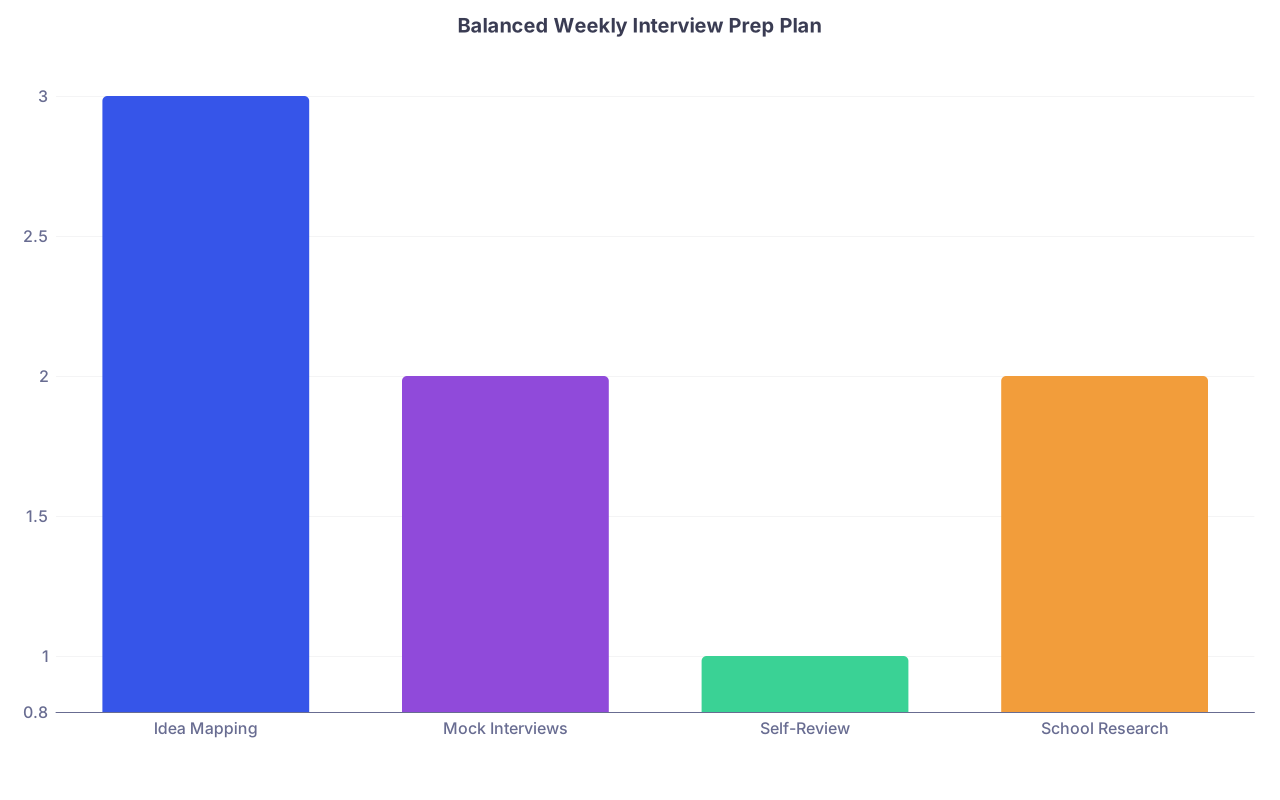
Over-preparation isn’t about hours; it’s about how you use them. Something like:
| Category | Value |
|---|---|
| Idea Mapping | 3 |
| Mock Interviews | 2 |
| Self-Review | 1 |
| School Research | 2 |
That’s 8 hours a week, max. Notice what’s missing? “Memorization time.”
3. Use three types of mocks
You need variety to avoid over-rehearsal:
- Friendly mock: for confidence and basic flow
- Tough mock: for pushback and uncomfortable questions
- Solo mock: record yourself answering random questions cold
If all three feel identical, you’re not stretching enough.
4. Protect your real voice
Do one simple test: After a mock, ask yourself, “Would I talk like that to a respected professor I know well?” If the answer is “Not even close,” you’ve drifted into fake-professional mode.
Dial it back. Keep the respect, lose the performance.

| Step | Description |
|---|---|
| Step 1 | Start Prep |
| Step 2 | Create bullet-point outlines |
| Step 3 | Practice with new questions |
| Step 4 | Do 3 types of mock interviews |
| Step 5 | Review recordings for clarity & authenticity |
| Step 6 | Adjust stories, not scripts |
| Step 7 | Light review before interview day |
FAQ (Exactly 3 Questions)
1. How do I know if I’ve crossed from “well-prepared” into “over-rehearsed”?
Three signs: First, your answers sound identical every time you practice—even down to specific phrases. Second, you panic when a question is phrased differently than you expected. Third, you feel mentally exhausted or weirdly bored by your own story. If those are showing up, you’re past the healthy prep zone.
2. Is it ever okay to memorize parts of an answer, like an opening line?
A short, clean opening line is fine—as long as the rest of the answer is flexible. For example, a one-sentence hook to your “Why medicine” story can be memorized. But if you find yourself defending that sentence structure instead of allowing natural conversation to shape your response, it’s doing more harm than good.
3. How close to interview day should I stop heavy practice?
You should taper, not grind until midnight the night before. Two to three days before the interview, shift from heavy mock sessions to light review: skim your bullet points, read up on the school, maybe one short mock just to stay loose. If you’re still “cramming” new phrasing the night before, you’re feeding anxiety and over-rehearsal, not improving your performance.
Open your current interview prep document right now. If you see paragraphs instead of bullet points, start deleting sentences until only ideas and stories remain. Don’t polish another word until you’ve unscripted your answers. That’s how you stop killing your authenticity before you even walk in the room.