
It’s 8:02 a.m. You’re standing in a carpeted hallway lined with identical doors, holding a clipboard and your heart rate at about 130. The bell rings. You flip your prompt, scan it, and walk into Station 3—“Difficult Communication Scenario.” There’s a calm-looking rater sitting in the corner, pen in hand, half‑smiling.
You think they’re just “listening to your answer.”
They’re not.
They’re tallying ten things in the first ten seconds, and most applicants have no idea what those things are.
Let me pull back the curtain on how MMI raters actually think. Not the sanitized “we assess communication, ethics, and professionalism” line you get on the website. The real stuff. The things they’re quietly scoring whether you mention Kant, beneficence, or none of the above.
What MMIs Are Really Designed To Expose
Forget the marketing language. MMI committees use this format for one main reason: it breaks the polished, over‑rehearsed “good interview” persona.
A traditional 30‑minute interview lets a smooth talker perform. An MMI circuit, with 6–10 rapid‑fire stations, rotating raters, role‑plays, ethical landmines, and time pressure, exposes pattern behavior.
Patterns are what they care about.
At the debrief, nobody says, “That applicant gave a superb explanation of deontology.” They say things like:
- “She calmed the actor down in under a minute.”
- “He interrupted constantly. I would never want him on my team.”
- “She changed her mind mid‑station and admitted it clearly. That’s rare.”
- “He got flustered when challenged and doubled down instead of listening.”
That’s the level they’re operating on.
So let’s walk through what’s actually getting scored, across almost all MMI stations, regardless of content.
The First 60 Seconds: What You Don’t Know They’ve Already Decided
By the time you finish your first sentence, a rater has already formed a working hypothesis about you. They’ll refine it, but they won’t erase it.
Here’s what’s happening in their head before you’ve even started your “framework.”
1. Your “Entrance Signature”
Every rater I’ve worked with pays attention to your entrance—far more than anyone tells you.
They’re clocking:
- Do you knock, wait, and enter with basic courtesy, or do you burst in like you’re late to lab?
- Do you make normal eye contact and a brief greeting, or do you robot‑walk to the chair?
- Do you sit before being invited when the instructions clearly told you this is a professional interaction?
In one faculty training session, a senior rater actually said, out loud: “I can usually tell in the first ten seconds if this person has ever had to work with actual people.”
Harsh. But accurate.
They’re not looking for theatrical charm. They’re looking for someone who can walk into a patient’s room or a family meeting without making it weird.
2. Anxiety vs. Competence Signal
Everyone is nervous. They know that. What they’re watching for is: does your anxiety drown your professionalism, or do you function anyway?
Small things that give them data:
- Can you say “Hi, I’m Alex, nice to meet you” without tripping over yourself or whispering it into your shoes?
- Do your hands shake but you still hold steady eye contact and speak clearly?
- When you sit, do you immediately hunch and ball up, or do you assume a reasonably open, attentive posture?
Several programs have an informal shorthand on score sheets—“NRB” = Nervous but Reliable. It’s a quiet compliment. It means: clearly keyed up, but still thoughtful, coherent, and kind. Those people get ranked.
What They’re Actually Scoring: The Unwritten Categories
Most score sheets have a few visible headings: communication, ethical reasoning, professionalism, teamwork. That’s the surface. Underneath, here are the unspoken dimensions they’re mentally tagging you on.
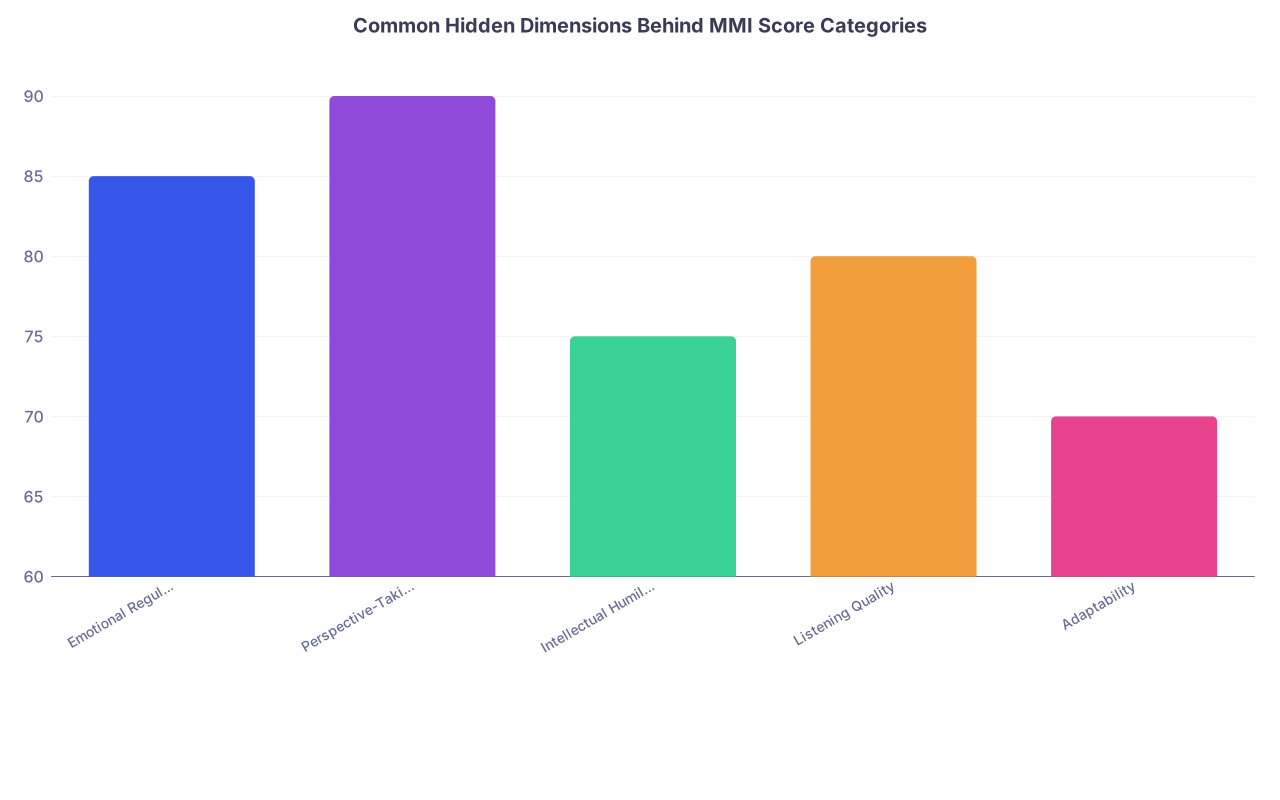
| Category | Value |
|---|---|
| Emotional Regulation | 85 |
| Perspective-Taking | 90 |
| Intellectual Humility | 75 |
| Listening Quality | 80 |
| Adaptability | 70 |
Emotional Regulation: Do You Stay Human Under Pressure?
We trained raters to watch one thing closely: what happens when you’re challenged.
You give your opinion. The actor pushes back. The rater asks, “Are you sure?” or throws a complication into the scenario.
Now the scoring really starts.
Patterns that sink people:
- Voice gets louder, more insistent, almost argumentative.
- They talk faster, ramble, and dodge the actual challenge.
- They visibly deflate—slump, stare down, long silent panic.
Patterns that help you:
- Brief pause. “That’s a good point, let me think that through.”
- You adjust your stance slightly: “Given that new information, I might modify what I’d do.”
- You maintain calm tone even if your hands are sweating.
I sat through one debrief where two applicants had nearly identical “ethical content” but opposite scores. The deciding factor? One got flustered and defensive when the rater disagreed. The other stayed curious and steady.
The second one matched. The first one did not.
Perspective-Taking: Can You Get Out of Your Own Head?
In communication and ethics stations, your content matters less than your ability to see more than one perspective.
What raters are quietly counting:
- Do you name more than one stakeholder? (Patient, family, healthcare team, system constraints…)
- Do you acknowledge emotions first, not just rules? (“I imagine you might feel scared or betrayed by this…”)
- Do you treat the standardized patient as a person, not a prop for your speech?
A classic line that shows up in rater comments: “Very self-centered framing.” That doesn’t mean you’re selfish. It means your answer was all “I would do X, I would say Y, I believe Z,” with no real sense of what it feels like to be on the receiving end.
You know what comment shows up only for top applicants? “Showed genuine curiosity about the other person’s view.”
The Parts of Your Answer They Actually Care About
Most applicants obsess over: “What exact ethical framework should I use?” Raters obsess over: “How did this person think in front of me?”
Let me walk you through the hidden scoring items inside your response.
1. Your Opening Move
Those first 1–2 sentences of content set the tone.
Bad openers:
- Diving straight into rules or policies with zero acknowledgment of the human being in the vignette.
- Overly rehearsed frameworks that sound memorized: “So this is a situation about autonomy vs beneficence and I will address it in three parts…”
What wins points:
- A brief orienting sentence that shows you actually read and understood the stem.
- A quick recognition of the human side. “This is a difficult situation for the family and the team.”
The rater isn’t thinking, “Nice topic sentence.” They’re thinking, “Okay, this person can actually see the situation in front of them, not just deploy a template.”
2. How You Structure Under Time Pressure
You know who gets quietly high scores? The applicant who can create order out of chaos in 6–8 minutes.
Raters listen for:
- Clear mental structure: “Let me think about this from two angles…” or “I see three key issues here.”
- Movement. You don’t get stuck on one micro-detail for four minutes.
- You actually answer the question that was asked, rather than the one you wish had been asked.
If halfway through, the rater interrupts with, “You have about two minutes left—anything else you’d add?” they’re testing whether you can prioritize. A strong applicant says something like, “Yes, I’d summarize my main approach as…” and lands the plane.
Weak ones panic, restart their whole argument, or say, “Umm… I think that’s it,” even when they haven’t addressed half the core issues.
3. How You Handle Uncertainty
Programs are sick of overconfident, under‑reflective trainees. The MMI is partly an “intellectual humility” test.
Behind closed doors, raters praise:
- “Comfortable saying ‘I don’t know’ in a thoughtful way.”
- “Didn’t pretend to have absolute answers.”
- “Was willing to modify stance when new variable was added.”
They penalize:
- Fake certainty when the scenario is obviously ambiguous.
- Dodging complexity with a simplistic “right answer” tone.
- Digging in when the rater intentionally complicates things.
A line that shows you get it: “Given this limited information, here’s how I’d approach it, and I’d want to consult with my team and the patient about…”
No faculty member expects a premed to solve an ethics consult. They expect you to know how to think like someone who will learn.
Nonverbal Behaviors Raters Take Way More Seriously Than You Think
Everyone’s heard “make eye contact” and “don’t cross your arms.” That’s kindergarten level. Here’s what raters actually discuss.
Eye Contact: Presence, Not Staring Contest
They notice:
- Whether you include both the rater and the actor (if present) in your visual attention.
- If you occasionally glance down to think, then come back up—normal.
- Or: you stare at the table, the wall, or the floor for 8 minutes—problem.
An applicant in one circuit got multiple comments: “Spoke to the wall, not to me.” Content was solid. Scores were mid‑range. You cannot connect with a wall.
Voice and Pace: Can You Be Understood in a Crisis?
Silent truth: some raters quietly ask themselves, “Would I trust this person to explain bad news to my family?”
That’s not about sounding smart. It’s about:
- A voice that’s audible without being aggressive.
- Pauses that feel deliberate, not frozen.
- Pace that can slow down to emphasize a sensitive point.
Extremely rapid, breathless speech screams “panic” and kills your perceived thoughtfulness, no matter how smart your ideas are.
Micro-Behaviors in Role-Play Stations
This is where applicants either prove they’re human or expose that they’ve only trained with flashcards.
Standardized patients report back on you. And their notes matter—often a lot.
They comment on:
- Did you introduce yourself to them or only talk to the rater?
- Did you use the person’s name at least once?
- Did you ask how they felt or just assume?
A common faculty refrain: “She never actually asked the patient what they wanted.” Instant hit to your patient‑centeredness score.

How Raters Score “Fit” Without Ever Saying the Word
Programs will swear they’re not selecting for “personality fit.” Officially, they’re selecting for competencies. Unofficially? They’re absolutely asking: “Do I want this person on my team at 2 a.m.?”
I’ve heard variations of these exact comments behind closed doors:
- “Great brain, zero warmth. Patients will hate him.”
- “Average content, but I’d trust her with my parents.”
- “He argued with the actor like he had to win. Hard pass.”
That “team at 2 a.m.” test runs constantly in their heads.
Teamwork / Collaboration Stations: The Trap You Don’t See
In group or collaboration stations—building a structure, solving a puzzle—most applicants think the goal is to be “the leader.”
You’re being scored much more on:
- Do you invite quieter people in? “What do you think about this approach?”
- Can you adapt your role—sometimes lead, sometimes support?
- Do you acknowledge others’ ideas and build on them?
At one school, group station raters used a simple informal grid:
| Archetype | How Raters See Them |
|---|---|
| Steamroller | Red flag |
| Ghost (silent) | Concerning, low impact |
| Contributor | Solid, usually safe |
| Facilitator | Top-tier, highly ranked |
Everyone wants to be the “facilitator”—organizes, listens, synthesizes. Very few are. You don’t get there by grandstanding; you get there by making other people more effective.
How Scoring Actually Works Behind the Clipboard
Let me tell you what’s really on that sheet. It’s not a secret answer key.
Typical station scoring has 4–6 domains, each with a 1–5 or 1–7 scale, sometimes anchored like this:
- 1: Unsafe / unacceptable
- 2–3: Below expectations
- 4: Meets expectations
- 5–6: Above expectations
- 7: Outstanding / exceptional
The rater is not ticking a box for “mentioned autonomy.” They’re asking:
- Did this person identify relevant issues?
- Did they communicate clearly?
- Did they show empathy and respect?
- Would I feel okay if they handled a real-world version of this, with supervision?
The dirty little truth: many raters make a provisional “global” score in their head in the first 2–3 minutes, then adjust up or down at the end by 0.5–1 point based on how you finish.
That means your overall impression—how you handled yourself, not just what you said—matters more than your perfect middle paragraph.
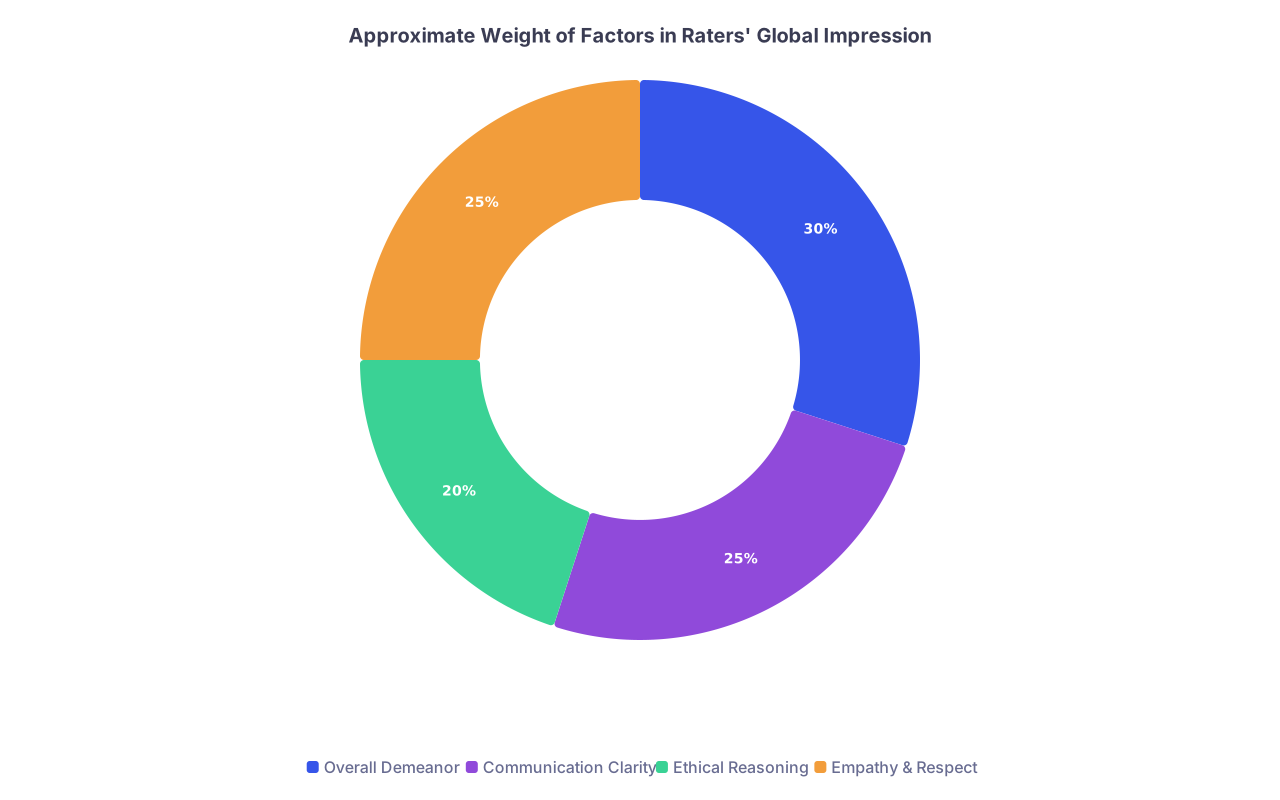
| Category | Value |
|---|---|
| Overall Demeanor | 30 |
| Communication Clarity | 25 |
| Ethical Reasoning | 20 |
| Empathy & Respect | 25 |
Common Self-Sabotaging Behaviors Raters Gossip About Later
Yes, they talk. After the circuit, there’s always a debrief. You want to know what gets mentioned? Not your clever distinctions about confidentiality law.
They remember:
- The applicant who rolled their eyes at an actor. More than once.
- The one who laughed at a patient scenario that was clearly serious.
- The one who spoke over a standardized patient mid-sentence to get their “framework” out.
- The one who said, “Honestly, I think patients just need to trust us, we know what we’re doing.”
These are instant character red flags. They don’t get “balanced out” by an excellent answer two stations later.
On the flip side, they also remember human moments:
- “He noticed the patient was about to cry and slowed down.”
- “She apologized when she misspoke, instead of just bulldozing through.”
- “He thanked the actor at the end, even though he was stressed and out of time.”
You’re being scored on whether you treat people like people in a simulated environment. Admissions committees bet that’s a decent proxy for how you’ll treat them in the real world.

How To Actually Practice The Skills They’re Scoring
You can’t fake this the night before. But you can train the specific muscles raters care about.
Here’s what I’ve seen work when applicants take it seriously.
Practice Under Observation, Not Just in Your Head
Talking through practice stations alone in your bedroom is useless past the first few tries. You need:
- Another human watching your body language.
- Someone who will interrupt you mid‑answer, like a real rater.
- Real time limits with a visible countdown.
Do 3–5 stations with a friend or mentor just watching for: “Would I want you explaining a tough situation to my family?” Have them give brutal, specific, behavioral feedback.
Train “Pause, Name, Frame”
A simple internal habit that maps beautifully to what raters want:
- Pause for one full breath after hearing the prompt or a challenge.
- Name the core tension or emotion: “This is really about X,” or “I imagine they feel Y.”
- Frame how you’ll approach it: “I’d want to do three things…”
It slows down your panic, signals thoughtfulness, and gives the rater a roadmap.
I’ve watched anxious applicants jump an entire scoring tier just from this one habit.
Work on Real-Life Conversation, Not Just “Interview Skills”
You can’t be emotionally flat or socially clumsy 24/7 and then magically turn it on for MMIs.
Spend time in roles that demand real human interaction: tutoring, crisis line, coaching, caregiving, actual jobs with customer service. Then reflect afterwards:
- When did I interrupt?
- When did I assume instead of ask?
- When did I get defensive?
That’s the same circuitry raters are scoring.
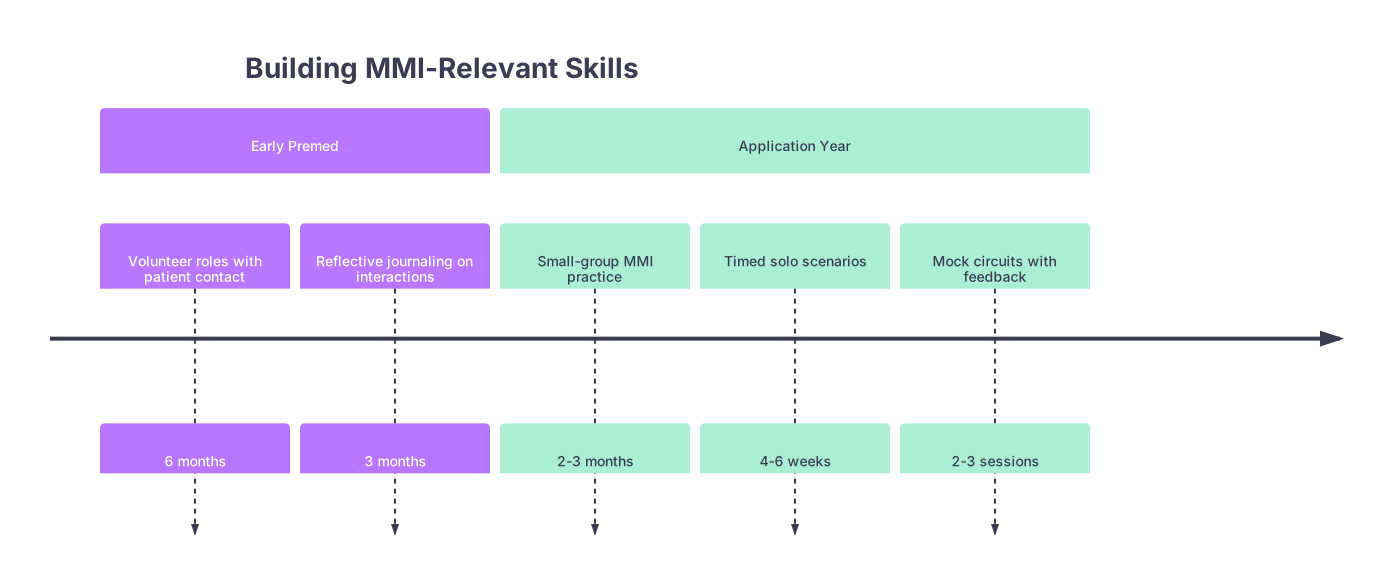
| Period | Event |
|---|---|
| Early Premed - Volunteer roles with patient contact | 6 months |
| Early Premed - Reflective journaling on interactions | 3 months |
| Application Year - Small-group MMI practice | 2-3 months |
| Application Year - Timed solo scenarios | 4-6 weeks |
| Application Year - Mock circuits with feedback | 2-3 sessions |
What Program Directors Actually Say About Top MMI Performers
When committees review applicants, they rarely remember exact details of your scenarios. They remember archetypes.
Comments I’ve heard repeatedly about top MMI performers:
- “I’d let them talk to any patient in my clinic.”
- “Wasn’t flashy, but clearly safe, kind, and thoughtful.”
- “Adapted when pushed; didn’t cling to a script.”
- “Felt like a future colleague, not someone trying to win points.”
MMIs are not an exam to be aced. They’re a stress test for your baseline way of interacting with other humans when you’re a little scared and a lot observed.
You can’t memorize your way out of that. But you can train into it.

FAQs
1. If I totally mess up one MMI station, am I automatically done?
No. I’ve seen applicants blow a single station—freeze, misinterpret, run out of time—and still get in. Why? Because across the whole circuit, their pattern was solid: respectful, thoughtful, good listener, steady under pressure. One disaster doesn’t kill you. A pattern of disasters does.
2. Should I use named ethical frameworks (autonomy, beneficence, etc.) to impress raters?
Only if you can use them like a fluent language, not like vocabulary words you’re forcing into an essay. Raters care more that you recognize the patient’s perspective and the real tension than that you label it correctly. An honest, clear reasoning process beats clumsy “ethics speak” every time.
3. How much are nonverbals actually weighted compared to content?
Nobody has a separate “eye contact: 5/7” line, but nonverbals bleed into every domain. If your tone is harsh, your empathy score drops. If you seem scattered, your reasoning and communication scores drop. In practice, your demeanor and delivery probably account for a third to half of a rater’s global impression.
Key takeaways: Raters are quietly scoring how you are with people under pressure, not just what you say about ethics. Emotional regulation, perspective‑taking, and real listening carry more weight than clever frameworks. Train those, and your MMI stops being a minefield and starts looking like what it really is: a conversation about whether you’re someone they’d trust in the room when it matters.