
The feel‑good language around “holistic review” is a lie of omission. They are not just “seeing you as a whole person.” They are running you through an unspoken rubric that almost no one explains to you honestly.
I’ve sat in those rooms. I’ve watched applicants with 528 MCATs sink and quieter 510s float to the top. Not because of magic. Because of patterns, politics, and risk management hiding under the word “holistic.”
Let me walk you through what’s actually happening when you walk into that “conversation, not interrogation” interview.
What “Holistic Review” Really Is Behind Closed Doors
Holistic review is not chaos. It’s not vibes. It’s structured judgment pretending to be soft and humane.
Every school has some version of three buckets, whether they admit it publicly or not:
- Can you survive the curriculum and exams here?
- Will you be a headache, a risk, or a PR problem?
- Will you make the school look good in 5–10 years?
Different schools weight those buckets differently. But they’re all there.
Here’s the part students never get told: by the time you’re interviewing, bucket #1 is mostly done. Your MCAT, GPA, and transcript already answered, “Can this person probably pass Step 1/2 and our courses?” The interview is mainly about buckets #2 and #3.
That’s what “holistic” means in the interview stage:
They’re hunting for risk and for upside.
They’re using your answers, your body language, and even how you talk to the student host to score you on that unspoken rubric. Yes—score. Many schools literally translate interview impressions into numbers.
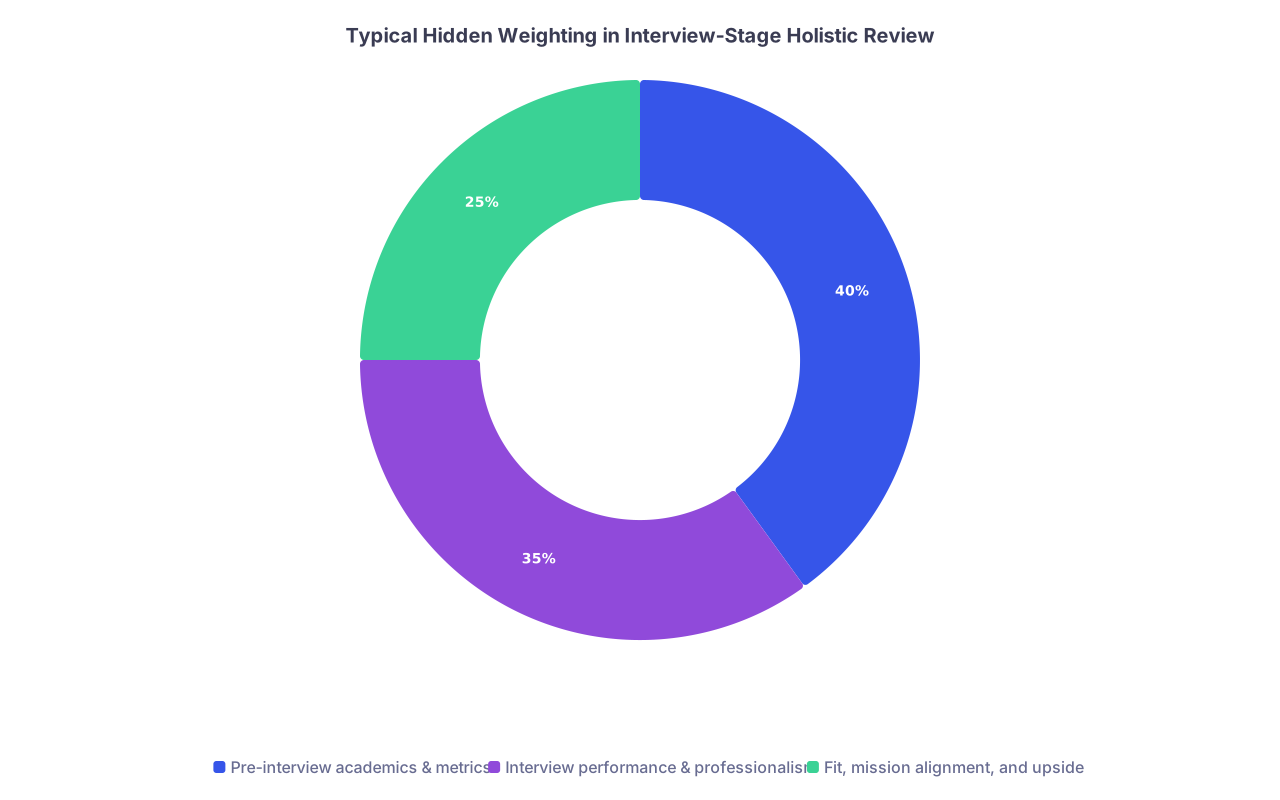
| Category | Value |
|---|---|
| Pre-interview academics & metrics | 40 |
| Interview performance & professionalism | 35 |
| Fit, mission alignment, and upside | 25 |
Those percentages shift, but the structure doesn’t. When faculty say “We really value holistic review,” they usually mean: “We’re willing to take a 511 with great human signals over a 521 who worries us.”
So the real question is: what are those human signals?
The Unspoken Rubric They Actually Use
No one hands you the score sheet, but I’ve seen enough versions to know the common skeleton. Different labels, same ideas. Here’s how they’re silently grading you.
1. Professionalism & Risk Profile
This is column one on almost every rubric:
“Is this person going to be a problem?”
That sounds harsh. It is. But after a few students get reported to the Dean’s office, or a resident posts something stupid on Instagram that hits the local news, schools get very conservative.
Interviewers are scanning for:
- Emotional volatility
- Entitlement
- Blame-shifting
- Poor boundaries
- Poor judgment online or in person
You’ll never see “Risk of professionalism incident” printed on a form. But you’ll see things like:
- Maturity
- Judgment
- Insight
- Integrity
- Reliability
Same thing. Different words.
Red flags they actually talk about in the debrief room:
- “He threw his PI under the bus in that story.”
- “She blamed every problem on someone else.”
- “He seemed very angry about his undergrad premed office.”
- “She dodged every question about weaknesses.”
You want interviewers walking away saying variations of: “Low risk, stable, grounded. I’d be fine having them on my team at 3 a.m.”
2. Self-Awareness & Insight
This is where a ton of high-stat applicants crash.
They talk at length. They list activities and achievements beautifully. But they’ve never turned the lens inward. No reflection. No insight. Just performance.
On rubrics this shows up as:
- Self-awareness
- Insight/reflective capacity
- Openness to feedback
Behind the scenes, the mental question is:
“Can this person recognize when they’re wrong, learn, and adjust? Or are we getting a rigid, fragile ego?”
Things that score high here:
- Owning real mistakes without melodrama
- Showing what you learned in specific terms
- Admitting uncertainty and how you handle it
- Being able to laugh, lightly, at a past naive version of yourself
Things that tank you:
- “I don’t really have weaknesses; I just care too much.”
- Long, defensive justifications when challenged.
- Dodging any question that touches on failure.
I’ve seen more than one applicant sink because an interviewer wrote: “Defensive. Could not accept any imperfection.” That alone is enough to put you in the “no” stack when there are hundreds of other viable options.
3. Mission Alignment (The Quiet Filter)
Here’s a piece almost no one outside admissions appreciates: schools are under constant pressure to prove to accreditors, donors, and the public that they train the “right kind” of doctors.
“Right kind” means different things at different schools, but it’s not vague internally:
- State schools care about: Will you stay in-state? Primary care? Underserved areas?
- Research-heavy schools care about: Will you publish? Get grants? Become academic faculty?
- Community-focused schools care about: Service, longitudinal commitment, real community roots.
They do not want to train people who will never fit their mission. That’s lost ROI.
So in the interview, they’re unconsciously running:
“Do your past actions and your future goals line up with what we sell as our mission?”
If their website screams “urban underserved, primary care” and you gush about derm in a private practice in the suburbs, you just made their job easy: soft pass.
Not because derm is bad. Because it’s off-brand for them.
Your job isn’t to lie. But you’d better know what they care about and how the real you honestly intersects with that. If there’s no overlap, do not rank them high. They feel that mismatch too.
What Interviewers Are Actually Writing Down
You imagine they’re remembering your every sentence. They aren’t. They’re scribbling phrases and checking boxes on some form that looks something like this:
| Category | Typical Scale |
|---|---|
| Professionalism/Maturity | 1–5 |
| Communication Skills | 1–5 |
| Insight & Self-Reflection | 1–5 |
| Motivation for Medicine | 1–5 |
| Mission Fit | 1–5 |
| Overall Enthusiasm/Support | Strong No–Strong Yes |
Different school, same bones.
Let me translate those categories into what they really mean:
- Professionalism/Maturity → “Would I trust you with my patients or my kids at 2 a.m.?”
- Communication Skills → “Will patients understand and not hate you? Would you embarrass us in an OSCE?”
- Insight & Self-Reflection → “Will you get better over four years or stay the same stubborn version of yourself?”
- Motivation for Medicine → “Do you actually know what this career is, beyond shadowing and YouTube?”
- Mission Fit → “Can we justify you at our next LCME visit and to our Dean?”
- Overall Enthusiasm → “Do I want to fight for you in committee?”
Two key things you probably haven’t heard:
“Overall enthusiasm” can override almost everything.
I’ve been in meetings where a borderline applicant gets in because one respected faculty member says, “I really want this one. I’d be happy to mentor them.” That’s it. That’s the difference.“Fatal flaws” are real.
One serious professionalism concern in an interviewer comment can kill your file—even if every other box is 5/5. It sounds like:- “Arrogant, dismissive of nurses in past story.”
- “Made an inappropriate joke about burnout.”
- “Minimized patient suffering as ‘not a big deal’.”
Holistic review is not “we forgive everything.” It’s more like: “We’ll bend on scores, not on risk.”
How Holistic Review Actually Plays Out in Committee
Here’s the part students never see: the sausage-making. The committee meeting.
Picture a U-shaped table. Each stack of applicants color-coded by something (state resident, special program, etc.). Laptops open. Coffee everywhere. People are tired.
Your file comes up. Someone who read your application summarizes:
“Applicant 247. 510 MCAT, 3.72 GPA, strong upward trend. First-gen, significant work during college. Shadowing, some research, long-term involvement with a free clinic.”
Then your interview scores flash on a screen or get read out. Now the room cares about exactly three things:
- Did anyone love you?
- Did anyone hate you?
- Do you help or hurt our class composition?
Maybe the interviewer says:
“She was thoughtful, very grounded. Talked about caring for her younger siblings when her parents worked nights. Clear understanding of Medicaid issues from her job in a clinic. I’d be happy to see her here.”
You’re in very good shape now. That phrase—“I’d be happy to see her here”—is like gold.
Different case:
“Stats are excellent—522, 3.9. But in the interview he was pretty dismissive of team-based care, said he prefers ‘being in charge’ and not having to ‘explain himself to people who don’t understand the science.’ He also said burnout is ‘overblown’ and ‘good doctors push through.’ I’d be cautious.”
Your numbers won’t save you. You might still sneak onto a waitlist if the rest of the file is flawless. But the enthusiasm just died.
Holistic review in action: they are choosing the 510 with team awareness over the 522 who scares them.
And the discussion is fast. You are not dissected at the granular level you imagine. It’s often a 2–3 minute conversation, then a move to the next file.

| Step | Description |
|---|---|
| Step 1 | Open applicant file |
| Step 2 | Academic screen: any red flags? |
| Step 3 | Reject or waitlist low |
| Step 4 | Read interview summaries |
| Step 5 | High rank / priority admit |
| Step 6 | Middle group / waitlist pool |
| Step 7 | Any strong concerns? |
| Step 8 | Any strong champions? |
You want to be either in “No concerns + strong champion” or at least “No concerns + acceptable fit.” What kills you is “concerns.” Even one. Even mild.
What You Should Actually Do Differently in Your Interview
Let me be blunt: most interview prep focuses on polishing answers. That’s surface-level. It doesn’t map cleanly onto the hidden rubric.
You need to engineer three impressions:
- Safe.
- Self-aware.
- Aligned.
1. Signal “Safe” Without Being Boring
You don’t have to be robotic. But you do have to avoid giving them anything they can misinterpret as unstable, reckless, or hostile.
Concrete moves:
When you talk about conflict, let the other person be at least partially reasonable.
If your story is “everyone else was terrible, I was the only sane one,” you look like the problem.Do not perform outrage as your personality.
Passion is fine. But if your tone is constantly “burn it all down,” schools hear “future disciplinary issue.”Talk about boundaries like an adult.
“I’ve learned that to take good care of patients, I have to protect some basic parts of my own life—sleep, relationships—so I can show up fully” sounds mature.
“I don’t let medicine define me” with a flippant tone sounds like someone who will opt out when it gets hard.
2. Practice Real Self-Reflection, Not Scripted Vulnerability
They can smell a staged “weakness” answer from a mile away. The classic nonsense—“I care too much,” “I work too hard”—earns eye-rolls in the debrief.
Instead, pick something that:
- Actually cost you something
- You’ve clearly worked on
- You can name specific changes you made
Example of what lands well:
“I used to panic in group settings and avoid speaking up, even when I had something useful to add. In my sophomore year lab, my PI called me out on it—kindly, but directly. I started forcing myself to present small parts of our work in journal club. The first few times were rough, but by the end of the year I was leading discussions. I’m still not the loudest voice in the room, but now I reliably contribute.”
That checks every box on “insight & growth” without making you look dangerous.
3. Align Honestly With Their Mission
Do your homework. And no, skimming the “About Us” page isn’t enough.
Look at:
- Their clinical sites: urban? rural? safety-net hospitals?
- Their research output: heavy on bench? outcomes? community health?
- Any special tracks: primary care, leadership, global health, MD/MPH, etc.
Then, in your answers:
- Use examples from your real life that line up.
- Use their language sparingly, but accurately.
- Talk about specific ways you picture yourself using their resources.
If a school pushes community engagement and you’ve actually done sustained volunteer work in a community clinic, don’t be shy about drawing that line:
“In your partnership with X Community Health Center, I see a way to deepen what I started at Y free clinic: working longitudinally with uninsured patients around medication access and literacy.”
That makes you a “fit” instead of a generic good applicant.
Three Applicant Archetypes and How They Fare in Holistic Review
You’ll understand the rubric better if you see how it handles different types.
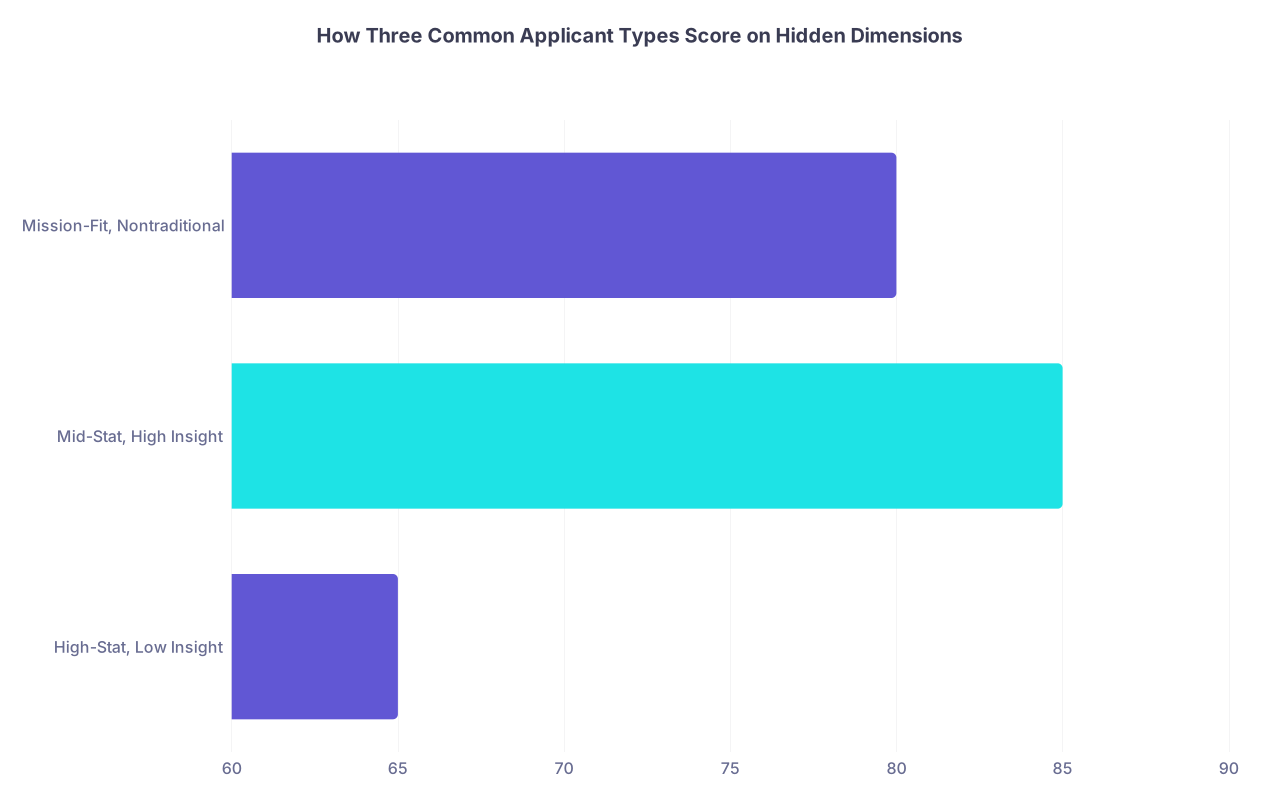
| Category | Value |
|---|---|
| High-Stat, Low Insight | 65 |
| Mid-Stat, High Insight | 85 |
| Mission-Fit, Nontraditional | 80 |
Think of that numeric value as “overall committee enthusiasm.”
1. High-Stat, Low Insight
- 522 MCAT, 3.9, impressive research.
- Interview: polished but shallow, clearly sees medicine mainly as an intellectual puzzle and status marker. Weak answers on failure and teamwork.
On paper, they’re strong. In conversation afterwards, you hear:
“Great stats, but I’m nervous about how they talked about patients as ‘interesting cases’ and dismissed nursing input.”
They might get in at a stat-obsessed school desperate to keep Step averages high. But many programs now have enough solid applicants that they’ll say, “Why take the risk?”
2. Mid-Stat, High Insight
- 510 MCAT, 3.6 with trend up. Worked 25–30 hours/week.
- Interview: thoughtful, specific, clear growth arc. Has seen real illness in family, can talk about systemic barriers without ranting.
Comments sound like:
“Not the strongest MCAT, but I’d trust them in front of patients. They’ve clearly thought about what this life actually entails.”
Holistic review is designed to save this person from being filtered out purely on numbers. These are the ones you see matched at good schools that supposedly “only take 520+.” They don’t. They take people interviewers want to teach.
3. Mission-Fit, Nontraditional
- 507 MCAT, 3.4 several years ago, but since then: full-time MA, years in a community health setting, leadership in harm reduction program.
- Interview: grounded, realistic, knows underserved care from the inside out.
At a research powerhouse who cares mostly about publications? Maybe not.
At a safety-net oriented state school? They may be at the very top of the list.
Holistic means context + trajectory + mission alignment, not “we ignore stats and go on vibes.”
How to Prepare Without Becoming Robotic
You don’t beat this system by memorizing 50 questions and performing a character. Faculty see that ten times a day.
You beat it by:
- Understanding what they’re really screening for.
- Choosing stories that clearly demonstrate low risk, high growth, and real fit.
- Practicing enough that you’re fluent but not scripted.
Do mock interviews, but add one twist: after each answer, ask your partner:
“If you were an attending filling out a rubric, what one word would you write next to that answer?”
If they say:
- Defensive
- Vague
- Unsure
- Intense
You’ve got work to do. You want words like:
- Grounded
- Thoughtful
- Genuine
- Mature
Because those single words are exactly the kind of shorthand interviewers jot down.
And remember: the bar is not perfection. The bar is “someone we believe will grow well here and not blow up in our face.”
You can absolutely clear that, even without flawless numbers, if you understand the unspoken game.

FAQs
1. If my interview feels “casual,” are they still using a rubric?
Yes. Even in so‑called “conversational” interviews, there’s usually a form waiting on the other side of the door. The interviewer might fill it out right after you leave instead of during, but the categories are the same: professionalism, communication, insight, motivation, fit, overall impression. A relaxed tone doesn’t mean the stakes are lower; it just means they want to see how you act when your guard is down.
2. Do MMI stations use holistic review too, or just checklists?
MMIs lean harder on checklists, but the same underlying concerns show up. Each station might score you on things like empathy, ethical reasoning, teamwork, and communication. Over multiple stations, they’re essentially building a composite picture of your professionalism, insight, and risk level. And yes, extreme red flags from a single MMI station can sink you, even if your other scores are solid.
3. How much can a single bad interview hurt me if the rest are good?
More than you’d like. At most schools, each interview generates an overall “support level.” A strong negative—especially one citing professionalism, arrogance, or dishonesty—can outweigh multiple neutral or mildly positive interviews. On the other hand, one lukewarm interview in a sea of “strong yes” comments usually doesn’t kill you. It’s the strongly negative outlier that’s fatal, not the merely average one.
4. Should I ever admit I’m not sure about my future specialty?
Yes. Saying “I’m completely certain I want to be a neurosurgeon” as a premed often makes you look naive. A better move is something like: “I’m leaning toward X because of Y experiences, but I’m open to discovering new interests in medical school.” What they want to hear is that you’ve thought about the kind of problems and patient populations you’re drawn to, not that you’ve already tattooed a subspecialty on your soul at 22.
5. What’s the one thing that most impresses interviewers in holistic review?
A specific, grounded story that shows growth. Not a dramatic trauma saga, just a clear example of you encountering a limitation, recognizing it, and changing your behavior in a way that stuck. When you can tell that story succinctly, without self-pity or self-aggrandizement, you light up three key boxes at once: insight, maturity, and future potential. Those are the applicants people remember and fight for in the room.
If you remember nothing else:
Holistic review at the interview stage is about risk and upside, not perfection.
They’re quietly grading your professionalism, insight, and mission fit, not your ability to recite polished lines.
The applicants who win are the ones who look safe to bet on and interesting to teach—for four intense years and beyond.