Last cycle, I watched two faculty argue in the hallway over a single applicant. Same MCAT range as the rest. Same GPA. Same generic research. But one of them said, “I want this student on my team,” and that was it—the tipping point. That applicant didn’t just “do well” in the interview; they triggered all the right hidden signals that most premeds never even realize exist.
Let me walk you through what actually makes interviewers go to bat for you when no one else is in the room. Because that’s the game you’re really playing: what they write and say about you after you’ve left the building.
What Interviewers Are Really Doing In That Room
If you think the interviewer is sitting there to verify your CV and ask a few behavioral questions, you’re already behind.
They’re doing three things simultaneously:
- Scanning for red flags – ego, rigidity, poor judgment, weird vibes.
- Estimating future value – will you represent the school well, work hard, not burn out or quit, not make their life miserable.
- Picking up micro-signals – tiny behaviors that hint at how you function on a team, under pressure, and with patients.
The official rubric might say “communication skills,” “professionalism,” “motivation for medicine.” Fine. That’s the public story. The private reality is more specific and more brutal:
“Would I trust this person alone with my mother at 2 a.m.?”
“Will this person embarrass us?”
“Would I want them on my service for a month?”
Students think it’s all about the content of their answers. It isn’t. It’s 60% content, 40% unspoken signals—tone, timing, how you handle small awkward moments, even what you do right after the interview.
Let’s break down the signals that actually move the needle.
Signal #1: How Fast You Recover From a Miss
Everyone prepares “perfect” answers. Almost no one prepares for the moment they choke.
I’ve watched this play out dozens of times. Interviewer asks, “Tell me about a time you failed.” The student launches into a story, loses their thread halfway, panics, and you can see the light go out behind their eyes.
Average applicant response? Long pause. Apology. Awkward restart. They never really recover. On the score sheet, that usually becomes “struggles under pressure” or “needs structure.”
The applicants people fight for handle that moment differently. They do three subtle things:
They name the glitch instead of pretending it isn’t happening.
“Let me reset that—I jumped ahead in my own story. I’ll start again briefly.”They compress instead of rambling.
They restart with a shorter, tighter version. Not a longer justification.They keep their body language open and steady.
Shoulders stay relaxed. Eye contact still there. No nervous laugh spiral.
To you it may feel like a meltdown. To a seasoned interviewer, that looks like clinical composure—exactly what you need with a crashing patient, a pimping attending, or an angry family.
Interviewers talk about this. I’ve heard comments like,
“He stumbled early, but the way he regrouped was impressive.”
“She got flustered, but she stayed present and didn’t spiral. That’s a good sign.”
Notice: they’re not looking for perfection. They’re looking for your recovery curve.
Practice this on purpose: have someone interrupt you mid-answer with “Start again, but more concise,” or “You lost me there—reset.” Train that smooth reset. It reads as emotional resilience, which is absolute gold.
Signal #2: Whether You Make the Interviewer’s Day Harder or Easier
This is the part no one tells you: interviewers are tired.
By the time you walk in, they’ve already seen 3–8 of you that day. They have charts to sign, emails to answer, maybe an OR case they’re thinking about. They are not looking for someone “impressive.” They’re looking for someone who doesn’t drain them.
The unspoken question: “Do I feel better or worse after 30 minutes with you?”
Applicants who get people fighting for them do a few things that lighten the whole interaction:
They pick up on the interviewer’s energy. If the interviewer is obviously rushed or low-key, they don’t talk like they’re giving a TED talk. They match the tone, but slightly more positive. That “slightly” matters.
They give clean, structured answers that don’t wander, so the interviewer doesn’t have to mentally herd them. Structure is a kindness.
They don’t make the interviewer pull teeth for every detail. When asked, “Tell me about your research,” they give a brief plain-English summary, then naturally add one layer of context without prompting. No jargon dump. No five-minute monologue.
You want the interviewer to think, “That was easy. I get who this person is. I could work with them.”
Here’s the insider secret: at the end of the day, when they’re ranking, the students who made their lives easier always creep higher than the stats alone would justify. Because committee members fight harder for the person they can already imagine on rounds, not the person who made them dig for meaning.
Signal #3: Your Relationship With Uncertainty
You’re entering a profession built on not knowing everything. Interviewers are very tuned into how you handle “I don’t know.”
Bad signals:
- Overconfident guessing
- Making stuff up
- Dodging direct questions
- Acting like asking for clarification is a weakness
I remember one MMI station: a scenario about a public health policy. Completely outside strict premed knowledge. One student confidently spouted nonsense about “CDC regulations” that didn’t exist. Another student said, “I’m not certain about the specific guidelines, so I’ll reason it out based on the principles I do know: equity, resource allocation, and harm reduction.”
Guess who scored higher. It was not the bullshitter.
When you don’t know, a strong signal is:
Acknowledge the limit without collapsing.
“I don’t know the exact statistic, but I understand the general trend is X.”Then reason out loud using principles, tradeoffs, or experiences.
“If I had to make a decision in that scenario, I’d consider A, B, C…”Close the loop with humility.
“If this were a real case, I’d check with… / I’d review…”
That pattern tells faculty: This person won’t fake knowledge with a patient. They’ll think clearly under uncertainty. They’re teachable. Those are non-negotiables.
Signal #4: The Way You Talk About Other People
This one is brutal because most applicants have no idea they’re failing it.
Interviewers listen very carefully to:
- How you talk about classmates
- How you describe “bad” group members
- How you narrate conflicts with supervisors or mentors
- How you handle questions about “difficult patients”
I’ve literally watched an applicant sink themselves in one story: “We had this lazy group member who never did anything, so I basically took over and did it all. We still got an A.”
On paper, that sounds like “work ethic.” In the room, it sounds like:
- Blames others quickly
- Control issues
- Poor insight into team dynamics
Contrast that with the applicant who says:
“We had a group member who was missing deadlines. Initially I was frustrated, but I realized I hadn’t actually asked what was going on. When I checked in, it turned out they were dealing with some family issues. We re-distributed the work, set up clearer check-ins, and ended up finishing on time.”
That’s a completely different signal:
- Empathy
- Accountability for communication
- Problem-solving within human realities
Here’s the insider rule:
Any time you talk about someone else’s flaw, you’re really talking about yourself.
Interviewers hear your judgment style, not just your story.
The people faculty fight for almost never throw others under the bus, even when invited to. They describe problems honestly, but they include their own learning and growth. That reads as emotionally safe, which is huge on clinical teams.
Signal #5: Micro-Leadership Without Swagger
Premed culture has ruined the word “leadership.” Everyone thinks it means titles and self-promotion. Faculty don’t care that you were “President” of something if your stories scream “I liked power.”
The students who stick in people’s minds display leadership in much quieter ways, right there in the interview:
They answer in a way that orients the listener.
“I’ll answer that in two parts—first, what drew me to medicine, and second, why this school in particular.” That’s what good residents do on rounds: they organize chaos for the team.When given a group or ethical scenario, they naturally bring in multiple perspectives without grandstanding.
“From the patient’s side, this might feel X. For the nurses, it creates Y. As a student, my role would be Z.”They don’t pretend to be the hero in every story. They share credit. They show they can follow well, not just lead.
Faculty want future residents, not future med school club presidents. They’re scanning for people who can move information clearly, respect hierarchy, and still take initiative where appropriate.
One interviewer’s comment that I still remember:
“She never called it leadership, but everything about the way she framed her stories was what I want in a senior resident.”
That’s the signal you’re aiming for.
Signal #6: Your Relationship to Pressure and Failure (Beneath the Script)
Every applicant has a canned answer to “Tell me about a challenge” or “Tell me about a time you failed.” Most of them sound rehearsed to death and emotionally flat.
Here’s what experienced interviewers are actually listening for:
- Do you describe only fake failures? (“I studied so hard that I burned out a little.”)
- Do you present yourself as the secret hero in every scenario?
- Do you ever admit to being wrong in a way that actually cost you something?
- Have you metabolized the failure, or are you still defensive?
I watched a student with a mediocre MCAT get ranked above stronger applicants because of how he handled this exact thing. He talked about bombing his first organic chemistry exam and initially blaming the professor. Then he said, very plainly:
“I realized I had been coasting on what worked in high school. I wasn’t actually learning, just memorizing. I went to office hours, admitted that to my professor, and completely changed how I studied. It was a hit to my ego, but it changed how I approach every challenge now.”
No drama. No over-selling. Just honest self-confrontation plus adaptation.
The signal underneath: This person won’t crumble the first time residency smacks them in the face.
If every story you tell somehow ends with you being secretly perfect, you’re sending the opposite message: fragile ego, can’t handle real feedback, high risk of implosion.
Signal #7: How You Close the Loop After the Interview
Now here’s the part applicants consistently misunderstand.
No, a thank-you email will not magically save a bad interview. But the way you follow up can reinforce or weaken the internal picture they already have of you.
Faculty won’t tell you this, but they absolutely show each other standout messages. I’ve seen this play out in real time:
One student sends a generic, obviously copy-pasted thank you. Fine. Neutral.
Another sends: “Thank you again for our conversation about longitudinal primary care. I looked up the community clinic you mentioned and was struck by how early students get exposure there. It made me even more excited about the possibility of learning at [School].”
Short. Specific. Thoughtful. Not needy.
When that student’s name came up in ranking, the interviewer said,
“He followed up on what we talked about; he’s actually thinking long-term.”
That small reinforcement nudged them over another equally qualified applicant.
Do not overdo this. You’re not writing a second personal statement. One or two lines that show you listened and connected something from the conversation to your real interests—that’s enough.
The hidden rule: every touchpoint, even after you leave, either confirms “professional, grounded, reflective” or “trying too hard, anxious, generic.”
Hidden Rubrics: What They’re Actually Scoring
You won’t see this written in the official materials, but this is more or less how many faculty mentally bucket you. Not in exact words, but in feel.
| Category | What It Really Means |
|---|---|
| Easy Yes | I’d be happy to work with them anytime |
| Mild Yes | Solid, no concerns, not unforgettable |
| Fence / Neutral | Fine, but no one will fight for them |
| Mild No | Something feels off, not worth the risk |
| Hard No | Clear red flags, absolutely not |
You want to live in “Easy Yes.” Not because you dazzled them with brilliance, but because you quietly checked all the risk boxes:
- They won’t embarrass us.
- They’ll treat people decently.
- They’ll handle stress and feedback without drama.
- They’ll pull their weight.
- They might even be fun to have around at 3 a.m.
Every signal I’ve described feeds directly into those unspoken categories.
How to Actually Practice These Signals (Not Just “Prepare Answers”)
Most premeds “prepare for interviews” by memorizing answers and reading their own personal statement three times.
That’s not how you build these signals.
You need to simulate the dynamics of the room:
- The interruption
- The weird question
- The long pause
- The slightly skeptical interviewer
- The end-of-day fatigue
Here’s a practical sequence you can run with a friend, mentor, or advisor:

| Step | Description |
|---|---|
| Step 1 | Start Mock Interview |
| Step 2 | Standard Questions 10-15 min |
| Step 3 | Introduce Curveball or Ethical Scenario |
| Step 4 | Deliberate Disruption or Interruption |
| Step 5 | Forced Reset of an Answer |
| Step 6 | Debrief on Signals Not Content |
When you debrief, don’t just ask, “Did my answers sound good?” Ask:
- When I got stuck, did I look rattled or did I reset cleanly?
- Did I make you work to follow me, or was it easy to listen?
- Did any story make me sound arrogant, bitter, or like a martyr?
- Did I ever seem to fake knowledge instead of reasoning?
You’re tuning how you show up, not just what you say.
And record yourself. Painful, but necessary. Watch for:
- Talking speed
- Rambling
- Defensive body shifts when challenged
- Over-smiling when you’re uncomfortable
You’re training signal control. That’s a very different mindset from memorizing talking points.
The One Thing Most Applicants Still Won’t Do
Here’s the dirty secret: everything I’ve told you here, a savvy student could implement in 3–4 weeks of deliberate practice.
Most won’t. They’ll read it, nod, and go back to rehearsing perfect answers in the mirror.
If you actually want interviewers to fight for you, focus on these:
- Control your recovery when things go off-script.
- Make the interaction easy and energizing for the interviewer.
- Show a mature, grounded relationship with failure, uncertainty, and other people.
Those are the levers insiders use when we decide who we’re willing to stake our name on in committee.
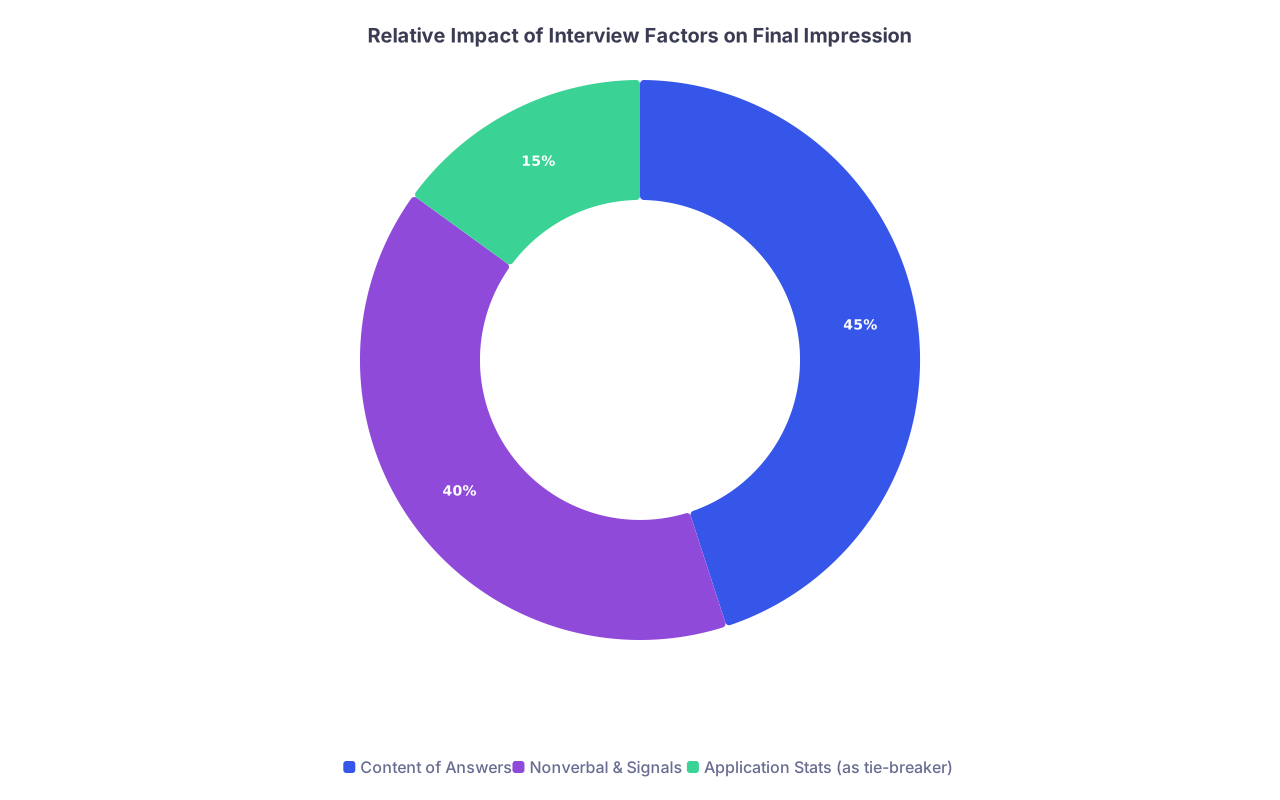
| Category | Value |
|---|---|
| Content of Answers | 45 |
| Nonverbal & Signals | 40 |
| Application Stats (as tie-breaker) | 15 |
When two applicants have similar stats—and that’s most of you—those silent 40% of signals decide who gets pulled into “Easy Yes” and who gets quietly left in the middle of the list.
Learn to control those, and you stop being “another good applicant” and start being the one people argue for when the doors are closed.