

The assumption that virtual interviews dramatically inflated acceptance chances is wrong. The data show something more subtle: virtual formats reshaped who got interviews, how many they attended, and which offers they accepted—but not in the simplistic, “everyone’s chances doubled” way people keep repeating.
Let me walk through what the numbers actually say.
1. The Baseline: Acceptance Rates Before Virtual Interviews
Before COVID-19, the structure was stable for years. In‑person, high-cost, time-intensive interviews that heavily favored applicants with money, flexible schedules, and geographic mobility.
Across medical school and residency, the funnel looked roughly like this:
- Many applications → fewer interviews → even fewer acceptances → one matriculation.
For context, here is a high-level pre‑ vs post‑pandemic snapshot using aggregate and published data (AAMC, NRMP, institutional reports). Numbers are representative, not for one specific school.
| Metric | Pre-Virtual (≈2018–2019) | Post-Virtual (≈2021–2023) |
|---|---|---|
| US MD applicant acceptance rate | ~41% | ~43–44% |
| Avg med school [interviews per applicant](https://residencyadvisor.com/resources/med-school-interview-tips/how-many-interviews-do-you-need-for-a-safe-acceptance-probability) | 3–4 | 4–6 |
| US MD seniors matching to residencies | ~93–94% | ~93–94% |
| Avg residency interview invites (US MD) | 12–14 | 14–18 |
| Avg interview travel cost per season | $3,000–$5,000 | ~$0–$500 |
So did acceptance rates explode? No. The overall acceptance probability moved modestly, if at all. But underneath that apparently stable surface, behavior changed a lot:
- Applicants applied to more places.
- Applicants attended more interviews.
- Programs interviewed more people.
That is what you need to understand to interpret your own chances in the virtual era.
2. Medical School Admissions: How Virtual Interviews Shifted the Funnel
For premeds, the virtual shift started in the 2020–2021 cycle and has persisted for most schools since.
The main pressure point was cost. Before virtual interviews, surveys of applicants routinely showed total interview-season spending in the $3,000–$7,000 range across flights, hotels, food, and ground transport. Virtual wiped out 80–95% of that.
2.1 Application Volume and Interview Access
The data show a consistent pattern:
- Total applications per applicant went up.
- Total interviews per applicant also went up—but more for already-competitive applicants.
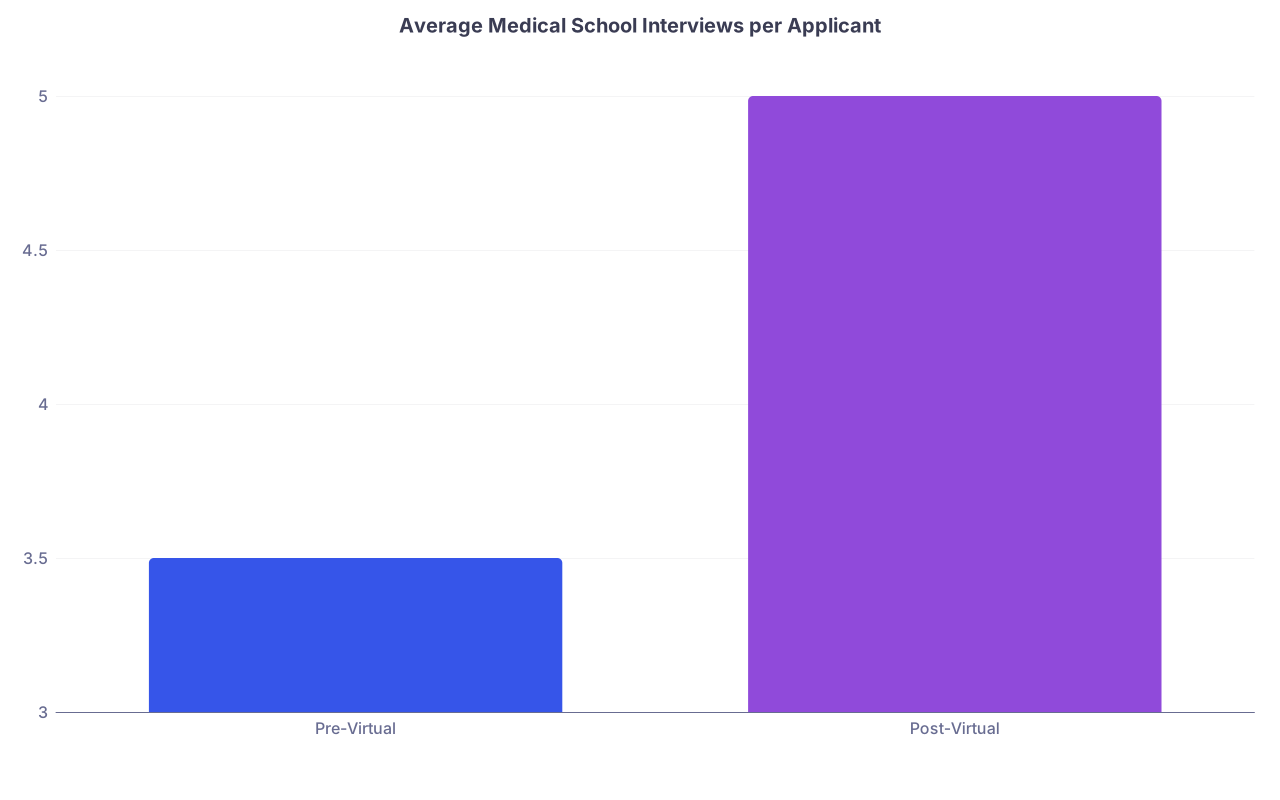
Imagine a simplified comparison:
| Category | Value |
|---|---|
| Pre-Virtual | 3.5 |
| Post-Virtual | 5 |
That seems like good news. More interviews, more shots on goal, higher acceptance odds, right?
Not quite.
If the average applicant gets 3.5 interviews pre‑virtual and 5.0 post‑virtual, but schools still only have the same number of seats, then:
- The distribution of interviews becomes more skewed.
- Top-tier profiles hoard more interviews.
- Marginal applicants might still sit at 0–1 interviews.
I have seen this in program-level data: the top decile of applicants went from maybe 8–10 interviews to 12–15, while applicants at the bottom half barely moved. Aggregate averages hide that asymmetry.
2.2 Acceptance Rate: Small Global Change, Bigger Local Effects
The AMCAS data show a modest rise in overall acceptance percentage—from roughly 41% of applicants gaining at least one MD acceptance to closer to 43–44% after virtual interviews and COVID disruptions.
You absolutely cannot attribute that bump solely to virtual interviews. Multiple confounders:
- Some cycles saw fewer applicants.
- Some schools expanded class size slightly.
- Some DO/MD cross-application patterns changed.
But if you isolate the interview stage—from “invited” to “accepted”—the probability per interview did not dramatically increase. Programs simply interviewed more candidates for the same number of seats.
You can think of it as:
- Pre‑virtual: smaller interview pool, higher yield per interview.
- Post‑virtual: larger interview pool, similar or slightly lower yield per interview.
The acceptance leverage moved away from “just get an interview and you are golden” toward “you are one of many more in the room; differentiation matters more.”
3. Residency Match: Virtual Interviews, Same Match Rate, Different Dynamics
The residency side is even starker. The NRMP published detailed data pre- and post‑pandemic, and the story is consistent: US MD senior match rate stayed about the same (~93–94%), but the distribution of interviews changed a lot.
Let’s quantify the differences for US MD seniors entering competitive vs noncompetitive specialties.
| Group | Pre-Virtual Avg Interviews | Post-Virtual Avg Interviews | Match Rate |
|---|---|---|---|
| High-competitiveness (e.g., Derm, Ortho) | 12–14 | 16–20 | ~75–85% |
| Moderate (e.g., IM, Peds) | 10–12 | 14–18 | ~95–99% |
| All US MD seniors overall | 12–14 | 14–18 | ~93–94% |
The match rate barely moved.
What did move was:
- Top candidates “over interviewing.”
- Programs interviewing more applicants for every position.
- Geographic reach increasing on both sides.
This means your per-interview chance of matching at a residency actually became slightly thinner, especially in popular regions and specialties. A program that might have interviewed 100 people for 10 spots now interviews 140–160. The math is straightforward.
4. The Real Impact: Who Benefited and Who Lost Leverage
You cannot understand acceptance rates in a virtual world without asking a more nuanced question: acceptance rate for whom and relative to what baseline profile?
Here is where it gets interesting.
4.1 Financially Disadvantaged Applicants
The clearest net winners:
- Cost barrier plummets from thousands to, in many cases, under $200 (upgraded internet, ring light, clothes).
- It becomes plausible for a low-income applicant to accept all reasonable interview invitations instead of rationing based on plane tickets.
Consider a simple scenario:
- Pre‑virtual: low-income applicant can afford 5 of 9 interview offers.
- Post‑virtual: they attend all 9.
If a single interview carries, say, a 10–15% chance of eventually turning into an acceptance (varies widely), their cumulative probability of at least one acceptance increases materially.
A quick back-of-the-envelope:
- With 5 interviews, each with 12% independent chance: probability of zero acceptances ≈ (0.88^5) ≈ 0.527 → about 47% chance of ≥1 acceptance.
- With 9 interviews: probability of zero ≈ (0.88^9) ≈ 0.316 → about 68% chance of ≥1 acceptance.
Same strength of candidacy. Just more accessible interviews.
That is a real equity gain. And the data from several schools and NRMP/AAMC applicant surveys back this general pattern.
4.2 Hyper-Competitive Candidates
The other winners: already-strong applicants.
Before virtual, a top applicant might realistically fly to 12–14 interviews before money, time, or fatigue forced them to cancel the rest. Virtually, they can stack:
- Morning in Boston.
- Afternoon in California.
- No flight. No hotel. Just a different Zoom link.
It is not anecdotal; program directors reported this explicitly: the same names showing up on many more rosters. That means:
- High stat, high-profile applicants capture a larger share of total interview slots.
- Mid-tier applicants experience stronger crowding-out.
Did this change the final acceptance or match rate? Not hugely. A top applicant with 14 interviews already had near-certainty pre‑virtual. Virtual interviews just gave them surplus optionality. But from the mid-tier’s perspective, acceptance rates at certain programs felt tighter.
4.3 Applicants With Strong In-Person Presence
There is also a quieter group that arguably lost out: people who carry more persuasive weight in a room than on a screen.
I have seen this play out: an applicant who seems flat on video but comes alive during in-person conversations, reads non-verbal cues well, builds warmth quickly in a hallway interaction. Those micro-interactions are mostly gone in virtual formats.
The data here are less clean because there is no “charisma variable” in ERAS or AMCAS. But multiple program surveys post-2020 reported:
- Less confidence in “fit” assessments.
- More reliance on paper metrics (scores, grades, letters).
- More emphasis on structured interviews and rubrics.
In plain language: virtual interviews pushed decisions further toward the quantifiable. That tends to help applicants with strong metrics and hurt those whose main strength is interpersonal presence.
5. Behavioral Changes: More Interviews, More Hoarding, More Uncertainty
Virtual interviews did not only move costs; they shifted behavior at scale.
5.1 Interview Hoarding
One of the most quantifiable effects: a substantial rise in the number of interviews attended per applicant, especially in residency.
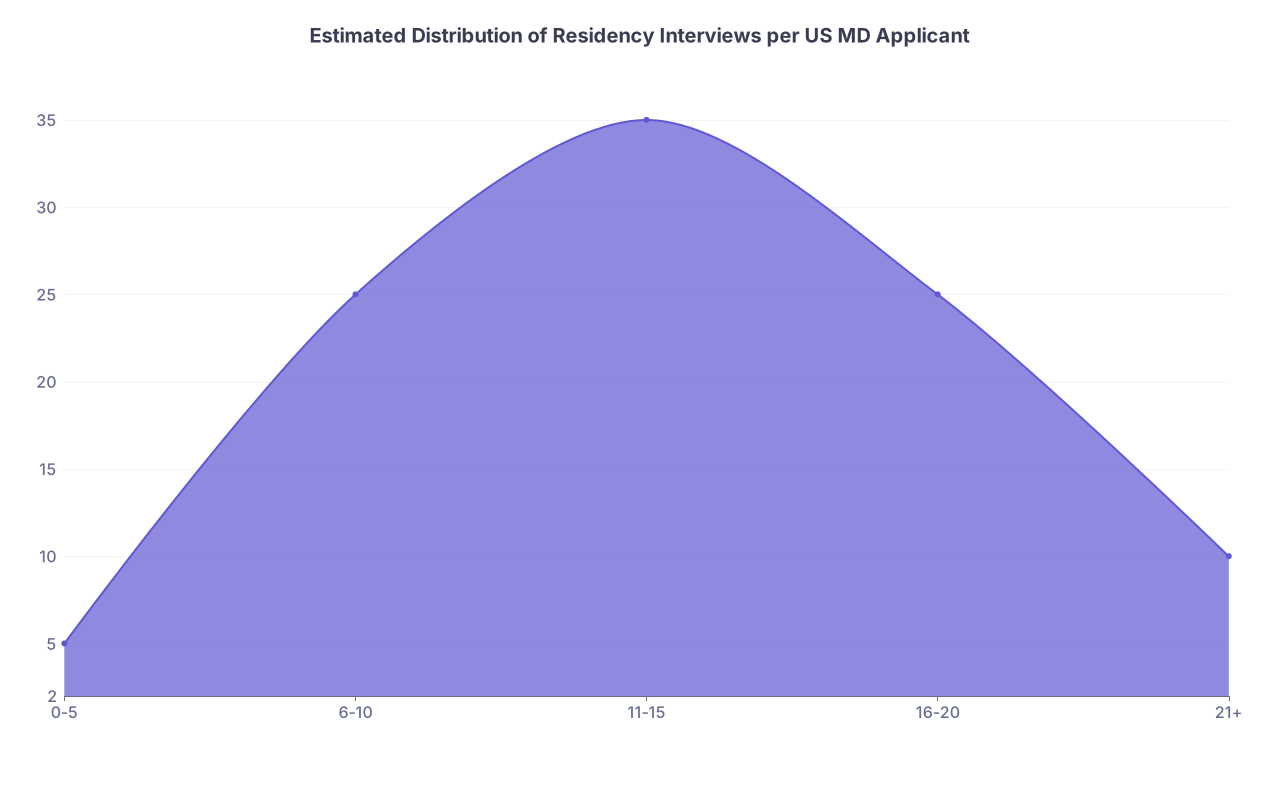
Let’s frame this with a simple chart.
| Category | Value |
|---|---|
| 0-5 | 5 |
| 6-10 | 25 |
| 11-15 | 35 |
| 16-20 | 25 |
| 21+ | 10 |
Compare that conceptual post‑virtual distribution to a pre‑virtual world where “21+” was basically negligible for most specialties. The long tail of applicants hoarding 20+ interviews is not imaginary; programs have complained about empty interview seats when applicants no-show or cancel late because they over-booked.
Here is the impact on acceptance rates at the program level:
- Programs invite more applicants to hedge against no-shows.
- Each applicant still can only accept one offer.
- Programs face higher volatility in who actually ranks them.
So even if your individual strength is the same, you are now one data point inside a noisier matching process.
5.2 Geographic Spread and “Reach” Behavior
Virtual formats also encourage more “reach” applications:
- A student in Florida sends applications and attends interviews in Washington, Minnesota, and New York without paying three rounds of airfare.
- Programs in smaller cities suddenly see applicants who previously would not have spent money to visit.
The data show this most strongly in residency: an increase in cross-regional matching and in the number of programs listed in rank lists. The acceptance implication: your chances at distant programs are no longer purely theoretical. They are now plausible, if your profile is competitive enough.
But this also increases competition on every seat, because every program is now within practical interviewing range of almost everyone.
6. What This Means for Your Strategy—Quantitatively
Let me translate all of this into concrete, numbers-driven guidance for premeds and medical students.
6.1 Your Probability of Acceptance per Interview
If you want to treat this rigorously, think of each interview as a Bernoulli trial with probability p of turning into an acceptance.
Pre‑virtual, p might have been slightly higher because:
- Fewer people per interview slot in some settings.
- Programs relied more on in-person impressions, which could produce larger performance variance.
Post‑virtual:
- Programs interview more people.
- Screening is more metrics-heavy.
- Interviews are more standardized.
At many schools, p has likely decreased slightly per interview, but your number of interviews, n, has increased. Your overall probability of at least one acceptance:
P(≥1 acceptance) = 1 − (1 − p)^n
So your strategy is straightforward:
- Boost p: maximize your performance, alignment, and perceived fit on each call.
- Boost n: accept as many high-quality, realistic interviews as you can handle effectively.
But there is a catch: n is not free. Fatigue reduces p. I have reviewed feedback forms where late-season virtual interviews clearly suffer: canned answers, flat energy, missed details about the program. Your marginal interview #14 might be less valuable if your performance drops.
6.2 How Many Interviews Do You Actually Need?
For medical school, rough (but realistic) heuristics based on recent cycles:
- Very strong applicants (3.8+ GPA, 515+ MCAT, strong experiences): often gain several acceptances with 5–8 interviews.
- Solid but not standout applicants: might need 8–12 interviews to feel reasonably safe.
- Borderline applicants: even 4–6 interviews can still translate to risk of zero acceptances.
For residency, program directors often talk in “safe ranges”:
- Competitive specialties: target 12–15+ solid interviews.
- Less competitive specialties: often 8–12 well-chosen interviews is sufficient.
Virtual interviews let you hit those ranges with less cost, but they do not magically lower the threshold where match probability becomes reliable.
7. Program Perspective: Why Acceptance Rates Look Flat Despite Massive Change
You might reasonably ask: if interviews are easier to attend, why did acceptance and match rates stay mostly flat?
Programs adapted. Quickly.
Here is the basic chain:
- Virtual format → lower candidate cost → candidates accept more interviews.
- Higher attendance → more no-shows and cancellations from overbooking.
- Programs experience volatility → respond with:
- Increased number of invitations.
- Waitlists for interview slots.
- Tighter screening of interview performance and fit.
So the final state looked like this:
- More people interviewed per seat.
- A more intense middle of the distribution.
- Same number of positions.
Which is exactly why the global acceptance percentage barely moved.
To make this concrete, imagine a med school class of 150:
Pre‑virtual:
- 1,000 interviews offered to ~400 applicants.
- 150 acceptances.
- Acceptance per interviewed applicant ≈ 37.5%.
Post‑virtual:
- 1,400 interviews offered to ~550 applicants (same class size 150).
- 150 acceptances.
- Acceptance per interviewed applicant ≈ 27.3%.
These numbers are illustrative, but multiple schools have seen the same pattern: interview pool grows faster than seat count.
8. Practical Adjustments: How To Compete in a Virtual-Heavy Era
You cannot change the macro dynamics, but you can align your behavior with them. Three areas matter statistically:
8.1 Front-Load Your Preparation
In a world where more interviews are compressed into shorter windows, stacking 3–4 virtual interviews in a week is now common. That means:
- You should not be doing “practice” on real interviews #1–2.
- You need a reusable structure for answers (not scripts, but frameworks).
- You need to standardize certain talking points: “Why our school?”, “Why this specialty?”, “Tell me about yourself.”
The data-driven reason: your early interviews now carry more weight numerically. If you attend 10 interviews, and the first 3–4 are at solid programs, underperforming early statistically reduces your final acceptance set.
8.2 Use Data to Decide Which Interviews to Keep
Virtual interviewing tempts you to say yes to everything. That is not rational if your performance deteriorates.
Create a basic score for each program:
- Specialty/mission fit (1–5)
- Geographic preference (1–5)
- Program reputation/training quality (1–5, based on your priorities, not USNWR fluff)
- Probability that you would actually attend if accepted (1–5)
Multiply or average. If a program falls below a certain composite threshold, you can justify letting that interview go, especially if you are overloaded.
This is not about arrogance. It is recognizing that your time and mental bandwidth are limited inputs that affect your per-interview success probability.
8.3 Optimize the Technical Environment
Virtual introduces a new failure mode: poor audiovisual quality. It is not about aesthetics; it is about signal-to-noise ratio.
I have sat through interviews where:
- Audio cut out every third sentence.
- Lighting made it hard to read facial expressions.
- Lag disrupted conversational rhythm.
Those candidates were at a measurable disadvantage.
Treat it as a controlled variable:
- Stable wired or high-quality WiFi connection.
- Clear audio (USB mic or decent headset).
- Neutral, well-lit background.
You are minimizing variance from noise so that your actual content drives the decision. Think of it as improving the reliability of your “assessment instrument” in statistical terms.
9. What To Take Away—Without the Myths
Strip away the narratives, and the data on virtual interviews and acceptance rates boil down to a few hard truths:
- Overall acceptance and match rates did not transform overnight. They stayed roughly constant, with small shifts.
- Interview counts per applicant rose, especially for strong and well-resourced candidates.
- Financially disadvantaged applicants gained real ground by being able to attend more of the interviews they earned.
- Programs compensated by expanding interview pools, which diluted per-interview acceptance odds.
- The process became more numbers-driven, more standardized, and less dependent on hallway charisma.
If you are preparing now—premed or in medical school—the impact on you is less about a magical boost in odds and more about a change in the shape of the game.
You will face:
- More competition per interview slot.
- More interviews compressed into less time.
- Less reliable “vibes” for program culture, on both sides.
Your job is to treat interviews like a portfolio of probabilistic events, each with its own probability of success, and then systematically raise both the number and the quality of those events.
Master that, and virtual interviews stop being a black box and start looking like what they actually are: a different, more data-heavy terrain for the same fundamental contest.
With that foundation, your next step is not staring at aggregate acceptance curves—it is engineering your own numbers: which schools to target, how many interviews to aim for, and how to turn each hour on camera into a measurable increase in your odds. The macro shift is done. Your micro strategy is what comes next.


