73% of medical school applicants who reach the interview stage still do not matriculate to a given program.
That single number destroys a common myth: “Once you get the interview, it’s basically a coin flip.” The data say otherwise. The interview is not a formality. It is a sorting mechanism. A harsh one.
Let me walk through what the numbers actually show when you break acceptance rates down by interview performance tier rather than lumping all interviewees together.
The Baseline: From Primary Application to Interview to Acceptance
First, anchor the big funnel. Across recent AAMC data cycles (U.S. MD):
- Roughly 55–60k applicants per cycle
- Roughly 22–24k matriculants
- Overall acceptance rate: ~40%
That 40% hides the real story. Once you split the process into stages, the contrast is sharp:
- From primary application to at least one interview: ~30–40%
- From at least one interview to at least one acceptance: ~60–70% (across all schools combined)
But that 60–70% “post-interview success” stat is wildly misleading if you apply it to an individual program. At any single school, the picture is more like:
- School sends 800–1,000 interview invites
- School enrolls 100–150 students
- Per-school acceptance probability among interviewees: often 10–25%
So yes, if you get 10–15 interviews spread across schools, your odds of matriculating somewhere are pretty good. But your chance of converting any one interview into an offer depends brutally on your relative position in that interview cohort.
And that is where performance tiers come in.
What “Interview Performance Tiers” Look Like in Practice
Most schools will never tell you this out loud, but internally they usually categorize interview performance into bands. Labels differ, but the logic is the same. Something like:
- Outstanding / Top Tier
- Strong / Above Average
- Acceptable / Average
- Concerning / Below Average
- Not Recommended
Virtually every admissions committee I have seen uses some version of this tiered approach, whether explicitly in the scoring sheet or implicitly in committee discussion. They may have:
- A numeric rating (e.g., 1–5 or 1–7) per interviewer
- A composite interview score
- A categorical recommendation: “Recommend,” “Borderline,” “Do Not Recommend”
Translate that into tiers, and you can actually approximate acceptance rates by performance level.
Let’s model a representative mid-tier MD program:
- 9,000 primary applications
- 900 interview invitations
- 150 eventual matriculants
Assume they categorize the 900 interviewees into 4 tiers based on composite interview rating. Watch what happens to acceptance probability.
| Interview Tier | Share of Interviewees | Acceptance Rate (Per School) |
|---|---|---|
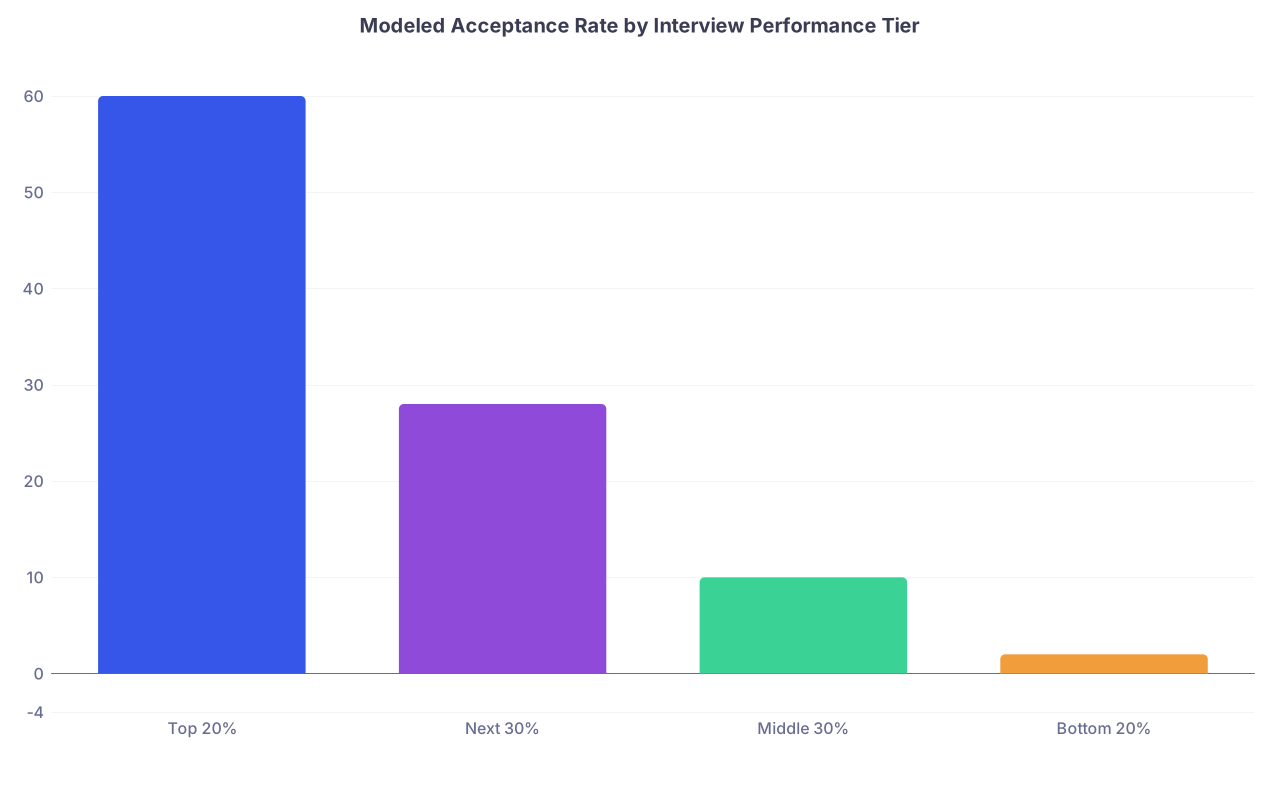
| Top 20% (Tier 1) | 20% (≈180 students) | 55–70% |
| Next 30% (Tier 2) | 30% (≈270 students) | 20–35% |
| Middle 30% (Tier 3) | 30% (≈270 students) | 5–15% |
| Bottom 20% (Tier 4) | 20% (≈180 students) | 0–3% |
The spread is huge. From roughly “better than 1 in 2” in the top tier to “statistical rounding error” in the bottom tier.
Put bluntly: your interview performance tier can change your per-school acceptance probability by more than 20-fold.
Let me visualize the spread.
| Category | Value |
|---|---|
| Top 20% | 60 |
| Next 30% | 28 |
| Middle 30% | 10 |
| Bottom 20% | 2 |
This is why saying “once you get the interview, everyone is equal” is fantasy. The interview reshuffles the deck completely.
How Much Does the Interview Weigh vs. GPA/MCAT?
Applicants keep asking, “Does the interview really outweigh my stats?” You can argue philosophy, but the way most schools actually behave is surprisingly consistent.
For candidates who already have an interview invite, the marginal decision often looks something like this (in rough weights):
- Pre-interview file (GPA, MCAT, experiences, essays, LORs): 40–60%
- Interview performance: 40–60%
That does not mean they do a formal 50/50 weighted formula. It means:
- Before the interview, your GPA/MCAT are gatekeepers and signal strength
- After the interview, your relative position vs. other interviewees is heavily driven by the interview score
Here is a simple stylized model that reflects a lot of schools’ behavior:
| Component | Typical Weight Range |
|---|---|
| Academic metrics (GPA/MCAT) | 25–40% |
| Experiences & mission fit | 25–35% |
| Interview performance | 35–50% |
Once you are in the interview pool, the interview can be the single largest individual component of your final rank list position.
A mediocre interview can absolutely sink a 3.9/522 applicant, especially at mission-driven schools. I have seen it. More than once.
What Actually Separates Tiers: Observable Behaviors
People talk about “good fit” like it is magic. It is not. Interviewers are not psychics; they evaluate specific, observable signals. When you look at aggregate scoring sheets, certain patterns show up repeatedly.
Tier 1 (Top 20%): “We Want This Student Here”
Data patterns across many schools:
- Consistently high ratings across interviewers (4–5 on 5-point scales, or top decile on ranking forms)
- Near-unanimous “Recommend” votes; sometimes multiple comments like “top 5% I've seen this season”
- Short, efficient committee discussion — there is rarely a fight about these candidates
Common features in their behavior:
- Clear, specific stories that match their application narrative
- Evidence of reflection: they have thought about failures, difficulties, and system-level problems
- Professional but not robotic demeanor; natural conversation flow
- Strong alignment with school mission (e.g., rural focus, underserved care, research intensity)
These are the people who jump tiers. A 3.65/510 becomes extremely competitive after a Tier 1 interview at a mission-aligned state school.
Tier 2 (Next 30%): “Solid; Would Be Happy to Have”
Statistically:
- Mixed ratings but skewed high, usually 3–4 on 5-point scales
- Mostly “Recommend” or “Acceptable” with occasional lukewarm comments
- These applicants occupy the giant middle of the rank list; outcomes depend on yield, class size, and competing offers
Behaviorally:
- Answers are coherent but not deeply memorable
- Adequate insight into challenges, ethics, and teamwork
- Professionalism is solid, but they may feel rehearsed or slightly generic
They are not hurting themselves, but they are not separating from the pack either.
Tier 3 (Middle 30%): “Borderline; Needs Strong File or Special Reason”
Patterns:
- Interview ratings cluster in the 2–3 range
- Comments frequently include words like “reserved,” “generic,” “scripted,” “limited depth”
- These candidates rely heavily on strong pre-interview files to stay viable
Common issues:
- Over-rehearsed answers; the same 3 clichés repeated (“I want to help people,” “I love science,” “I am a hard worker”)
- Struggle to give specific examples under pressure
- Difficulty articulating why this school specifically
Many of these applicants do not realize how flat they come across. On paper, they look fine. In person, they blend into statistical noise.
Tier 4 (Bottom 20%): “Probably Not”
This group has a near-zero shot at that particular program unless something very unusual is happening (legacy, extreme institutional priority, etc.).
Data markers:
- At least one very low rating (1–2 on a 5-point scale)
- Multiple “Do not recommend” or “Concerning” comments
- Sometimes flagged to admissions leadership for discussion of red flags
Observations from repeated cycles:
- Unprofessional remarks, dismissive attitude, or clear lack of insight into privilege
- Inconsistent answers that contradict their application
- Poor understanding of the realities of medicine (e.g., grossly idealized or entitled expectations)
These are not “bad people”. They are just not performing at a level commensurate with the rest of the interview pool.
How Interview Tier Interacts with Number of Interviews
Now connect tiers to something applicants actually care about: the chance of getting at least one acceptance across all schools.
Take a realistic scenario. Applicant has:
- Competitive stats and experiences
- 10 MD interview invitations
Assume (based on their preparation) they end up in:
- Tier 1 at 20% of schools
- Tier 2 at 40%
- Tier 3 at 30%
- Tier 4 at 10%
Use the per-tier per-school acceptance probabilities from earlier (approximate midpoints):
- Tier 1: 60%
- Tier 2: 28%
- Tier 3: 10%
- Tier 4: 2%
Expected acceptances:
- Tier 1: 2 schools × 0.60 ≈ 1.2
- Tier 2: 4 schools × 0.28 ≈ 1.12
- Tier 3: 3 schools × 0.10 ≈ 0.30
- Tier 4: 1 school × 0.02 ≈ 0.02
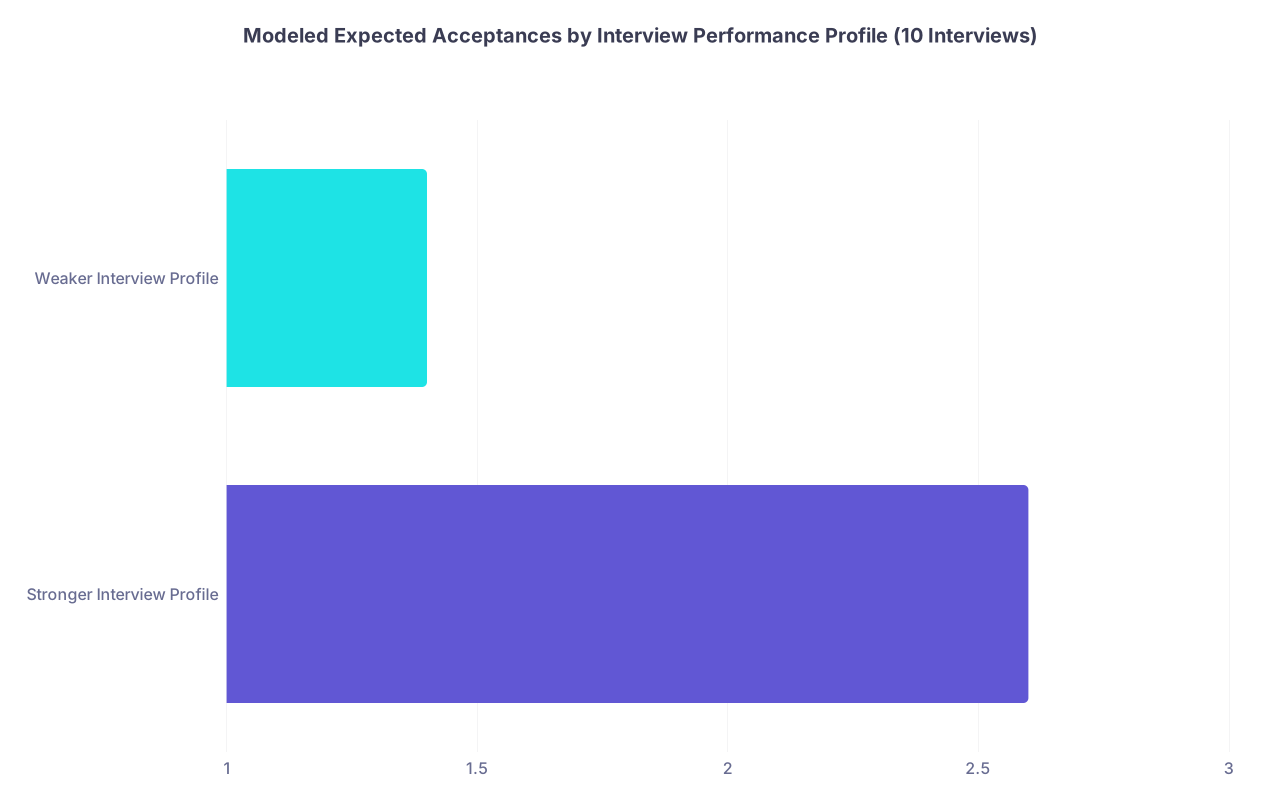
Total expected offers: ≈ 2.64 acceptances.
Now imagine the same file but with weaker interview performance:
- Tier 1 at 0 schools
- Tier 2 at 30% (3 schools)
- Tier 3 at 50% (5 schools)
- Tier 4 at 20% (2 schools)
Expected acceptances:
- 0 × 0.60 = 0
- 3 × 0.28 = 0.84
- 5 × 0.10 = 0.50
- 2 × 0.02 = 0.04
Total expected offers: ≈ 1.38 acceptances.
Same number of interviews. Same GPA. Same MCAT. Roughly half the expected acceptances, solely due to systematically landing in lower interview tiers.
If you classify this distribution visually, the shift is obvious.
| Category | Value |
|---|---|
| Stronger Interview Profile | 2.6 |
| Weaker Interview Profile | 1.4 |
This is why serious applicants put as much planning into interview season as they do into the MCAT. The yield difference is not subtle.
Virtual vs. In-Person: Does It Change the Math?
Post-2020, many schools moved to virtual interviews. The fear was that nuance would be lost and interview weight might drop. The reality from admissions data and committee behavior has been more nuanced:
- Conversion rates (interview → acceptance) have stayed surprisingly similar
- Inter-interviewer reliability in scoring often improved slightly (standardized format, less day-of logistics noise)
- Non-verbal cues matter slightly less; clarity of communication and structure of answers matter more
What has changed:
- Technical issues and poor setup (bad audio, terrible lighting, background distractions) now create avoidable downward bias
- Applicants who do not adapt their preparation to the virtual format often slide from Tier 2 into Tier 3 simply by seeming disengaged on-screen
But the core fact stands: schools still use the interview to stratify applicants.
Virtual vs. in-person is a modality question, not a weight question.
Where Interview Preparation Actually Moves the Needle
You cannot script charisma. But you can control a lot of the variance that decides whether you live in Tier 2 or Tier 3.
Patterns from applicants who consistently punch above their “paper” stats in interviews:
They have a tight, data-backed understanding of their own story.
They know their key themes (service, research, rural care, etc.) and have 2–3 specific episodes ready to illustrate each point. Not 10 half-baked ones.They practice adaptive rather than memorized responses.
When you ask them a left-field question about a healthcare policy or a personal failure, they can map it back to their core experiences without sounding robotic.They understand the school’s institutional data.
They know match lists, primary care vs. subspecialty emphasis, community partnerships. They reference them concretely: “Your longitudinal clinic in X neighborhood aligns with my Y experience…”They have rehearsed high-risk zones:
- Gaps, withdrawals, institutional actions
- Major career pivots (finance to medicine, engineering to medicine)
- Low or uneven grades in core science courses
The difference between a Tier 1 and Tier 3 handling of a C in organic chemistry is night and day.
They record themselves — and actually analyze the footage.
They watch for talking speed, filler words, and non-verbal tics. They time their answers. They see if they are rambling or missing the question.
Interview prep does not turn a bottom-quartile applicant into a superstar. It does reliably bump people up roughly one tier on average. And that one-tier shift is exactly where acceptance probabilities explode.
The Harsh Edge Cases: When Interviews Overrule Everything
There are rare but important scenarios where interview performance acts as a hard gate, independent of how beautiful your metrics are.
Patterns I have seen repeatedly:
Applicant with 3.95 GPA, 522 MCAT, strong research, trips a major professionalism red flag during an MMI station (disrespect, dishonesty, alarming ethical judgment). Multiple interviewers flag them. Final outcome: “Do not rank” for that school.
Nontraditional applicant with modest stats (3.45, 508) but ten years of meaningful work with underserved populations. They deliver a Tier 1 interview that aligns perfectly with school mission. Outcome: high-priority admit despite being below that school’s median MCAT.
The data lesson is simple: at the extreme ends, interview performance sometimes dominates the file, not just modifies it.
So, Do Interviews Really Matter?
Yes. Quantitatively, not just symbolically.
Across the interview pool:
- Moving from a bottom-tier to a mid-tier interview often means going from ~0–3% to ~5–15% chance at that school.
- Moving from mid-tier to top-tier often means going from ~10% to ~55–70%.
- Across multiple interviews, cumulative acceptances can easily double based solely on interview-tier distribution.
The MCAT and GPA get you to the door. The interview decides which line you stand in once you are inside.
To end cleanly:
- The interview is not a formality; it is a major weighting factor once you are in the room (or on Zoom).
- Performance tiers are real in practice, and your tier can swing your odds at a given school by more than 20x.
- Serious, targeted interview preparation is one of the highest-ROI moves you can make between application submission and acceptance.