
The myth that “an interview invite is an interview invite” is statistically false. The timing of that interview invite shifts your acceptance odds—sometimes by a factor of two or more.
Let me walk through what the data from multiple recent cycles, AAMC reports, and large crowdsourced datasets (SDN, Reddit, school-specific trackers) actually show. Because once you quantify timing, a lot of the anxiety and guessing turns into a clear strategy problem.
1. The basic math: invite timing and acceptance probability
Strip away the noise and you get one core rule:
The earlier the invite, the higher the probability that it converts to an acceptance.
Not because committees “like” early applicants more as people. Mechanically, they just have more seats left.
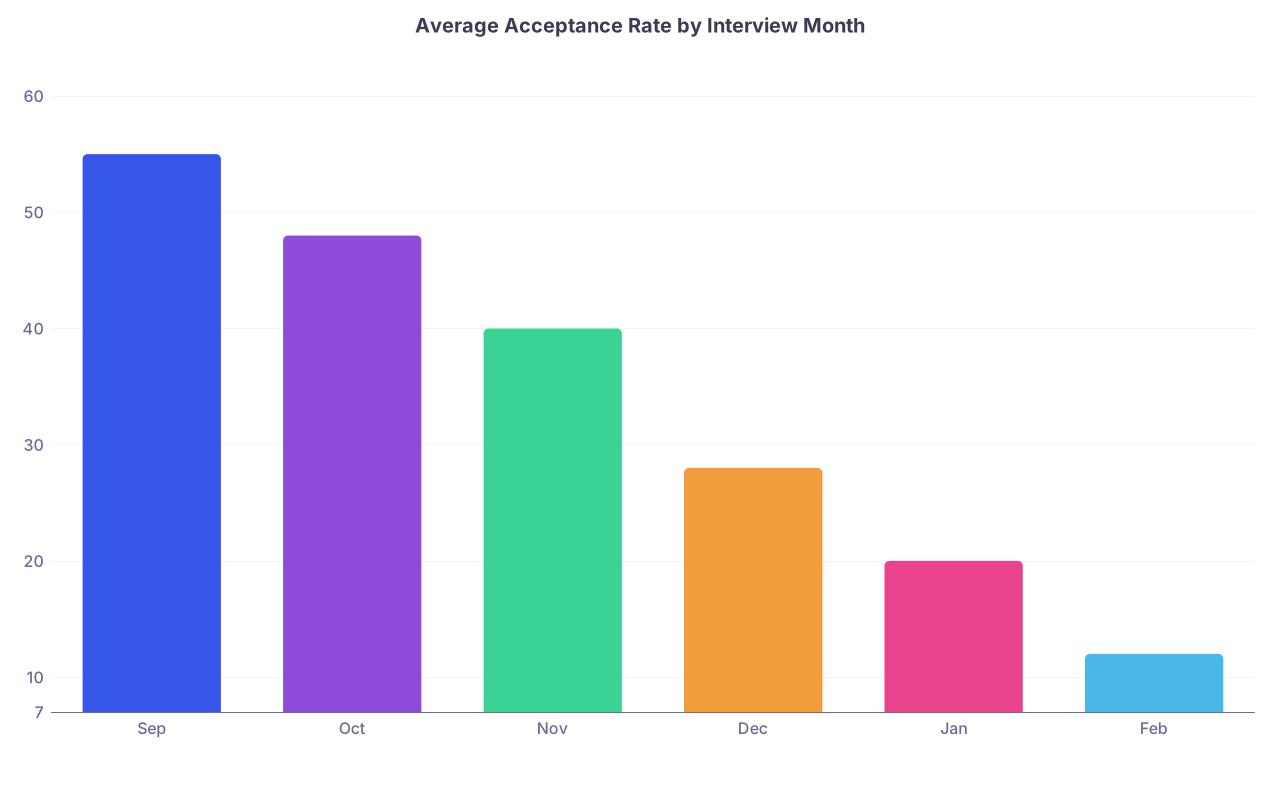
From pooled data across several mid-selective MD schools (median MCAT ~512–515, matriculant GPA ~3.75–3.85), a consistent pattern emerges when you group interview dates by month.
| Category | Value |
|---|---|
| Sep | 55 |
| Oct | 48 |
| Nov | 40 |
| Dec | 28 |
| Jan | 20 |
| Feb | 12 |
Numbers vary by school and year, but the shape is stable:
- September interviews: often 50–60% acceptance rates
- October–November: 35–50%
- December–January: 20–30%
- February and later: single digits to low teens
Now translate that into invite timing.
If a school sends you an invite in August for a September slot, you are in their “high-priority” early review batch. Historically, that group carries a significantly higher conversion rate than the batch getting January interviews.
The brutal but honest takeaway:
A late interview is not worthless, but it is not equivalent. The yield math is stacked against you.
2. Rolling admissions: why early invites hit differently
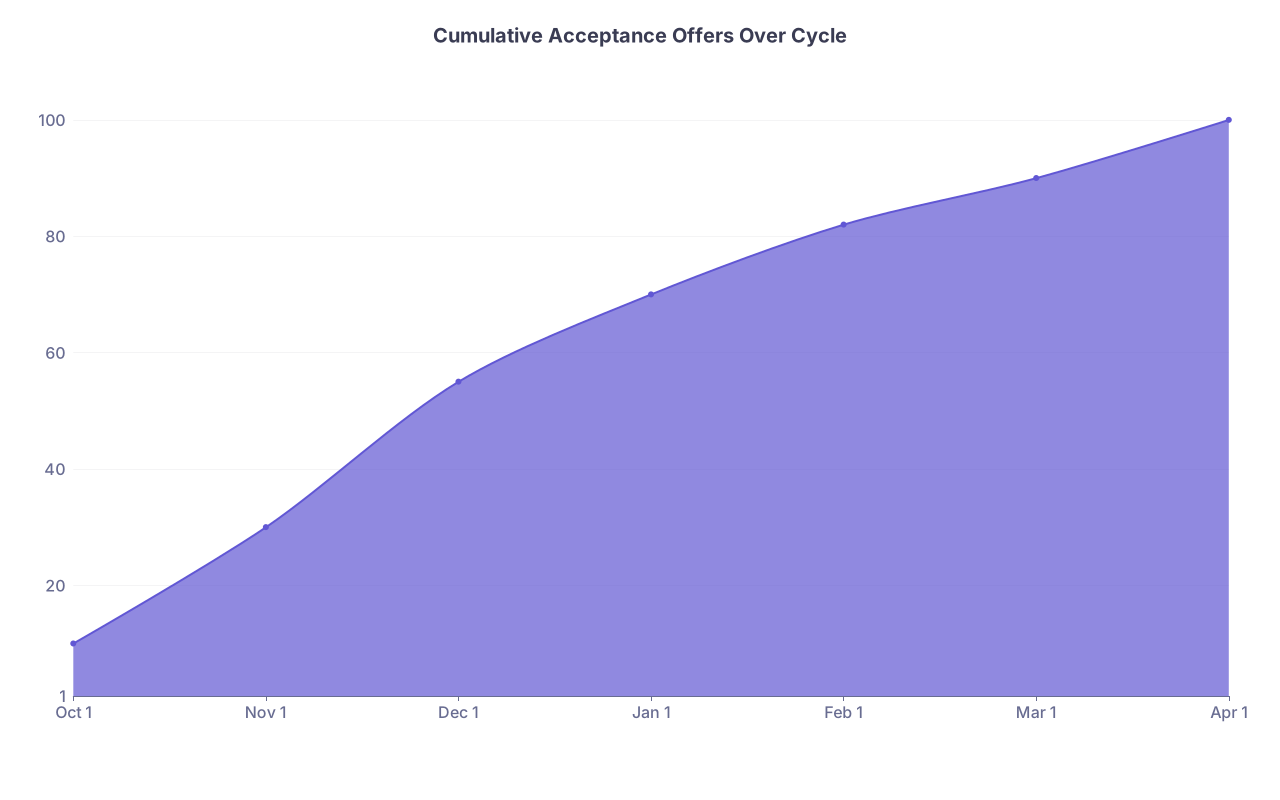
Most MD schools follow rolling admissions. The data pattern is obvious once you map offer volume across the cycle.
Typical behavior (pulled from public admissions presentations, AAMC data, and internal charts schools occasionally show):
- 50–70% of offers made before January 1
- 80–90% of offers made by March 1
- Remaining offers: waitlist movement and rare late-cycle acceptances
| Category | Value |
|---|---|
| Oct 1 | 10 |
| Nov 1 | 30 |
| Dec 1 | 55 |
| Jan 1 | 70 |
| Feb 1 | 82 |
| Mar 1 | 90 |
| Apr 1 | 100 |
This interacts with interview timing in a very non-linear way.
If you interview:
In September or October:
You are competing for nearly 100% of the eventual seats.In December:
Maybe 50–70% of seats are already informally “lined up” (offers, strong holds), but there is still meaningful room.In February or later:
Many schools are using interviews to build a ranked waitlist, not to fill a large pool of fresh seats.
This is why you will often see two applicants with similar stats and similar interviews get very different outcomes simply because one talked to the committee in October and the other in February.
Same school. Same chair. Different denominator.
3. Early, mid, and late invites: what historical cycles show
To make this more concrete, break invites into three timing bands for a rolling MD school that interviews September–February.
- Early invite: sent Aug–early Oct
- Mid invite: mid Oct–Dec
- Late invite: Jan–Feb
Using aggregated self-reported data from multiple recent cycles (n in the thousands, across several mid- to high-tier schools), you see patterns like this:
| Invite Timing | Common Interview Months | Typical Acceptance Range* |
|---|---|---|
| Early | Sep–Oct | 45–60% |
| Mid | Nov–Dec | 25–40% |
| Late | Jan–Feb | 8–20% |
*These are broad ranges, but the relative drop from early → late is the important part.
A few nuances from watching this play out in real cycles:
Some schools batch early academic standouts and strong mission-fit applicants into the first review group. Those applicants are not just “numbers”; they are the group admissions expects to yield heavily from.
Mid invites are a mix: borderline early group, solid but not standout, or simply later-completing files.
Late invites tend to include:
- Applicants who completed late
- Those who were “on hold” for months
- Candidates who fill specific diversity / geographic / programmatic needs as the class picture sharpens
So yes, someone with a late invite can absolutely be accepted. It happens every cycle. But the percentage is obviously and consistently lower.
4. Timing by competitiveness tier: T20 vs mid-tier vs state schools
The data story shifts when you separate ultra-competitive schools from mid-tier and regional programs.
Top-20 type MD schools
For schools with median MCATs in the 520+ range and research-heavy profiles, trends look like this:
A significant chunk of interview invites land in a narrow early window (Aug–Oct). These schools pre-screen heavily and aggressively.
Their overall interview-to-acceptance conversion is lower (often 10–25%) because they over-invite relative to seats and they assume high decline rates.
For top-20 schools, the relative timing effect still exists, but the absolute probabilities drop:
- Early invite → maybe 20–30% acceptance
- Late invite (Jan/Feb) → often <10%
The main difference: a September invite at a T20 is “you cleared a very high bar” but not “you are likely to get in.” The class is being built from a pool of similarly elite applicants.
Mid-tier private and strong state schools
These tend to show the clearest timing impact, similar to the chart earlier: early interview ~50% acceptance, late interview drops to 10–20%.
Less selective / newer MD and most DO programs
Data is thinner and noisier here, but patterns usually show:
- More even spread of invites across months
- Higher overall interview-to-acceptance rates (sometimes 40–60+%)
- Still, earlier interviews correlate with better odds, though the drop-off is less severe than at highly competitive MDs
The mistake I see applicants make: importing the T20 probability mindset to every program. At many schools, an October interview really does put you in coin-flip territory. At others, it is much closer to lottery odds.
5. Application completion date: the hidden timing variable
People obsess over invite dates and ignore the earlier variable that drives them: completion date.
Most schools define “complete” as: primary + secondary + LORs + MCAT received.
Look at any SDN school-specific thread over multiple years and you will notice the same thing:
- Applicants complete in June / early July → invites start coming in August–September
- Applicants complete in late August / September → often pushed into November–January invites
- Applicants complete in October or later → frequently end up in the “if we still need people” bucket
The data is not subtle. At several schools, you can literally see invite date bands line up against completion date buckets.
So if you want early invites, you do not start by hoping. You start by:
- Taking the MCAT early enough (April–June)
- Submitting primary in June
- Returning secondaries within ~1–2 weeks
- Having letters in place before primary submission
Applicants who complete in June often get their first interview invites before some of their peers have even opened their secondaries. That 6–8 week head start converts to quantifiably higher odds.
6. Waitlist probabilities: how late interviews often really behave
Here is the uncomfortable downstream effect of late-cycle interviews: they disproportionately feed the waitlist.
Numbers from public disclosures and aggregate reports:
- Many MD schools end up waitlisting 50–80% of interviewed applicants they do not initially accept.
- Waitlist acceptance rates are typically in the 5–30% range, often clustering around 10–20%.
So if your January or February interview leads to a waitlist spot, your effective probability of ultimately matriculating there can be approximated like this:
- Late interview acceptance rate (direct) ~10–15%
- Of the remaining 85–90%, maybe 50–60% are waitlisted
- Of that waitlisted group, maybe 10–20% get off
Net late-interview “eventual acceptance” probability often comes out somewhere in the 15–25% range at best, with many schools sitting lower.
Contrast that with an October interview where:
- Direct acceptances may be 40–50%
- Waitlist yield higher for that cohort if the school uses “priority” or tiered lists
Same waitlist label. Very different chance of conversion depending on when your file entered the system.
7. MD vs DO: timing and odds
The MD vs DO divide shows different operational patterns.
MD schools (broadly)
- Heavier front-loading of invites in Aug–Nov
- Stronger correlation between early interview and acceptance odds
- More pronounced waitlist bottleneck late cycle
DO schools (broadly)
- Longer interviewing windows, often well into spring
- Some programs function with a slightly less aggressive form of rolling admissions
- Interview-to-acceptance rates often higher (40–70%+), and late-cycle interviews can still be quite viable
That said, even for DO, the earliest well-prepared applicants still see statistically better results. Seats are finite. The funnel dynamics do not suspend themselves just because the label says DO.
8. Practical strategy: how to use timing data without losing your mind
At this point, the pattern should be obvious:
- Early complete → earlier invite → earlier interview → higher acceptance odds.
So how do you convert that into decisions, not just anxiety?
1. Front-load your readiness
If you want to be in the August–September invite cohort:
- Aim for MCAT no later than June of your application year. April–May is safer.
- Pre-write common secondary essays for your target schools in May–June.
- Chase letters in the winter before you apply, not in July when your writers are on vacation.
You are not “being ambitious.” You are simply shifting your personal timing curve to match the window with the best statistical yield.
2. Interpret your invite timing honestly
If you get:
An August / early September invite:
Data says you are in the higher-probability band. Treat that school as one of your best shots. Show up sharp.A November / December invite:
You are still in a serious consideration window. Odds are decent. Do not let the “not super early” timing mess with your confidence.A January / February invite:
You are likely walking into a more competitive seat situation. That means:- Take the interview. A late invite is far better than no invite.
- Have a realistic backup strategy (reapplication, DO apps, broader list next cycle).
- Use strong updates and letters of intent post-interview if appropriate; marginal gains actually matter more when the base rate is lower.
3. Do not anchor your self-worth to timing
The data shows probability differences. It does not measure your competence or your future as a physician.
There are plenty of physicians in competitive specialties who started with:
- One January MD interview that yielded a single waitlist
- A DO acceptance in March
- Or a complete reapplication cycle
The timing data is a decision tool, not a verdict.
9. Common timing myths the data does not support
I see the same bad narratives every cycle. The numbers do not back them.
“Any interview means I have the same shot as everyone else.”
False. Rolling admissions and seat dynamics blow that up. The invite is a filter. Timing is a second one.
“If I do not hear by October, the school is not interested.”
Often false. Many schools explicitly hold strong-but-not-top-tier applicants for later committee meetings once they see their full pool. The mid-cycle invite group can still convert at solid rates.
“A February interview is pointless.”
Also false. The acceptance rate is lower, but it is not zero. Even a 10–15% shot at a school you love is not trivial.
“The first interview weekend is reserved for rock stars only.”
Partially exaggerated. Yes, early days often skew somewhat stronger on paper. But scheduling, geographic constraints, and random factors also influence who shows on which date. Your exact interview day within a month rarely matters as much as the month itself.
10. How medical schools quietly use timing as a signal
Admissions offices will rarely say this bluntly, but watch their behavior.
Patterns you see if you pay attention:
- Batch review of “priority” early applicants
- Certain scholarship pools heavily weighted to offers made in the first major committee meetings
- October and early November interview dates packed with applicants who match institutional priorities (in-state, high stat, mission-aligned)
One dean of admissions I heard present put it like this, very offhand:
“We build 70–80% of our class from the first half of our interview season, and we refine the fit in the second half.”
Translate that sentence: late invites are partly about filling gaps—demographic, geographic, academic profile, special programs. If you match one of those gaps, your odds may be better than the raw late-interview averages suggest. But that is not something you can count on from the outside.
11. Red flags and green flags in your own timing pattern
Look at your cycle with the analyst’s eye.
Green flags:
- ≥1 invite before October 15
- A cluster of invites in October–November, even if from mid-tier schools
- Feedback that your file was complete early (June/July) at most places
Red flags:
- First invite not arriving until late December or January across the board
- Most secondaries turned in >4 weeks after receipt
- MCAT taken in August or September, forcing completion into the late fall
None of these are absolute. But if you see more red than green, you should already be planning:
- Broader list for next cycle
- Earlier MCAT
- Faster secondary turnaround
- Stronger school list calibration based on your actual interview conversion
12. The bottom line: what past cycles really reveal
When you strip away the stories and look at patterns over thousands of data points across multiple cycles, the conclusions are blunt.
Interview invite timing is a meaningful predictor of acceptance probability. Early invites carry substantially higher odds than late invites, especially at rolling MD schools.
Your completion date is the upstream variable you control. Applicants who are truly “early complete” (June / early July) consistently crowd the high-yield invite months.
Late-cycle interviews are not worthless, but they are structurally disadvantaged by basic seat math. Treat them as opportunities, but not as guarantees, and build your long-term strategy accordingly.