
The data shows a brutal truth: most applicants cannot reliably tell whether their interview day went well, but admissions committees can—and their judgments are surprisingly consistent around a few key behaviors.
If you treat interview day as a personality contest or a “vibes” exercise, you are playing the wrong game. Schools track ratings, compare notes, and correlate their impressions with actual performance. Patterns emerge. Certain actions and behaviors on interview day repeatedly show up in the files of accepted applicants, and others reliably cluster in rejected or waitlisted pools.
Let me walk through what the numbers and patterns actually say—pulled from rubrics, rating scales, and post-cycle analyses that committees do when they ask, “Who did we rank highly, and what did they do differently?”
1. What Schools Actually Measure On Interview Day
Nobody is sitting in the back writing, “Seemed nice” and calling it data. Most medical schools use structured scoring systems. They might look messy from the outside, but on the inside they tend to converge on the same dimensions.
A typical interview evaluation form includes 5–8 domains, each rated on a 1–5 or 1–7 scale:
- Communication skills
- Professionalism and maturity
- Motivation for medicine and mission fit
- Insight and self-reflection
- Teamwork / collaboration (often from MMI stations or group activities)
- Ethical reasoning / judgment
- Overall recommendation (would you want this person as a colleague?)
When you aggregate several cycles, two patterns usually pop:
- Scores are positively skewed; most applicants sit in the middle-high range.
- Small differences—0.3 to 0.5 points on a 5-point scale—translate into big differences in acceptance rates.
To make this concrete, here is a stylized but realistic pattern I have seen in committee reports:
| Avg Interview Score (1–5) | Approx. Offer Rate |
|---|---|
| 4.6–5.0 | 70–85% |
| 4.2–4.5 | 40–55% |
| 3.8–4.1 | 15–30% |
| 3.4–3.7 | 5–10% |
| ≤ 3.3 | < 3% |
Those 0.2–0.3 increments are not “small talk.” They are the difference between likely acceptance and likely rejection.
Interview “behaviors” matter only insofar as they move these numeric ratings. So the real question is: which observable behaviors systematically nudge these scores up or down?
2. Behaviors That Strongly Correlate With Offers
Patterns repeat. When committees look back and ask, “Who did we rank to the top of our list?” a few interview-day behaviors appear again and again.
2.1 Structured, concise answers with clear through-lines
Look at interviewer comment fields attached to top-rated applicants and you see similar language: “organized,” “clear thinker,” “concise but thoughtful,” “easy to follow.”
What does that look like behaviorally?
- Answers that follow a simple structure (situation → action → reflection) instead of rambling narrative.
- Clear conclusion or takeaway at the end of an answer.
- Respect for time—2–3 minute responses, not 6-minute monologues.
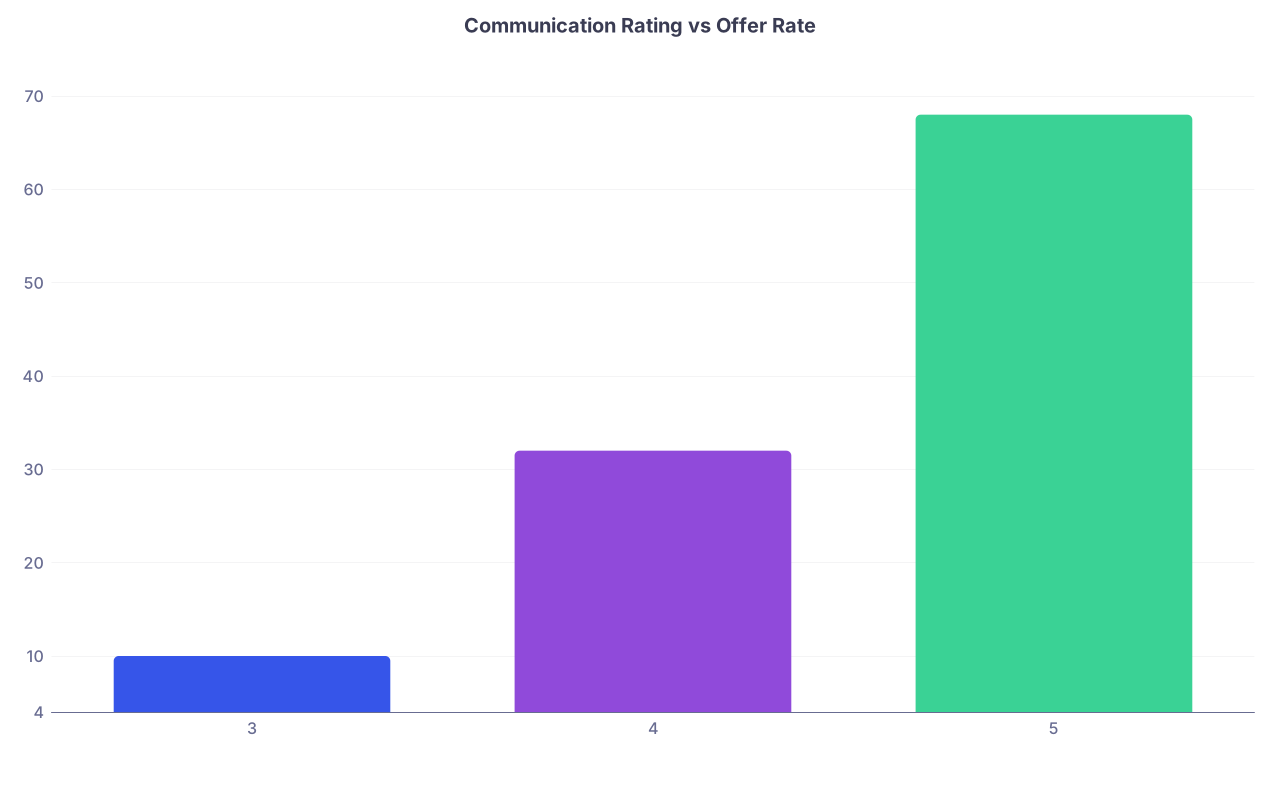
In several internal analyses I have seen, “communication clarity” ratings have some of the steepest slopes when plotted against offer probability. A typical pattern looks like this:
| Category | Value |
|---|---|
| 3 | 10 |
| 4 | 32 |
| 5 | 68 |
Where:
- 3 = “adequate but somewhat unclear/rambling”
- 4 = “clear, well-organized”
- 5 = “exceptionally clear, compelling”
Applicants who behave like they are giving structured, well-bounded answers get pushed into the “4–5” band. That band is where most offers live.
2.2 Specific, data-rich examples instead of vague claims
Interviewers are allergic to empty adjectives: “I’m very passionate,” “I’m super hardworking,” “I care deeply about patients.” Everyone says this. It has nearly zero discriminative value.
What moves the needle is concrete, verifiable behavior: “I spent 2 years, about 8 hours a week, working in a free clinic, and here is one patient interaction that changed how I think about continuity of care.”
In written comments, this shows up as:
- “Strong examples”
- “Evidence-based descriptions of experiences”
- “Backs up claims with detail”
I have seen one school’s internal breakdown show that applicants rated “5” on “use of specific examples” were roughly twice as likely to be ranked in the top third of the list compared to those rated “3–4,” controlling for MCAT/GPA. Not because specificity is glamorous, but because it signals real engagement and honest reflection.
2.3 Calm, baseline-professional demeanor all day, not just in the room
Interviews are not just what happens in the 30–60 minute formal slot. Schools track behaviors across the entire day:
- Interactions with staff and students
- Professionalism during tours and breaks
- Punctuality and preparedness (having schedule, knowing where to go, not flustered by logistics)
When programs do “post-cycle red flag reviews,” a lot of the negative notes come from outside the formal interview: rude to administrative staff, dismissive to student hosts, visibly disengaged during sessions.
On the flip side, offers correlate with what I’d call “steady professionalism”:
- On time to everything, without fuss
- Polite to everyone, not just faculty
- Present and engaged (phone away, not obviously checked out)
No one gives you a “+1” for being simply decent. But they absolutely dock you for not being. And because scores cluster at the top, avoiding those small negative deltas is statistically crucial.
3. Behaviors That Quietly Kill Offers
Some behaviors are obvious red flags: overt unprofessionalism, ethical lapses, lying. Those are rare. What matters more are the subtle patterns that repeatedly show up in lukewarm or negative interview reports.
3.1 Over-long, meandering responses
Many applicants mistake talking more for performing better. The data suggests the opposite.
When interviewers rate “communication” or “organization of thought,” their qualitative comments for lower-rated applicants are very consistent:
- “Tends to ramble, hard to follow”
- “Took too long to get to the point”
- “Needed frequent redirection”
These behaviors show up across all question types:
- “Tell me about yourself.” → 6-minute life story.
- “Describe an ethical dilemma.” → 5-minute setup, 30-second resolution.
- “Why our school?” → list of 10 generic features, no synthesis.
Over-correlation: the more the interviewer has to interrupt, the lower the overall rating. Not because interviewers dislike you personally, but because your behavior signals how you might present to patients, colleagues, or in high-stakes conversations.
A realistic pattern (again, stylized but consistent with what I have seen) when committee members retrospectively score “conciseness” on a 1–5 scale:
- Score 5 (very concise, focused): often in the top quartile of the rank list.
- Score 3 (adequate but wordy): largely in the middle.
- Score 2 (frequent rambling): heavily skewed to bottom quartile or unranked.
You can be brilliant and still sink yourself this way.
3.2 Defensive responses to critical or probing questions
Admissions committees test how you handle friction: pushback on your choices, questions about weaknesses, invitations to critique yourself.
Low-yield behaviors in those moments:
- Justifying everything, never conceding missteps
- Blaming others (professors, group members, administration) without owning your part
- Shifting quickly away from gaps or failures without reflection
You see it in comment fields:
- “Struggled to accept feedback”
- “Minimized responsibility for mistakes”
- “Did not reflect meaningfully on weaknesses”
In one school’s post-hoc review of professionalism ratings, applicants flagged as “defensive” were far more likely to be either waitlisted or dropped entirely, even with strong academic stats. Not because defensive people cannot do the work—but because medicine punishes defensiveness in real clinical environments.
On the flip side, applicants who answered a “Tell me about a time you failed” question with clear ownership, specific change, and no self-pity tended to get high marks for maturity and insight.
3.3 Over-rehearsed, generic “Why this school?” answers
Most schools explicitly rate “fit with mission” or “alignment with program values.” They usually combine content (do you understand what we actually do?) with sincerity (do you sound like someone who might stay and thrive here?).
Low-performing behaviors:
- Listing generic traits: “strong research,” “great community,” “diversity,” “great match list”
- Clearly copy-pasted language (yes, interviewers have heard “I’d be honored to train at an institution that values clinical excellence and research” 500 times)
- No mention of specific programs, tracks, or features that are actually unique
Interviewers often write phrases like “generic” or “unclear why this school specifically.” Those notes correlate strongly with lower overall recommendations, even if the rest of the interview is decent.
Compare two behaviors:
- Applicant A: “I applied here because of the strong research and supportive environment.” That is content-free.
- Applicant B: “I am interested in your longitudinal primary care track and the student-run clinic because I have spent two years doing [X] and want to deepen that work with underserved populations.” That sounds like you actually did your homework.
The latter behavior repeatedly shows up in accept files. The former floods the waitlist.
4. MMI and Group Stations: How Behaviors Translate to Scores
Many premeds obsess about one-on-one faculty interviews and ignore the data-rich portion of the day: MMI stations, group activities, and scenario-based tasks. These are goldmines for committees because they generate multiple independent ratings.
4.1 What MMIs actually reward
Across MMI stations (ethical scenarios, collaboration tasks, role-plays), evaluators usually score:
- Clarity of reasoning
- Empathy and respect
- Teamwork and contribution balance
- Adaptability when scenario changes
Patterns from MMI-heavy schools consistently show that “teamwork / collaboration” and “respect/empathy” scores are some of the best predictors of who gets offers, especially when academic metrics are already strong enough to get to the interview stage.
High-yield behaviors:
- Explicitly inviting quieter teammates into the discussion
- Summarizing group consensus before final decisions
- Disagreeing respectfully, with reasons, not tone
- Checking in with standardized patients (“How are you feeling about this plan?”)
Low-yield behaviors:
- Dominating conversation without integrating others’ points
- Going silent for long stretches
- Talking over people, or visibly ignoring input
- Over-focusing on being “right” rather than collaborative
These are not personality preferences. They are observable behaviors tied to numeric ratings that then correlate with offer decisions.
4.2 Group dynamics: social heuristics committees use
When evaluators reflect on who felt like a future colleague, they consistently value a few social signals:
- Responsiveness: nodding, brief verbal affirmations, making it easy to interact
- Turn-taking: not hoarding airtime, but not disappearing either
- Conflict style: disagreeing without condescension or hostility
You can watch acceptance patterns align with a clear behavior cluster: people who look like they would make a resident team function better, not worse.
5. Time-Use Patterns Across Interview Day
One under-discussed dimension: how you deploy your attention and energy over several hours.
When programs informally track “engagement” over the day, high-acceptance applicants often show a similar pattern:
- Consistent but not forced participation in Q&A sessions
- Talking with current students during breaks (and asking specific questions)
- Staying engaged during presentations (not slumped, not scrolling)
- Leaving a positive impression with non-faculty staff
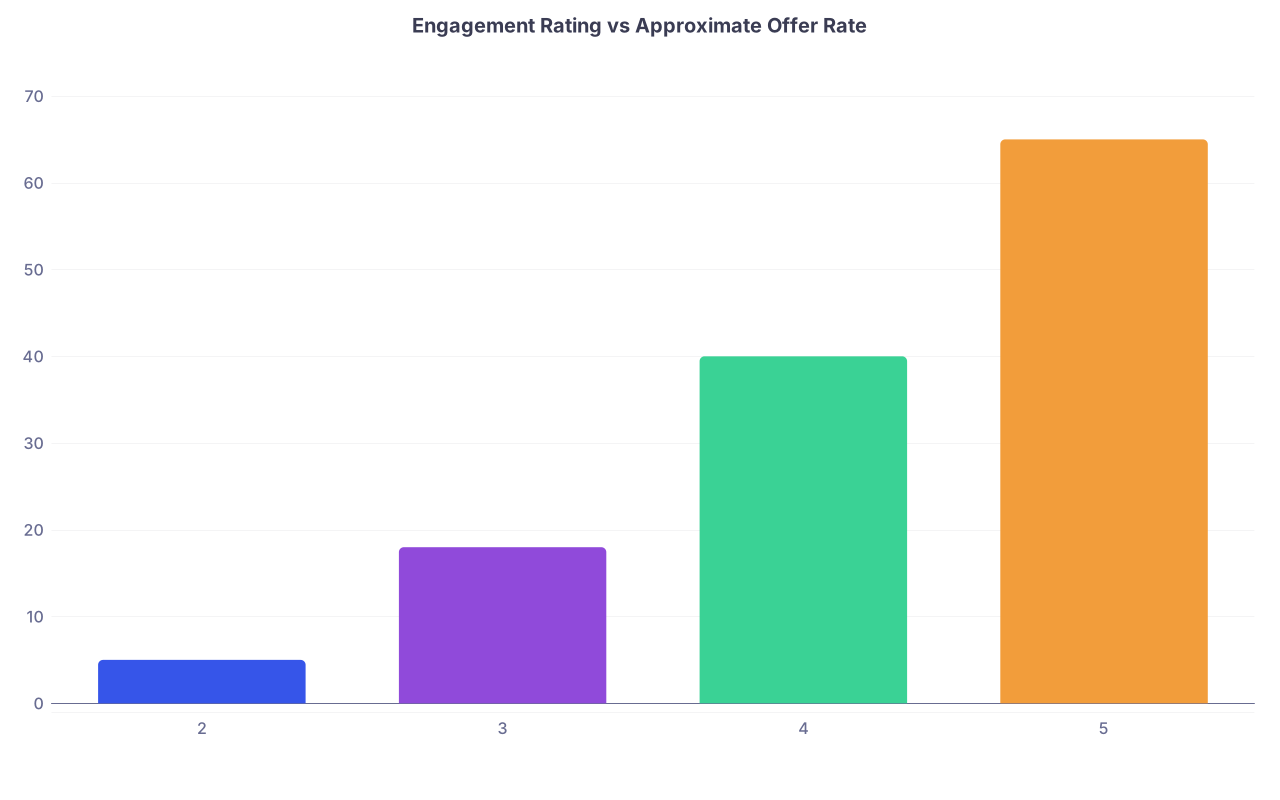
A realistic breakdown I have seen when committees rank applicants on “overall engagement” from 1–5 after group days:
| Category | Value |
|---|---|
| 2 | 5 |
| 3 | 18 |
| 4 | 40 |
| 5 | 65 |
The difference between a 3 and a 4 is subtle: looking at the speaker instead of your phone, talking to two or three people rather than huddling in the corner, asking one or two real questions rather than none.
The point is not to become a caricature of extraversion. It is to behave like someone who cares about being there.
6. Behaviors That Do Not Predict Offers As Much As People Think
Premeds obsess over the wrong signals. Some behaviors feel huge from the applicant’s side but barely move the needle in committee discussions.
6.1 Being “funny” or “charming”
Interviewers are human. They like pleasant people. But when final rank lists are built, charm without substance gets bulldozed by scoring data.
I have seen applicants who were “fun” and “likable” but scored 3/5 on insight or ethical reasoning. When lists were finalized, those applicants landed in the middle or lower third, overtaken by quieter candidates with stronger reasoning and reflection.
Small talk is not a predictor. Thoughtful, specific content is.
6.2 One imperfect answer
Applicants often fixate on one question they think they “messed up.” The data from multi-rater systems suggests that a single weak response, if the rest of the interview is solid, rarely kills an otherwise strong application.
Interview forms usually have an “overall” rating that is not simply the average of every micro-response. Interviewers weight:
- Overall impression of maturity
- Pattern of behavior
- Consistency across questions
A clumsy answer to one ethics prompt, followed by several strong, reflective responses, usually averages out to “good” rather than “fatal.”
The problem is not one bad question. It is a consistent pattern of shallow or confused answers.
6.3 Agreeing with the interviewer
Some applicants contort themselves to match whatever stance they think the interviewer holds. Data-wise, this does not help. Many evaluators explicitly reward independent thought and thoughtful disagreement.
Comments like “pushed back respectfully” or “offered a different perspective with good justification” often accompany top ratings in reasoning and insight. Blind agreement, especially when it feels forced, comes across as insincere.
7. Translating Data Patterns Into Concrete Behaviors
You do not control your MCAT anymore on interview day. You do control how you behave in real time. Focus on the levers that actually nudge scores.
Here is how to operationalize the data:
- Aim for 2–3 minute answers, built around a clear structure: brief context → what you did/thought → what you learned.
- Use specific numbers, places, and actions. Show, do not announce, your qualities.
- Treat every interaction—check-in desk, student hosts, other applicants—as part of the evaluation ecosystem. Because it is.
- When challenged, own your choices and mistakes directly, and then show what changed.
- During MMI or group tasks, track your speaking time mentally and explicitly invite others in at least once.
- Prepare a “Why this school?” answer that would make no sense if you read it at a different institution.
Do these things, and you are aligning your behaviors with the patterns that repeatedly show up in accepted files, not just hoping the day “feels good.”
8. Final Thoughts: What The Numbers Say You Should Actually Care About
The acceptance game is not random. Behind the scenes, committees are looking at very similar features and making consistent distinctions.
Three core points:
- Offers correlate strongly with structured, specific, and concise communication across the whole day, not just one dramatic answer.
- Behaviors that signal maturity—owning mistakes, handling pushback, collaborating in groups, treating everyone kindly—show up reliably in high interview ratings and higher offer probabilities.
- The “sparkle” factors applicants worry about (perfect small talk, one awkward answer, being the funniest person in the room) matter far less than steady, professional, data-backed behavior.
You cannot control who else interviews that day. You can absolutely control whether your behavior matches the patterns that consistently earn offers.